
The Germans wanted workers, and they got human beings.
One of the main aims of ethnomusicology is to integrate musical and social insights, as in classics like Enemy Way, Sardinian chronicles, Thinking in jazz, and Soundscapes of Uyghur Islam. So I was fascinated to watch the documentary
- Aşk, Mark ve Ölüm (Love, Deutschmarks, and death, Cem Kaya 2022) on Mubi. Here’s a trailer:
See this interview with the director Cem Kaya, and introductions e.g. here and here.
The film vividly evokes the lives of Turkish immigrants to Germany from their early days as Gastarbeiter struggling for jobs and rights as workers (music making a means of expression for those lacking a voice in society), right through to rap/hip-hop, as their descendants assert their rights as citizens.
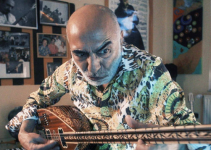 The Turkish music scene in Germany was far from homogeneous. Cem Kaya elicits some excellent comments from characterful musicians. The film opens and ends strikingly with İsmet Topçu, the Hendrix of the bağlama, putting the story in wacky extra-terrestrial context…

Among the first wave of Gastarbeiter was the protest singer Âşık Metin Türköz, who found a huge audience among the poor factory workers with his songs reflecting their harsh life:
He became the first Turkish star to sing in German:


Left, Yüksel Özkasap; right, Cavidan Ünal.
We meet the female singers Yüksel Özkasap (“the Nightingale of Cologne”) and Cavidan Ünal, as well as the brilliantly camp Hatay Engin (playlist). Such singers who made their name in Germany become popular in urban and rural Turkey too.


The film shows evocative archive footage of the first waves of Gastarbeiter from 1955. Turkish workers were always at a disadvantage besides their German colleagues, but by the 1970s, as the economy went into recession, they came out together on strike. Paradoxically, the 1980s were a heyday for gazinos (cf. The Club)—more footage of the Türkische Basar in Berlin—and the conspicuous consumption (flashing the cash) of ostentatious weddings, which required musicians to perform in regional styles from all over Turkey. Visiting Turkish stars like İbrahim Tatlıses, Zeki Müren, and Ferdi Tayfur drew huge audiences among their compatriots in Germany.
Like the Black Sea, Germany is a region of Turkey…
The theme of protest continues with the charismatic Türk-rock singer Cem Karaca and his band Die Kanaken. He left Turkey for Germany in 1979, but when the post-1980 coup government issued an arrest warrant for him and other intellectuals, he was unable to return home until 1987. This playlist has 62 tracks—here’s Mein Deutscher Freund:
and Es kamen Menschen an (1984):
Another critical singer was Ozan Ata Canani, here with a variation on the “German friend” theme:
Further listening on the Songs of Gastarbeiter compilations (here and here).
Also impressive are the folk-rock/disko-folk duo Derdiyoklar—here they are performing live for a wedding in 1984:
Perhaps their most successful song was Liebe Gabi—again protesting racism:
As the early Gastarbeiter settled, new German-born generations created their own styles, with arabesk leading to R’n’Besk. We find Derya Yıldırım accompanying her wistful song on bağlama, before she progressed to Anatolian psych-pop with her Grup Şimşek. The film’s third section covers recent years. As anti-immigrant sentiment grew in Germany from the 1980s, increasing after the Fall of the Wall, young hip-hop artists from a “lost generation” born of immigrant parents (multi-ethnic groups like King Size Terror and Microphone Mafia) confronted xenophobia and the rise of the far right. Cem Kaya draws astute comments from popular Turkish-German “oriental” rappers of the day such as the inspirational mentor Boe B. (1970–2000) of Islamic Force (musical wing of the 36 Boys gang):
Also contributing are Kabus Kerim and Erci E. of the short-lived but influential Cartel; Muhabbet, who also gained a wide following; Tachi of Fresh Familee and Volkan T error of Endzeit Industry. Such rappers creatively combined their mother tongues with German in Kiezdeutsch or Kanak sprak (cf. French slang).
To complement the archive footage and interviews, Cem Kaya has really gone to town on the psychedelic captions.

Do also watch the documentary Jazz in Turkey, leading to several posts on the Istanbul jazz scene, as well as an introduction to Alevi ritual in Istanbul that ends with a note on its fortunes in Germany—all part of my extensive series on west and Central Asian cultures.
* * *
Another impressive recent exploration of Turkish-German identity is the stage drama Türkland, realised by Dilşad Budak Sarıoğlu, Ilgıt Uçum, and İrem Aydın.

 Stephen Jones: a blog