
Modifying the image of inter-ethnic harmony
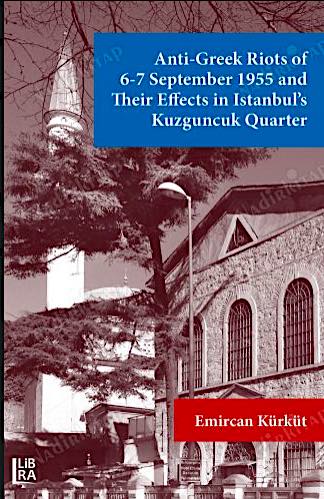
Since I’ve been spending so much time in the neighbourhood of Kuzguncuk on the Anatolian shore of Istanbul, I’ve followed up Amy Mills’ fine study by reading
- Emircan Kürküt, Anti-Greek riots of 6-7 September 1955 and their effects in Istanbul’s Kuzguncuk quarter (2019).
Impressively airing delicate topics, Kürküt uses a range of archival and published sources (notably the work of Nedret Ebcim and Dilek Güven), and like Mills, he’s sensitive to the locals’ own narratives, seeing through the harmonious image. A barely-revised edition of his MA thesis, its English could have done with more editorial polishing, both for sense and fluency of reading.
Since the 198os, media images of Kuzguncuk have congealed, milking the nostalgic fantasy of ethnic minorities—Greeks, Armenians, Jews—happily coexisting with their Muslim neighbours, even though waves of Anatolian migrants have almost entirely replaced those minorities since the 1960s.
The pogroms of 6–7 September 1955 are well known in the central Pera/Beyoğlu area, on the European side of Istanbul; but a polite veil is commonly drawn over how the events unfolded in Kuzguncuk.

Rioting in Beyoğlu. Source.
Though the chapter devoted specifically to the 1955 riots in Kuzguncuk provides only limited further detail, it’s a diachronic survey, from the millet system of the Ottoman empire right through to the (Muslim) character of Kuzguncuk and Istanbul today—both before 1955 (Armenian genocide, the 1923 Greek-Turkish population exchange, the “Citizen, speak Turkish!” campaign from 1928, Thrace pogroms of 1934, the 1941 conscription of non-Muslims, the 1942 capital tax, the 1948 foundation of the state of Israel), and after (the 1964 deportations, the Cyprus military operation in 1974).

Source: wiki.
Kürküt outlines studies of the 1955 pogrom in Istanbul, with Turkish security forces transporting people from Anatolia to take part in looting and rioting. As he notes, beyond Pera/Beyoğlu, the substantial non-Muslim populations of neighbourhoods (see map) such as Yeşilköy, Kumkapı, Moda, Fatih, Çengelköy, Ortaköy, Bebek, Eyüp, Kuzguncuk; even the Princes Islands suffered. This 2006 thesis on the long process of homogenization in Cihangir mahalle is cogent, with detailed material.
Focusing on Kuzguncuk, the multi-ethnic discourse was mobilised to deny the effects of the pogrom there. Most residents are aware that the neighbourhood was formerly dominated by non-Muslims, but rarely care to interrogate how the demographic changed. Different faith groups did indeed part in each other’s life-cycle and calendrical events; but such multi-ethnic communities were common throughout Turkey, and they weren’t necessarily a showcase for tolerance.
Population figures aren’t easy to interpret, but a 1933 census of Kuzguncuk shows that 90% of dwellers were non-Muslim. Armenians seem to have become more numerous than Jews until the eve of the 1915 genocide. While migration in the early 1960s brought Muslims from the Black Sea region, non-Muslims were emigrating to Israel, Greece, the USA, Armenia, and Australia..
As to the 1955 pogrom in Kuzguncuk, Kürküt finds archival sources to supplement often-contradictory memories. We find two common narratives (also heard in other neighbourhoods—and in conflict zones around the world): that the violence was instigated by gangs arriving from outside (notably Üsküdar just along the shore), by ship or in trucks; and that Muslims protected their non-Muslim neighbours. But while there were indeed noble instances of the latter, other Muslims helped the gangs.
Another strategy adopted by locals was to downplay the events by comparison with the violence on the European side of Istanbul. But Kuzguncuk houses, shops, and religious buildings were vandalised—displaying a Turkish flag did not necessarily save a building from attack. Rioters set fire to the Greek church, and though the blaze was soon extinguished, the building was desecrated and looted; locals protected the priest.
Four Muslim residents of Kuzguncuk were arrested. Compensation from an aid committee set up by the Istanbul Chamber of Commerce was inadequate. As elsewhere in Istanbul, non-Muslim groups had already suffered from earlier Turkifying measures; some residents claimed that they continued to coexist, but the pogrom inevitably soured relations. Non-Muslims had already been leaving before 1955, and would continue to do so until 1974; by then, those who remained were greatly outnumbered by Muslim immigrants from the Black Sea region.
Chapters 4 and 5 discuss the elimination of the economic power of non-Muslims not just by direct violence but by appropriating their properties, notably with the 1942 Wealth (Capital) Tax but also in various other ways. Here Kürküt focuses on the architectural spaces of Kuzguncuk: religious buildings and schools, houses and workplaces. As Black Sea migrants moved in, gecekondu shanty dwellings encroached on former non-Muslim sites such as the Jewish cemetery on the hill. Both the new migrants and the state colluded in the gradual expropriation. Street names were being Turkified as early as the 1930s. Naturally, shops and restaurants (hitherto owned by the non-Muslim majority) were now taken over by a new Muslim majority. Conversely, any impact from the “Citizen, speak Turkish!” campaigns largely affected people’s behaviour outside the village, such as on ferries.
Following Mills, Kürküt unpacks the founding of the Kuzguncuk mosque in 1952, right next to the Armenian church. Whereas this is paraded by the nostalgists as a beacon of inter-faith tolerance, the very fact that no mosque was needed until 1952 confirms how very few Muslims had been living there, and symbolises their growing presence.
While the 1964 deportation of Greeks took place without violence in Kuzguncuk, the Greek church and cemetery—as well as Armenian schools—were further attacked during the 1974 Cyprus military operation, which also consolidated nationalist feelings among the new Muslim majority.
With the nostalgic fantasy already firmly embedded, when Güngör Dilmen’s play Kuzguncuk Türküsü (Ballad of Kuzguncuk) was staged at the State Theatre in 2009 (excerpts; see e.g. this positive review), locals took exception to his candid portrayal of the 1955 pogrom—see e.g. rebuttals here and here.
Confounding the media portrayal of the neighbourhood, Kürküt concludes,
Kuzguncuk was not special as a result of its tolerance culture, peaceful relationship between non-Muslims and Muslims and multi-cultural property. In other words, Kuzguncuk was Turkified and homogenized by the Turkish Republic throughout history just like other non-Muslim neighbourhoods.
Similarly, I might add, there’s nothing surprising in the reluctance of communities around the world to dwell on a traumatic past. Not all genocides around the world can be publicly commemorated; perhaps the best we can hope is for that history to be publicly acknowledged (as in Germany or the USA) and not suppressed by the state (as in China). In Turkey, more liberal media would be able to counteract state propaganda. But it’s not even so rare for the silence about Kuzguncuk’s past to accompany a rosy media image.
 Stephen Jones: a blog