
Early history (a pitch raid, Greek pre-eminence, Black Stockings FC);
Mesut Özil supports the Uyghurs; and a clerical tournament
Football was introduced to the Ottoman empire by English residents of Saloniki in 1875, the teams consisting of Greek, Armenian, and English players (wiki, and here). Over in Smyrna, the numinously-named Orpheus Music and Sports Club was founded in 1890.
James La Fontaine, who developed football in İzmir [Smyrna], moved to Istanbul in 1889, and the game started to become popular there. Expats and non-Muslim Ottoman citizens played in the city’s Kadıköy and Moda districts.
The first document on football in the Ottoman archives is a police report dated Nov. 23, 1890:
Around 20-25 English youth, under the supervision of the sons of Monsieur Witek, a Moda resident, gathered at Kuşdili and played with a ball made of a tire in an encircled area. The play area had two doors at both ends. This incident was investigated and it was understood that they were playing charity matches for schools. After the game, those who won would donate the prize money to schools. The English will do exercises every Saturday until the final match is played. The Üsküdar Lieutenant Governorship is looking into when the real match will be played, how much money will be collected and which schools it will be given to. It is necessary to take precautions and report developments to the police so nothing improper happens.
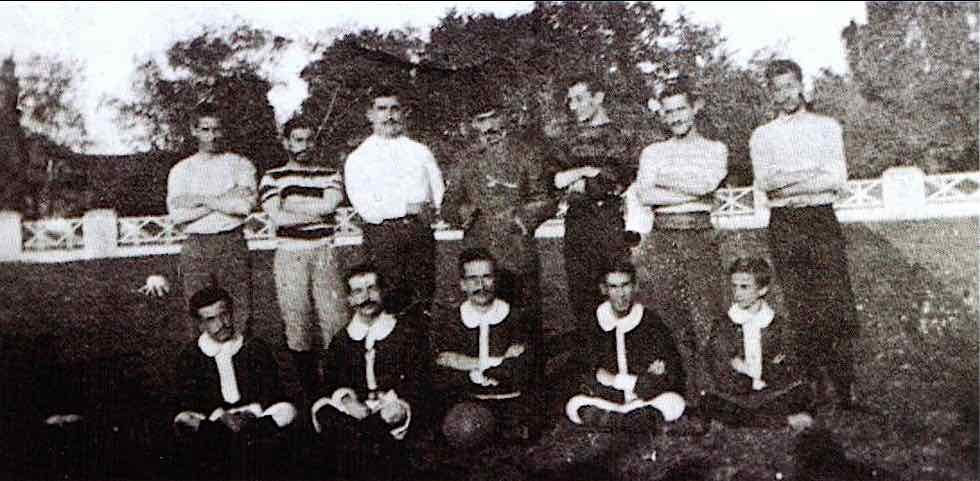
Black Stockings players (“purportedly”), 1901. Source.
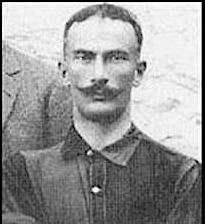
The first club with Turkish players was Black Stockings FC in Kadiköy (wiki—more in the Turkish version), abruptly dissolved after their first and only match on 26th October 1901 when the players were arrested after the Sultan’s detective Ali Şamil Bey and police raided the pitch, suspicious that the purpose of the team was to organise a coup against the Sultan. Fuat Hüsnü Kayacan (right; source), the first ever Turkish football player, was a soldier on assignment in İzmir in 1898.

Elpis FC, Greek team in Istanbul, active 1904–1910. Image from 1905.
The first competitive league was founded in 1904. Galatasaray, the first Turkish football club, was founded in 1905, Fenerbahçe in 1907, Beşiktaş in 1910. But as an impressive TRT article shows, through the years preceding the 1923 population expulsions, Istanbul teams were dominated by Greek players (cf. Songs of Asia Minor). Significantly, the Turkish national team was formed in 1923.

The Turkish national team, 1929.
* * *
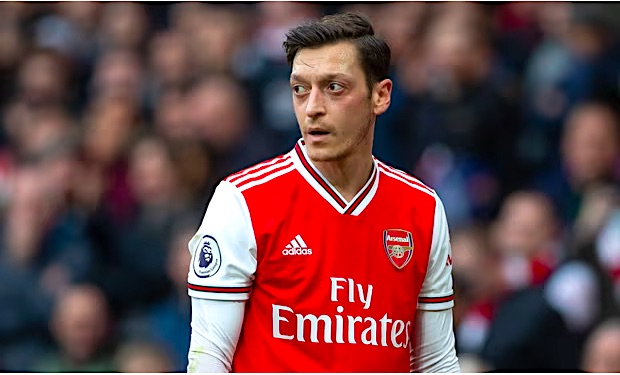
I’m still a great fan of Mesut Özil (“floating, vulnerable muse”, a descendant of Gastarbeiter) from his days at Arsenal. Apart from his wizardry on the pitch, in 2019, still some time before China’s suppression of the Uyghurs became a widely-subscribed international cause, his principled protest prompted the club to disassociate from his comments. The position of Uyghur refugees in Turkey remains precarious.
* * *
One weekend in Istanbul recently we were invited to a sports ground in a village along the Anatolian shoreline, where a brilliant initiative is under way: an amateur football tournament consisting of forty 7-a-side teams of religious clerics from all over the metropolis (cf. Inter-faith ping-pong). The matches are timed to take place between the dawn and noon calls to prayer.
This weekly social event makes a great opportunity for them all to meet up, beyond formal, intermittent symposiums. They are young and jovial, the matches competitive; we saw one yellow card, and a muezzin later bemoaned the unjust award of a penalty against his team.
Our host, the enterprising organiser of the league, mischievously introduced me as former Real Madrid striker Stefan (none other than the legendary Alfredo Di Stéfano). Fortunately I wasn’t called upon to demonstrate the legendary dribbling skills of my heyday—but it evoked my dream in which I was called up for the England squad (aged 70) and couldn’t work out how to change into the team strip or make my way onto the pitch.
Happy to learn that we are keen on a good ezan, some of the finest muezzin in Istanbul invited us to come and hear them. We also met a standup comedian there who serves worthy social and political causes; even as the Turkish economy collapses, Istanbul seems full of people doing good things. Afterwards we meandered through the lovely shoreline villages for brunch in a fine commune-run restaurant in Beykoz.
My sojourns in Istanbul have been blessed with such wonderful encounters, like attending Alevi cem rituals, visiting Sufi tekkes, a master craftsman, and an instrument maker—and getting to know our Kuzguncuk neighbours…
* * *
For Turkey’s impressive showing at Euro 24, click here. Note also women’s football there since 1954—again starting in İzmir—and its current thriving scene. Cf. Daoist ritual and football and other posts under A sporting medley: ritual and gender, including Football in Stalinist Albania.
 Stephen Jones: a blog