

In my youth I watched The big sleep (Howard Hawks, 1946) More Times than I Had Hot Dinners—not so much in the cinema as on TV, where it was among a wealth of old movies shown in the dim and distant days before DVDs and streaming.
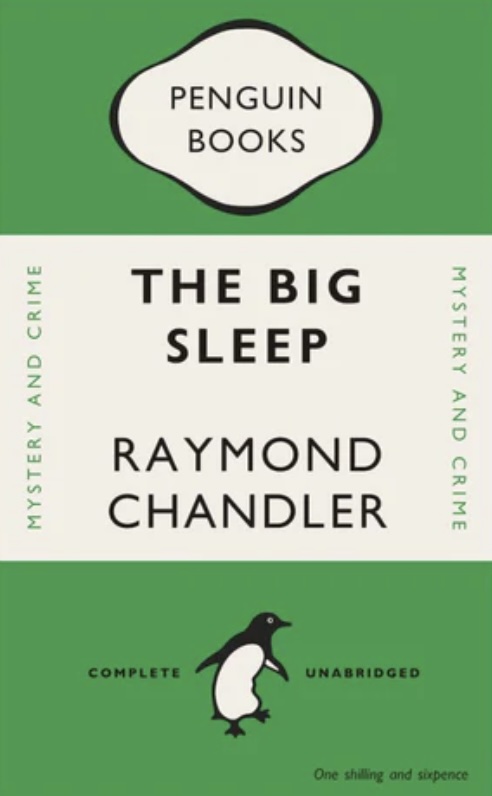 The film does justice to Raymond Chandler’s brilliant prose style. Roger Ebert, always a perceptive reviewer, made some good points. He described it as
a black-and-white symphony that exactly reproduces Chandler’s ability, on the page, to find a tone of voice that keeps its distance, and yet is wry and humorous and cares.
However often we watched the film (or read the book), the plot remained elusive. Ebert cites Sperber and Lax’s Bogart:
Hawks sent Chandler a telegram asking whether the Sternwood’s chauffeur, Owen Taylor, was murdered or a suicide. “Dammit I didn’t know either”, Chandler recalled.
But details yield to the atmosphere.
Bogart’s career was on the up with The Maltese Falcon (John Huston, 1941; trailer here)—the novels of Dashiell Hammett rivalling those of Chandler—and the iconic Casablanca (Michael Curtiz, 1942). On the Bogart–Bacall relationship, a recent book by William Mann is reviewed by David Thompson in the LRB:
The span of William Mann’s well-researched dual biography is some 115 years. But a case can be made that the “greatest love affair” promised by Mann amounted to no more than 216 minutes in the busy years of the mid-1940s. That’s the combined duration of To Have and Have Not (1944) and The Big Sleep (1946).
Their affair (she was 19, he 44), with its “thrilling ping-pong innuendo”, began while they were filming To have and have not, Bacall’s screen debut:
This led to Bogart divorcing his third wife and drinking still more heavily. Off screen he was regarded as surly and dull.
Moving on to The big sleep, here’s the opening (Chandler’s original here):
The horse-racing dialogue is “one of the most daring examples of double entendre in any movie up until that time”:
In the film, Marlowe is irresistible to a succession of women—something unfathomable to British men well into the 1970s. During wartime, women were admitted to professions from which they were otherwise barred:
Most astounding is the bookstore scene, with Dorothy Malone (and note Max Steiner’s portentous soundtrack):
And here’s the very ending:
OK, I can’t stave off old age for ever. Such films (whether 40s’ noir * from the States or modernist creations from France, Italy, or Japan) came as a kind of blessing to us on a cloistered, repressed island, and are indelibly etched into our collective memory; yet (more an observation than a lament) I doubt if they are quite so iconic to Young People Today. For other seminal influences on “my generation”, see under The conformist.
For a modern take on LA noir, see Bosch.
Irrespective of the Academy, popular culture is clearly, well, popular. Since the 60s, the Fusty Pundits of Yore have been disconcerted to find film, film music, and pop, becoming serious subjects for study; but they wield a profound influence on us all, even on those with more classical concerns… Cf. What is serious music?!, and Feminine endings: Madonna and McClary.
* I read that the term film noir was “coined by French critic Nino Frank in 1945 when a flood of dark Hollywood thrillers made during the war eventually arrived on Parisian screens after the four years of German occupation. Nearly 40 years passed before the term became current in the English-speaking world.”
 Stephen Jones: a blog