
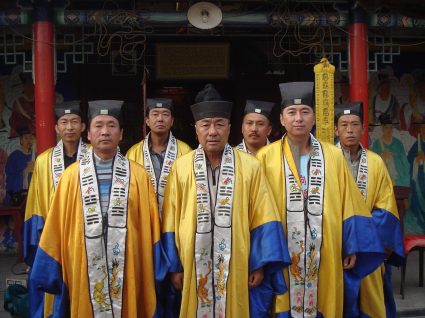
Household Quanzhen Daoists of Shuozhou, Shanxi.
I still find it worth reminding you of my page Rethinking Zhengyi and Quanzhen, for its fundamental rethink of Daoist ritual practice.
In my book In search of the folk Daoists of north China (2011) I began exploring the false dichotomy between Orthodox Unity (Zhengyi 正一) and Complete Perfection (Quanzhen 全真) branches (note especially pp.17–18). The page on my blog augments the material there in the light of further fieldwork.
Whereas the household Daoist groups of south China have dominated previous research, numerous groups of household Daoists are also active throughout the north—and they may nominally belong to either Orthodox Unity or Complete Perfection branches. But such simplistic pigeonholing may distract us from the details of their ritual practice; in both their rituals and ritual manuals I can rarely discern any significant distinction between them. When the Complete Perfection branch evolved in the 12th century, its priests (both temple and household) inherited a long tradition of Orthodox Unity ritual practice: as John Lagerwey once observed to me, “that was the only show in town”. And while a distinct Complete Perfection literature did evolve (see my book, pp.203–207), their ritual practice never developed into a separate corpus of Complete Perfection ritual texts.


That explains why such an august Complete Perfection temple priest as Min Zhiting was constantly citing Orthodox Unity ritual manuals from the Daoist Canon; and why the best mainstream source for the ritual texts of the Li family (Orthodox Unity) household priests in Yanggao is the repertoire of modern “Complete Perfection” temple practice like the Quanzhen zhengyun and Xuanmen risong.
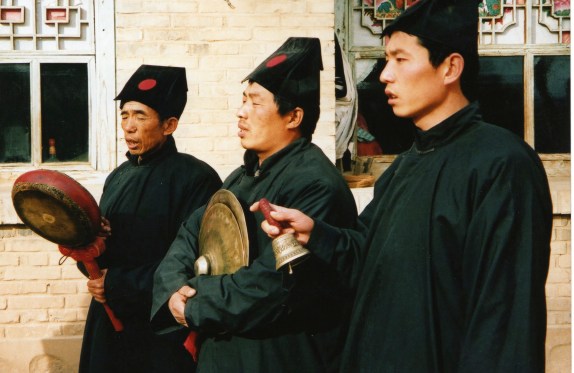
Household Zhengyi Daoists of the Li family, Shanxi.
In some places now—since around 2000—the picture is further confused by a certain “centripetal” tendency. With wider access (such as the internet), some groups that have always been Orthodox Unity may be exploring ways of “legitimising” themselves by seeking manuals from prestigious central sites like the White Cloud Temple in Beijing, and having costumes and hats made which make them appear to be Complete Perfection Daoists. They may even reform their “local” ritual practice by adopting elements from the “national” White Cloud Temple.

Daoists of Hunyuan, Shanxi—a most interesting case.
The local ritual scene is further obfuscated by a tendency among some scholars (both local and central) to assume that if a group is household-based, then they must be Orthodox Unity—a problem I have already queried. We really must debunk this assumption. Among my articles on Local ritual, the household Daoists of Changwu in Shaanxi turn out to belong to the Huashan branch of Complete Perfection, and the household Daoists of Guangling in Shanxi appear to come from a Longmen tradition. Actually, this is not so clear-cut—even non-Quanzhen priests might adopt Longmen titles (note sources by Vincent Goossaert cited in my In search of the folk Daoists, p.18 n.34).
So while both the ritual texts and ritual sequences of the two notional branches are rather similar, what always makes local traditions distinctive is the way in which the texts are performed. Even here there’s another erroneous cliché that needs debunking. Generations of scholars of Daoist music have parroted the notion that in style the “music” of Orthodox Unity (conceived narrowly as “household” or folk) Daoists is more popular and lively, whereas that of Complete Perfection (again, conceived narrowly as austere monastic) Daoists is solemn, slow and restrained. This derives entirely from an unfounded theory about household and temple practice. We only need to watch my film about the Li family band to realise this simply won’t do. The basic style of Orthodox Unity Daoists (exemplified by the zantan hymns that permeate all their rituals) is extremely slow and solemn—but as you can hear, it is indeed punctuated by exhilarating moments. The idiom of (household!) Complete Perfection Daoists is certainly no more “solemn”. Both branches may use melodic shengguan instrumental ensemble—and if anything, that of the Orthodox Unity groups tends to be more slow and solemn.
Indeed, when I showed Li Manshan my videos of funeral segments by the Complete Perfection household Daoists in Shuozhou just south of Yanggao, he found their performance “chaotic” (luan). Orthodox Unity groups in Yanggao like that of Li Manshan pride themselves on the “order” (guiju) of their performance. My only ongoing note on this is that several household Complete Perfection groups (such as in Shuozhou and Guangling) may have preserved the element of fast tutti a cappella recitation of the jing scriptures better than in some Orthodox Unity traditions like those of Yanggao. But that doesn’t bear on the false stylistic dichotomy. Like Life, It’s Complicated… We always need to expand our database and use our critical faculties, rather than parroting outdated clichés.
Do refer to my original page, with its greater detail! More essays on conceptual issues in Chinese ritual under Themes in the top menu—besides many fieldnotes on Local ritual…
 Stephen Jones: a blog