
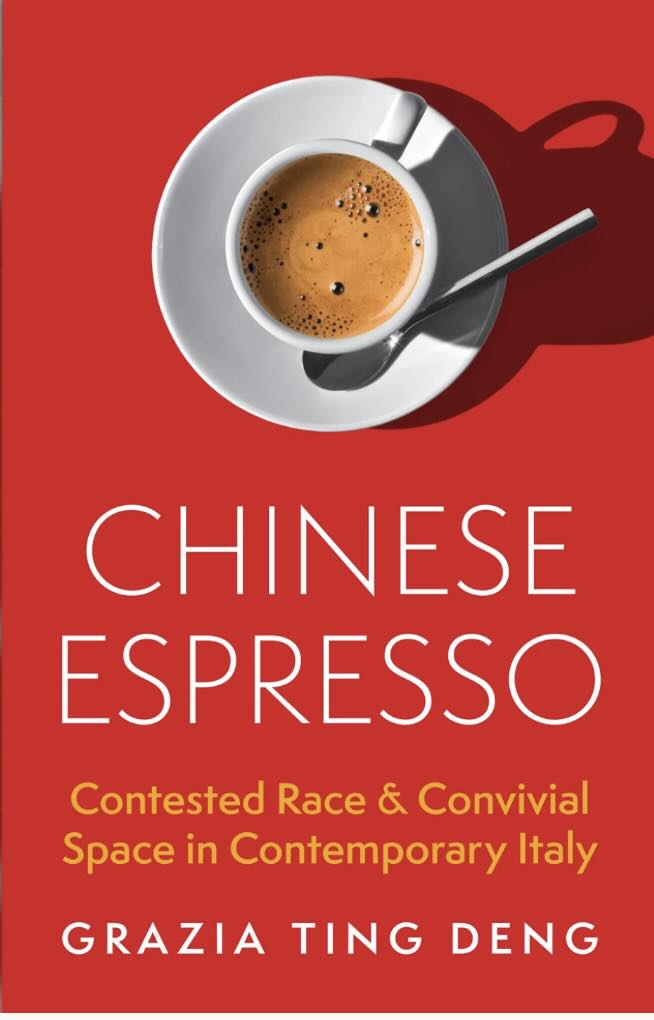
On another trip to Milan seeking to finalise the editing of my new film on the New Year’s rituals in Gaoluo with Andrea, taking a break at his local Chinese-run coffee bar makes a suitable backdrop to digest an interview with Grazia Ting Deng on her new book Chinese espresso: contested race and convivial space in contemporary Italy, based on fieldwork in Bologna.
Over the past four decades, Chinese residents have become one of the most prosperous and economically powerful ethnic and immigrant groups in Italy. The increasing number of “Oriental” faces as well as their products and their storefront enterprises are so visible as to constitute an integral part of the urban landscape and urban life. The seemingly mysterious economic boom of Chinese immigrants in tandem with China’s rise as a global economic power look like a counter current to Italy’s chronic economic stagnation. In Italy’s populist-nationalist discourse, the “China threat” has now taken on a new guise that merges admiration and resentment.
As a Chinese immigrant, Deng experienced institutional discrimination and everyday racism; as a woman, she faced the male/patriarchal gaze—from native Italian men, Chinese men, and other male immigrants. She found that Chinese bartenders are both subject to racialisation and reproduce it.
Chinese entrepreneurs usually purchase an existing coffee bar, often located on the periphery of the cities, embedded in neighbourhood life. Their main patrons are marginalised people, including working-class men of different generations who often have a migrant background from within or outside Italy. So their bars are sites where diverse racial and ethnic groups interact.
There the author found emotion, friendship, care, and a kind of social solidarity. However, as Chinese baristas sought to maintain the sociality of the space they managed, the way they policed their customers conformed to the moral expectations of “good” customers (white Italians) while excluding “bad” customers (foreign migrants) who risked destroying such sociality. This provided a context for tension and conflict.
Chinese baristas’ construction of a convivial social space is a dynamic process that runs in tandem with their own racial formations.
Deng found that social relations do not extend beyond the boundaries of the bar.
Italy’s more liberal sexual mores and pluralistic family structures that Chinese baristas have learned about from their customers seem to have confirmed their negative stereotypes of native Italians’ callousness regarding marriage and family. They contrast this with the traditional value of family integrity espoused by recent Chinese immigrants, who see this also as a prerequisite for upholding a family business and its economic prosperity. […]
Excessive consumption of alcohol and addiction to gambling—two fundamental sources of income for many Chinese-managed coffee bars—somewhat ironically become evidence allowing Chinese baristas, especially those who are Christian, to judge their customers as morally defective.
Coffee bar management has therefore reshaped Chinese baristas’ racialised perceptions of native Italians. […] A civilised, developed, and affluent Western country with only well-educated and respectable white Westerners turned out to be an Occidentalist fantasy.
Social interactions are never gender, class, racially, or ethnically neutral.
Sometimes, they would hire white baristas to submerge the Chinese ownership of a quintessentially Italian social space that they manage. On the other hand, Chineseness itself could also become an effective strategy in dealing with certain social situations. For example, Chinese identity, along with their supposed lack of linguistic skills, provided a good excuse and a strategy for Chinese female baristas to use to refuse unwanted communication and to dodge awkward and embarrassing harassment. […]
The coffee bar space was a kind of prism through which Chinese baristas acquired racial knowledge and produced a racialised world view. Their racialisation of both native Italians and foreign migrants reflects their double disenchantment with Italy, as well as the insecurity of their lives in this host country. […]
Many Chinese with whom I talked even questioned their decision to emigrate to this supposedly affluent and developed Western country. They commonly believed that Italians’ problematic work ethics and other perceived negative qualities were the real reasons for Italy’s economic stagnation, in contrast to the success of both the Chinese in Italy and China in the world. […]
Chinese baristas and many other Chinese entrepreneurs in Italy have been disappointed that their increasing economic prosperity has not translated into social respectability but, ironically, resulted in even more insecurity and exposure to crime. This predicament of being simultaneously economically privileged and socially vulnerable further fuelled Chinese baristas’ ethnic consciousness, while establishing boundaries to the conviviality that they cultivate.
For Deng’s related articles, see here.
 Stephen Jones: a blog
Chinese are hardworking and very good at making money – and at isolating themselves. 🙂
LikeLike
so that’s why it’s good to learn what They think of Us…
LikeLike