

Source: CHIME newsletter.
On Sunday SOAS hosted a grand celebration of the life of the great ethnomusicologist David Hughes (1945–2025), who died in May. Among many notices online, see this by Rachel Harris and Hwee-san Tan; Frank Kouwenhoven wrote eloquently in the CHIME newsletter.
After embarking on a PhD in ethnomusicology at Michigan under William Malm, from 1977 David thrived on fieldwork in Japan, together with his wife Gina Barnes. In 1981 they came to Cambridge (England!) to further their research, and it was there that I first met him as we consulted Laurence Picken. David went on to teach Japanese and Southeast Asian music at SOAS, becoming Head of Music and building a vibrant performance culture in a wide range of genres (he covered some of these topics, engagingly as ever, in this playlist). So the SOAS event resembled a retrospective of three decades of world music at SOAS and in Britain, with many of David’s former students performing; apart from copious Japanese music, among other featured groups that David supported and inspired were lively renditions of Cuban music and gamelan. And videos of his own performances were on display at the reception.
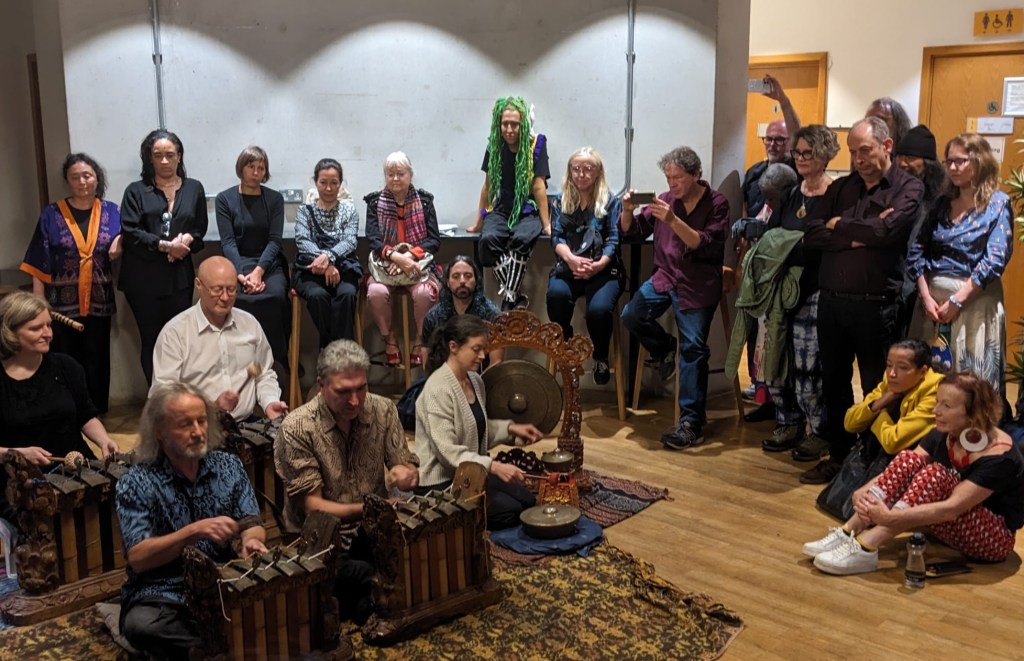
David was a co-founder of the British Forum for Ethnomusicology, and offered wise perspectives as a member of the CHIME board. Along with his in-depth research on Japanese folk-song, he had an authoritative grasp of Japanese musical cultures, as shown in his co-editing of The Ashgate research companion to Japanese music and his chapter on Japan for The other classical musics; he received several awards in Japan for outstanding contributions to Anglo-Japanese understanding. His lively and informal presence offered a welcome antidote to the more traditional British style of academic presentation—as a jovial performer, he was the life and soul of the party, delighting in language, an inspiration to many students. As is the nature of such things, the one person who would most have relished the event could not be present. David is much missed.
See also Some posts on Japanese culture.
 Stephen Jones: a blog