

My book Plucking the winds (2004), a detailed diachronic ethnography of Gaoluo village on the plain south of Beijing, includes many black-and-white photos and an audio CD. But the village’s ritual life cries out for a documentary—and only quite recently did I realise it might be possible to create one, using my amateurish footage taken during a three-week stay over the New Year’s rituals in 1995. So here it is!
Here’s the YouTube link, just in case (and while you’re there, my embryonic playlists there may lead you to more posts on my site). And here is the version with Chinese subtitles.
The new documentary is shorter, and less detailed, than my portrait film on the Li family Daoists, but the vitality of the New Year’s rituals just has to be experienced in film—not least the exhilarating percussion suite. I much appreciate Andrea Cavazzuti‘s patient editing. For reviews in Chinese, click here and here; for screenings, here and here.
On this site, in a revised Menu layout I’m collecting my articles on Gaoluo, based on Plucking the winds (see also Gaoluo tag). The most relevant page, edited from Chapter 11 (which further details change throughout the 1990s), is Gaoluo: New Year’s rituals.
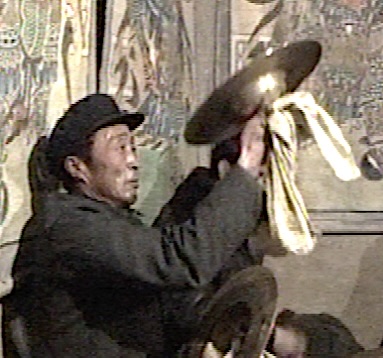
Following the final credits, note the bonus section offering clues to the workings of the majestic percussion suite Fendiezi, with Cai An and Cai Yurun demonstrating the patterns of the bo cymbals with oral mnemonics (for more, see Plucking the winds, pp.378–81 and CD #4–13). In the demos, I also love the shots of onlookers: Cai An’s mum, and kindly old Li Shutong thoughtfully miming the patterns (some captions for mnemonics will be revised in a future version!). The complete performance (from 42.39) begins with §1, omitting the preludial Changsan pai.
Comments and further leads
- 1.30, 2.12: Yang Yinliu‘s 1953 recording of the shengguan music of the Zhihua temple, Beijing is always spine-tingling.
- 1.39: for the wider context, see blog Menu, under Hebei.
The two historical interludes are largely told through photos—I hope they engage the attention. Relief from my voiceovers is provided by the sonorous gravitas of Kuan Guang (Qing Liang Buddhist Centre, Peckham), to whom I’m also grateful.
- 3.18: see posts on Shan Fuyi and the village’s early history.
- 3.40: for “precious scrolls” in Gaoluo and other nearby villages, see The Houshan Daoists and The Houtu precious scroll.
- 3.52: for the Boxers and Catholics, click here. 3.58: tiny clip from the movie Holy Whip—click here.
- 5.27: posts on the devastating national famine are rounded up here.
- 5.34: the extraordinary 1959 photo comes from North Xinzhuang, introduced under Ritual groups of suburban Beijing.
- 8.05: see under Funerals in Hebei.
- 14.25: for the training of the teenage boys, see under Vocal liturgists. All over China I note the importance of the brief early 1960s’ revival, between the famine and the Four Cleanups campaign.
- 17.04: see Women of Gaoluo.
- 18.30: while I made the film with the rather straightforward idea of documenting the village’s ritual life in 1995, I suppose a comparison is likely with the later condition of the association since Gaoluo (like other ritual groups on the Hebei plain) has been “elevated to the Hall of Great Refinement” (deng dayazhi tang 登大雅之堂), “hijacked by the razzmatazz of the Intangible Cultural Heritage system, with its sanitised packaging of traditional culture, quite removed from its function in local society”. The film’s approach does indeed make an intriguing contrast with that of the ICH.
My assessment of the ICH system may be negative, but in the case of Gaoluo I can see it as a Faustian pact born out of genuine concern for the future—and the members’ openness to the project had its own background. The commodification of such ritual groups on the Hebei plain goes back to the “discovery” of Qujiaying village in 1986. At the time the Qujiaying association was exceptional for hitting the headlines and staying there, thanks largely to the extraordinary determination of its village chief. In Gaoluo, the association members were already in heated debate by the early 1990s about various ways to guarantee their survival (Plucking the winds, pp. 324–9)—concerned for the future while many men were absent doing temporary labour in nearby towns and cities, and with popular culture already reducing younger men’s interest in such an old-fashioned ritual tradition. With my Beijing colleagues I warned our village friends that “the Qujiaying road” was not easy to follow, involving a lot of work for no clear benefit, and endangering the association’s age-old function serving their own community. But the alternative might have been for the association to wither away—and I was always aware that the villagers’ decisions were none of our business (我说话不算数 , as I and some of the less influential members liked to say)..
Anyway, they were well aware that associations like this were always closely tied to the local leadership, under all regimes—so what could possibly go wrong?! I’d love to know how all the villagers feel about it now—there will be a variety of viewpoints.
- 23.26: on the left, note the left-handed cymbal player Yan Chuncai, of the North village Guanyin Hall. I’m left-handed, which often caused comment in rural China. However, by 1998 I was coming across more and more left-handed people in Gaoluo—at one meal I was one of four at a table of eight men, another reminder of the potential for non-conformity in China (Plucking the winds, pp.291).
- 30.48, 33.44 etc.: if your eye is caught by the wall-posters, try Some Chinese posters and pinups.
I’m delighted that this new documentary can join my portrait film on the Li family Daoists. Do spread the word about both!

 Stephen Jones: a blog