
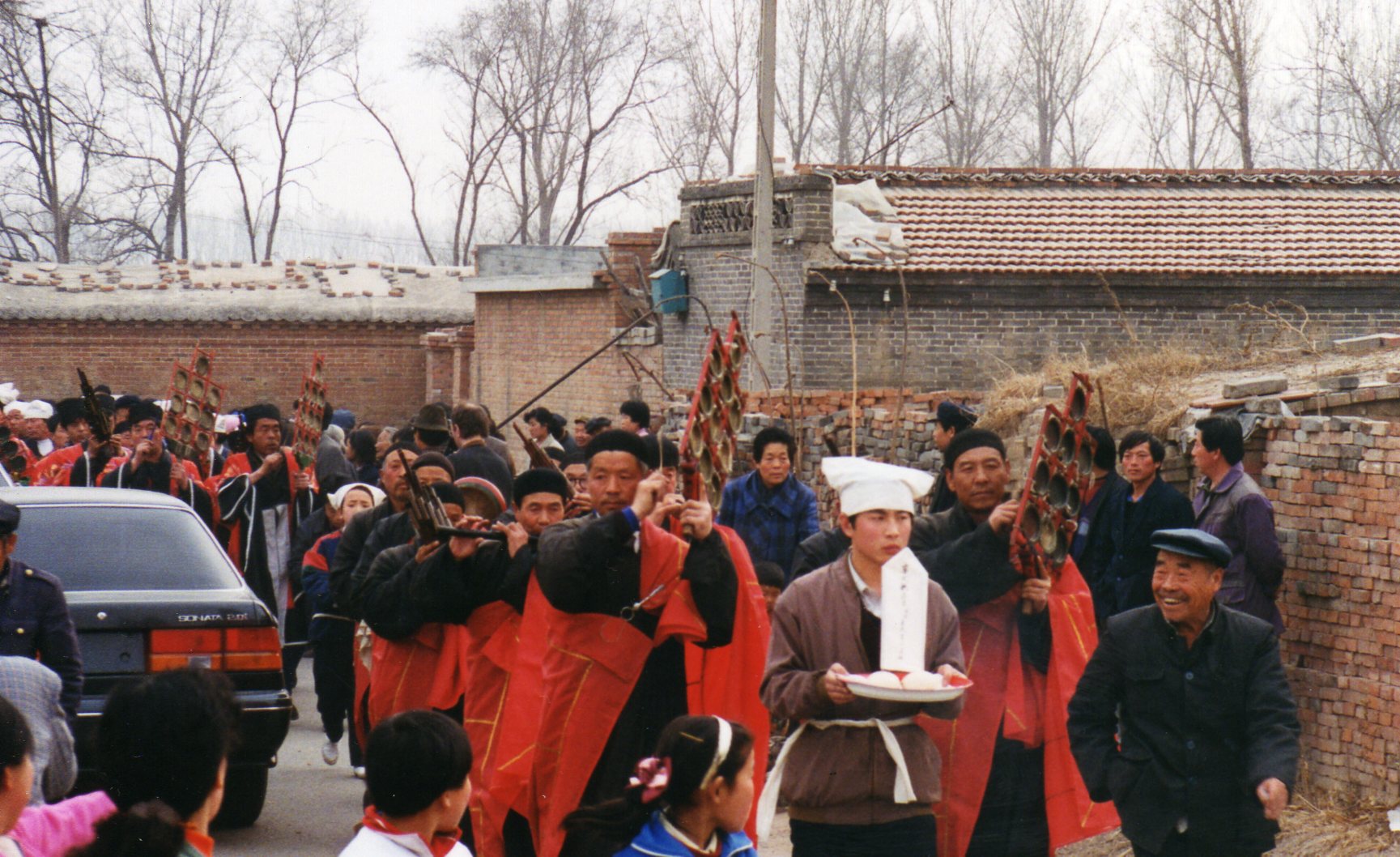
The new Menu that I’ve just launched looks quite different, with rubrics including
- the Li family Daoists
- and other household traditions of Daoist ritual in Shanxi
- Gaoluo village
- and other ritual associations in Hebei.
Apart from my main sites of north Shanxi and the Hebei plain, the heading “Elsewhere” subsumes brief surveys of some further local ritual traditions. These articles reflect varying degrees of depth. Many derive from “hit-and-run” fieldwork (more poetically, “gazing at flowers from horseback” 走马观花)—some on the basis of my In search of the folk Daoists of north China (now in paperback!), others based on secondary sources. But they’re all worth sharing, both as overviews and as preparation for undertaking one’s own fieldwork. I spell out the various levels of fieldwork, from provincial surveys to studies of an individual family, here.


The main headings here, all with sub-menus, are
- Shaanbei
- Gansu
- Fujian.


This list is far from exhaustive—for instance, many posts are collected under the south China tag (in addition to the south China subhead of the ritual category!), and you can find several posts on folk cultures of Henan.
* * *
On reflection, there are several reasons why household Daoists in north China haven’t received much attention, except from musicologists. Scholars of Daoism have long studied household Daoists in Taiwan, and when mainland China opened up in the 1980s it was natural to cross the strait in search of their relatives, their origins, in south Fujian and east Guangdong (see e.g. Kristofer Schipper and Ken Dean). From there the topic gradually spread through south China, and we now have a vast body of field reports.
Meanwhile in the north there was actually a longer tradition of studying folk ritual, but it derived mainly from musicologists. Others—even scholars of Daoism and ritual—had inherited a misleading modern idea that the only Daoists in the north were ascetic monastic priests of the Complete Perfection branch. Accordingly, most scholars have limited their searches to such temple priests.
So I suggest a rethink. It’s not that we shouldn’t study temple clerics. But they are always vastly outnumbered by household Daoists, throughout north and south China. Instead of heading for a temple, it’s generally more fruitful to ask in a funeral shop.
And this work shouldn’t merely be outsourced to musicologists. Scholars of folk religion are still the right people for the job—as long as they make an effort to achieve basic literacy (if that’s the word) in the soundscape, and modern ethnographic enquiry. As in south China, which is much better covered, once one begins joining up the dots on the map, one hopes to learn more about the empty spaces.
Buddhist ritual is very much a subsidiary topic. Among the pages above, so far I’ve given sketchy introductions to Ekou (central Shanxi), Zuoyun (north Shanxi), Yangxian (south Shaanxi), Buddhist ritual of Chengde (Hebei) and Tianjin. It features often in my articles on the Hebei plain; and others can be found via the Buddhism tag in the sidebar.
 Stephen Jones: a blog