
Our material on ritual groups in north Shanxi (also under Li family Daoists in main Menu) relates mainly to the area east and south of Datong city. But Zuoyun county, just west, has potential—indeed, the whole area west of Datong would be worth exploring.
Before the 1949 “Liberation”, temple and household groups (both Buddhist and Daoist) regularly performed rituals among the folk in cities such as Beijing, Xi’an, Chengde, and Shenyang. I met former Buddhist monks who had taken part in the ritual band of the Huayan si 華嚴寺 Buddhist temple in Datong—which then accompanied its liturgy with shengguan wind ensemble. But for Yanggao, I could only give slender clues to the rituals of Buddhist temple monks on the eve of Liberation (Daoist priests of the Li family, pp.50–51).
And in inverse proportion to the historical ratio of Buddhist to Daoist temples, household Buddhist ritual groups are always a small part of the folk scene. For north China, apart from amateur ritual associations on the Hebei plain and around Xi’an, I have only introduced groups in Ekou near Wutaishan, and Yangxian in south Shaanxi.
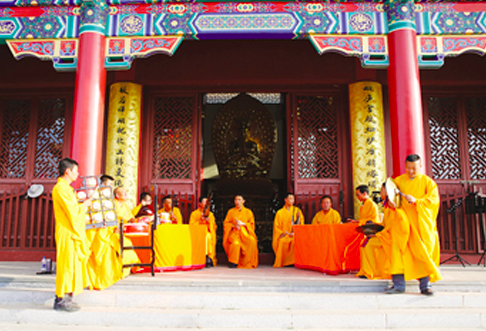
Exceptionally, whereas north Shanxi is dominated by Daoist groups, the ritual tradition of Zuoyun appears to be Buddhist, belonging to the Lengyan si 楞嚴寺 temple. But the situation is doubtless more complex. I have a solitary mimeograph from 1979, entirely undocumented, called “Performing scores of yinyang in Zuoyun county” (Zuoyun xian yinyang zanzoupu 左云县阴阳演奏谱). These transcriptions of recordings, which are now unlikely to surface, were evidently prepared as an early submission for the Anthology, but the volume consists solely of transcriptions of shengguan wind ensemble suites, with no textual explanation whatsoever. If the yinyang of the title is accurate (referring to household Daoists, as elsewhere in north Shanxi), then it suggests a substantial household Daoist tradition—but one can’t tell, for it might just as well be a Buddhist shengguan tradition. Whether this repertoire was performed by either former Buddhist monks, household Daoists or household Buddhists, the material gives no details of its transmitters, and the current Lengyan temple group all learned since 1979. So it is hard to assess the scene around Zuoyun county without fieldwork, village by village.
As often, the “Buddhist music of Zuoyun” has been hijacked by the Intangible Cultural Heritage, whose scant material is full of the usual flapdoodle. Typically, the material focuses on a single grand temple, the Lengyan si. The temple monks perform daily liturgical services, but instead the “genre” is conveniently packaged merely as instrumental “temple music”. Such temples are inevitably co-opted into the patriotic agenda of the ICH and the state. A short documentary from 2014 (no longer online) is most unpromising (always beware when you see a music-stand!); it’s a model of all the faults of the ICH, the awed melodramatic voiceover (standard for all such presentations) cramming in a wealth of fatuous clichés. Classic “negative teaching material“!
Wuzhai and further south
Judging from mainly instrumental pieces transcribed in the Anthology, household Buddhist ritual specialists may also be active further south in Wuzhai county, though it is unclear if this material (from the late 1980s) derives from “salvage” fieldwork or a still active tradition. Among those consulted for the Anthology were former temple monks with the intriguing clerical names of Daoxian 道仙 (secular name Zhang Fengming 張鳳鳴) and Daocun 道存 (Bai Shan 白山), as well as Yuan Ying 圓瑛 (Liu Yuanying 劉圓瑛). [1]
Still moving south, the Anthology also documented household “Buddhist” groups in Jingle and (further east) Zuoquan (Luocun 駱村 village) counties. Yet further south in Linfen municipality, the brief paragraph on Xiangfen, Hongtong, and Fenxi counties claims combined Buddho-Daoist (sengdao 僧道) groups. [2]
Daoist groups are very active in south Shanxi—I outlined them briefly in In search of the folk Daoists of north China, pp.85–7.
There’s still a lot of fieldwork to be done here. Where there are temple groups, I expect there to be household groups too; and where there are Buddhist bands, there are likely to be Daoist ones too. As usual, our first port of call should be not temples or apparatchiks, but funeral shops.
[1] Zhongguo minzu minjian qiyuequ jicheng, Shanxi juan p.1550, transcriptions pp.1724–57.
[2] Ibid. p.1550, transcriptions pp.1757–68.
 Stephen Jones: a blog