
This blog is full of “world music“, from far and near. I’ve always been a great fan of Irish music, but somehow I’ve never quite paid attention to the English folk scene. While I’ve made a modest attempt to get to grips with Morris dancing, I struggle to get over the quaint “Hey Nonny No” shtick—which is an irrelevance for English folkies like the women featured below; they keep ploughing their own furrow (sic), nestling in a niche alongside (and branching out towards) pop and rock.
So I welcomed Eliza Carthy’s delightful recent chat with John Wilson on BBC Radio 4.
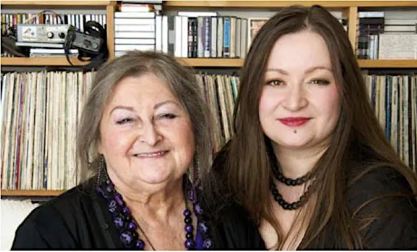 Eliza Carthy with her mother Norma Waterson.
Eliza Carthy (website; wiki) comes from a tradition of domestic musicking in a family of musicians that goes back at least seven generations (cf. Bach, household Daoists in China, flamenco, India, and so on). She was brought up with the singing of her parents Martin Carthy and Norma Waterson—here’s their album Frost and fire: a calendar of ritual and magical songs (1965):
Eliza tells a nice story about singing on stage with her folks for the first time when she was 6, and she fondly remembers joining the family for the Vancouver folk festival in 1989, aged 13. Touring the States, she got the opportunity to hear regional traditions she could recognise as derived from the British Isles.
Having focused on a cappella singing, as a fiddler she began exploring instrumental music in more depth. She didn’t rate classic folk-rock, but was inspired by the Scottish band Shooglenifty. She also pays tribute to Billy Bragg. Of her many collaborations, such as The Imagined Village, I’m keen on Ratcatchers, with Jon Boden and John Spiers of Bellowhead:
More recently Eliza relished touring with the Wayward band—some great tracks on their YouTube channel. And she still appeared with the family; here they are live in 2007:
She sees nothing particularly bold about her rather edgy updating of the heritage, a bit punk: tradition was always evolving, and “I was never going to float around in a tree!”. She believes in the importance of every generation developing their own sound.
How do you make a song your own?
[laughs] Well, I sing it… […]
As to “traditional” songs,
You take out what’s not you, and you put in what is you…
As her mother commented in 2010,
We thought—my generation of musicians—that we’d all get old and grey and there’d be nobody left. And then all this new generation of young musicians came up, and we all said, “Thank God”. So if people say traditional music has got to be like that, or like that, then you’re going to freeze it. You may as well put something in a museum or bury it in the ground in a time capsule and dig it up so many years later to see what it was like then. You can’t do that with tradition. You have to hope each generation brings their own thing to it, so it keeps going forever.
Here mother and daughter sing Psalm of life:
Now that Eliza is President of the English Folk Dance and Song Society, she reflects, “It’s strange being the president of something that nobody really knows exists—and I’m not talking about the society…” She gives a suitable tirade against the government’s philistine disregard of culture.
Alas, another programme, in which Kathryn Tickell visited the family home, with more generous sound excerpts, isn’t currently available.
* * *
Moving from north to south England, another senior doyenne of the English folk scene is Shirley Collins (b.1935) (website; wiki; articles e.g. here, with a fine playlist, here, and here). She and her sister Dolly were steeped in the songs of Sussex from young.


Left, Shirley Collins in her youth (photo: Brian Shuel/Redferns)
right, after her comeback (photo: Andrew Hasson/REX).
After meeting Alan Lomax in 1954, they made a song collecting trip to the USA in 1959 (as described in her book America over the water), making some major discoveries—notably Mississippi Fred McDowell:
Also in 1959 Shirley recorded her debut album Sweet England—here’s Barbara Allen:
Through the 1970s she sang with the Albion band. She was then silent for over three decades, but in recent years she has begun singing again, to much acclaim. Like the Carthys, she doesn’t hold with the whole purist folk shtick:
There was some controversy surrounding Anthems in Eden, but most of it came from the Ewan MacColl lot who wouldn’t brook any other way of singing than, you know, putting your hand behind your ear so that everyone knew you were serious about it.
And she was underwhelmed by the political link:
For me, Pete Seeger bashing his bloody banjo and exhorting an audience to join the chorus of We Shall Overcome never seemed to advance any causes.
Her songs were championed by John Peel; more recently another great fan is Stewart Lee—in this chat they discuss “music, creativity under lockdown, civil rights, the government’s support of the arts, and the importance of having the right spoons”.
There’s a wealth of material on English folk to explore on Topic records alone. And Songlines is always a good source for updates—including #189 (July 2023).
 Stephen Jones: a blog