
David Murray
Part of my “strangely extensive” jazz series!
The London Jazz Festival crams so many fabulous events into just over a week that one inevitably misses a lot. I didn’t even manage to hear Ron Carter, Aynur, or Hiromi, but I delighted in young musicians’ tribute to Tomasz Stańko.
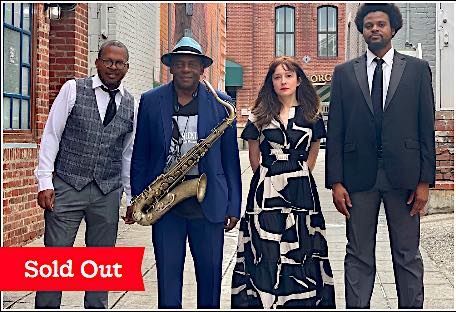
After Ronnie Scott’s (NB my post on Ray Man, covering a lot of ground!), another site for Soho jazz history is the conducive ambience of Pizza Express in Dean street. Besides the endless subtleties of the rhythm section, I’ve always delighted in trumpet playing (see e.g. Fats Navarro, Clifford Brown, Lee Morgan, and several posts on Miles, to be found under A jazz medley), but it’s good to refocus on the sax, in the hands of the great David Murray (b.1955). Raised in Cali, in 1975 he moved to New York, taking part in the loft scene; soon he founded the World Saxophone Quartet. Like Rahsaan Roland Kirk, he benefits from circular breathing. Since 1998 he’s spent periods living in Paris (working on projects such as Banlieu Blues), and collaborating with Afro-Cuban musicians. No longer an enfant terrible, and not yet quite a veteran, he’s constantly exploring.
I relish this, live at the Village Vanguard in 1986, with Ed Blackwell (drum), Fred Hopkins (bass), and John Hicks (piano):
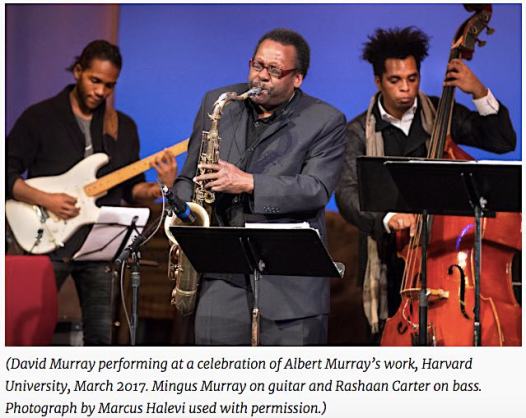
In 2018 Murray formed Class Struggle (see e.g. here) with his son Mingus (guitar), Rashaan Carter (bass), Russell Carter (drums), Craig Harris (trombone), and Lafayette Gilchrist (piano).
In this interview he reflects:
As tenor players get older, we tend to play fewer notes, but with more authority. We play the truer tones. Even in the kind of music I play, I feel my notes are getting more selective. I don’t have to fool around with unnecessary notes. Some of my predecessors—Archie Shepp, Paul Gonsalves, Lester Young, Coleman Hawkins—got a chance to mature in their sound. Part of the maturation process on the tenor is to become more frugal with your note selection. Some notes ring on the tenor saxophone more so than on other instruments. There are certain notes inside of a chord—if you hit the right tones in the measure, you don’t need to spell out every note inside of a chord. It takes experience to do that. You have to tell a story on the tenor saxophone. A young musician won’t tell the same stories as an older musician—a musician who has been through divorces, who has been through the travails and tribulations of life. Some of the truest stories in jazz have been told on the tenor saxophone. When you hear a story being told, you take note.
Fred Jung called him “the Madonna of jazz, reinventing himself in a contemporary union with the times”. Murray laments the lack of individuality in the factory approach and the Lincoln Center treadmill. He speaks highly of Jerry Garcia and the Grateful Dead.
Blues for Memo (2018; playlist), with rapper Saul Williams, was recorded in Istanbul (see here). It’s a tribute to Turkish jazz promoter, Mehmet “Memo” Uluğ. “We try to remember him with this album. He was a bass player and he and his brother, Ahmet, owned the Babylon jazz club and Positive Productions. They’ve done great things in Istanbul” (cf. Nardis, and Jazz in Turkey). Here’s an introduction, opening with the sounds of kanun zither:
Here’s a “teaser” for the documentary I’m a jazzman (Jacques Goldstein, 2008):
* * *
For how jazz musicians learn and develop their voice and style, it’s always going back to Paul Berliner, Thinking in jazz. Jazz genealogies are notoriously hard to trace (dig the trumpet family tree here)—for the sax, see e.g. this basic outline. Murray may sound “avant-garde”, but he recognises his influence from players of previous generations such as Paul Gonsalves, Lester Young, Coleman Hawkins, and Dexter Gordon. From the next generation, he’s inspired more by Albert Ayler and Ornette Coleman than by Coltrane. The sax lineage moves on through the likes of Pharaoh Sanders, Wayne Shorter, Art Pepper, Sonny Rollins, and Archie Shepp, then extending to Britain with musicians like Courtney Pine and Nubya Garcia.
At the LJF gig Murray appeared with Luke Stewart (bass), Russell Carter (drums), and Marta Sanchez (piano). His gutsy honking in the bass contrasted with some amazing squealing way up the top of the register, just like a high trumpet. He ended with vocals reminding us of his advocacy for the African-American cause. Here’s his 2004 album Gwotet with the Gwo-Ka Masters and Pharaoh Sanders:
The creativity of jazz never ceases to astound me. David Murray exudes an air of authority, at once dynamic and benign—it was a delight to hear him.
 Stephen Jones: a blog