
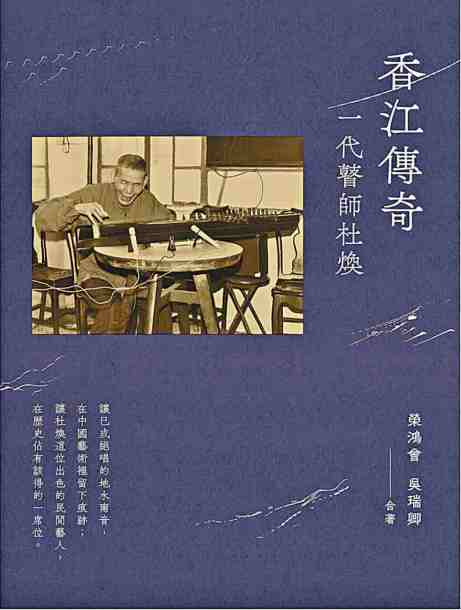
Bell Yung has already issued a fine series of CDs, recorded in 1975–6, that make an impressive anthology of the repertoire of the blind bard Dou Wun 杜焕 (1910–79) in Hong Kong (click here). Now he has published a detailed book, in Chinese, on the topic:
Rong Hongzeng 榮鸿曾 [Bell Yung] with Wu Ruiqing 吴瑞卿 [Sonia Ng], Xiangjiang chuanqi: yidai gushi Du Huan 香江傳奇:一代瞽師杜焕 [Tales from Fragrant River: the blind master Dou Wun] (2023, with CD).
In English, note Bell’s eloquent article
- “Voices of Hong Kong: the reconstruction of a performance in a teahouse”, Critical zone 3 (2009),
and now also his
- “A humble blind singer’s autobiographical song: oral creation facing a Hong Kong teahouse audience”, Ethnomusicology 67.2 (2023).
As to the book, the nine chapters of Part One introduce successive social, economic, and political changes of Hong Kong; the genre of naamyam 南音 as part of a rich tradition of performed oral literature, with constant improvisation; musical and textual analysis of naamyam, as well as baan’ngaan 板眼 and lungzau 龍舟. In chapters 7 and 8 Sonia Ng gives useful roundups of Dou Wun’s comments on his fluctuating experiences amidst changing Hong Kong society, illustrating another subaltern milieu.


The Fulong teahouse, 1975.
With Hong Kong constantly modernising, the tradition was virtually defunct by the 1970s, so this was already very much a salvage project. Even finding a suitably conducive ambience, venue, and audience to record Dou Wun’s performances was a challenge. After a poor childhood in Guangzhou, he had arrived in Hong Kong in 1926; from the teahouses and brothels of his early years there (despite the 1935 prohibition of the latter, he managed to sing at illegal venues until 1952), and beset by family tragedies, he had mainly “sold his singing” on the streets, besides a regular radio slot from 1955 to 1970. So by 1975, Dou had hardly performed in teahouses for over twenty years; Bell did well to arrange thrice-weekly sessions at the Fu Long teahouse in Sheung Wan district, the stories punctuated by the chirping of caged songbirds brought by its clientele (pp.34–43) (contrast the sterile, empty venues where PRC fieldworkers have mostly recorded).
Part Two (pp.184–237) provides the complete text of Du Huan’s precious six-hour sung autobiographical tale, heard on the 6-disc CD set Blind Dou Wun remembers his past: 50 years of singing naamyam in Hong Kong, and Part Three (pp.239–355) the texts of other items in his repertoire—also featured on the CDs.
Biography is an important component of anthropology and ethnomusicology (for China, see e.g. Helen Rees ed., Lives in Chinese music; cf. my own work on Gaoluo and the Li family Daoists). Yet it’s an unattainable goal to “become as one” with the people on whom we impose (see e.g. here). In personal reflections, Bell has expressed a certain regret that he couldn’t take the project further, entering more fully into Dou Wun’s life; their interaction, and Bell’s material, was largely based on the recording sessions and brief chats at the teahouse. The reader might also like more detail on Dou Wun’s use of the zheng plucked zither (cf. its use to accompany narrative-singing in Shandong).
While it works well as a self-contained project about one artist, one is curious to learn more about the whole performing culture of which Dou Wun was part, not only in Hong Kong but over in the PRC, in Guangzhou and around the Pearl River Delta. There, a starting point might be the narrative-singing volumes of the great Anthology for Guangdong province—for instance, on naamyam, see Zhongguo quyi yinyue jicheng, Guangdong juan 中国曲艺音乐集成, 广东卷, pp.422–66, with brief biographies (including Dou Wun!) on pp.467–9; and under a variety of rubrics, Zhongguo quyi zhi, Guangdong juan 中国曲艺志, 广东卷 (at a mere 470 pages, surely among the Anthology‘s shortest volumes!).
See also my roundup of posts on narrative-singing and on blind musicians in China and elsewhere.
 Stephen Jones: a blog