

The Tallis Scholars.
As an Early Music performer manqué, I (along with most of my colleagues) never delved deeply into theoretical issues. Akin to factory workers, we were more concerned with turning up for the gig, getting the notes right, and keeping together. Only quite recently have I begun to admire the work of scholars like Richard Taruskin and John Butt.
Andrew Parrott’s book The Pursuit of Musick (2022) is astutely reviewed for the LRB (“Hickup over the Litany“) by Peter Phillips, based on his own experience in the Early Music world as director of the Tallis Scholars over half a century. Phillips opens by observing:
One of the abiding mysteries in presenting music from the past is what the singers sounded like. There is no evidence for it, apart from written descriptions, all of which fall far short of telling us anything precise.
Citing a description of the singing in the Chapel Royal in 1515, written by the Venetian ambassador to Henry VIII’s court: “More divine than human; they were not singing but jubilating [giubilavano]”, Phillips comments: “the exact meaning of ‘giubilavano’ has been long debated, to no avail”. He goes on to ask
And what does this résumé of national styles, written in 1517, tell us? “The French sing; the Spaniards weepe; the Italians, which dwell about the Coasts of Genoa, caper with their Voyces; the others bark; but the Germanes … doe howle like wolves.”
Thus in recreating the sounds of early music, instrumentalists had more to build on than singers:
Performing on copies of old instruments produced cleaner textures. Research indicated lighter and quicker tempi, and suddenly the colours inherent in the orchestration became apparent, like the colours concealed under centuries of varnish on Old Master paintings. Singing followed suit. Romantic slush became almost morally unacceptable, when it was realised that vibrato in singing, as in playing, had gone too far by the 1960s. The only difference was that the instrumentalists were building on solid foundations, and the singers on what was sometimes no more than guesswork.
He refers to Parrott:
In 1707, Thomas Brown wrote that some of the singing men at St Paul’s Cathedral and Westminster Abbey “dayly come wreeking hot out of a Bawdy-House into the Church; and others Stagger out of a Tavern to Afternoon-Prayers, and Hickup over a little of the Littany, and so back again”.
—observing that “at times one wonders whether Parrott, after all, isn’t out to persuade us that standards in the past weren’t as high as they are now”.
Whereas Parrott was always more radical, sometimes even contrary, Phillips is among those choral directors who concluded that
the cake isn’t worth the candle, and one might as well go back to basics, look at the music carefully and create a sound which seems to suit what the composer may have wanted, as seen through his scores, and which pleases a modern public.
He notes the common accusation that
the reinvention of the past was doing no more than anaesthetising and colonising it, to give modern people a comfortable sense of nostalgia and possession. And in fussing about minutiae of detail, which might have been misleadingly reported and interpreted, it could distract performers from giving themselves wholeheartedly to a convincing, living interpretation.
Indeed, the Early Music revolution gave way to box-office pragmatism (see e.g. here, and here).
Among those criticising the Early Music movement was Pierre Boulez—here he offered a more recent example:
It is not clear that one would really be pleasing the composer […] by re-establishing performance circumstances that could never have been entirely satisfactory. Stravinsky asserted the unique documentary value of his own recordings and maintained that future interpreters should study them and be obliged to refer to them. Unfortunately, though, his precarious gifts as a performer, the circumstances and time pressures under which the recordings were made and the quality of the forces at his disposal do not let us regard this evidence as any sort of absolute model. In any case, can there be such a thing? Every interpretation conveys an essentially transitory truth.
Along with notes on falsetto, and pronunciation, Phillips cites Richard Sherr on the Sistine Chapel Choir in Palestrina’s time,
when it was the premier choir in Christendom. What indeed would Palestrina say, given the standards of the choir that habitually sang his works at the time, if he could hear modern performances? His music, so perfectly formed, so gleaming, cries out for the kind of choral discipline which is rare today, but must then have been non-existent. [Sherr:] “What is surprising, perhaps, is the number of papal singers throughout the 16th century who were thought by their contemporaries not to have been competent.” […]
The adjectives used to describe them include “harsh” (aspra), “hoarse” (rauca), “dissonant” (disona: “untuned”) … and they are occasionally associated with the noun imbecillitas (“weakness”). Many of them were routinely ill, or absent, some were very old but couldn’t be sacked, and some had been admitted without taking an audition. “In short,” Sherr concludes, “we may really not want to hear the music the Sistine Choir sang in the age of Palestrina in the way that they sang it.”
Phillips too reflects,
I have no doubt that if we were really to recreate an evening with an 18th-century orchestra, or a service with a 16th-century choir, we would be horrified by the standard of performance, and disgusted by the smells.
Phillips adduces Parrott’s 1987 recording of Allegri’s Miserere, shorn of its famous high C:
He moves on to the earliest surviving recordings of (WAM) singers—Caruso, and (also eschewing vibrato) this remarkable 1904 version of Ave Maria by Alessandro Moreschi, then 45 “and reportedly past his prime”:
(Moreschi was part of the Sistine Chapel Choir when they recorded Mozart’s Ave verum corpus in 1902, but not so you’d hear..).
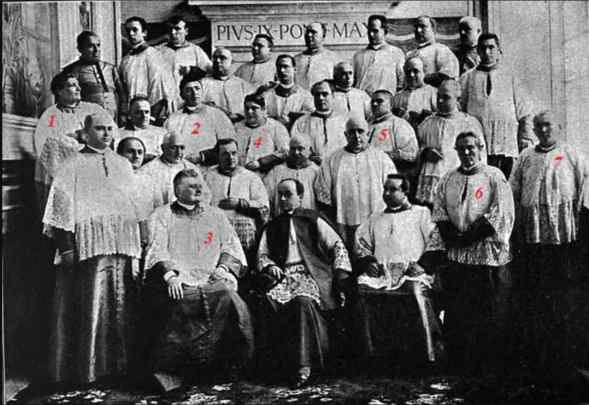
Sistine Chapel Choir, 1898; Alessandro Moreschi (4, middle row, centre)
among seven castrati. Source.
As Phillips observes:
If trends can change that much in a century, how much more must they have changed in five hundred years?
His review ends gloomily:
You are left with the impression that old music, when presented narrowly, is for old people.
* * *


Of course, the sound of early singing is still with us, perhaps not so much in the world of Western Art Music as in folk and popular musics (cf. Peter Burke on Popular culture in early modern Europe), in “world” traditions (e.g. Peter Jeffery for liturgy) —and, one might say, in daily life (on a lighter note, click here for a London taxi-driver’s interpretation of the term “early music”). I’m also keen to learn what Phillips has to say about the way that vocal and instrumental sounds of North Africa and the Middle East have been incorporated by interpreters of medieval music, such as Jantina Noorman with Musica Reservata, or in the work of Jordi Savall and Hespèrion XX. And in European regional folk genres we might find clues in living traditions to the way “Spaniards weepe” in the cante jondo of Andalucian flamenco, or how “the Italians, which dwell about the Coasts of Genoa, caper with their Voyces” in trallalero (under Italy: folk musicking). However imprecise, such oral/aural material may supplement early textual sources, adding further pieces to the jigsaw.
 Stephen Jones: a blog