
The going was tough for the members of the BBC Symphony Orchestra in the years following the regime of William Glock. A rigorous, ear-scouring diet of avant-garde music was leavened only occasionally by returns to the core symphonic repertoire, as well as dutiful lip service to the “cowpat” school of early-20th-century English composers—although I recall being impressed by Arnold Bax’s Tintagel.
Following Berlioz’s distaste for the music of the not-so-mystic East, I’ve touched on musical chinoiserie in posts such as Mahler and the mouth-organ. Among other composers whose work Angela Kang discusses in her 2011 thesis are Purcell, Gluck, Roussel, Puccini, Debussy, and Stravinsky—see also Ravel, and this article on the American composer Charles Griffes (more here). Cf. Lili Boulanger’s Vielle prière bouddhique, and Kreisler’s Tambourin chinois.
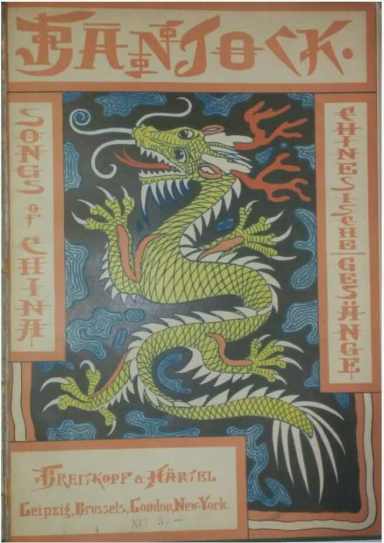
Granville Bantock (1868–1946) was one of the English composers whose work we must have played, somewhat casually, in the BBC SO. I’ve only recently clocked his 32 Chinese songs, a substantial series that he wrote from 1918 to 1920, inspired by the exotic East—Arabia, Japan, Egypt, India, and Persia (note also his vast suite Omar Khayyám) (see also here).
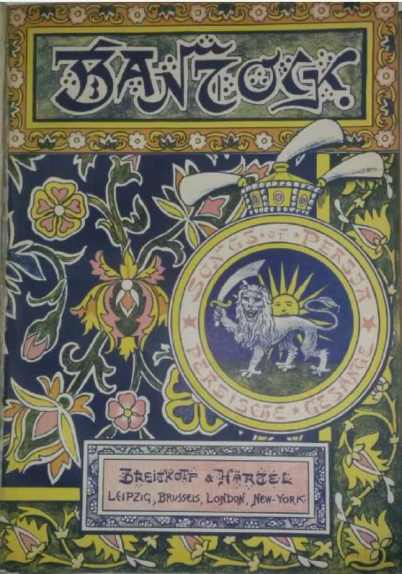
Great designs, eh? Well done, Breitkopf & Härtel…
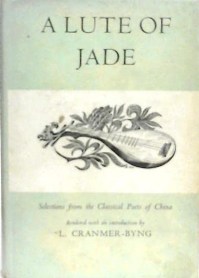 The first cycle of Five songs from the Chinese poets (score) set English texts by Bantock’s friend the euphoniously-named Launcelot Cranmer Byng, after Tang poems by Zhang Zhihe, Du Fu, Li Bai, Tong Hanqing, and Sikong Tu. All but one appear in A lute of jade (1909)—one of the first collections of Chinese poetry that I bought (probably from Watkins) while still at school. The cycle was arranged for string quartet in 1933 as In a Chinese mirror. According to this post, some of the lyrics of Songs of China were written by Bantock’s wife Helen.
From the second set (score), here’s John McCormack singing a version of a text by the Tang poet Cen Shen in 1927:
* * *
Bantock also composed Chinese-inspired works on a larger canvas. Besides Choral suite from the Chinese (1914, again to texts by Cranmer Byng), I note the orchestral Four Chinese landscapes (1936)—the latter mostly directed by Walter Collins in 1946:
To the modern ear, such sketches are no more enticing than the works of Chinese composers trained in the WAM idiom such as Xian Xinghai, Nie Er and He Luting (a focus for much ideological wrangling in China over the following decades). But “it is what it is“: Bantock and others were part of a lasting European fascination with the Mystic East (see e.g. More East–West gurus), as yet largely uninformed by later fieldwork in the folk cultures of a vast region.
For later Eastern-inspired works, see e.g. Messiaen, and the ambivalent reaction of Toru Takemitsu to Japanese tradition. For the great Bruno Nettl‘s taxonomy of responses to the growing hegemony of Western musics in developing societies, click here. For Tang poetry, see under A Tang mélange.


Charlotte Devéria ( 1856-1885) was the wife off Jean-Gabriel Devéria ( 1844-1899), a French Diplomat and chief translator at the French legation in Beijing, was responsible for publishing a book on “Chinese Music” which is very interesting. In 1889 she published “Twenty Melodies for Singing and Piano”. Four of them use popular Chinese Beijing folk songs. 1. Chanson pékinoise. 4. Chinoiserie –air chinos. 5. Ivresse-air chinos 6. Le Lys d’eau – air chinois.
Emmanuel-Edouard Chavannes’s ( 1865-1918) wife Alice Dor collaborated with different composers and published “ Chinese fables from the 3rd to the 8th century AD ( of Hindu origin)/trad. By Ed Chavannes; versified by Mrs Ed.Chavannes; L.-J. music Rousseau ( 1916).( Bnf https://data.bnf.fr/en/15438485/alice_chavannes/)
LikeLiked by 1 person
I am not sure Charlotte Devéria had published a book on Chinese but aware of her article, “Essai nouveau sur la musique chez les chinois,” Le Magasin Pittoresque (1885), pp. 234-238, 287-288, 327-328, 390-392.
LikeLiked by 2 people
“Songs of Cathay” were previously unknown to me. They were published in 1930 by T.Z. Koo ( 1887-1971) .He says that the melodies are traditional and correct, but that he has harmonised them to please himself and that sometimes he has changed the words so that they become patriotic songs.
What is interesting is that he has printed the words in Chinese and also included an English translation, so that they can be sung in English. So these are a good 18 years before Yao Yinxin published her “ Flower Drum Songs”.
As you would expect there is some duplication and these songs appear in both compilations:-
.So in “Songs of Cathay”
No 3 Love’s Lament in Mid-Autumn. The same in Flower Drum Songs
No 5 Ban Chaos Philosophy This is called Old Fisherman in Flower Drum songs
No 6 The Feng Yang Drum .This is Flower Drum No 2 in FDS
No 7 Purple Bamboo .Same in FDS
No 9 Spring Tidings .Same in FDS
No1 2 Little Cabbage .Same in FDS
No 16 Meng Chiang Nvs Lament .Same in FDS.
There are however some interesting songs included.There are 6 what he calls “Confucian Temple Music” .
No 4 is called “Han Palace Autumn Moon” is an instrumental piece with two movements. It is written in 2 parts with both parts in the G Clef but the upper part to be played an octave higher. Very strange harmony and I wonder what instruments it was originally intended to be played on?
The other interesting piece of information is that T.Z.Koo says the inspiration to write these folk songs came from a suggestion from Dr Helena Wright. Helena Wright ( 1887-1982) was a fascinating person. She trained as a Doctor and was an early advocator for Nurses and female Doctors to be trained in gynecology. She was a pioneer in both birth control and sex education. For a short time, she and her husband worked as missionaries in China 1921-1927.
https://oregondigital.org/concern/documents/df72d421z…
LikeLiked by 1 person
I have written articles on T.Z. Koo (顾子仁) and the genesis and various editions of his《民间音乐》, initially called Songs of the People. The edition you referred to is the fourth.
LikeLiked by 2 people
Great , I ‘ll search the articles out because I would like to know more about him.
LikeLike
One of the more interesting Musical Chinoiserie I think is the music of Julius Schloss ( 1902-1972). In the Julius Schloss Collection held at the Marvin Duchow Music Library of McGill University there is a collection of 46 Chinese folksongs in jianpu notation with Chinese lyrics, and Schloss’s transcription of the melodies into Western Notation. The Chinese lyrics are too difficult for me to translate but I like the tunes. He used some of these melodies in his Chinese Rhapsody No. 2 for Violin and Orchestra (1948–49).
LikeLike