
The great Seiji Ozawa died last week (tributes; obituaries e.g. NYT; see also nippon.com). *
Born in 1935 to parents based in Mukden (Shenyang) during the Japanese occupation of Manchuria, he returned with his family to Japan in 1941. His rise to conducting stardom was meteoric. A pupil of Hideo Saito (1902–74), in 1959 he won a conducting competition in Besançon. This led to an invitation to study with Charles Munch and Pierre Monteux in Boston, where he soon won the Koussevitzky Prize; this began his close association with the Tanglewood Festival. Gaining a scholarship to study with Herbert von Karajan in West Berlin, he was spotted by Leonard Bernstein, who made him assistant conductor of the New York Phil in 1961. Here Bernstein introduces Ozawa conducting the overture to The marriage of Figaro in 1962:
Ozawa remained the only conductor to have studied under both Karajan and Bernstein (cf. Unlikely bedfellows).

Meeting Messiaen and Yvonne Loriod on their honeymoon in Japan, July 1962.
In 1963, still little-known in the USA, Ozawa appeared on What’s my line (cf. Anna Mahler on You bet your life, 1952!). By the late 60s, in contrast to the staid, ageing Teutonic maestros to whom concert-goers were accustomed, he exuded a rock-star vibe that no-one has since been able to emulate (NYT: “with his mop of black hair, his boyish demeanor and his seemingly boundless energy, he captured the popular imagination early on”; Peter Gelb: “a symbol of male beauty on the podium that I don’t think the world had seen before.”) As Norman Lebrecht commented (The maestro myth, pp.137–41):
Ozawa sported a Beatle fringe, flowery shirts and cowboy boots, and wore a roll-necked sweater instad of a dress-shirt at concerts. His appointment was clearly aimed at rejuvenating the Symphony Hall subscription list. Oriental mysticism was all the rage among the East Coast college kids who escaped conscription to Vietnam; and Ozawa was, they said, something else.

In the early 70s I too basked in his charisma at London concerts, hearing him conduct an exhilarating Symphonie fantastique, as well as November steps—Takemitsu’s music becoming known partly thanks to Ozawa’s advocacy.
 Baseball with Lenny, Japan 1970.
Here Ozawa directs Maki Ishii’s Sō-Gū II for Gagaku and Orchestra (1971):
Ozawa acted as music director of the Boston Symphony from 1973 to 2002, a tenure that “many thought too long for anyone’s good: his own, the orchestra’s or the subscribers’ “.
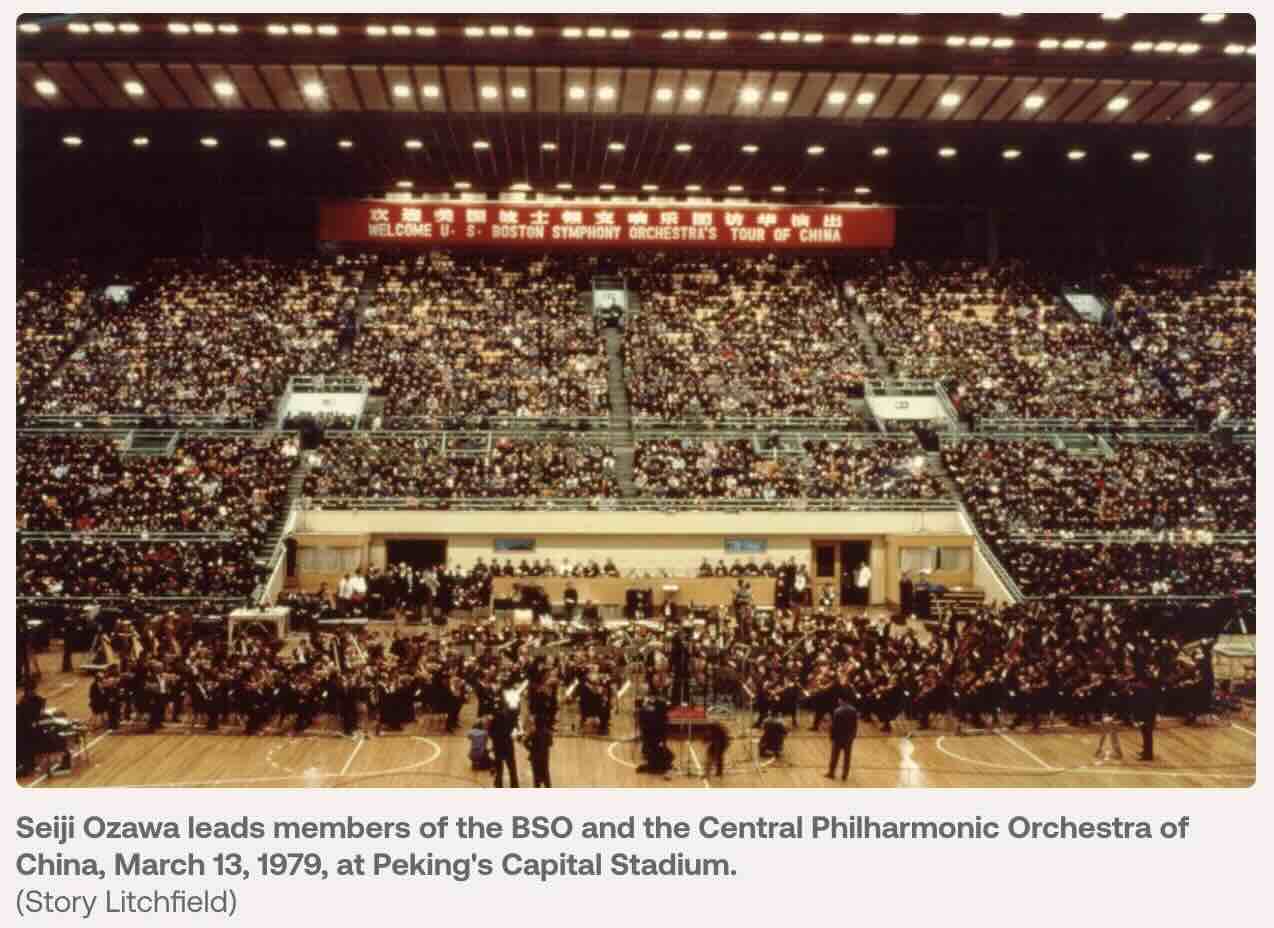
According to the NYT, he played a role in easing tensions between China and the USA in 1979, when the Boston Symphony toured China, still emerging from the Cultural Revolution (cf. the 1973 visits of the Philadelphia and London Philharmonic). Peter Gelb, then the orchestra’s publicity director, said that Ozawa had been crucial in making the tour happen, Chinese officials feeling “a connection with him since he had spent part of his childhood in China” (hmm, I wonder how that worked…).
Noting Ozawa’s fine ear for timbre and nuance, some magical selections:
Ravel: this playlist, with the Saito Kinen orchestra that he nurtured, contains his 2015 recordings of both L’enfant et les sortilèges and Shéhérazade (cf. my main Ravel page, and links). Here’s Pavane pour une infante défunte, from a concert in 2007:
Ozawa’s 1968 recording of Messian’s glorious Turangalîla, with Jeanne and Yvonne Loriod (on 2 LPs, with November steps), is on this playlist—here’s the fifth movement Joie du sang des étoiles (Gramophone: “turbo-thrusted to the point of kinky delirium”):
and the sixth, Jardin du sommeil d’amour (“an early window into Ozawa’s ear for obsessive detail and softer-than-soft textures”):
Ozawa also conducted the 1983 premiere of Messiaen’s monumental opera Saint François d’Assise.
All this can only be matched by Mahler 2, live in 1995 for a Nagasaki peace concert:
In 2016 Ozawa’s conversations with Haruki Murakami were published as Absolutely on music (introduced here and here). See also this Gramophone roundup from 2014, and the magazine’s review of his complete DG recordings. For more maestros, see The art of conducting: a roundup.
* As I write, the regular Guardian is strangely devoid of an obituary—a gap filled by the East London and West Essex Guardian, whose readers seem rather less likely to be avid tofu-eaters. Update: Guardian notice here.
 Stephen Jones: a blog
un magnifique chef d’orchestre. Une énergie phénoménale. De superbes phrasés. Tout sonne avec lui!!!!
LikeLiked by 1 person