

I’m most impressed by the early Japanese noir movie
- Drunken angel (Akira Kurosawa, 1948).
It was the first of sixteen film collaborations between the director (1910–98) and Toshiro Mifune (1920–97)—after they parted ways, neither was quite the same again. The film finally opens my eyes to Mifune’s genius—much as I love Seven samurai (1954), for me the hero is the Zen swordsman Kyūzō; I find Mifune’s buffoon persona something of a parody.
Here’s Drunken Angel:
Made while Japan was still occupied by the Americans, the film had to comply with US government censorship rules, which forbade scenes critical of the occupation. As Ian Buruma notes in a fine review, the set
consisted of a filthy sump surrounded by ruined buildings, shabby wooden houses, and the facade of a sleazy nightclub. It was a setting that could have been found almost anywhere in Tokyo in 1948, or any other bombed-out Japanese city where postwar life revolved around the teeming black markets. One of the wonders of the early postwar Japanese cinema was the public appetite for realism, and the pestilential sump, filled with toxic garbage, stood as a symbol for all that was rotten about life in the wake of a catastrophic wartime defeat. The cheap hookers lurking in the shadows, the young thugs fighting over territory, loot, and “face”. To have “face” in a particular district meant that you had the run of the place, taking what you needed for nothing and making huge profits off the backs of Japanese citizens who struggled to survive. Many of these petty (and not so petty) gangsters had been soldiers in a holy war to expand the glory of the Japanese Empire. Kamikaze pilots whose sacred suicide missions were aborted when surrender intervened became criminals exploiting the people for whose honour they had just months before sworn to sacrifice their lives. But some, in a perverse way, transformed their military code of honor into a gangland code that was just as deadly.
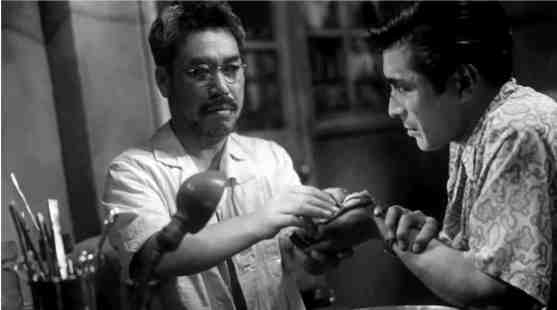
Small-time yakuza playboy Matsunaga (Mifune) develops a complex, fractious relationship with the brusque alcoholic doctor Sanada (Takashi Shimura—as Brian Eggert notes, “the first of several Kurosawa pictures where he would play spiritual guide to Mifune’s apprentice”).
The English subtitles are impressive. Sanada shows feminist credentials, protecting his nurse, a former girlfriend of sinister yakuza boss Okada:
You’ve got it all wrong, mister. Times have changed since you went in the cooler. Your feudalistic ways don’t fly now. Want me to spell it out for you? It doesn’t matter what you call her. She’s got to want you. Ever heard of equality?
In the opening scene a lonesome drifter plays a blues before the pestilential cesspool; later his guitar is snatched by Okada, just out of prison (his more genteel number less suitable than Kurosawa’s first choice Mack the knife—the rights to which were too costly). In the nightclub dance scene (53.30), the garish Jungle boogie is an homage to Gilda—for the music, see Michael Harris, ”Jazzing in the Tokyo slum: music, influence, and censorship in Akira Kurosawa’s Drunken Angel”, Cinema Journal 53.1 (2013).
Rob Kotecki makes a relevant analogy with Scorsese:
By starting with Shimura’s point of view, we see the gangsters’ moral rot in the context of the entire neighbourhood. Scorsese achieves his critiques of the gangster mentality from intimacy, living within that world exclusively, so we understand the appeal and eventually its hypocrisy, and with The Irishman, its banality as well. Kurosawa achieves the same, but with the distance from it that Shimura’s point of view provides.
My roundup of posts on Japanese culture includes the brilliant genre-bending movie Tampopo.
 Stephen Jones: a blog