
It’s not all beer and skittles, travelling, you know.
—Gertrude Bell, 1911.
Several biographers have told the remarkable story of archaeologist, writer, and traveller Gertrude Bell (1868–1926), who “came to be associated with crude ‘lines in the sand’ used to conjure nation-states from the territory of the defeated Ottoman empire”. Moving swiftly on from Nicole Kidman’s portrayal in Werner Herzog’s 2015 movie Queen of the desert (cogently trashed here),
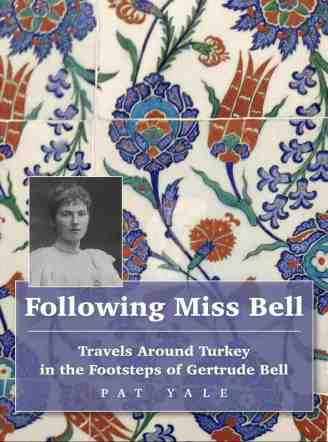
- Pat Yale, Following Miss Bell: travels around Turkey in the footsteps of Gertrude Bell (2023)
makes an engaging, personal read, focusing on Bell’s earlier years delving into the ancient artefacts of remote corners of Anatolia, which have been largely overlooked, despite her two books The thousand and one churches and The churches and monasteries of the Tur Abdin. Yale bases most of her account on the rich material now available in the Gertrude Bell Archive of Newcastle University. Besides encouraging you to read the book, I recommend reviews by far better-informed authors than myself: Caroline Finkel and Arie Amaya-Akkermans, as well as pertinent comments from Sara Wheeler. See also Yale’s website.
Following Miss Bell interweaves explorations a century apart. Having grown up in a hidebound Victorian society, after Bell’s first visit to Constantinople in 1889, she undertook her main Anatolian expeditions from 1905 to 1914; Yale, long resident in Turkey, retraced most of the route in 2015—a journey already fraught by severe tensions in Kurdish areas and the fragile situation near the Syrian border.
Bell went in search of Byzantine architecture, also finding traces of Roman, Hittite, and Selçuk cultures at sites such as Ephesus and Aphrodisias. At Carchemish in 1911 Bell first met T.E. Lawrence (“an interesting boy, he is going to make a traveller”). Yale colourfully translates onto the page her own contacts with people along the road—enlisting taxi drivers and local planning officers who share her taste for Bell’s expeditions. Taking in her stride the modern landscape of flyovers, factories, and supermarkets, Yale makes dogged enquiries, her refrain often rewarded:
At the teahouse in the main square I cast around for the oldest men present, then strike up a refrain that is to become so routine that I almost wish I could record it: “Hello. I wonder if you could help me. Just before the First World War there was an English traveller who was travelling around Turkey on horseback taking photographs. I’m following her travels. Her diary says she stayed at your village…”
Besides the archaeological remains that Bell discovered, Yale seeks sites where Bell pitched her tent, and the urban hotels where she stayed. Bell first visited the bustling port city of Smyrna in 1899, staying several times before the devastating fire of 1922 and expulsion of the Greeks. Yale finds modern Izmir “a secretive city, lumbered with a history in which the glorious victory over the Greeks that it wants to celebrate sits uneasily atop the cataclysmic destruction of the past that it knows is so unattractive to visitors”.
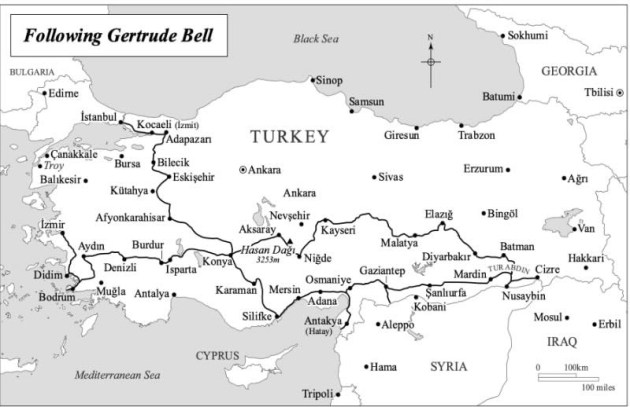
Yale revisits towns such as Konya, where Bell met “the great love of her life” Dick Doughty-Wylie, later killed at Gallipoli. Bell’s travels south and east through troubled towns such as Adana, Urfa, Mardin, Diyabakir, Harput, Elaziğ, and Talas attest to growing tensions on the eve of the Armenian genocide—a region now beset by the PKK’s conflict with Turkish state forces and darkened by the Syrian civil war, refugees from which Yale encounters. The book contains useful maps.
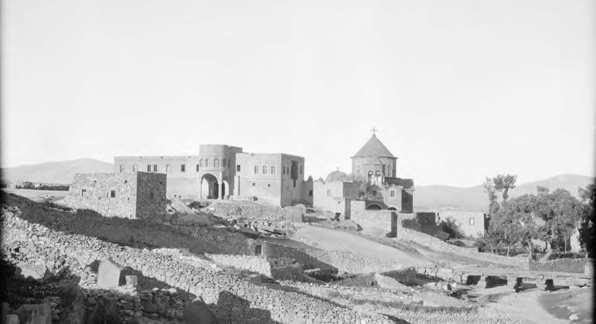 Lost Armenian monastery of Surp Asdvadzadzin at Tomarza,
Gertrude Bell 1909.
The clandestine survival of Armenian culture in Anatolia reminds me to consult Avedis Hadjian’s Hidden nation again.
As Bell travelled further south, she documented remote Syriac Orthodox monasteries, also evoked by travel writers such as William Dalrymple. Tur Abdin was the heartland of Syrian Orthodoxy until the ferman, local term for the 1915 genocide.
While much of their work consisted of reimagining the ancient culture of silent stones, Yale finds traces of the culture of dengbej bards.
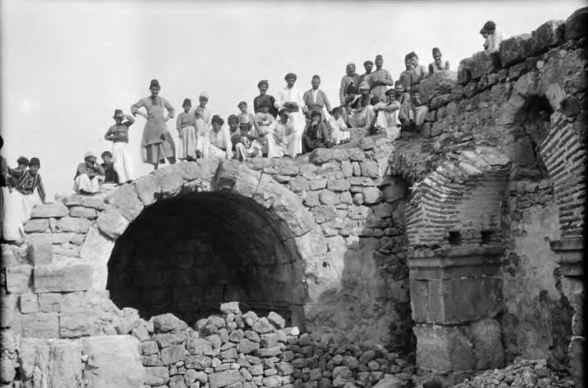
“Gertrude Bell sometimes struggled to complete her work because of the crowds that assembled to watch, as here in Midyat in 1909”.
On her occasional returns to creature comforts, Bell gives interludes on expat society—bridge, Patience, polo, croquet… The penultimate chapter on her return to Istanbul has vignettes on the Bosphorus villages, the Princes’ Islands, the inevitable Pera Palace Hotel, and Vita Sackville-West. Yale only reflects in passing on Bell’s attitude towards women:
Gertrude is often accused of having been a man’s woman, casually putting down the wives of colleagues as “little” women; and it has always seemed particularly odd that someone whose adventures cast her as the perfect feminist icon should at the same time thrown her energy into campaigning for the Anti-Suffrage League.
And Yale’s comments on urbanization remind me of China:
It’s a story I hear repeated all over Turkey, a story of the pell-mell emptying of villages, leaving them as glorified old-people’s homes, waiting rooms for an empty future. In Gertrude’s day perhaps 85% of Anatolians lived in villages, a figure that has now been inverted. Even the reassuring claim that around 25% of the population still lives in villages is deceptive since it fails to mention the age of those hanging on.
For other intrepid early female explorers, see Undreamed shores and The reinvention of humanity. See also under West/Central Asia: a roundup.

