

It’s only quite recently that I’ve started dipping my toes, or ears, into the vast ocean of maqam (see e.g. Iran: chamber music, Art music of Iran 3, and Shashmaqom). As part of the admirable Maqām Beyond Nation project, organised by SOAS and the Università Ca’ Foscari, Venezia, the Nasim-e Tarab ensemble of master musicians from Iran performed earlier this week at the Brunei Gallery, SOAS—last stop on a tour that also included concerts in Bologna, Venice, Bristol, Waunifor, and York.
Nasim-e Tarab (“The Breeze of Musical Enchantment”) is named after a Safavid musical treatise, compiled in Persian during the 16th century. The quintet is led by Saeid Kordmafi (santur), with Mehdi Emami (vocals), Siamak Jahangiri (ney), Hamid Ghanbari (percussion), and Saeid Nayebmohammadi (oud), all with illustrious pedigrees in Iran.
They performed a macro-suite consisting of four majles “sessions”, with metric cycles (of 6, 7, 8, 9, 10, 13 beats) punctuating lengthy, ecstatic free-tempo sections. Mehdi Emami (listen e.g. here, and here)—a pupil of Mohammad Reza Shadjarian and Mohammad-Reza Lotfi, no less—sang with dignity and passion, adorned by a halo of santur (cf. Zithers of Iran and Turkey) and ney flute.
The material was composed and arranged [terms I’d be curious to unpack—cf. improvisation] by Saeid Kordmafi, based on his long-term research on and practical involvement in creative practices and their historical interdependencies in the Middle/Near East and Central Asia, endeavouring to address classical Iranian music from a transnational and historically informed approach. As the blurb goes on to explain,
The ensemble is part of a dynamic aesthetic movement in contemporary Middle Eastern classical music which challenges the rigid (and heavily political) boundaries between national traditions, in favour of a cross-cultural approach to the musics of the region. This approach acknowledges how musical practices and musicians moved, varied, and influenced each other in the Middle and Near East as well as Central Asia for centuries.
Nasim-e Tarab comes from the heart of a troubled and war-ridden region with a simple yet powerful message that we have far more in common to celebrate than differences to fight over.
Here’s a brief preview:
While such music is still doubtless performed for festivities and gatherings of aficionados (see under my original post) alongside the more formal presentations of the academy, outsiders like me will happily settle for a suitably intimate concert venue. I relished the musicians’ rapport—part of the impact of this genre derives from the performers’ unaffected stage presence, eschewing the kitsch ethnic costumes that bedevil much “world music”. By contrast with China, I’m always impressed how the conservatoire system that has evolved throughout this region manages to nurture an integral, creative relationship with tradition.
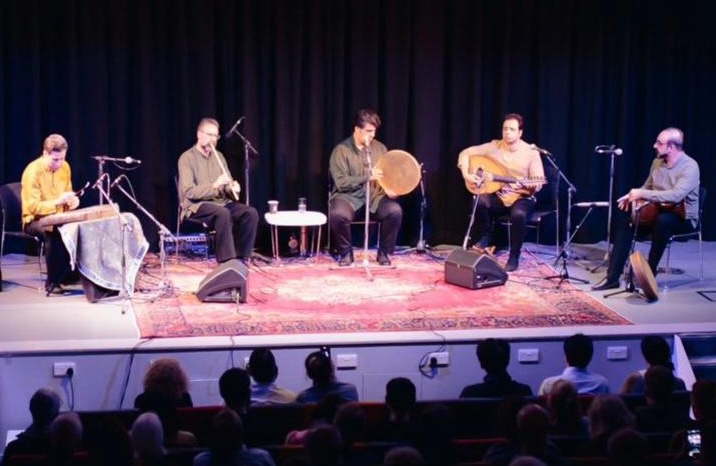
Image: courtesy @soasconcerts and @mikeskelton.
Even if the bewildering modal nest of radif, dastgah, and gusheh remains opaque to me, the whole maqām tradition is entrancing, in all its transformations.
See also under West/Central Asia: a roundup.
With thanks to Rachel Harris.
 Stephen Jones: a blog