
*Part of my extensive jazz series!*
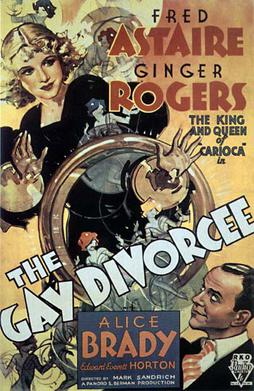
Cole Porter’s gorgeous song Night and Day achieved instant fame through Fred Astaire and Ginger Rogers’ iconic dance scene in The gay divorcee (1934; the UK release reverted to the 1932 musical’s title The gay divorce!):
While the scene is often adduced as an archetype of romantic love, and the dancing is of course stunning, it’s tricky reacting to the art of bygone ages with modern eyes and ears. Audiences today may find the couple’s “chemistry” elusive, their dynamics pointedly cold. His insistent “wooing”, and her reticent, never-rapturous compliance (“Cut the crap—oh well, at least he can dance”?!), may be standard for the time, but some may find the mood somewhat coercive.
Still, the song itself is brilliant—so we might listen without getting confused about the dance’s sexual politics (cf. racial politics in the filmed version of Only you). As wiki explains, the song’s melody, harmony, and structure are all unusual. In the obsessive opening (often omitted, understandably), after 35 repetitions of the same note (emulating Beethoven?) over a narrow range of chords, the pitch boldly rises twice by a semitone for more repetitions before sliding back to the original pitch for the melody proper. Among several accounts of the song’s origin, this is presumably the source of the reductive orientalist claim that it was inspired by the call to prayer in Morocco (cited here):
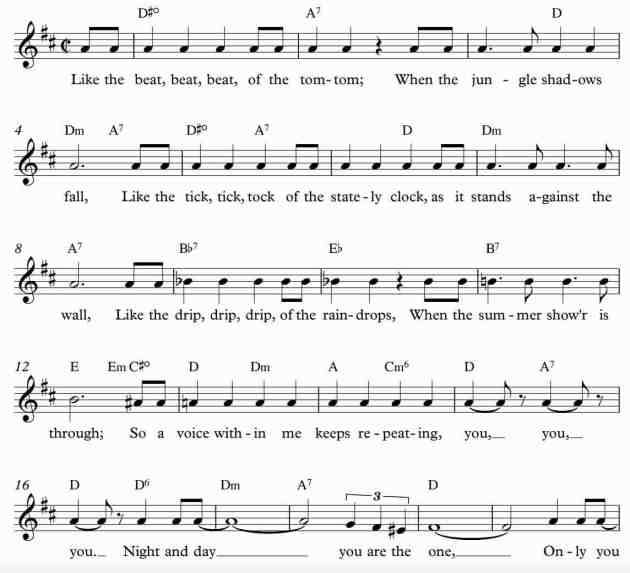
The song proper thrives on descending chromatic motifs (cf. Unpromising chromaticisms)–even when we think a regular melody might surface, in bars 44–5 the downward slide continues:
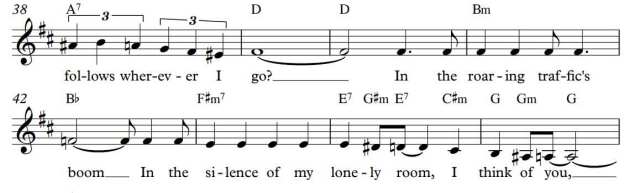
What might be a glorious climactic major 7th leap (making—love, from 1.37, bar 60) may hardly register:

In the dance, just as glorious is the way the band relishes all the rhythmic and melodic flourishes. After the dance, at the very end of the scene, when Astaire asks “Cigarette?”, Rogers still seems underwhelmed—if only she could have anticipated Lesley Nielsen’s immortal riposte in Airplane “Yes, I know”…
Recalling the Lexicon of musical invective is a story that when Porter first played the song for his friend Monty Wooly, Wooly sniffed, “I don’t know what this is you are trying to do, but whatever it is, throw it away. It’s terrible.”
* * *
Among other classic versions, apart from the likes of Ella Fitzgerald and Frank Sinatra, I always treasure Billie Holiday. Encapsulating the heartache of infatuation, she creates a new, angular melody unconstrained by the song’s original chromaticism—here’s her 1939 recording (the band including her constant soulmates Lester Young and Buck Clayton):
Charlie Parker, 1952:
Here’s a lengthy rendition by Stan Getz, live in Kildevælds Church, Copenhagen, 1960:
And Bill Evans in 1959, entirely eschewing the romance of the original—with Philly Joe Jones’s opening drum riff replacing the tom-toms of the lyrics:
 Stephen Jones: a blog