
*Furthering my education in the travails of modern Tibet*
Within the Tibetan cultural world, research on the Amdo region (see e.g. here) has become a remarkably dynamic field of scholarship. A fine recent instance is
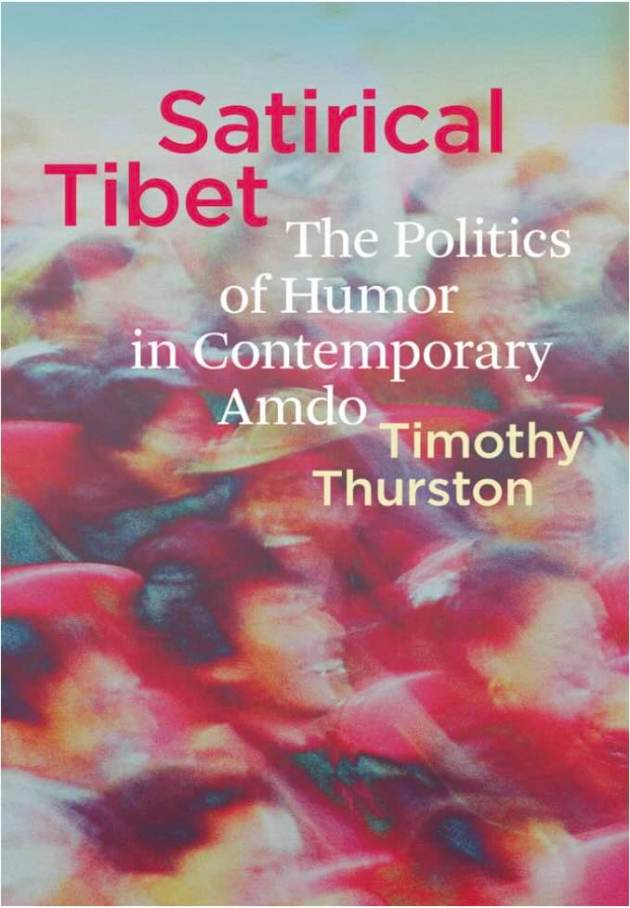
- Timothy Thurston, Satirical Tibet; the politics of humor in contemporary Amdo (2024; open access here), in the University of Washington Press series Studies on ethnic groups in China. Here’s the publisher’s blurb:
Humour has long been a vital, if under-recognised, component of Tibetan life. In recent years, alongside well-publicised struggles for religious freedom and cultural preservation, comedians, hip-hop artists, and other creatives have used zurza, the Tibetan art of satire, to render meaningful social and political critique under the ever-present eye of the Chinese state. Timothy Thurston’s Satirical Tibet offers the first-ever look at this powerful tool of misdirection and inversion. Focusing on the region of Amdo, Thurston introduces the vibrant and technologically innovative comedy scene that took shape following the death of Mao Zedong and the rise of ethnic revival policies. He moves decade by decade to show how artists have folded zurza into stage performances, radio broadcasts, televised sketch comedies, and hip-hop lyrics to criticise injustices, steer popular attitudes, and encourage the survival of Tibetan culture.
Surprising and vivid, Satirical Tibet shows how the ever-changing uses and meanings of a time-honored art form allow Tibetans to shape their society while navigating tightly controlled media channels.
As Stevan Harrell, editor of the series, observes in his Foreword:
Because Tibetans are an oppressed people, we can easily assume that there is little joy or laughter in their lives, and that we should approach their predicament with uniform solemnity. This is wrong. Tibetans deal with the tragedy of Communist oppression as they have dealt with the vicissitudes of life on Earth for centuries—not only with “quiet desperation” or extreme religious devotion but also with uproarious comedy and biting satire.
Whereas some studies of Tibetan folk traditions sadly circumvent sensitive issues (e.g. Shépa: The Tibetan oral tradition in Choné), Thurston engages fully with modern Amdo society, illustrating periods since the reform era of the 1980s through changing popular media. As he notes, such satirical sketches (for which he uses the nuanced term zurza) always have a serious purpose, exploring a social problem of some sort: they convey important messages about contemporary Tibetan life, shaping attitudes towards issues such as language, culture, urbanisation, education, territory disputes—and the popular topic of fake lamas. Such sketches may be subversive, but they are not “underground”: though inevitably accommodating to the institutions of the Chinese state, a large part of their efficacity lies in the very fact that they can be aired in the public domain.
Thurston’s extensive quotes from the various genres are instructive, even if their broad appeal to Amdowa people is hard to convey in English. Though the book lacks images, for this post he has kindly suggested some illustrative YouTube clips, embedded below. The extensive final References are useful.
The Introduction, “Doing zurza”, provides useful context.
Zurza and the laughter that frequently accompanies it are hardly the first things most people think about when they hear the words China and Tibet in the same sentence. And why should they be? Many in the Euro-American “West” may hear the word Tibet and think of a traditionally Buddhist society, perhaps oppressed by a colonising Chinese Communist Party. The same people may think of recent news reporting about Tibetans self-immolating, and Tibet’s Nobel Prize-winning exiled religious leader. For many who have grown up in China, meanwhile, images may range from a feudal society liberated by and incorporated into the People’s Republic in the 1950s, to news spots showing Tibetans dancing happily in displays of gratitude to the Communist Party for the “gift” of modernity, to a pristine environment for young Han to conquer as they escape from China’s heavily polluted coastal metropolises. These descriptions, all carrying elements of truth, select some of the most contrasting images possible to make a rhetorical point. But the discourses of modernity and progress, and of traumatic experience and dramatic resistance, all emphasise grand narratives that leave little room for zurza.
Set against the background of these ongoing and well-publicised cultural and political tensions, a book about a topic as seemingly trivial as zurza and humour can come across as being in poor taste. And yet, laughter has served as the soundtrack to almost every one of my experiences of Tibet. This also manifests in everyday life. During dinners among friends, the seemingly endless toasting with liquor—almost always three cups at a time—often lowered inhibitions to the point at which teasing and reminiscing might devolve into uncontrolled hilarity. At traditional weddings, women from the host village may use humour and wit to demand some sort of payment or gift from the visiting representatives of the person marrying into the village (usually the maternal uncles of the bride). In the valley of Rebgong, interludes in the annual harvest festival featuring inebriated villagers—sometimes cross-dressing or wearing monks’ robes—may make fun of the behaviour of certain members of the community, to the applause and laughter of all in attendance. Tibetan communities possess a diverse vocabulary for humorous activity that mirrors the diversity of ways that laughter appears in everyday life, including kure (joking), labjyagpa (boasting), tséwa (play), and zurza. This humour frequently accomplished important social work: to entertain, mask existential pain, serve hegemonic forces, speak the otherwise unspeakable, provide a “steam-valve” for social discontent, and/or to project and reflect worldviews. […]
When famed trickster Uncle Tonpa tricks a landlord or merchant, or makes a king bark like a dog, he “does zurza.” When the seventeenth-century lama Shar Kalden Jyamtso (1607–1677) composed songs poking fun at the behaviour of monks, he was also “doing zurza.” And when a contemporary comedian mocks people whose behaviour seems out of touch in the contemporary moment, they too do zurza.
In Chapter 1, “Dokwa: ‘eating the sides’ in oral and literary traditions”, Thurston notes:
Amdo boasts an incredible array of oral and festival traditions. Just focusing on the oral ones, Tibetans in Amdo are known to perform a variety of secular and religious verbal arts, including but not limited to tamhwé (proverbs), tamshel (speeches), khel (riddles), laye (love songs), and lushag (antiphonal song duels). These sit alongside a much broader array of oral and festival practices from across the Tibetan cultural world [see e.g. under Bhutan].
He also adduces the satirical street songs of Lhasa from before the Chinese invasion (Goldstein 1982), and satirical elements in Tibetan opera, as well as in other cultures.
Not limited to the oral tradition, Tibetan poets and authors like the renowned early-20th-century polymath Gendun Chopel also traditionally used zurza in satirical poems to criticise the behaviour of others, including powerful monks. […]
Even in the most difficult moments of the Maoist and post-Mao reform eras—periods when the Tibetan language and portrayals of Tibetan traditions in media faced tight restrictions—zurza served as one valuable tool for authors, folktale collectors, and others to be seen and heard.
Chapter 2, “Khashag: language, print, and ethnic pride in the 1980s”, introduces the scripted, staged performances of khashag “crosstalk” dialogues after the end of tjhe Cultural Revolution (reminiscent of the Chinese art of xiangsheng), which satirised the politics of language and ethnicity in the emerging post-Mao order. In Chapter 3, “Khashag on air: solving social ills by radio in the 1990s”, Thurston gives detailed, astute comments on the “Careful Village” sketches of Menla Jyab, who shared “complex critiques about Tibetan engagement with modernity”.
Whereas comic dialogues had hitherto been disseminated mainly via radio broadcasts and audio cassettes, Chapter 4, “Garchung: televised sketches and a cultural turn in the 2000s”, explores the new style of garchung that extended from state TV stations to VCDs and the internet. Audiences could now see as well as hear the performers, requiring more preparation and better acting. In style and themes, these sketches continued to reflect the rapidly changing conditions in Amdo, such as (in Harrell’s words) “the increasingly precarious state of Tibetan culture, with many barbs directed at both Chinese and foreigners who began to view Tibet as a source of religious and ecological inspiration, often aided by Tibetans eager to benefit from their national and cosmopolitan connections.” The main exhibit here is “Gesar’s Horse Herder”:
With zurza providing one device in reappropriating state discourse, the chapter also addresses the Intangible Cultural Heritage system (note Isabelle Henrion-Dourcy’s perceptive article).
In the wake of the repression following the 2008 Beijing Olympics, Chapter 5 explores “Zheematam: Tibetan hip-hop in the digital world”. The emerging cultural nationalism of the previous decade now “moves online, intensifies, and becomes more frustrated. With this change, new forms of satirical cultural production emerge to articulate this critique digitally.” This new genre provided
a new generation of artists with opportunities to rework oral traditions and emerging cultural practices—in conjunction with modern concerns about linguistic and cultural loss—into new and emerging art forms. In doing so, their work builds on the trends of previous generations and articulates a new set of concerns, all during a period of increasing restrictions in Tibet’s cultural sphere.
Thurston contrasts the styles of Uncle Buddhist, such as his 2019 song City Tibetan:
and Jason J, such as Alalamo:
In such work,
artists still say they are “doing zurza,” but it ceases to be as humorous or playful. Instead, it uses indirection to articulate an (at times) almost angry cultural nationalism directed both at the current conditions of Tibetan life and of the intellectual foundations of Tibetan modernism. The example of Jason J, however, demonstrates that this inversion and indirection also ensures that zurza provides a resource of constant revision and renewal of Tibetan culture in the face of increasing political and economic headwinds.
In his Conclusion, “The irrepressible trickster”, Thurston reflects saliently:
I left Amdo in 2015, returning for short trips each year prior to 2019. Since leaving, I often struggled to describe to people outside of China—including but not limited to academics, activists, and members of the exile community—the very complex calculus of internal motivations, social pressures, and external incentives that seemed to shape the decision-making processes of the Tibetans I met. At conferences, workshops, and in casual conversations, my descriptions were frequently met with some variation of the response: “They’re brainwashed” or “They have no choice”. Others reflexively seemed to blame every problem on “the Chinese.” I cannot accept these assumptions—at least not when formulated in this way.
Tibetans in the People’s Republic undoubtedly live in and navigate a highly constrained environment, in which they must carefully monitor what they say and do (and, as I have shown in this book, how they say and do them). But ignoring the creative ways that Tibetans have maintained and even revolutionised their culture—both from within the state system and in resistance to it—denies them agency and treats them only as victims. I have shown how zurza—the Tibetan arts of indirection, sarcasm, and satire—provided cultural producers with a powerful way of actively localising new expressive resources, accessing state media to do this work, and ensuring Tibetan physical and cultural presence in some of the harshest of times. Across decades and media, the texts examined in this book record some of the ways that Tibetans have used zurza to foreground issues seen as particularly pressing for their communities in spite of the tremendously asymmetric power of the Chinese state.
Such ethnographic research on the embattled resilience of Tibetan culture within the PRC evinces an impressive maturity in Amdo studies, belying the simplistic polarised propaganda of both Party apologists and the exile community.
See also rubrics under Isabelle Henrion-Dourcy’s bibliography on the Tibetan performing arts, including the work of Anna Morcom. Cf. Tibetan jokes, and Tibetan clichés.
 Stephen Jones: a blog