
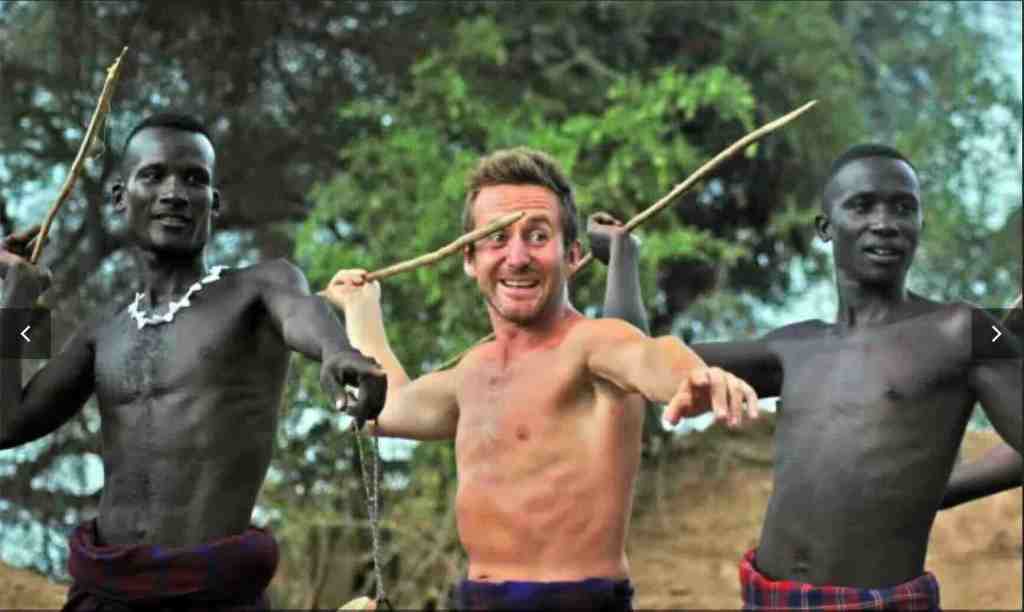
As rich white men intensify their attempts to destroy the planet, I’m watching the new series of Bruce Parry’s Tribe on BBC2 (website; wiki), some two decades after the fifteen programmes of the original three series.
Parry being a self-avowed explorer rather than an anthropologist, his programmes are more entertainment than education. The same formulas recur (contact, ordeals of pain and drugs, sharing food, camaraderie, fond farewells…), with sensationalism obligatory—the price that must be paid to get on TV. Yet the programmes remain attractive in a way that hardcore ethnographic film can hardly match.
It’s worth consulting Anthropology today for some nuanced discussions of the original series:
- Pat Caplan, “In search of the exotic: a discussion of the BBC2 series Tribe“, 21.2 (2005)
- Felicia Hughes-Freeland, “Tribes and tribulations: a response to Pat Caplan”, 22.2 (2006)
- André Singer, “Tribes and tribulations: a response to Hughes-Freeland”, 22.3 (2006)
- Adam Fish and Sarah Evershed, “Anthropologists responding to anthropological television: a response to Caplan, Hughes-Freeland, and Singer”, 22.4 (2006).
Caplan sets the critical tone. As she observes, since the halcyon days of the 1970s and 1980s, anthropology has largely disappeared from our TV screens; but “while the genre of ethnographic film has burgeoned and grown in sophistication, it has also now been relegated to specialist festivals and the classroom.” As she observes, anthropologists may be dismissive of such popular searches for the exotic, “their irritation perhaps stemm[ing] in part from having territory they considered their own invaded by ‘amateurs’ “. She doubts that the programmes “banished many of the tribal stereotypes” or “told the truth about their changing lives”. As she observes, many of these societies have been researched by anthropologists, and some are exposed to tourism—despite the impression given that they were virtually “discovered” by the series.
Hughes-Freeland too, while describing Tribe as a “Victorian romp”, wonders how genuine anthropology might gain a popular public profile. Singer is more tolerant:
Bruce Parry is sincere in his desire to understand and attempt to identify with whatever society he finds himself visiting; and he makes no claims to any deep anthropological insights or analysis. He’s an explorer and adventurer, the curious outsider who pretends for a short while to be an insider. It’s a process he enjoys, a sentiment apparently shared by his hosts who frequently make fun of his often inept efforts at trying to be one of them.
Yes, we need to worry about perpetuating the old stereotypes, and yes, there is a “hint of the ‘noble savage’ conceit in the series” but there is also genuine affection, respect (both ways) and empathy with the subjects chosen.
Singer calls for anthropologists to engage effectively with TV rather than standing snootily on the sidelines. Fish and Evershed also defend the series. They note that Tribe “reveals the process of beginning fieldwork rather than announcing the results”, the process of establishing rapport; it “shares more with contemporary trends in reflexive ethnography than with the observational ethnography of the past”. And they note that Parry does indeed feature globalisation and change. “Anthropology’s inability to generate a substantial television audience results from academic elitism”.
Threads of entertainment and education course through Tribe, allowing viewers to braid cross-cultural encounters in a global world. As the boundaries separating the rural and the urban, the wild and the domestic, the provincial and the cosmopolitan are further eroded by the pervasiveness of global media, migration, and macroeconomics, so too will the discrete subjects of anthropologist and television producer, and indigene and viewer, tend to merge.
If anthropology is to have a future in this transnational multimediated world to come, we are going to need to apply our tools of cultural relativity to television programmes, producers, hosts and audiences. Before we become shareholders in the future of anthropological television we must become better ethnographers of the modes of media production and reception.
At least Tribe may lead some curious viewers to do some fruitful Googling to learn a little about groups whose lives are otherwise sidelined in the media.
Click here for some ethnographic documentaries on China and elsewhere. BTW, those same issues of Anthropology today also contain thoughts on Kate Fox’s splendid popular book Watching the English.
 Stephen Jones: a blog
Don’t let rich Chinese people off the hook lol
LikeLiked by 1 person