
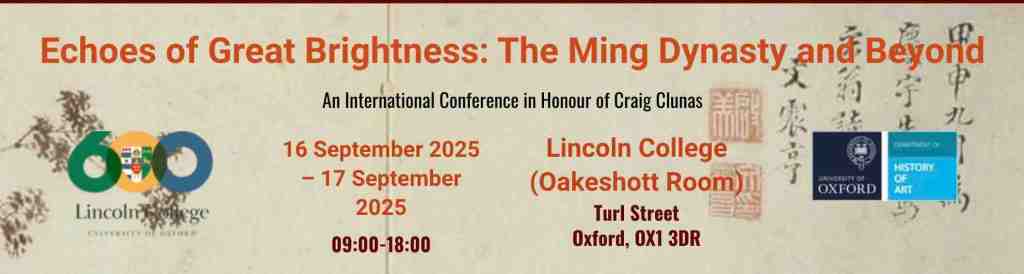
An international conference in honour of Craig Clunas will be held on 16–17 September at Lincoln College, Oxford, bringing together leading scholars in the field of Ming studies and art history.
From the publicity:
The Ming period (1368–1644) is central to our understanding of Chinese art, both as the time when many key texts and objects from preceding centuries were edited or curated into the forms in which they have come down to us today, and as the era to which much subsequent artistic practice and discourse has looked back for validation and inspiration. No one would dispute that Professor Craig Clunas pioneered the application of social history to the study of the Ming dynasty and Chinese art history. His innovative methodology has positioned the study of the Ming dynasty as one of the most dynamic and engaging areas in both art history and sinology. With more than a dozen monographs to his name, his international research and publication profile is unparalleled among art historians in the United Kingdom. In 2018, he retired from his position as the Statutory (Distinguished) Professor of Art History at the University of Oxford.

Craig’s innovative work is relevant to a wide range of fields. On this blog, see his guest post on his mentor Wang Shixiang; and for our time at 1970s’ Cambridge, only somewhat less distant than the Ming, see Revolution and laowai. See also art tag, including On visual culture, China’s hidden century, Vermeer’s hat, and a series of posts on the ritual paintings of north Chinese ritual groups.
 Stephen Jones: a blog