
For those coming to Daoist ritual from a sinological background (as is likely)—and for those who recognize that if we are going to study ritual, that involves performance, which in turn involves sound—here’s a quick crash course. Indeed, it comes in handy for anyone—particularly for those whose concept of music and singing is based on either WAM or pop (see e.g. here and here).
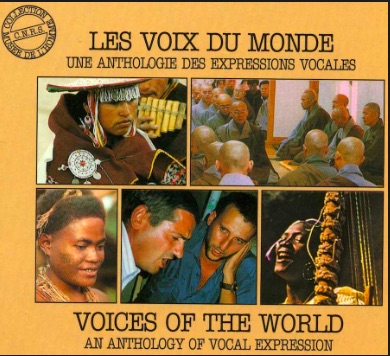
Among all the ethnomusicological surveys of vocal music, the 3-CD set
- Les voix du monde: une anthologie des expressions vocales
(CNRS/Musée de l’Homme, 1996),
with its detailed booklet, makes a precious introduction. A wide range of styles of vocal production is covered here:
- Techniques
Calls, cries, and clamours
Voice and breath
Spoken, declaimed, sung
Compass and register
Colours and timbres
Disguised voices
Ornamentation
Voices and musical instruments
Employ [sic] of harmonics - Polyphonies
Heterophony
Echoes and overlapping
Drones and ostinato
Parallel, oblique or contrary motion
Chords
Counterpoint and combined techniques.
Apart from a veritable smorgasbord [sorry, been writing too many blurbs] of amazing audio tracks from all over the world, the booklet contains valuable notes, a glossary, and tables such as “Different forms of polyphony” in graphic form:

Here are the CDs:
For ethnic polyphony in China, see here.
Then all we need is to digest
- Bell Yung “The nature of Chinese ritual sound“, in Yung, Rawski and Watson eds., Harmony and counterpoint: ritual music in Chinese context, pp.13–31
and we’re all set to enter the fray…
 Stephen Jones: a blog