
The life of ritual performance around Xi’an may not be the first thing that springs to mind when visiting the, um, ancient Tang capital, now typically submerged under skyscrapers and traffic jams. On this site I have so far introduced ritual styles in peripheral areas of Shaanxi (Shaanbei, Changwu), but it’s worth outlining those around the provincial capital (cf. my In search of the folk Daoists of north China, pp.95–6).
The introduction in my 1995 book Folk music of China (pp.227–45) is still useful—it’s a tad musicological, but I don’t neglect the social angle. (Whenever I come across a passage in my earlier writings that makes sense, I never know whether to be pleased at my sagacity or disturbed by my lack of progress…). As I observed there:
Xi’an is the site of the Tang capital Chang’an, and the music still played by folk musicians in the area has more claim to antiquity than the garish Hollywoodesque spectacle doled out to unsuspecting tourists under the guise of the music of Tang Chang’an. However, since 1949 the performing tradition has been very much impoverished, with only four ensembles meeting sporadically. It is ironic and perhaps significant that a virtually defunct genre should be among the most studied genres of Chinese instrumental music.
(For a brilliant misreading of that last sentence, see here!) Actually, even when I made my final revision of the book, I qualified that depiction “virtually defunct”.
Among a multitude of surveys, note Qiao Jianzhong, “ ‘Xi’an guyue’ yanjiude liushinian” 西安鼓乐研究的六十年, Qiao Jianzhong wenji 乔建中文集 vol.5, pp.486–509.
My visits
I was drawn to Xi’an by a precious clue from Raffaella Gallio, first foreign student to study at the Shanghai Conservatoire when they were admitted after 1980. As we met up later in Venice, she told me about Li Shigen’s work with the Xi’an groups, and I was keen to visit.
So, soon after my arrival in Beijing on my very first stay in China in 1986, I took the train there (then an epic journey) to study for a couple of weeks with the great Li Shigen 李石根, indefatigable authority on the ritual groups of the area. Neither of us quite knew what to do. Despite Raffaella’s visit, foreign scholars were still hardly known, and apart from a brief session in Beijing with former Buddhist monks from the Zhihua temple tradition, this was my very first experience of fieldwork. Perhaps inevitably, Li Shigen organized the “musicians” to perform specially for us—the Dajichang 大吉昌 group in the city, and a trip to Hejiaying 何家营 in Chang’an county south of the city.
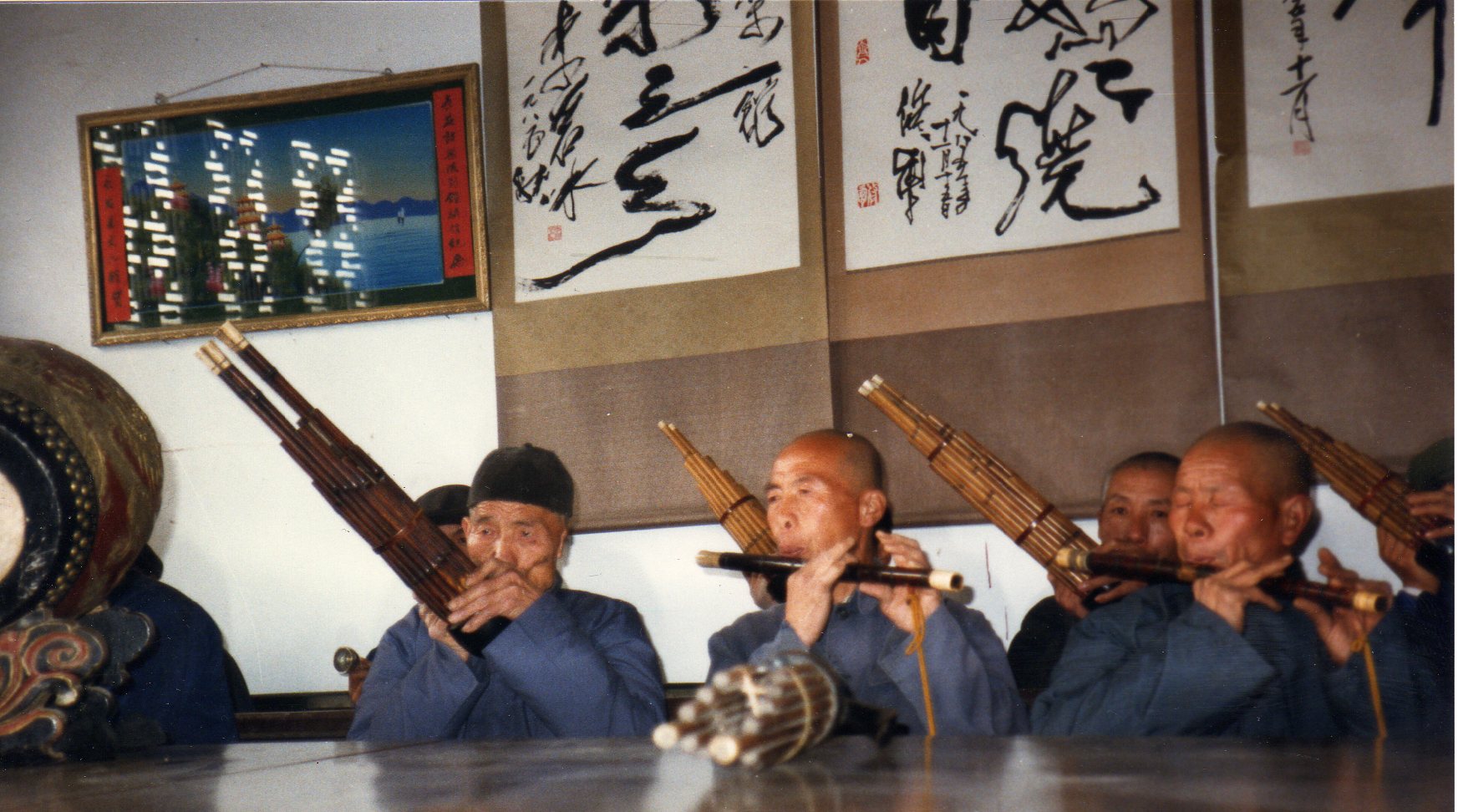
Hejiaying, 1986.
For me, such an excursion into the countryside was still a mere expedient in my search for the music of ancient times; as yet I was absurdly oblivious to the living conditions of peasants there.
My photos are underwhelming, and my fieldnotes were quite free of the ethnographic approach that I later adopted; but my audio recordings aren’t bad, considering, and Li Shigen was wonderful, patiently guiding me in my faltering studies. Ha gave me a hefty series of mimeographed volumes that I devoured back in Beijing and London.
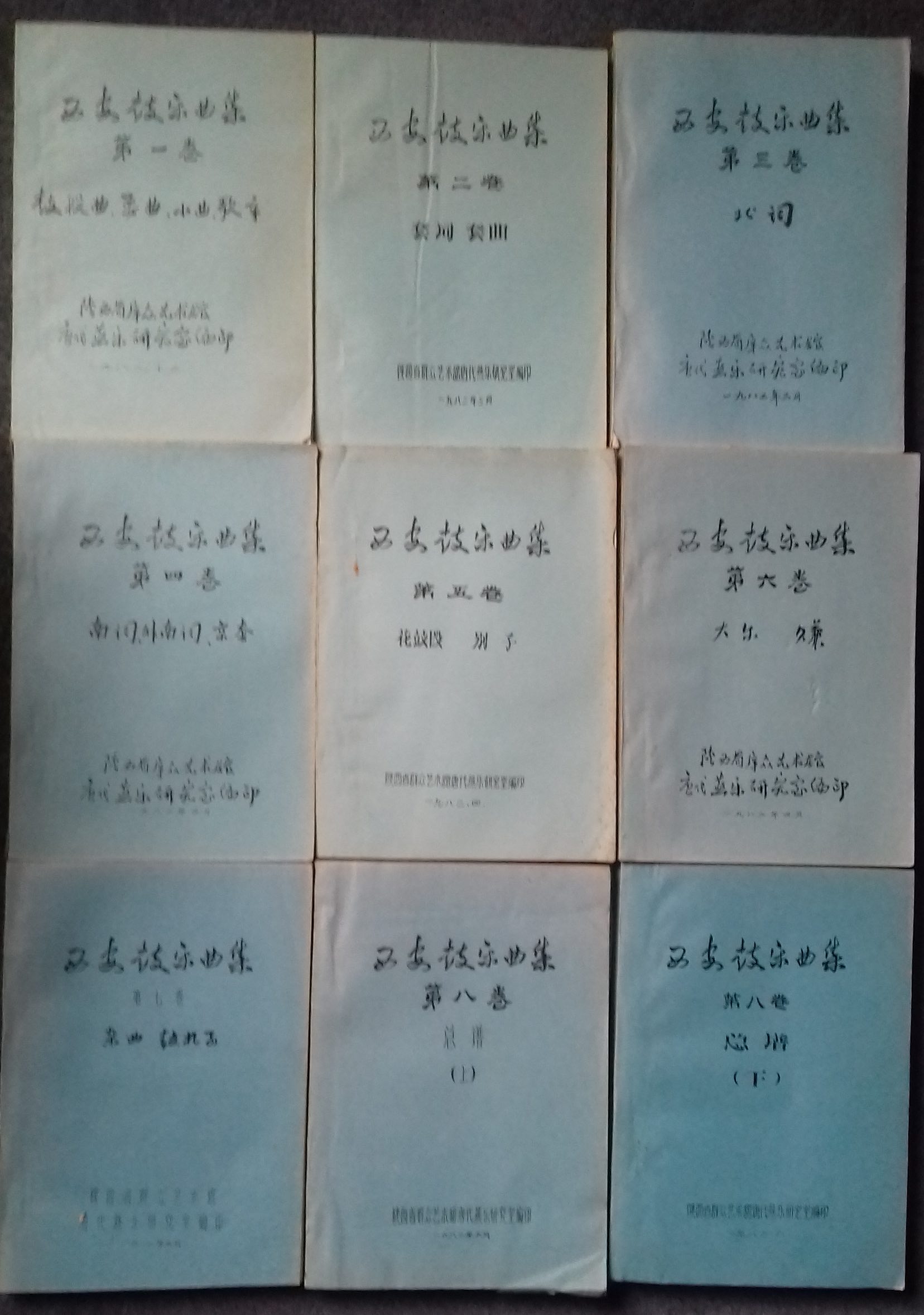
(My house is packed to the rafters with precious early mimeographs like this—they have a very different feel to later published versions; for reflections, click here.)
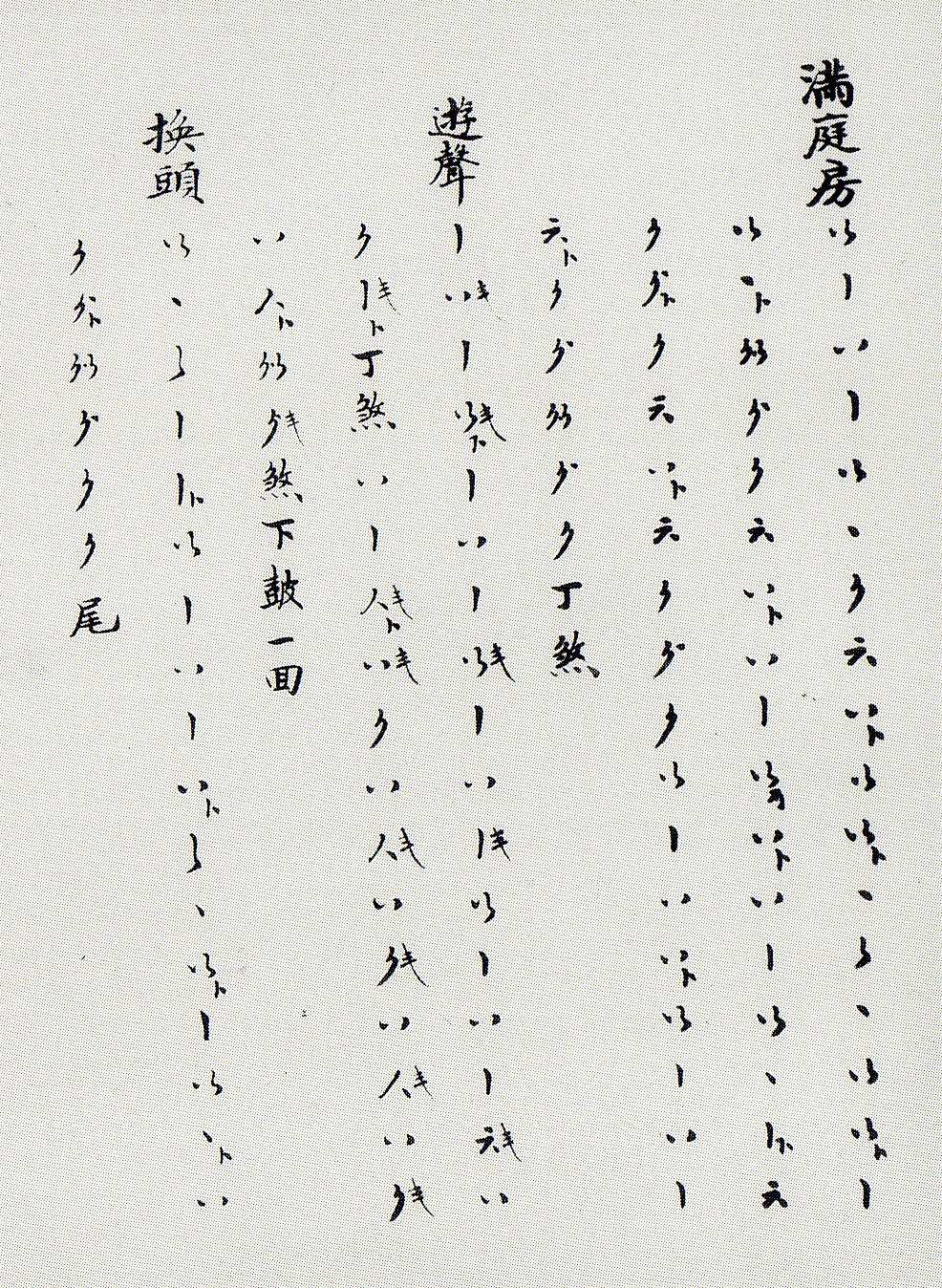
My little 1990 article for Laurence Picken’s magnum opus Music from the Tang court shows how I still had an antiquarian bent, but it was a significant discovery to find the term yousheng in early Xi’an scores, just as in the Tang—and with a living performance practice, to boot.
It was inevitable that scholarly enthusiasm to discover the lost music of the Tang dynasty would alight upon the genre. Chinese musicologists were all for “living fossils”—a focus that even now deflects scholars from the need for basic modern ethnography on the changing ritual life around the city, in villages, and on pilgrimages to the mountains to the south. As with other such “ancient” genres (nanyin in Fujian, the Zhihua temple, and so on), this has detracted from proper, more tangible study—both of its ancestry in the Ming and Qing dynasties and more recent ethnography. [1]
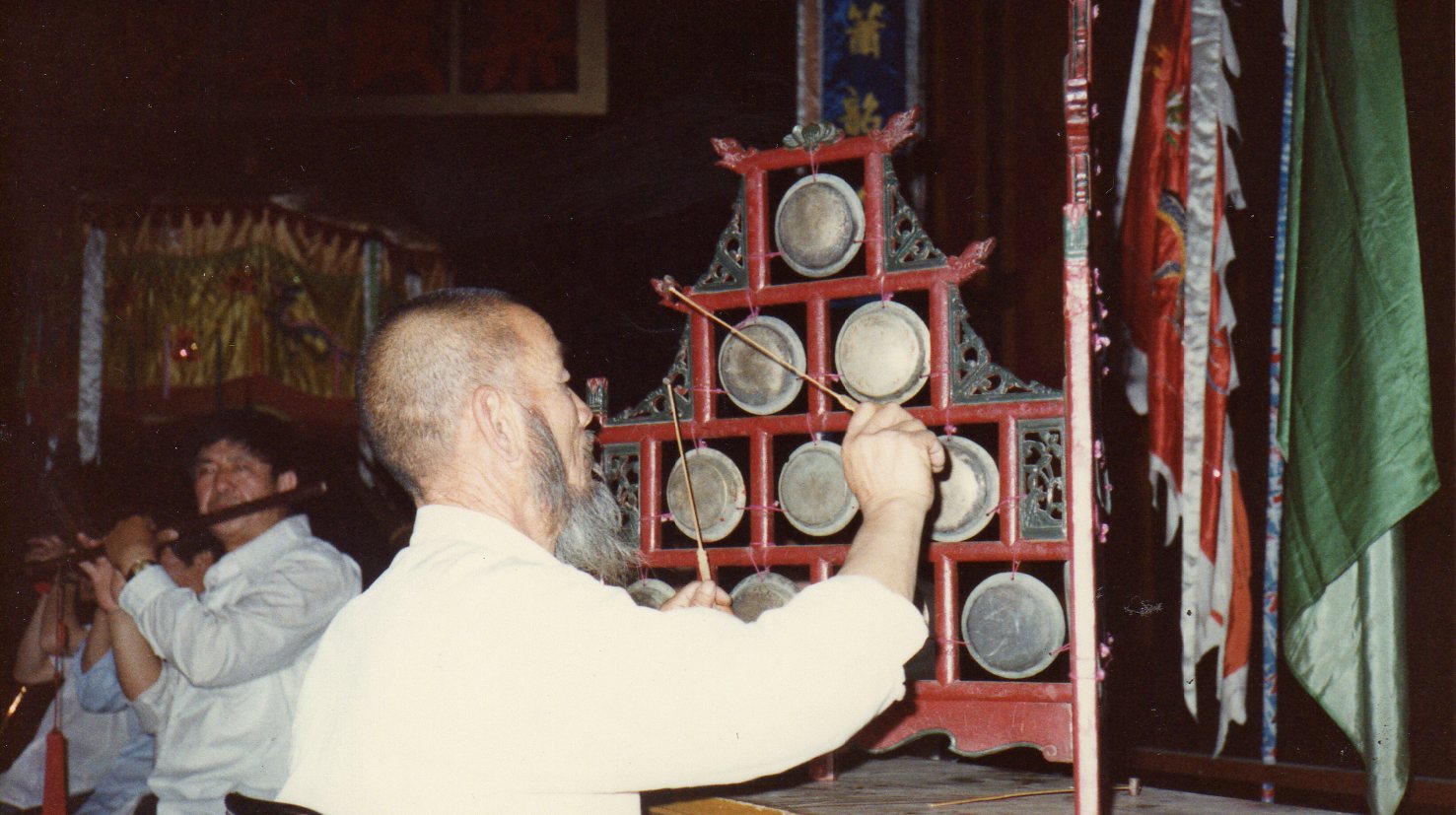
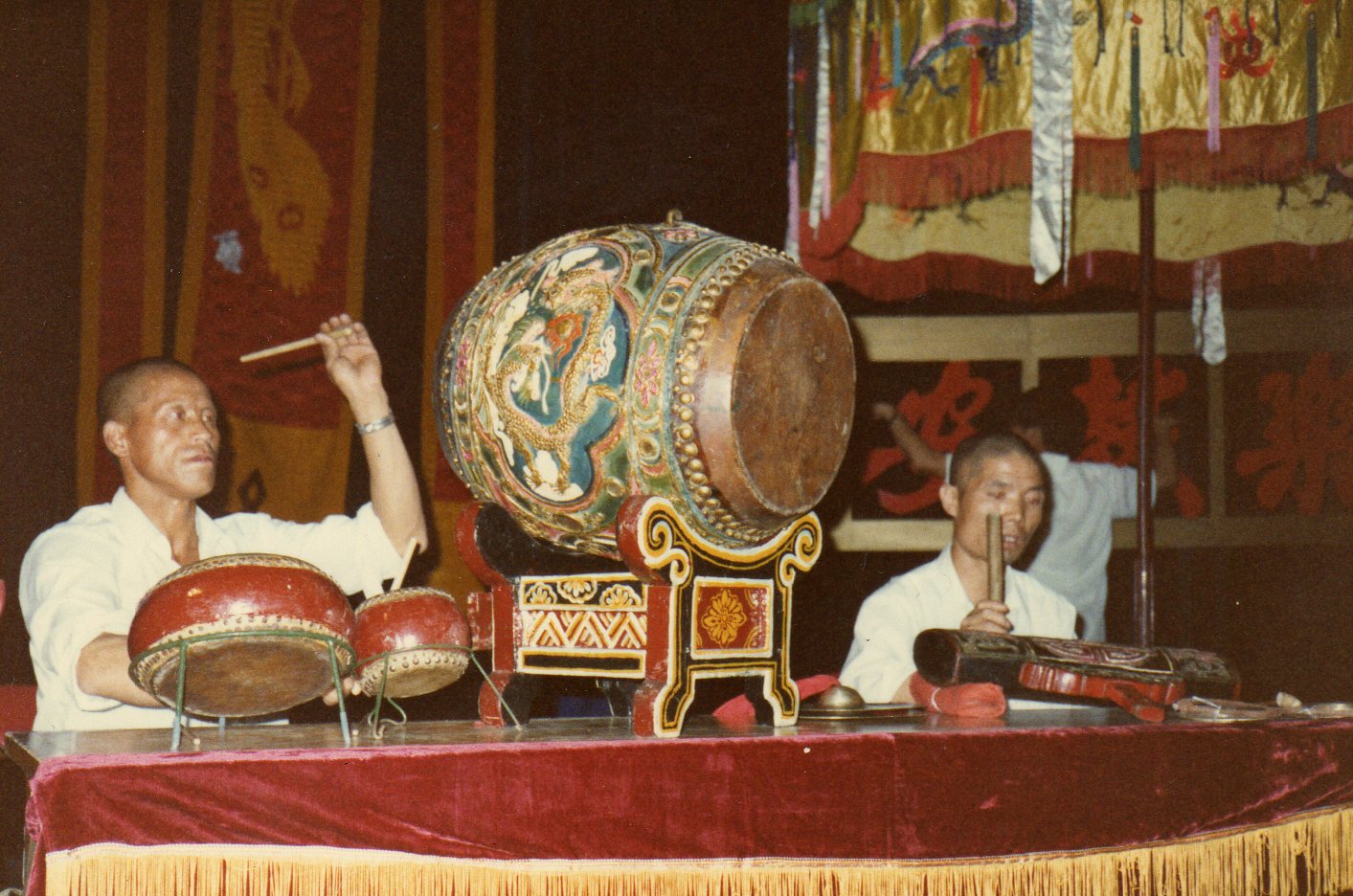
Beijing, 1987.
I met them again in 1987 when they came to Beijing to perform there.
A rival group was soon formed at the Xi’an conservatoire (musicians in fake-antique costumes reading from cipher notation on music stands—Pah!), throwing the baby out with the bathwater (see my Folk Music of China, p.227 and n.55). This commodification laid the groundwork for the later glitzy distortions of the Intangible Cultural Heritage.
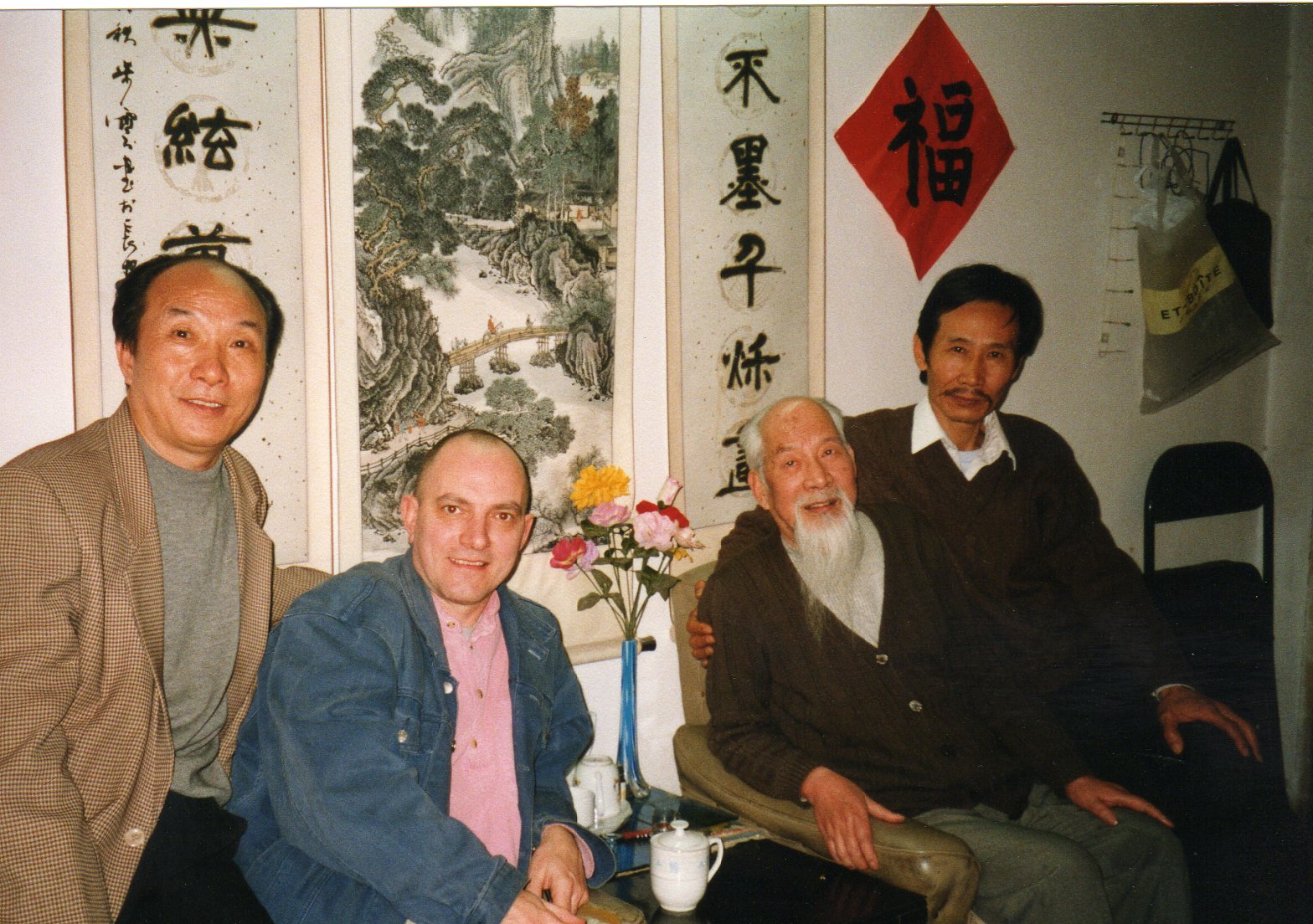
Scholar Li Shibin, me, Li Shigen, and qin maker and player Li Mingzhong, 2001.
I returned to Xi’an briefly in 2001, partly to talk to some people there who could give me more background for my work on Shaanbei, and also to record some amazing earthy shadow-puppet music. I was happy to visit the venerable Li Shigen again, and I took the chance to reacquaint myself with more groups—though I still didn’t manage to experience their ritual practice.
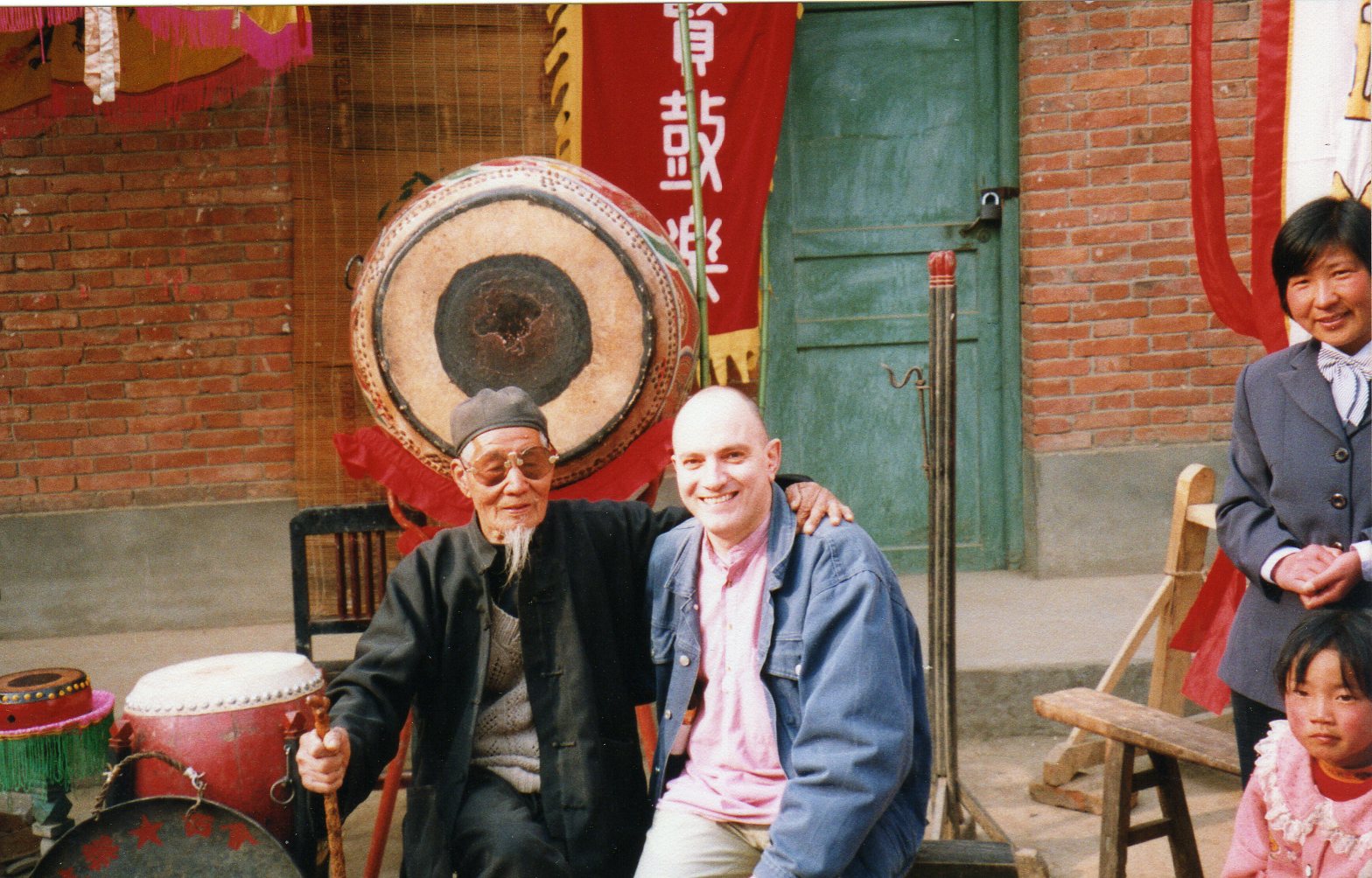
With Zhang Gui, South Jixian West village 2001.
In Zhouzhi county west of the city I visited both East and West villages of South Jixian, a large township of some 8,000 residents. In West village I chatted with the senior Zhang Gui 张贵 (then 82). They were still performing for several calendrical temple fairs annually. The East village had only recently restored, but was also active. They had eighteen (!) sheng players, four dizi players, one yunluo player, and seven percussionists (two of whom were female). With the exodus of men to seek laboring work in the towns, women were already being recruited widely: twelve of the sheng players were female, and two of the percussionists. This sounds like a rational move, and there have been some similar initiatives among amateur groups in Hebei and Yunnan, but it hasn’t become so common there.
Apart from these village groups still active to the south of the city, there are several in Lantian county to the southeast.
Social aspects
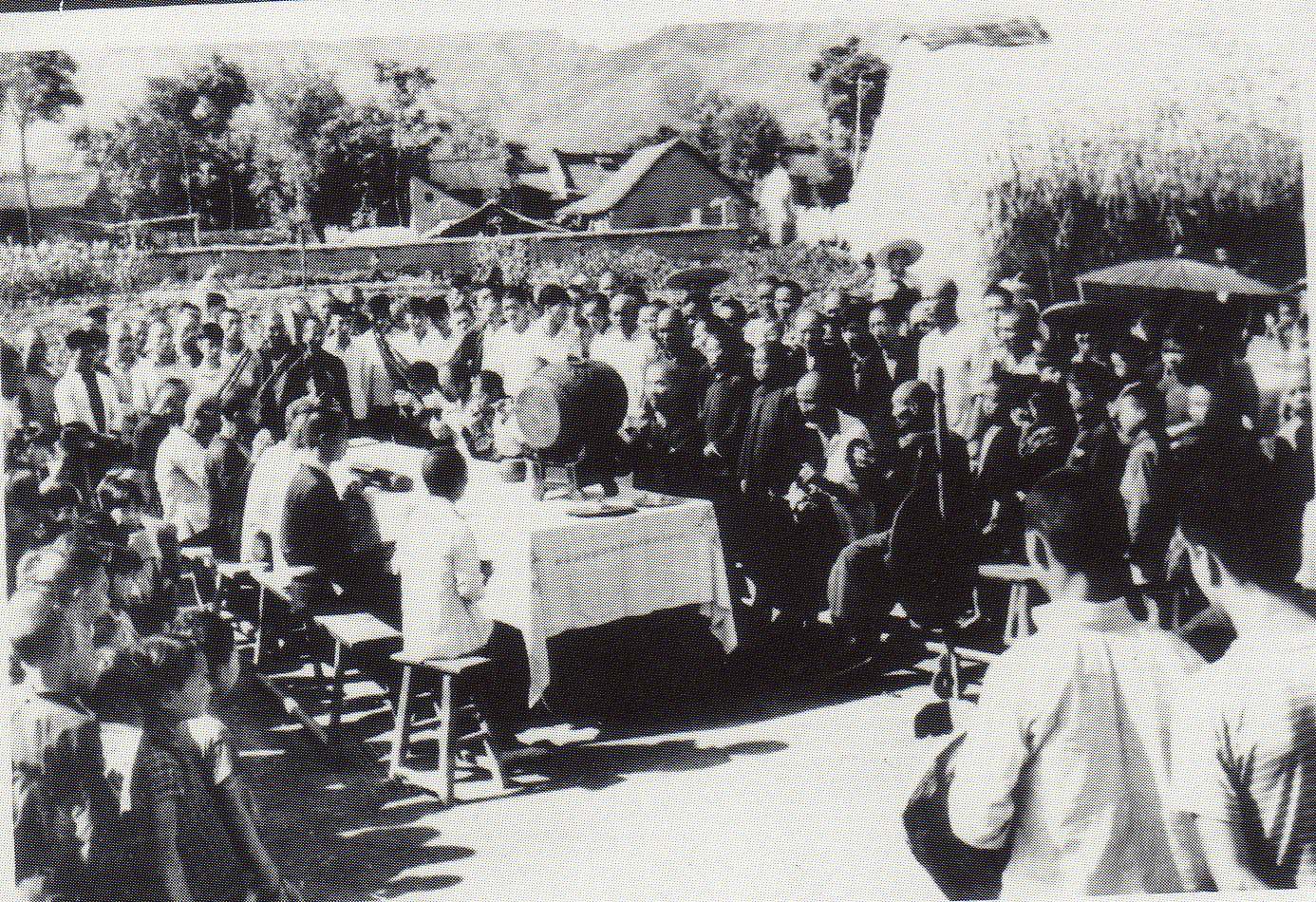
Village festival, 1950s. Photo: courtesy MRI, Beijing.
Performing contexts are temple fairs in the city and villages, and the major rain pilgrimages to the “southern Wutai” and Zhongnanshan mountain ranges in the 6th moon—indeed, the local term for such village groups is often “water associations” (shuihui).
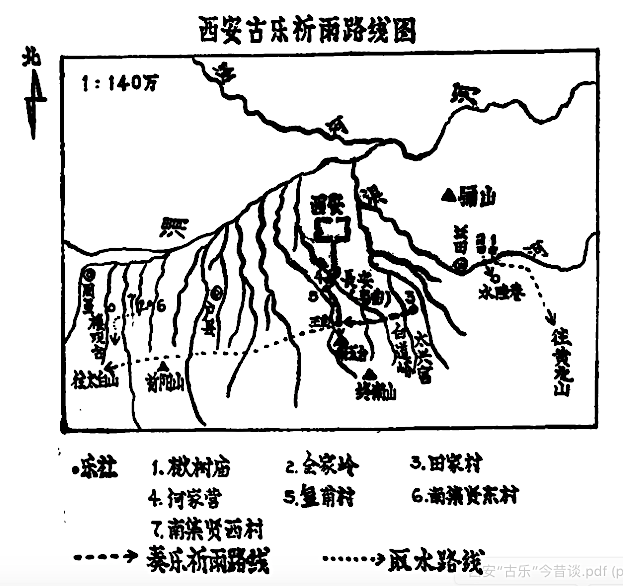
Map of routes for rain processions. Source: Li Jianzheng and Yu Zhu, “Xi’an guyue jinxi tan”, Jiaoxiang 1983/3, p.18.
In its amateur devotional practice the genre belongs in a group with the Hebei ritual associations and Dongjing associations of Yunnan (on which, see the fine work of Helen Rees)—as opposed to family groups of occupational ritual specialists like the Li family Daoists in Yanggao, with which they otherwise share a lot in vocal liturgy, instrumentation, and social context.
As with those other groups, both amateur and occupational, they are based on Daoist and Buddhist practice. Now that I’ve suggested the complexity of the links between Complete Perfection and Orthodox Unity branches, work is needed here too.
City groups until the 1950s included
- Chenghuang miao 城隍庙
- Yingxiang guan 迎祥观
- Taiyang miao 太阳庙
- Xicang 西仓
- Dongcang 东仓
- Dajichang 大吉昌
- Xianmi si 显密寺
- Xiangmi yuan 香米园
- Guangren si 广仁寺 (Lama si 喇嘛寺)
Even the temple names listed above didn’t necessarily mean that their members were clerics—many were folk groups named after their neighbourhood temple, though some priests might take part.
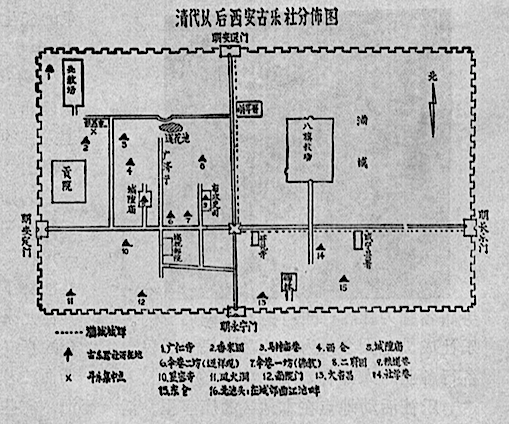
City groups before the 1950s. Source: Jiaoxiang 1983/3, p.11.
We know little of the ritual practices of city temples like the former Yingxiang guan or Chenghuang miao. At the latter, master Daoist priest An Laixu was a revered instrumentalist, but I wish his vocal liturgy had been documented. Nor do we have much detail on the Buddhist temples that performed folk ritual in the area before the 1950s.
An Laixu 安来緖 (1895–1977) became a priest at the age of 11 sui. After Liberation his ritual life was much reduced. He was never formally laicised, but was kept in check by being recruited to prestigious official committees; he only cut his hair in 1966.

1961 Beijing performance, led by An Laixu on drums. Photo courtesy MRI, Beijing.
An Laixu led a celebrated 1961 trip to Beijing to perform (in the sidebar of this site, audio playlist #12, with notes here, track 6 of China: folk instrumental traditions; also track 6 on the CD with the 1998 paperback edition of my Folk Music of China). After the silence and ignominy of the Cultural Revolution, he died in obscure poverty in 1977 before he could be rehabilitated.
Li Shigen
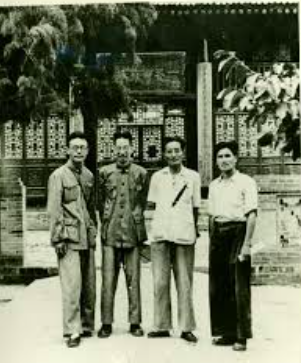
Left to right: Fan Zhaoming, Li Shigen, Yang Yinliu, He Jun, 1953.
Li Shigen (1919–2010) was already engaged in documenting these groups (known, like many amateur ritual groups, as she “societies”) when the great Yang Yinliu visited in summer 1953, inspired by his recent work on the Zhihua temple in Beijing—here’s their recording of the Dongcang group:
Outstanding as Yang and Li Shigen were, they came up with the unfortunate term Xi’an guyue 西安鼓乐, which, in a common pattern, has proved hard to erase. Guyue (“drum music”) is the widely used folk term for shawm bands (aka chuigushou “blowers-and drummers”), who are a very different kettle of fish—occupational outcast groups quite separate from such amateur devotional associations. But the term stuck, used by such influential authorities as Yuan Jingfang. When I came to write my Folk music of China I plumped for the more neutral term “Xi’an ceremonial music”.
In 1957 Li Shigen made what must have been an arduous journey to Baiyunshan in Shaanbei with Fan Zhaoming and his faithful assistant He Jun, finding the 4th-moon temple fair thronged with pilgrims. Their visit resulted in a slim 1959 volume of transcriptions of the Daoists’ shengguan pieces and ritual songs, as well as shawm pieces.
It was after Li’s return to Xi’an that he began to suffer in the Anti-Rightist campaigns, but he managed to pursue his studies until 1965. As academic and traditional activity revived after the end of the Cultural Revolution, he resumed work with renewed vigour. Several other scholars also contributed to research; Li engaged in heated polemics with Yu Zhu 余铸, a senior master recruited to the conservatoire.
Li Shigen lived to see his works collected and published in the multi-volume Xi’an guyue quanshu.

Li Shigen with his life’s work.
Most voluminous among later encyclopedic compilations (see Qiao Jianzhong’s overview) is Liu Kuanren 刘宽忍 ed., Xi’an guyue dadian 西安鼓乐大典 (2016, 20 vols).
“Music”
Ritual groups like these are easily misconstrued as “instrumental ensembles” (see my comments on Hebei). But to outline their instrumentation, they belong broadly to the northern shengguan style, though in most groups the guanzi oboe is subsidiary, with an exceptionally large quorum of sheng mouth-organ and di flute players (playing more in unison than in heterophony). The large and varied percussion section is also exceptional.
There is a strong percussion component even in the groups using melodic wind ensemble, but some (known as dagua she 打瓜社 or tongqi she 铜器社, cf. Henan) play percussion alone. Most appear to sing only a few short ritual songs; not a prominent focus of research, this deserves further exploring. [2]
Scores
One feature that has attracted antiquarian scholars to the genre is the vast collection of gongche solfeggio scores that Li Shigen meticulously transcribed into cipher notation, worthily informed by the sung versions of senior performers. The original gongche scores were included in Xi’an guyue dadian 西安鼓乐大典.
These scores are all the more significant for the rather early form of their gongche characters, prompting somewhat ambitious links with Tang notation (Folk music of China, pp.119–23, 235–7). “But that’s not important right now.” The volume of such scores is perhaps comparable only with those we collected in Hebei (see under “Hebei” in main Menu).
As so often for north China, the musicological study is all very desirable, but there should be far more to it than that. It can’t be left only to musicologists—it’s just as much a topic for historians, ethnographers, and scholars of religion.
* * *
Online one can sometimes find a few videos of folk activity, but in this case, most clips are highly commodified—“negative teaching material”, I’d say. However, David Badagnani has found some rare archive footage—all the more valuable for predating the flummery of the ICH. Here are two scenes of the West village group in South Jixian in 1991 (not 1999, as the caption claims):
And here’s the Dajichang society on procession in 2001 (?):
[1] Li Shigen and other gave basic social outlines in several articles. In English, see also Cheng Yu’s PhD thesis from SOAS, and her article “China’s Xi’an guyue: ritual and performance contexts”, in Keith Howard (ed.) Music and ritual (Semar, 2006).
[2] The CD Xi’an drums music (Hugo, 1993, a rare published recording of folk groups) has two fine instances from the Fusanxue society (tracks 3 and 9)—brilliantly translated “This is a piece of rap music”.
 Stephen Jones: a blog