
 Among all the New-Fangled media that are making us feel old, even I can’t help noticing that emoji are a really useful means of communicating (yup, I’m leaping right in there and being geriatically pedantic about the plural already—see also here and here).

Pictograms evolving out of emoticons, emoji have been constantly developing since the early smiley face 😀, and there’s a wealth of discussion (e.g. wiki; and articles such as this). A 2017 study found that
The French use heart emoji ❤️ the most. People in countries like Australia, France, and the Czech Republic used more happy emoji, while this was not so for people in Mexico, Colombia, Chile, and Argentina, where people used more negative emoji in comparison to cultural hubs known for restraint and self-discipline, like Turkey, France and Russia. […]
Linguistically, emoji are used to indicate emotional state, they tend to be used more in positive communication. Some researchers believe emoji can be used for visual rhetoric. Emoji can be used to set emotional tone in messages. Emoji tend not to have their own meaning but act as a paralanguage adding meaning to text. Emoji can add clarity and credibility to text.
Psycholinguistically, the use of emoji differ depending on speaker and setting. Women use emoji more than men. Men use a wider variety of emoji. Women are more likely to use emoji in public communication than private communication [see also e.g. here].
Extraversion and agreeableness are positively correlated with emoji use, while neuroticism is negatively correlated. Emoji use differ between cultures: studies in terms of Hofstede’s cultural dimensions theory found that cultures with high power distance and tolerance to indulgence used more negative emojis, while those with high uncertainty avoidance, individualism, and long-term orientation use more positive emojis.
Succinct and expressive of nuance, emoji may be misunderstood according to the cultural and contextual interpretation of sender and recipient. Of course, verbal language (both written and spoken) can be misunderstood too, and it can also be a useful device; deliberate ambiguity is easier to detect in speech, which can provide more clues to your meaning.
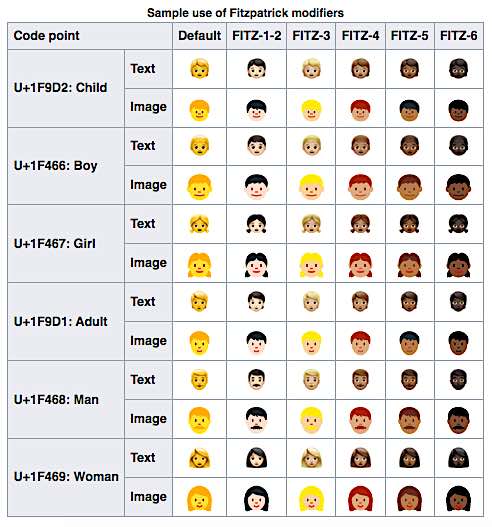
Feminism is also on the agenda (e.g. here, and here). And emoji designers are careful to reflect skin colours:
Emoji use by country has interesting but quite minor variations (see e.g. here, and here).

The Face with Tears of Joy emoji has led the field since 2015. It
started to decline in popularity around the early 2020s, because Generation Z began to associate it with older generations, thus perceiving it as “uncool”. It has been predominately replaced by the sobbing emoji (😭) and skull emoji (💀) to express similar emotions. However, CNN did note that “sometimes teens and twenty-somethings use emoji—like the laughing crying one—ironically, such as by sending six or seven of them in a row to friends, to exaggerate it. But, overall, that emoji is a no-go”. Whilst the emoji has maintained its popularity with millennials, Generation Z utilises the emoji as a form of irony. Following the decrease in usage over Twitter, the Face with Tears of Joy emoji was briefly dethroned as the most popular Twitter emoji. Researchers speculate that this decrease in popularity is due to its over-saturation and overuse within online communities. In late 2021 and early 2022, however, it returned to the top of Twitter’s most popular emoji.
Victor Mair writes on its Chinese connotations here.
I’m fond of the angel emoji 😇, also ambiguous, ingenuous. And emoji will keep evolving. The brilliant, useful “HELLO?” (or “Like, Duh”—also “Like, hello?” and in reported speech, “I’m like, hello?”) doesn’t quite seem to be covered yet (see this post featuring the sinister Haunted Pencil 👻✏️, adding emoji for racist sexist Tory bigot)—one could use the basic Waving emoji 👋, the Face with Rolling Eyes 🙄, or something in this range 🤔🤭, but we surely need a more focused one.
After Moby Dick, I look forward to emoji versions of Pride and prejudice and the Matthew Passion.
The likes of The Haunted Pencil may tut, but like Popular Beat Combos and the telephone (see Staving off old age), it looks like emoji might really catch on. YAY!
 Stephen Jones: a blog