
“A lost Daoist America”—Hannibal Taubes

Pursuing the theme opened up by Hannibal Taubes’ guest post on the Chinese temple in Chico, I’ve been admiring the hefty tome
- Chuimei Ho and Bennet Bronson, Chinese traditional religion and temples in North America, 1849–1920: California (2022; 523 pages, large paperback format).
An impressive work of scholarship, published under the auspices of the Chinese in Northwest America Research Committee (CINARC), the book is an elegy to the remains of popular Daoism that nearly died a century ago but was central to Chinese people’s lives in North America from the mid-19th century. Hannibal is far more able than I to identify salient themes, so below I consult his thoughtful review.
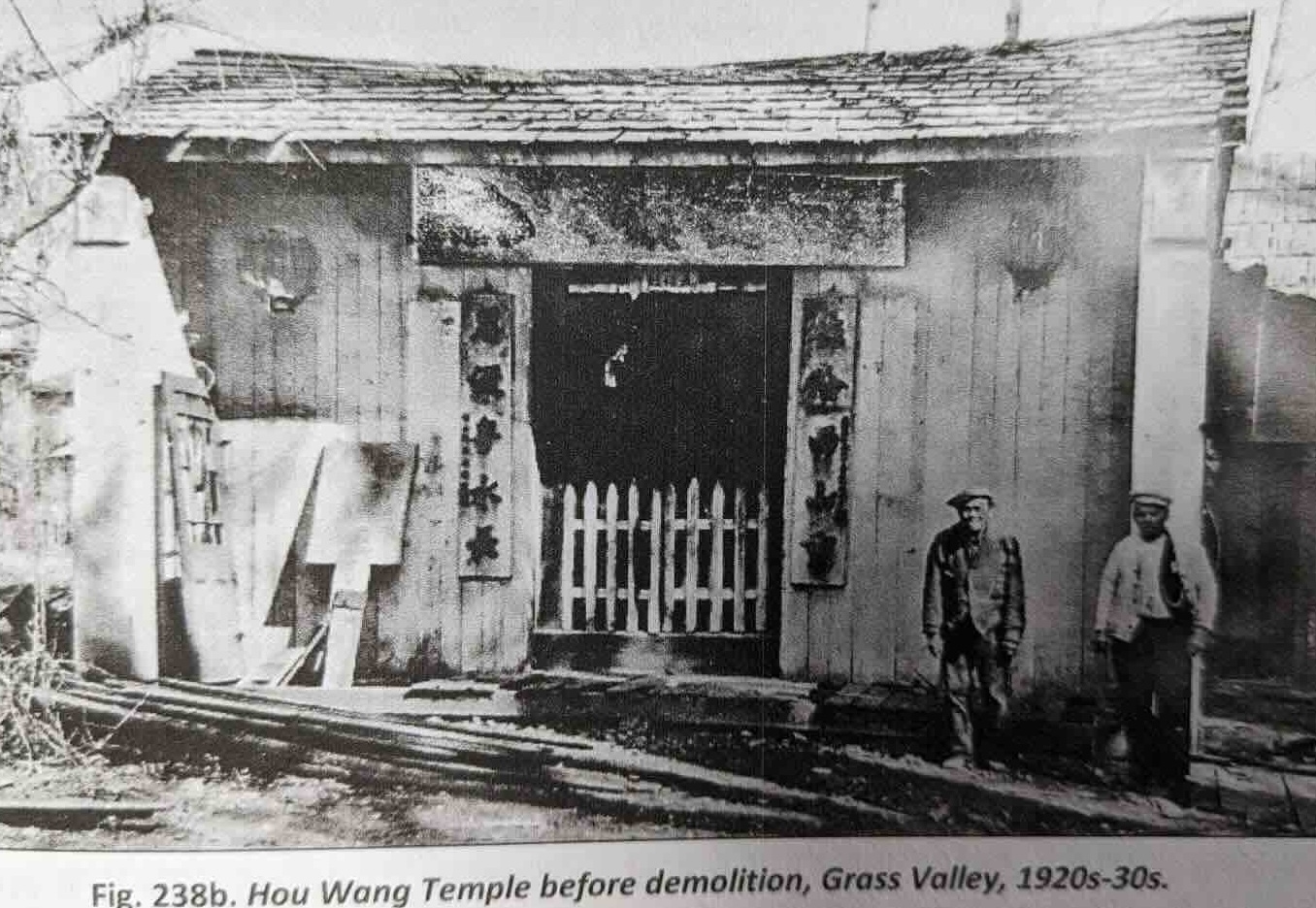
Among the wealth of illustrations on almost every page, many are reproductions of original black-and-white images, assembled from substantial local archives—perhaps a future edition might include a section of colour plates showing more recent photos. The CINARC website is a rich resource for many such images.

Marysville. Image courtesy Hannibal Taubes (here).
The topic is geographically distinctive, addressing migrants from the Pearl River Delta in the far south of China to the far west of America. As Hannibal notes,
Some counties in the Gold Rush hills had Chinese temples years before any Christian church was built, while yearly Chinese camp-meeting festivals in the mountains attracted thousands of worshippers, with Zhengyi-sect Daoist priests, great sacral processions, and deity-figures ten feet tall. By 1930 almost all of this had vanished.
Pondering reasons for the neglect of the subject, Ho and Bronson suggest:
Perhaps the main reason for a lack of scholarly interest has been an almost exclusive focus on immigration, anti-Chinese violence, economics, and racism. This has meant adopting a victims’ perspective, reciting long lists of grievances and instances of White hostility. However, we feel that a different perspective is needed, one that focuses on the sources of the courage and mental balance shown by Chinese immigrants.
They posit various provisional elements that may partially account for the rapid, severe decline in religious observances, including conversion to Christianity, white prejudice, progressivist politics, (interestingly) a lack of Chinese women—and the 1906 San Francisco earthquake. Anyway, the USA proved a less viable site for Chinese religion than southeast Asia.
By the late 19th century the early mining communities * servicing the gold rush gave way to agricultural centres. Both in San Francisco and the hinterland, the secret societies were major patrons.
Apart from newspaper reports (often negative in their portrayal), the study is based largely on the material evidence of the temples themselves—inscriptions, ritual objects, ledgers, and so on, “that we feel brings us closest to what interests us most: to hear, if only faintly, the voices of the pioneers who withstood astonishing hardships to build Chinese America”.
Section 1, “Spiritual and social aspects of temples”, clearly addresses the salient issues, discussing
- Why temples mattered
- Where they existed and who built them
- Functions
- Worship
- Temples and communities.
Temples served as refuges, hostels, clinics, and meeting places. They were sources of ethnic pride, and centers of community life. And most importantly, the deities they housed stood at the very center of a Chinese-American identity and psychological survival. The early immigrants withstood enormous pressures from physical hardship, cultural prejudice, threatened violence, and concern for loved ones back in China. They needed those temples. For many, the temples were the central institutions of an exile’s life.
Unpacking the ambiguity of the common term joss-house (“joss” deriving from Portuguese deus), the authors identify types of affiliated temples and their parent associations: shrines associated with districts of origin associations (huiguan), charitable halls (shantang), clan associations (zongci), tradesmen’s guilds (hanghui), and secret societies (“tongs”), as well as some independent temples.

Ho and Bronson go on to discuss individual and communal worship, ritual roles (mortuary services, divination, spirit mediums), cultural reinforcement (including education, and opera), secular functions, and investment. They detail the gods invoked (temples with single and multiple deities), life-cycle and calendrical rituals, “bomb festivals” (paohui), and (of special interest to scholars of Taoist ritual) communal festivals for the jiao Offering ritual, known as tachiu (dajiao 打醮, pp.66–73). They discuss the founding, ownership, control/management, and financing of temples.

Section 2 looks at “The physical side of temples”:
- Exteriors and siting
- Entrances and interiors
- Furnishings with fixed and variable locations
- Suspended furnishings
- Inscription boards
- Equipment for processions
- Other furnishings.
Overall, “very few Chinese religious buildings were close copies of homeland prototypes”.
Sections 3 and 4 are a detailed inventory of individual temples. Section 3 discusses San Francisco, “by far the most important Chinese religious centre outside Asia” in the late 19th century. Section 4 documents centres outside the Bay Area—mining, agricultural (farm labour), coastal, and urban (despite the great importance of railroad workers in building the West, they were too transient to sponsor temples). This section really opens our minds to the wealth of history in the hinterland, in communities such as Auburn, Marysville, Oroville, and Weaverville.


Left, Oroville; right, Weaverville. Images courtesy Hannibal Taubes.
Ho and Bronson’s concluding remarks survey the spatial and temporal distribution of temples; White views (often disparaging) on the phenomenon; and Chinese American religion in Chinese eyes, making astute distinctions between the perspectives of Chinese businessmen, officials, secret societies, religious professionals, and sojourners.
As Hannibal observes,
Ho and Bronson’s tome will now be the standard reference work on this subject and should be on the shelf of everyone interested in Chinese art and religion, Asian-American studies, immigrant visual cultures in the Americas, and California generally. The authors note that they are considering a follow-up volume that will treat Chinese temples in North America outside of California. Let us hope that this work is completed and that the two volumes can be published together under the imprint of a major press, with color photographs and a few editorial tweaks, as befits this important scholarship.
* * *
My only little contribution to the study of the Chinese diaspora is this tribute to Ray Man, Cantonese music pioneer in London. For the decline of Catholic worship among south Italian migrants in New York, see The Madonna of 115th street.
One point that Hannibal makes in his fine review seems to go rather against the grain of recent scholarship on religious life in post-Mao China. This isn’t the place to assess the vast religious revival that took place there after the demise of the Maoist commune system, but, making a somewhat ambitious comparison between the decline of temples in China and America, Hannibal opens with the statement “Sometime between 1850 and the present, almost all the temples in China vanished.” On the revival since the 1980s, he comments (n.9): “Even areas that appear to have rebuilt their temples en masse still experienced massive losses compared to pre-Communist numbers.” And
Those temples that still physically stood were bulldozed to build apartment complexes, or left to moulder and collapse in half-abandoned villages. Other areas have rebuilt their temples, sometimes in massive numbers, but from the preservationist standpoint this only compounds the destruction, since little care is taken to retain or record the original structures.
These are points worth making, but they downplay the significance of the vast revival. Though much fieldwork on recent Daoist activity (in volumes such as Daojiao yishi congshu) has a retrospective agenda, religious life has resurfaced widely, on a large scale (see e.g. Ken Dean, Adam Yuet Chau, Ian Johnson, and regions such as Fujian, Jiangxi, Hunan, Shaanbei). Moreover, temples are not the only yardstick to assess Chinese ritual life; material artefacts can only tell us so much (cf. China’s hidden century).
While the particular religious ethos that Ho and Bronson’s study reveals will be more familiar to specialists in the ritual history of the Pearl River Delta than to those focusing on other regions of south (and certainly north) China, the whole history of religious life in local communities in the PRC, with their diverse social and economic factors, is utterly different from that in the American West—and from that of the Chinese diaspora in southeast Asia, where ties with the mainland were much stronger and enduring.
* Cf. religious processions of mining communities near Beijing, n. here.


Thanks for posting this. Melinda teaches a class on “California landscapes” that looks at how the different communities over time have shaped the landscape over time – including the Chinese communities in different parts of the state. We have done some informal visits to temples – usually just the remains of – in Mendocino, Weaverville, Bodie and other places. We will be buying this book to learn more about the temples we have seen and others that we have not yet seen. Thanks.
LikeLiked by 1 person