
with a not entirely meretricious fantasy on world-music Passions…
 ©BBC/Mark Allan. Source: Artsdesk review.
This year is the 300th anniversary of the Leipzig premiere of Bach’s John Passion. * After John Butt’s performance at the 2017 Proms (more links to the Passions here), I’ve just returned to hear it with Masaaki Suzuki (b.1954) directing the Bach Collegium Japan, which he has led since 1990 (listen here—with an instructive interval talk thankfully replacing the interminable original sermon). Whereas performers these days know the work intimately, it must have been a serious challenge for Bach’s Leipzig forces (cf. this post); even to today’s listener it still sounds startingly modern—imagine how it must have sounded to the 1724 congregation!
Having studied with Ton Koopman in Amsterdam, Suzuki became a leading advocate for the early music movement in Japan. Joining several other complete recordings of the Bach cantatas (links here), his cycle with BCJ was completed in 2014. It’s most remiss of me not to have kept up, missing Suzuki’s previous visits to London, both with his own ensemble and as guest conductor of the Age of Enlightenment. Far from inscrutable, his style is dramatic, expressive, rather evoking that of Koopman, or perhaps Richard Egarr—both of whom direct from the keyboard, whereas Suzuki has gravitated to conducting from the podium, leaving the harpischord and organ to dedicated musicians (given which, he might go further and cede close control over the recitatives?).
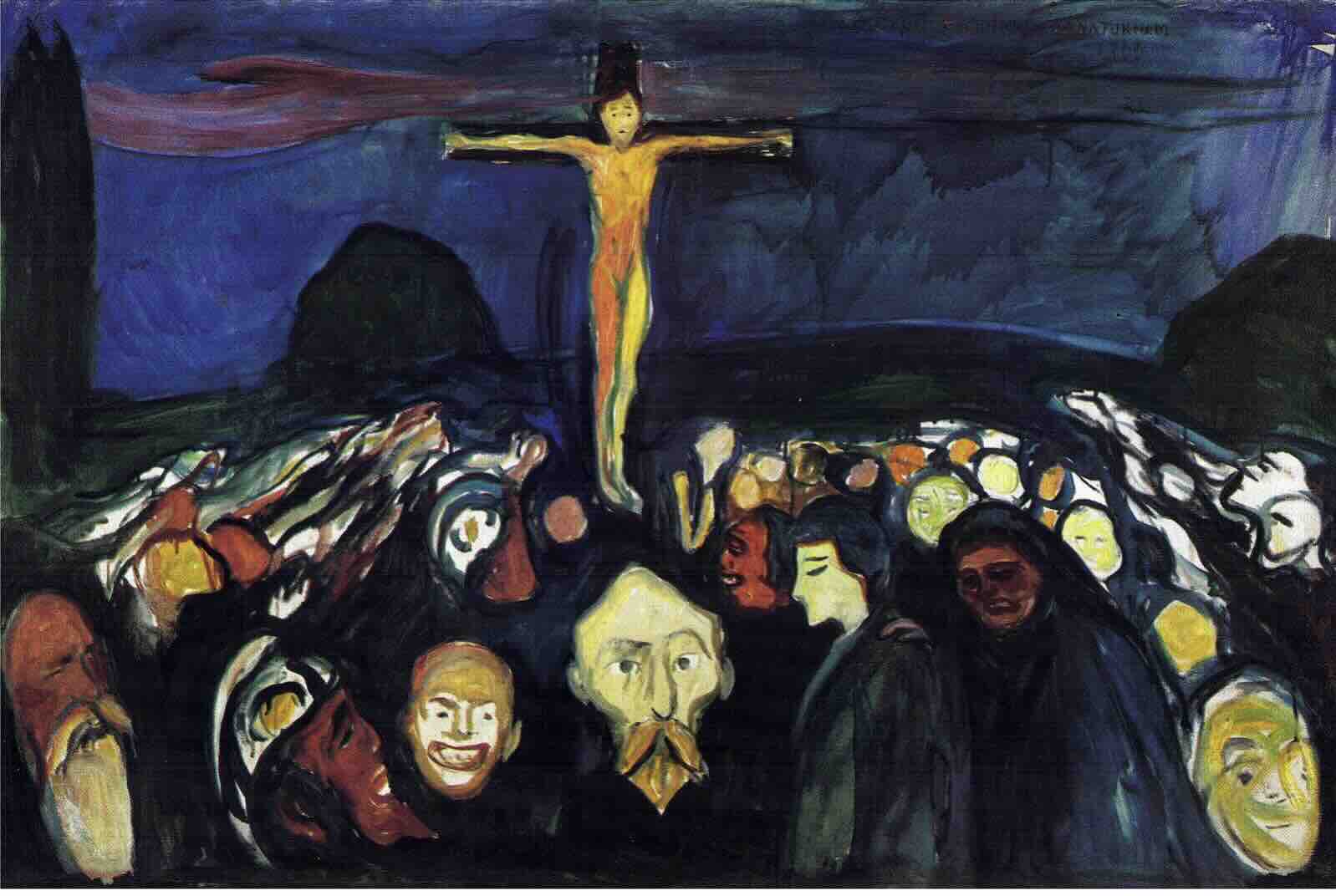
Bold idea of the programme booklet: Edvard Munch’s Golgotha (1900),
in which he represented himself as the Christ figure,
with the foreground figures casted as the seven deadly sins. Source: wiki.
Benjamin Bruns was the Evangelist to Christian Immler’s imposing Jesus. The choir sounded fabulous, with twenty singers in an arc, including soloists who emerged for the arias. Carolyn Sampson (whom I used to accompany on Bach tours with The Sixteen) was exquisite in Zerfließe, mein Herze, as was Alexander Chance in the counter-tenor arias—succeeding his father Michael, whose singing, such as Erbarme dich, enriched our own performances with John Eliot Gardiner; excellent too were Yusuke Watanabe and Shimon Yoshida. Following HIP style, Suzuki favours small instrumental forces—wackily augmented by a towering contrabassoon (as in Bach’s fourth version); oboes and flutes, seated front stage on the right, were well highlighted.
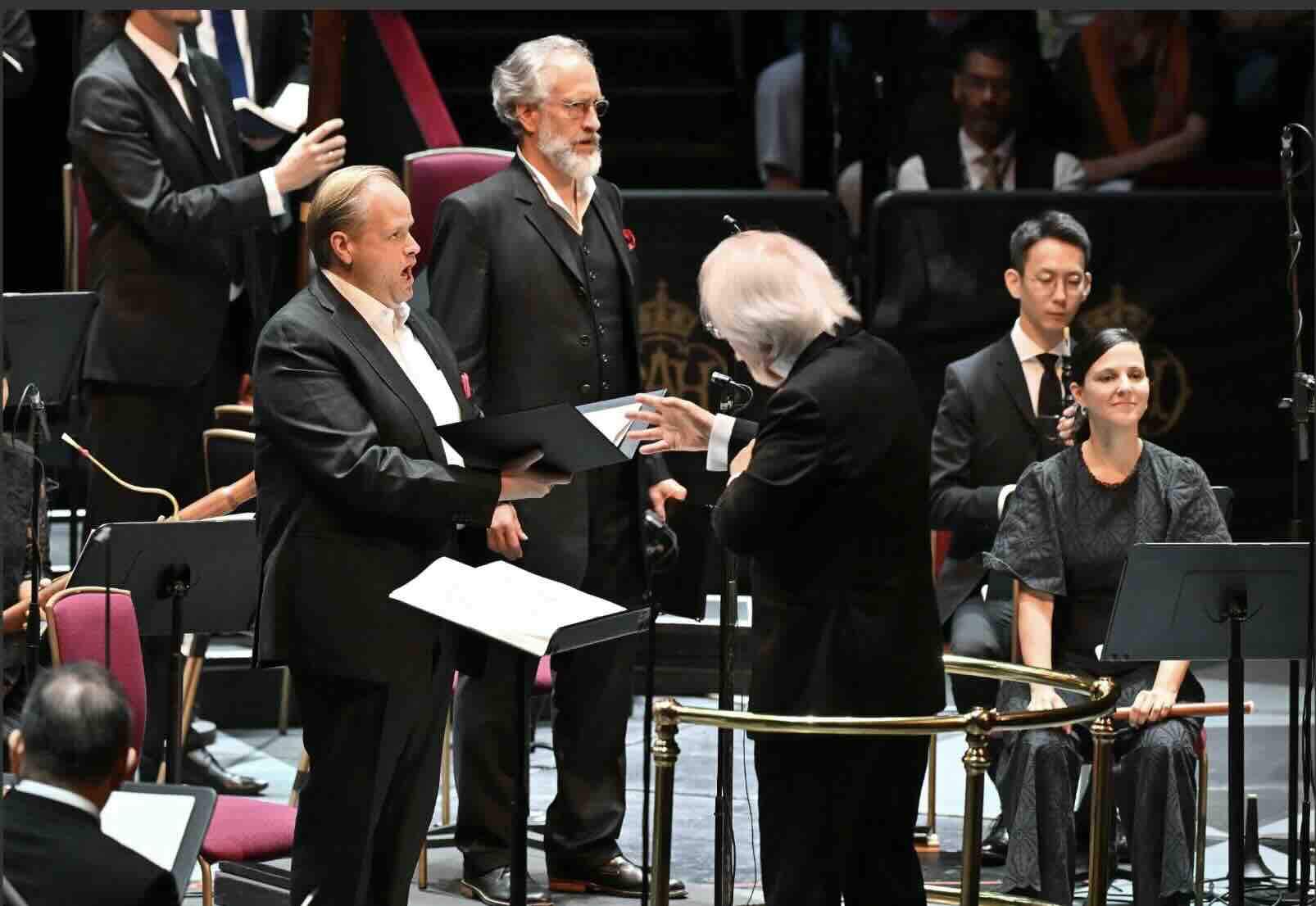 Benjamin Bruns, Christian Immler, Masaaki Suzuki.
©BBC/Mark Allan. Source: Bachtrack review (with the fine heading “Promenading on Golgotha”).
Suzuki and BCJ have long experience of performing and recording Bach (watch a John Passion from 2000 here); their Proms visit this week was part of a European tour—it’s a highly seasoned, accomplished ensemble.
Nothing can compare to the awe of being plunged into the opening chorus, with throbbing, turbulent strings overlaid by anguished suspensions on oboes.

Returning to the Bach Passions regularly over a lifetime (referring, perhaps, to Gardiner’s Music in the Castle of Heaven) is an essential part of our self-cultivation.
* * *
In This Day and Age™ there’s nothing remarkable about a Japanese ensemble excelling in Bach; even if we can resist projecting orientalist fantasies (with Suzuki as Zen Sage-Mystic), their taste for Historically Informed Performance somehow seems quite appropriate. Perhaps no-one else will even think of gagaku, another genre that was imported, from Tang China—and then radically slowed down until it was no longer recognisable.
I’ve long had a fantasy of staging a world-music version of the Passions (cf. Bach, um, marches towards the world), held at a cosmic site like the Grand Canyon (cf. Messiaen). Amidst sand mandalas, the Dalai Lama with his own halo of deep-chanting Tibetan monks accompanied by their cymbals, drums, and booming long trumpets, as well as ethereal ondes martenot or theremin… Mark Padmore sharing the role of Evangelist with a searing cante jondo singer… Uyghur bowed satar and Persian ney flute as obbligato instruments for the arias, a gamelan to embellish the choruses, and the catharsis of an Alevi sema… One day I’ll do a detailed programme, unfettered by funding or logistics.


A slightly less daunting project would be a Japanese staging of the Passions based on Noh drama. As continuo to the pilgrim/Evangelist visiting the site of an ancient mystery, the dialogue of the two drums, their eery kakegoe cries summoning the spiritual world… the Noh chorus both evoking the crowd and offering redemption… Augmented by the timbre of gagaku, magically transforming the wind music of the choruses and arias (Bach’s own timbre for Zerfließe is already not so distant—and with an archlute joining the continuo, the affinity would be even closer). While some Westerners have trained intensively in Noh, it’s more common, and must be easier, for Japanese musicians to learn to perform Bach (cf. Jazz in post-war Japan)—though it might be hard to find musicians who would be up to (or up for) the task.
At the heart of both these stagings will be Bach’s original music, devotedly illuminated by compatible traditions from around the world.
See also under my roundup of posts on Japanese culture—including some spellbinding Bach on a mile-long xylophone in an empty forest!
* After all this time, I still have reservations about my choice to imitate Bach’s original omission of the “St” before John Passion (Passio secundum Joannem) and Matthew Passion (Matthäus-Passion, or even Passio Domini nostri J.C. secundum Evangelistam Matthæum), with its apparent breezy familiarity—”The name’s Matthew, but call me Matt”). But Was ich geschrieben habe, das habe ich geschrieben, as Pilate observed pithily (a foretaste of “It’s what it is”, suggesting that Robert De Niro might be well cast for the role, albeit too late to join John Wayne as centurion for the crucifixion).
 Stephen Jones: a blog

This is great. I’ve been listening the BBC Proms if the St John Passion all afternoon. Great commentary too. Thanks so much Stephen.
Dan
LikeLiked by 1 person
The trouble with singers portraying Christus (Christian Immler included, I’m afraid – and I’ve taken part in performances with him this year) is that very few of them get into character (for me) – fine singing and all that, but where’s the humility? Can’t imagine many of them washing their disciples’ feet…
LikeLiked by 1 person
cf. the celebrated crucifixion scene https://stephenjones.blog/2017/09/17/mein-gott/
LikeLike