
My new film on the 1995 New Year’s rituals in Gaoluo has recently been screened at a grand event (billed as a conference) in the village itself, thanks to the enterprise of Wei Xiaoshi (CDTM) in collaboration with Cai Yurun, who has long served both as leader of the ritual association and the village. A detailed review of the occasion has just appeared on the CDTM WeChat site (click here).
I’m delighted that my old fieldwork companion Xue Yibing could take part—we witnessed the New Year’s rituals in the village together for the first time in 1989, and his careful fieldnotes on Gaoluo and other villages over the next decade were invaluable (see mainly under Hebei in main Menu).

Gaoluo: our first visit to the Lantern Tent, New Year 1989.
Besides many of the villagers, delegations attended from a variety of musicological departments in Beijing, and from Hebei University. If only institutes of folk religious studies and sociology could be alerted to the significance of such ritual associations! But even if they were to venture beyond the safety of historical research into fieldwork on the condition of these groups since the 1940s, their ability to publish in China is ever more limited.

One of my sessions with village litterateur Shan Fuyi, displayed on his daughter-in-law’s mobile.
I trust the film was well received, giving younger villagers an opportunity to glimpse their parents and grandparents in the days before the reified commodification inculcated by the Intangible Cultural Heritage began to influence their practices. With sonorous speeches inevitably the order of the day, the constraints of the occasion made me nostalgic for the informality of our fieldwork. The very setting, in a revamped Party Committee office, suggested how material conditions in the village have improved since my visits.
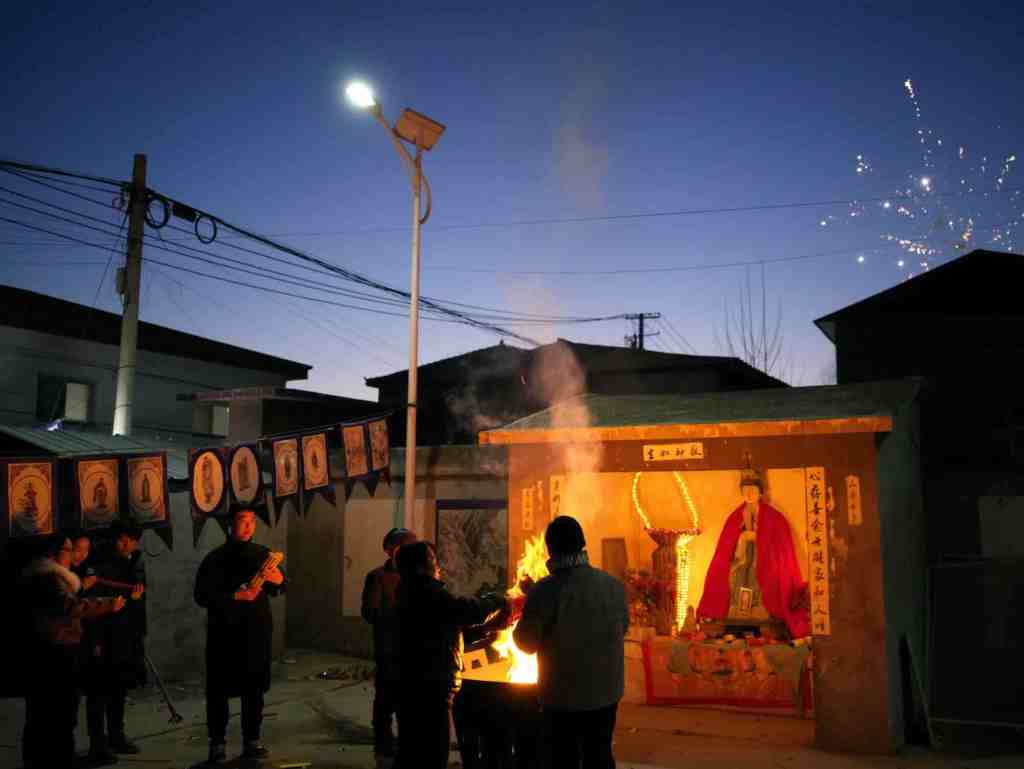

South Gaoluo New Year’s rituals, 2025. Images: Wei Xiaoshi.
Still, the religious context has not been lost: the New Year’s rituals still attract the village faithful, and the association still performs funerals for them. But the authoritative Cai Yurun voiced concerns that ICH support still can’t guarantee the future prospects of the association—in particular the vocal liturgy (which has been in a wider decline on the Hebei plain for many decades). It would take a further period of lengthy immersion in the villagers’ lives to learn their true perceptions (perhaps prompted by the film) on social and ritual change over these last thirty years. My film didn’t seem to prompt comments on how significantly the ethnographic perspective differs from the sanitised media approach typified by the ICH, but Zhang Zhentao has now published an intriguing review on this topic. Inevitably, whereas my book Plucking the winds stresses the constant tribulations of such villages under successive regimes, the prevailing congratulatory mood within China discourages such an approach.
Enbedded in the review of the event, the performance of the percussion suite in the courtyard, while still technically accomplished, inevitably lacks the spirit of the 1995 rendition before the gods. I doubt that this derives merely from the official secular context of the event; the total commitment of masters of yore like Cai An and Shan Rongqing seems to have been diluted.


Above: the association with helpers, 1995
Below: members of the association with connference delegates, 2025.
The Chinese version of the film will soon be available both on my YouTube channel (alongside the English version) and (in China) on the CDTM website. And do browse the posts under Gaoluo in the top Menu!
Click here for recent screenings in Leiden of my films on the Li family Daoists and Gaoluo.
With many thanks to Wei Xiaoshi!
 Stephen Jones: a blog