
Presenting my film on Gaoluo at SOAS the other day, and the following discussion, thoughtfully led by Rachel Harris and Feng Jun, prompted me to try and rework some of my thoughts.
My book on Gaoluo was published in 2004, the result of frequent fieldtrips ever since 1989, and it’s full of detail on the lives of villagers through all the social and political upheavals of the 20th century. But I then moved onto other projects, and I only returned to the topic recently, to compile this film from my footage of the 1995 New Year’s rituals, which makes a nice succinct subject—and already a historical one, as I say in the film.
I see ethnography and film as essential complements to library work on imperial history (see here). This kind of subject, though vital to folk society, can’t be addressed only by reading old books in libraries. Actually, the topic hardly appears at all in old books—it’s only revealed by fieldwork. Until the 1950s almost every village in the region had an organisation like this; and many of them still do. While I eventually focused on this one village, we also did a survey of over a hundred village associations nearby (see e.g. under “Hebei” in the main menu, including this survey).
Religion
The whole topic of the Hebei ritual associations was only “discovered” by Chinese musicologists in 1986, and it has become a major theme within that discipline—but alas, not in religious studies. I think there are two main reasons for this.
First, terminology. These groups are now commonly known by the umbrella term yinyuehui, which seems to translate simply as “Music Associations”. But it’s confusing: in these villages the term yinyue refers very specifically to the melodic instrumental ensemble that accompanies the rituals of Buddhist and Daoist temples. That indeed was our initial interest, but it’s only one aspect of the associations’ ritual activities, their “instrumental department”, if you like. The term does have an authentic historical pedigree, but to us (both in the West and for urban-educated Chinese) it suggests an unfortunately secular image, like some kind of folk club for entertainment, which encourages Chinese attempts (both in the media and in academia) to downplay the pervasive role of religion (or “superstition”!) in folk society. So I obstinately insist on calling them ritual associations. Despite the gradual decline of vocal liturgy in the region, associations preserve many ritual manuals. And while the melodic instrumental repertoire now dominates, many groups regard these pieces as “scriptures”.
Apart from terminology, folk religion is a sensitive subject. There are some fine scholars in China, but they mainly write about earlier history and written texts, and are cautious about documenting events since 1949, or current activity; whereas we who study expressive culture incline more towards fieldwork. At least, scholars of religion could choose a few villages to clarify the transmission (whether “Buddhist” or “Daoist”) from early temple priests, and study early artefacts such as ritual manuals (not least the “precious scrolls”) and god paintings. While it may now be hard to establish a different image to that of the ICH (see below), the system has legitimised such associations, and they are not subject to the taint of “superstition”—even if scholars of religion may choose to exercise a certain discretion about the early sectarian connections that we documented.
These associations on the Hebei plain are devotional, priding themselves on providing ritual services for their home village without payment. Their ritual sequences are not very dense, but their purpose is to appease the gods. I again put them in the context of other manifestations of religious behaviour in China (such as sects, occupational groups of household Daoists, and spirit mediums). Like my film on the Li family Daoists (which I also encourage you to watch!), this film is set in the north; the soundscapes of the two films are similar, but their social contexts are rather different.
After the end of the main film, the Appendix gives some clues to the workings of the majestic percussion suite, ending with the most moving complete rendition. This is the most convincing illustration of the inadequacy of text, audio recordings, and photos, and it shows the villagers’ deep commitment to the tradition.
All this is a good illustration of how ethnomusicology is based on society and soundscape. Ritual in performance is always animated by sound, so soundscape should always be a major element in our study of ritual. Indeed, most local traditions of “Chinese music” depend on ritual—folk-song, opera, narrative-singing, and dance. One might compare the ritual groups in southwest China studied by Helen Rees, or “song festivals” in the northwest. In Uyghur culture, the pervasive role of Islam is masked by Party propaganda on muqam. The world music industry also remoulds “Sufi music” misleadingly to highlight instrumental music.
Conflict, and the 1949 barrier
Politics and social change are major themes of my book and this website. It’s always important to break through the 1949 barrier. We must take modern history seriously. The story always continues, from imperial and Republican times to the Maoist and reform eras, adapting to the changing times. People’s life stories and personalities make a revealing human window onto history and social change. Stories like those that I document—amidst campaigns, conflicts, famine, massacres, thefts—are airbrushed under the current Chinese regime.
Unlike small occupational household groups such as Daoists and shawm bands, these associations are public bodies, which the villages cadres have always played a major role in supporting.

I’m always struck by this amazing image of a former monk training disciples in a nearby village in 1959 (see here, under North Xinzhuang), just as the devastating great famine was occurring—the famine is among crucial topics that can hardly be addressed in China.
Shadows in the field
I could only offer superficial responses to Feng Jun’s salient query about how I positioned myself in relation to the people and events I was documenting. It’s a major theme of the book (and of a thesis in Chinese). I was most fortunate to have two excellent fieldwork companions from Beijing, who were totally on board with studying social and religious change. It’s most important to stay in the village, and to take part in their ritual life (neither of which is common for Chinese scholars). The villagers were open in replying to my questions, which Chinese scholars hardly asked.
I never thought of making films for the public domain; I filmed strictly for my own research purposes, and only realised later that some footage could be edited into watchable films. Our visits energised the Gaoluo association, while others were declining, but transmission was a constant anxiety of theirs, and a theme of our discussions. We can now see this as a precursor of the Intangible Cultural Heritage system.
The ICH
Since my last visit in 2003, a lot has happened in these villages. They’re no longer so poor. Crucial issues, everywhere, are migration, social media, state education, and the whole emptying of the countryside. And there’s no escaping the ICH system, which has influenced many such village groups. Many authors have described how the system commodifies, secularises, and reifies local traditions (see e.g. here). It’s state propaganda; most “research” under its auspices is superficial. While my film, and the book, inadvertently make a contrast with the celebratory approach enshrined by the ICH, I’m perturbed that Chinese viewers don’t seem to articulate this; they can’t read my book in Chinese, and anyway I’m not sure they would care to dwell on my different approach. With recent Chinese fieldwork dominated by the ICH, it is hard to gain a more in-depth picture.
Although the system uses “music” and “culture” as a smokescreen to downplay religious life, it works both ways; for the communities themselves, it helps protect them, legitimise them. With the tenuous survival of these groups under question ever since the 1980s’ reforms, joining the ICH made a tempting expedient for the association leaders. And faith endures, with villagers using the system to their own ends; the Gaoluo association still does funerals, and villagers still offer incense.
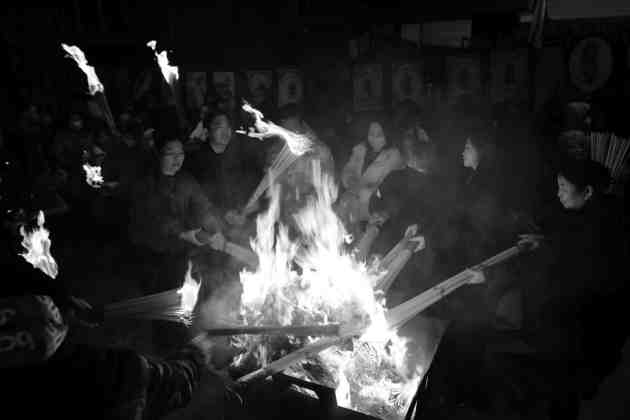
New Year in Gaoluo, 2025. Image: Wei Xiaoshi.
The village’s Catholic minority (whose brass band took part in a “demonstration” on 1st moon 15th in 1995, shown in the film) makes an intriguing sub-plot in the story. In this whole area the relationship between “Patriotic” and underground churches has long been opaque, and without a prolonged stay it would be hard to further our understanding of the shifting scene.
As with my work on the Li family Daoists, the combination of book, film, and website is most instructive.
 Stephen Jones: a blog