

I’m most gratified that my film Seated at the altar, on the 1995 New Year’s rituals in Gaoluo village, was awarded two prizes at the Chinese Musics Ethnographic Film Festival (CMEFF) International Biennial of Audiovisual Ethnomusicology, held in July at the Shanghai Conservatory of Music. In addition to the Bronze Award, it received the Intangible Cultural Heritage Music Documentation Award—which, given my trenchant critiques of the ICH system, has a fine irony!
Zheng Zhentao, in his stimulating review of the film, highlights the contrast between my method (representing ethnographic standards in the West, I’d say) and the glamorised reification that is de rigueur within China in the portrayal of folk culture—an established tradition long before the ICH. So I’m gratified to find that there are those in China who appreciate my approach, as confirmed both by the discussion at the festival and the film’s reception at the screening in the village. The mere fact that I filmed New Year’s rituals and funerals in the village—rather than choosing staged settings such as the concert hall—seems to be original. However, such a verismo method looks unlikely to gain ground in China.

My films should always be viewed in conjunction with my writings—for Gaoluo, my detailed diachronic ethnography Plucking the winds. In the latter, far more broadly than mere “music”, the main themes of ritual, poverty, politics, and conflict are far more explicit. As I stressed here, “music” is merely a prism through which to document ritual and social change.
While I was doing fieldwork I was educating myself on rural Chinese society through modern regimes as revealed through Western scholarship (see e.g. here), such as Chen village, Gao village, and the studies of Friedman, Pickowicz, and Selden, as well as the work of Jing Jun, and (in Chinese) Guo Yuhua. These were my major inspirations.
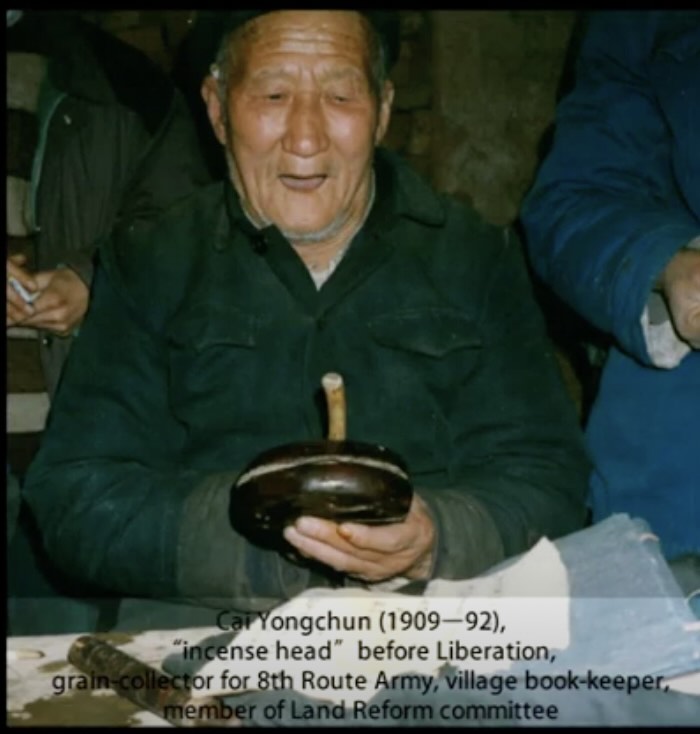
It is easier to depict history on the page than in film. While the film hints at political aspects through photos and voiceovers, showing the village cadres’ support for the ritual association amidst the upheavals before and after the 1949 “Liberation”, this will only become clearer by reading my book (see e.g. this excerpt, and the history of the village Catholics). Yet these topics can hardly be broached under the current climate in China, where early history is idealised and modern history sanitised, in both text and film. Self-censorship is inevitable; even the word “politics” is largely taboo (cf. Ritual studies mildly censored).

So returning to the film, I’m still curious to know how Chinese audiences perceive the contrast between their romanticised image and ethnographic verismo. And I still wonder how Chinese film-makers manage to glamorise their rural themes.
Note the many posts on Gaoluo in the main Menu.
 Stephen Jones: a blog
At last, tangible recognition (irony not lost) – and good to hear Kuan Guang’s sonorous tones again…
LikeLike
Congratulations! Well deserved acknowledgment of a lifetime dedicated to music and Gaoluo. Sent from my iPhone
LikeLike
Congratulations Steve!
LikeLike
Congratulations Steve. Your persistence and respect for the performers and their activities under difficult circumstances is gratifying.
LikeLike