Donors’ lists 2: Gaoluo

Towards a dynamic approach to material artefacts in diachronic social context

Further to my previous post giving background on material support for amateur ritual associations on the Hebei plain, I now focus on Gaoluo village, whose four ritual associations all preserve a wealth of ritual artefacts. Here our prolonged fieldwork allows us to “break through the 1949 barrier” by incorporating the easily-neglected Maoist era into the wider picture both before the Communist victory and since the 1980s’ liberalisations.

Again, please excuse the considerable duplication with many of my previous writings on Gaoluo—in particular my book Plucking the winds, and on this site, my pages on Ritual images: Gaoluo and the village’s three other ritual associations. [1]

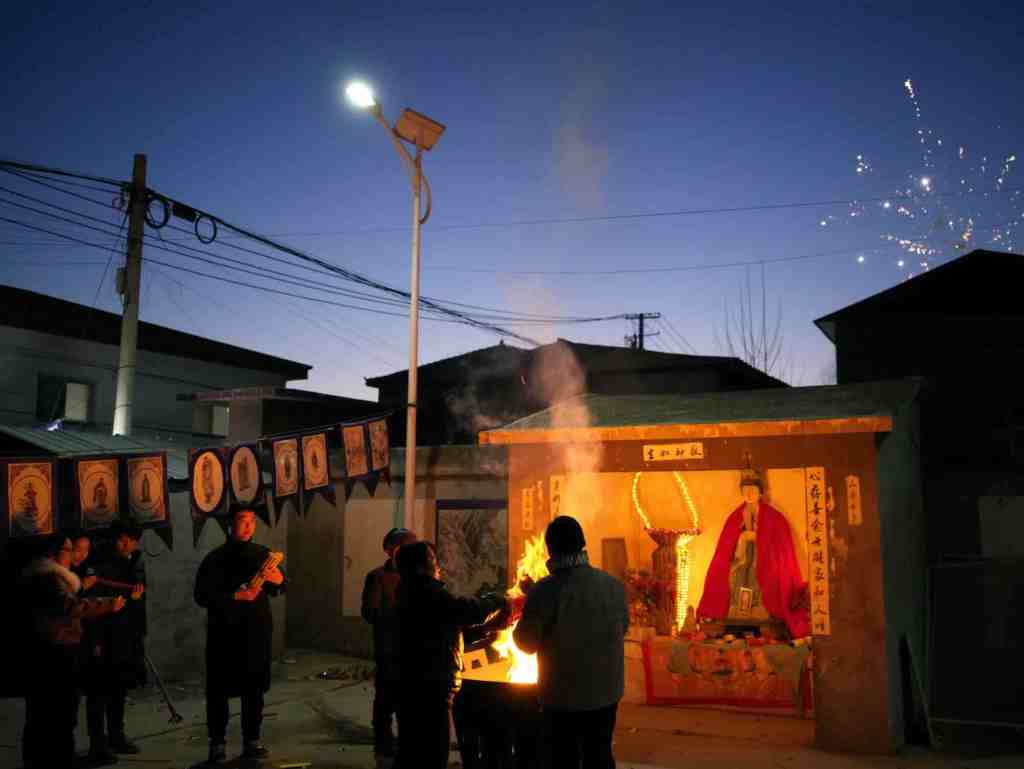
To remind you, both South and North villages have their own ritual association, now commonly known as Music Association (yinyuehui, yinyue referring to the “classical” style of paraliturgical melodic instrumental ensemble); and both villages have their own Guanyin Hall Association (or Eastern Lantern Association, dongdenghui), now known as Southern Music Association (nanyuehui, having adopted the more popular style of “Southern music”). But whereas the misleading term “music association” has since become standard in the region, note that neither the 1930 nor the 1990 lists of South Gaoluo use the term: both texts (like their 1983 gongche score) refer to “Southern Lantern Association” (nandenghui), the 1990 list glossing it as  “sacred society” (shenshe). So to stress yet again, this whole topic belongs firmly within the study of folk religion and society, far beyond “musicology”. Do watch my film on the 1995 New Year’s rituals in Gaoluo!

These two donors’ lists from 1930 and 1990 make striking exhibits, but the village’s other associations also suggest clues; having written about them separately, here I rework them into a diachronic account. 

A common stimulus for creating new donors’ lists is the expenditure of replacing ritual artefacts (ritual manuals, god paintings, instruments, and so on); besides recording the contributions of named villagers, many lists provide detailed public accounts.

The 1930s
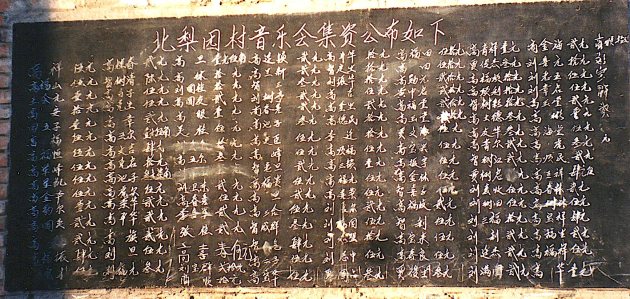
For our main ritual association in South village, one such list, which we saw adorning the lantern tent for the 1995 New Year’s rituals, was said to date from the late 19th century, but alas it was so faded as to be totally illegible. Instead, most handsome of the ritual artefacts on display was the 1930 donors’ list—apparently the only surviving list from before Liberation that we have found in the region:

Now if we saw this list on the wall of a museum, it would have limited potential. But since the tradition endures, not only can we witness rituals, hearing the wind and percussion music and vocal liturgy before the gods; but further, the descendants of the people featured in the list were able to provide considerable detail, putting the initiative in the context of the Republican era in the region. To summarise my discussion in Plucking the winds and in Ritual images: Gaoluo, during 1930 both associations in South village undertook a refurbishment of their ritual apparatus—apparently prompted both by the brief restoration of peace in the area after many years of fierce fighting between warlords, and by competition with the renewed energy of the village Catholics.

The 1930 list, entitled Wanshan tonggui (“The myriad charities return to the same source”), commemorates the commissioning of a major series of diaogua hangings from Painter Sun of Doujiazhuang village in Zhuozhou county just north. It records 92 heads of households, surely consisting of most of those then living in the southern half of South village which the association served, though some were doubtless too poverty-stricken to be able to afford even a minimal contribution. For all the beauty of the list, many (including all the womenfolk) were unable to read it.

The donations, ranging from 6 yuan to 5 jiao, totalled 109.83 yuan; the cloth cost 24 yuan, the paintings 61.5 yuan, and other expenses amounted to 33.83 yuan, leaving debts of 9.5 yuan. Five “managers” of the association are named at the head of the list: Cai Lin, Cai Ze, Shan Xue, Shan Chang, and Shan Futian (sketches in Plucking the winds, p.54). As their descendants recalled in the 1990s, all were prominent figures in the village, some of whom were also active as ritual performers.

Later in 1930, in preparation for the following New Year’s rituals, the South village Guanyin Hall Association also made a donors’ list for the commissioning of twelve new ritual paintings, listing four “managers”, two “organisers”, and three “incense heads”. The paintings were again made by Master Sun; the 1990s’ members also say he made new diaogua hangings for their association. In the years before the 1937 Japanese invasion, one Wang Laoguo from South Gaoluo painted more diaogua for them.

Further suggesting the ritual revival of the time, the early Dizang precious scroll of the Guanyin Hall Association in North Gaoluo contains a section recopied in 1932 (the precious scrolls are introduced here, and for Hebei, here and here).

Under Maoism
In the decades after the 1949 Communist revolution, many village ritual associations gradually became less active or ceased entirely. However, a close look belies the common notion that ritual life was in abeyance right until the 1980s’ reforms. For this crucial and ever more elusive period, material artefacts serve only as an adjunct to the memories of villagers.

With the new regime in its infancy, peace gave rise to hope for local communities long traumatised by warfare. Even as the collective system escalated, Gaoluo’s new village administration managed to embrace its traditional associations. The production teams used to give a little grain or other goods to support whichever association lay within their patch. The political climate didn’t dampen faith in village ritual associations: they continued to perform funerals and observe the New Year’s rituals in their respective lantern tents. Between 1950 and 1964 several groups of young men were recruited to learn both the vocal liturgy and the instrumental music; new gongche scores of the latter were compiled.

However, I doubt if the associations often dared hang out their ritual artefacts, and the atmosphere must have discouraged the making of donors’ lists. Our association didn’t make one between 1930 and 1990, but in 1952 the South village Guanyin Hall Association converted from their chaozi shawm-and-percussion music to the more popular style of “Southern music”. They invited the locally-renowned musician Hu Jinzhong from nearby West Yi’an village to teach them, giving him food and accommodation through the winter, but no fee, as ever. There was some official opposition to them learning the music, so the association sought no public donations; it still owned some land in the early 1950s, so it could buy instruments independently. Supporters merely “took care of a banquet” for the association, and no donors’ list was made.

The early 1960s
From 1961 to 1964, in the brief lull between the famine and the Four Cleanups campaign, ritual associations revived strongly throughout the Hebei plain, training youngsters in both the instrumental ensemble and the vocal liturgy. The latter tradition was in general decline on the plain, with the elders of the “civil altar” dying off. In Gaoluo, the vocal liturgy of South and North village Guanyin Hall Associations effectively came to an end with the deaths of Zhang Yi  in 1950 and Shan Yongcun around 1956. Only our South village ritual association had a group of keen teenagers who came forward in 1961 to study the vocal liturgy with senior masters. But elsewhere the shengguan instrumental ensemble increasingly came to represent the scriptures before the gods.

One might imagine the early 1960s’ revival prompting our association to compile a new donors’ list, but perhaps the leaders were wary of creating such a public pronouncement. However, in 1962 the South village Guanyin Hall Association used its 1930 list to add a new list of donors.

And in 1964 the Gaoluo village opera troupe, not inhibited by the taint of “superstition”, commemorated its revival in a donors’ list (composed by Shan Fuyi), with the 280 donors representing the great majority of households in North and South villages at the time. The list records the donation of c450 yuan in total.

For both the ritual associations and the opera troupe, the early 1960s were a cultural heyday such as they had not been able to enjoy since the early 1950s, reflecting the social recuperation after the famine afforded by a central withdrawal from extreme leftist policies. Little did they know that political extremism was once again to disrupt their lives still more severely; the optimism of their declarations was soon to look naive and hollow.

Since the 1980s’ reforms
In the Hebei villages, as throughout the whole of China, the last two decades of the 20th century were particular in that their associations were reviving after at least fifteen years of stagnation—and even those that had been active until the eve of the Cultural Revolution had practised somewhat furtively. Thus they needed to replace a considerable amount of their ritual equipment.

In Gaoluo after the liberalisations following the collapse of the commune system in the late 1970s, the village “brigade” (dadui) gave 100 yuan a year to all the village’s main associations, which our South village ritual association spent on getting its sheng mouth-organs tuned. In the early 1980s they commissioned a new ritual pantheon of Dizang and the underworld, and compiled a new gongche score, but they didn’t yet create a new donors’ list.

However, the North village Guanyin Hall Association had a donors’ list made as early as 1981, to commemorate their own revival, written in elegant classical Chinese (text copied in Zhang, Yinyuehui, pp.128–9). This association had a reputation for observing the ritual proprieties, and preserved splendid “precious scrolls” from the 18th century, but their fine tradition of reciting them was going into decline even before Liberation. The first historical material on the list consists of four names (“transmitters of the ritual business”) from the 1920s. Unusually, having originally been a temple-based ritual association based on reciting the scriptures, they had diversified by adopting secular genres, acquiring opera in the 1930s, reformed pingju opera in 1951, “Southern music” in the 1960s (learned from their sister association in South village), and lion dancing in 1981.

The 1990s
As the economic liberalisations gathered pace and communal consciousness was attenuated, many village associations that had revived found it hard to maintain activity. In Gaoluo the 1990s were distinctive for the renewed energy provided by our fieldwork (Plucking the winds, pp.189–205).

After our first visit over the New Year’s rituals in 1989, our association now resolved to refurbish their “public building”, which they had reclaimed from the village brigade after the collapse of the commune system. This initiative was led by the then village chief Cai Ran, himself a keen member of the “civil altar”. After writing enterprisingly but unsuccessfully to the Music Research Institute in Beijing to request funding for the project, they managed to be self-sufficient in realising the project, with villagers donating money and labour.

So in 1990 the leaders of our association invited Shan Fuyi to make a new donors’ list. His substantial text outlining the association’s history (see Ritual images: Gaoluo) makes clear that my visit was a stimulus for the project; still, it was written with no guarantee that outsiders would return.

The 1990 list names 270 heads of households. Still, villagers were becoming less conscientious about donating (see Women of Gaoluo, under “Rural sexism”).

From the 1930 and 1990 lists alone, we can hardly perceive change. The association still served the ritual needs of the villagers, and was still supported by most households in its catchment area. Without thick description from fieldwork and interviews, we might never know how ritual and social life were changing.

In the early 1990s there were several thefts of ritual artefacts in Gaoluo—but this served as a stimulus for the association to reclaim those that had been taken off by cultural authorities under Maoism.
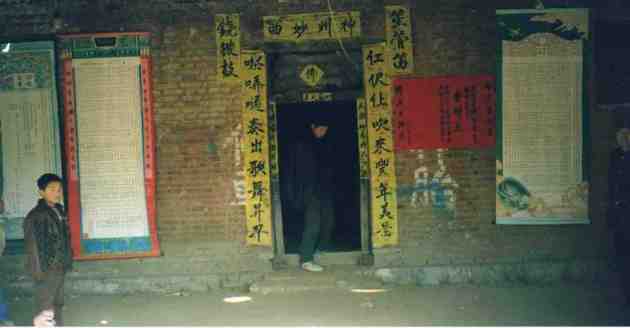
The lantern tent of the South village ritual association, 1998,
with new and newly-copied donors’ lists.

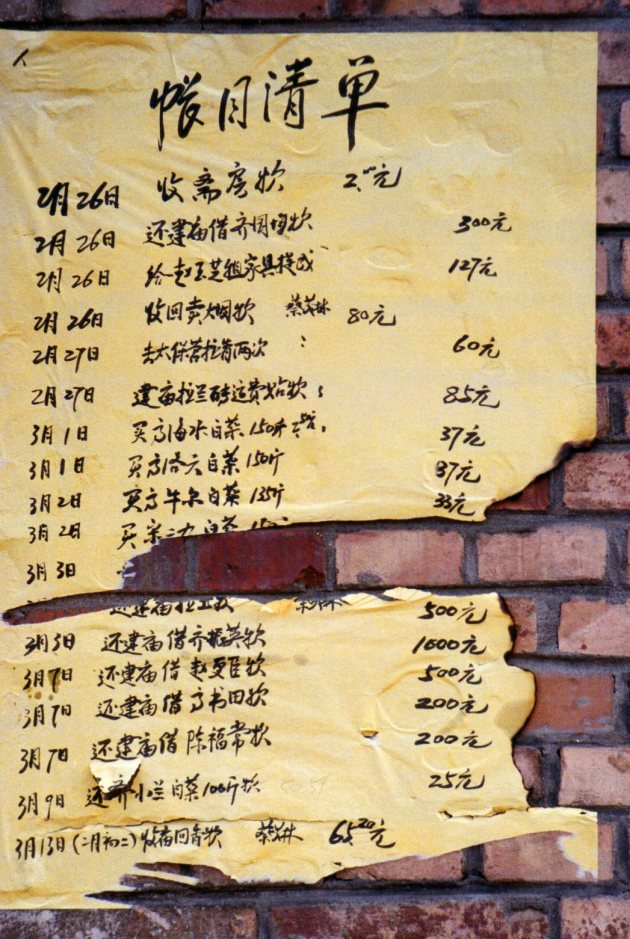
Our attention to the South village ritual association stimulated another competitive ritual flurry among the two villages’ other three ritual associations. For New Year 1990 the North village ritual association also had new ritual paintings made, of their own pantheon and the Ten Kings of the Underworld (for the donors’ list commemorating this initiative, see under Ritual images: Gaoluo). We also saw a more transient paper list of expenses from New Year 1992, pasted at the entrance to their ritual building, and already decrepit and hard to read by the following summer. They had received 690.47 yuan; they had incurred expenses such as buying coal, meat, vegetables, doufu, oil, salt, tea, firecrackers, tuning sheng, buying cloth bags for sheng, copying scores, and mounting ritual manuals and paintings—all conscientiously recorded. At New Year 1998 we saw their paper lists of income and expenses for the past year. Most of the association’s income had come from the hiring of crockery; donations had also been made when the association performed funerals (the rate being around 100 yuan). Some individuals had donated cash (one as much as 750 yuan), and the village committee had given 200 yuan. They had received 3,638.2 yuan (including 939.8 yuan brought forward from the previous year) and spent 2,992.2 yuan.

After the demise of the commune system, the South village Guanyin Hall must have revived along with the other associations by about 1980. Following our 1989 visit and the revamping of the ritual associations of North and South villages, they too had a surge of energy. For New Year 1992 they made a new donors’ list (image here) for the rebuilding of their humble ritual building, with this inscription:

The Eastern Lantern Association of South Gaoluo rebuilt its public building in 1992 AD under the People’s Republic of China, with the aid of the donors listed above. Total expenditure 2,984 yuan 4 jiao; 15 yuan surplus.

The list shows 215 household heads giving sums from 20 yuan to 2 yuan.

Conclusion
In all, community support for ritual life had not waned despite successive social upheavals. But new challenges were taking their toll: migration to the towns in search of work, state education, and popular media culture. Since my last visit in 2003, Gaoluo has continued to be transformed—notably by the arrival of the Intangible Cultural Heritage system, which I will address soon.

Static, silent material artefacts are most instructive when we can use them in conjunction with fieldwork and interview, helping us connect them to changing social life, filling in the gaps, learning more about practice and personalities over time. This is where the ethnographer has an advantage over the historian. I wish we had been able to find yet more detail—for instance on the 1950s: how funerals were changing, how calendrical rituals became less frequent, the decline of the vocal liturgy, and so on. We were lucky to be able to consult people who had taken part in the events commemorated in donors’ lists; but as time goes by, fewer villagers remain who can recall the early years of Maoism, let alone the “old society” before 1949.


[1] See the index of Plucking the winds, under “donations and donors’ lists”; Zhang Zhentao, Yinyuehui, pp.116–35, copies and discusses all the Gaoluo donors’ lists. On this site, note also the series of articles under the Gaoluo rubric of the main Menu.
Donors’ lists 1: Hebei

Stone, cloth, paper: economic support for village ritual associations

My new film on Gaoluo prompts me to revisit our fieldwork the ritual associations of the Hebei plain—a task further stimulated by the recent reification of these groups under the Intangible Cultural Heritage system. I now wish to outline economic support for such ritual organisations under the successive political regimes of modern times—”breaking through the 1949 barrier”.

First, in this post I expand on some themes from my survey of ritual associations on the Hebei plain; and in a sequel I focus on Gaoluo, where we found a wealth of ritual artefacts to accompany our prolonged fieldwork and discussions with villagers. Both essays are mere samples of the material we collected through the 1990s—please excuse the considerable overlap with many of my previous writings, both on the ritual associations and on Gaoluo. [1]

Introduction
Living traditions of Chinese folk ritual provide a rich source of material artefacts dating back several centuries (cf. China’s hidden century). Still, they are mere snapshots of particular moments: one hopes to be able to augment them by fieldwork on observed ritual practice and the oral accounts of villagers throughout living memory.

In rural China, as everywhere, ritual and cultural life depends on moral and economic support from local communities. Patronage, in cash and in kind, depends on the nature and scale of the enterprise.  Occupational family-based groups such as household Daoists and shawm bands (as well as individual intermediaries like spirit mediums) are paid for a particular event such as a funeral, and have successfully adapted to changing patterns of social support in the post-reform era.

In the religious sphere, alongside local temples, the composite term huidaomen (used pejoratively by the Communist state—hui Association, dao “Way”, and men “Gate”) subsumes both ascriptive amateur village-wide devotional associations and voluntary sectarian groups. On the Hebei plain, the two broad categories overlapped (see e.g. our notes on Xiongxian and Xushui counties).

Priding themselves on not accepting payment, ascriptive ritual associations have long relied on recouping their expenses through donations from the village communities whose ritual needs they serve. But whereas support for voluntary sectarian (as well as Catholic) groups remains grounded in enduring faith, the ascriptive associations have faced a particular crisis in the new economic climate since the 1980s. 

Temples and temple fairs, ritual associations and the “public building”
Temples have always been an important focus of community life, and in many regions they remain so, such as in south China (Fujian, Jiangxi, Hunan, and so on) and the northwest—although much research there has focused on the imperial legacy rather than modern change.

On the Hebei plain, temples were ubiquitous until the 1950s. Village ritual associations learned from Buddhist or Daoist temple clerics, or from other nearby associations that had done so, at various times since the Ming dynasty; they existed mainly to serve the village temples. But in a long process over the 20th century, temples were destroyed or abandoned; rather few have been rebuilt since the 1980s’ liberalisations, and still fewer have any regular staff apart from a temple-keeper. So the main venue for the reduced calendrical rituals of such villages became the “public building” (guanfangzi: Zhang Zhentao,Yinyuehui, pp.181–204), an inconspicuous building only adorned with god paintings and other ritual artefacts, easily stored away, during calendrical rituals on behalf of the community. Besides the long-term decline of active temples in the region, this may suggest insecurity among village communities through political upheavals.

Villages that have restored their former temples are in a minority, but in such cases the refurbished temples seem to provide a greater focus, visited and tended more often, as in Gaozhuang (Xushui county) and two villages in Xiongxian county, Hanzhuang and Kaikou. Still, their annual ritual calendar remains quite sparse (see my survey, under “Ritual duties”).

Even once we recognise the importance of the “public building”, a major part of the duties of these associations is to supply funeral rituals at the homes of deceased villagers.

Donors’ lists
Alongside the wealth of material artefacts that we found among the Hebei village ritual associations (ritual paintings, ritual manuals, scores, and so on) are donors’ lists (beiwen 碑文), documenting support over the previous year, or for a major initiative. Displayed alongside the god paintings in the ritual building, they proclaim the associations’ support among their community for providing calendrical observances and funerals, symbolising the village’s sacred core. As Zhang Zhentao notes, local terms like beiwen and bushi 布施 (“donating”) remind us of the living connection of these groups with the tradition of supporting Buddhist and Daoist temples.

More ephemerally than the stone steles of temples, the donors’ lists of Hebei village ritual associations are commonly inscribed on cloth; but many are even more perishable, written on paper, pasted on the wall of the ritual building over the New Year’s rituals—when new donations (often in cigarettes and tea) are recorded daily. Thus they might never be documented unless some ethnographer happened to be there to take photos at the time.

Throughout China, paper documents are commonly pasted up announcing temple fairs, temple inaugurations, and particular rituals; some of these may record donors and amounts contributed. Even for weddings and funerals, scribes record gifts. The donors’ lists of the Hebei associations are rather different, recording the names of household heads—thereby establishing them as members of the association not just for particular rituals but throughout the year—and amounts contributed. Since these associations were responsible for performing rituals on behalf of the whole village, their leaders sought donations from virtually every household. Besides a few more affluent patrons, most families could only afford a token contribution.

While village ritual associations were inextricably linked to their local temples, there is no direct transition from the stone steles of the latter to the cloth and paper memorials of the former. Most associations must have made donors’ lists ever since their founding, generally in the Qing dynasty or even the Ming, but alas they don’t survive. Even if they did, we couldn’t make a simple comparison.

For those Hebei temples that have been rebuilt since the 1980s’ liberalisations, we found a rare instance of a stone inscription listing donations on the back of the 1993 stele for the inauguration of the Ancestral Hall to Venerable Mother (Laomu citang) in Gaozhuang, Xushui county—led by the village’s ritual association.

Whatever the material on which such lists are written, the Hebei associations are mostly village-wide public bodies, perhaps encouraging them to openly display both their expenditure and the names of their patrons. Still, many of these groups have sectarian ancestry, so I wonder if such lists have been documented among sectarian groups elsewhere in China—leads welcome.

Lists of expenses
Also often detailed on such lists is the expenditure of the association, justifying the leaders’ probity on behalf of their patrons. Expenses documented include replacing instruments or maintaining them (notably tuning and repairing sheng mouth-organs), commissioning new ritual paintings; buying other equipment (tables, pennants, incense, candles, lanterns, paper, food for banquets); “utility bills” for the ritual building or rehearsal venue (coal for rehearsals, oil for lanterns, electricity); and New Year’s expenses such as firecrackers. For example, again from Gaozhuang is a paper list of expenses from 1995:

Here’s a 1994 list of expenses from Kaikou village (Xiongxian county) for the revival of the temple and its association (Zhang, Yinyuehui, pp.140–43):

Beiwen with written histories
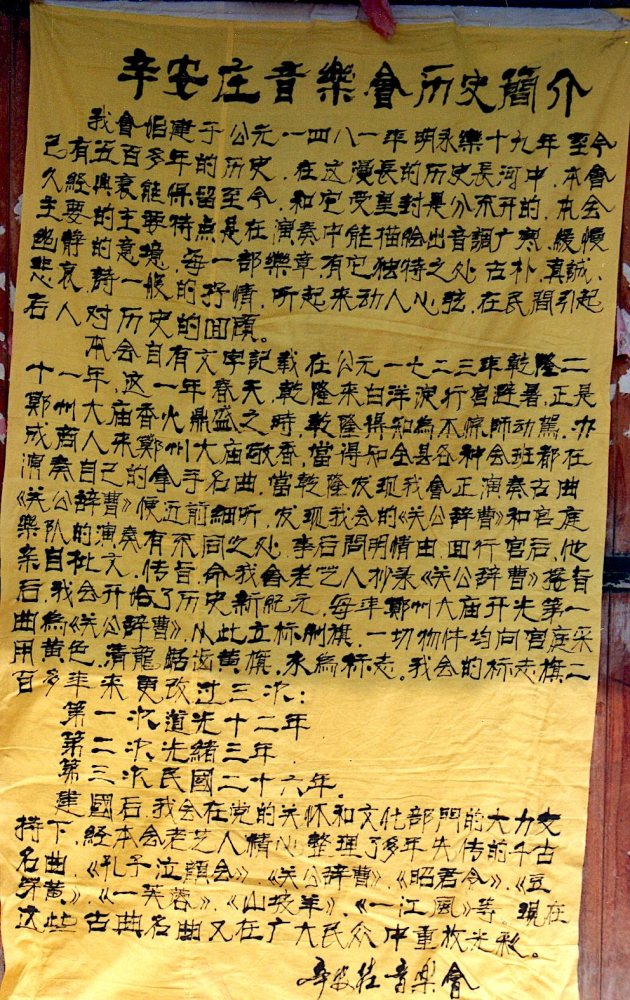
Rather as temple steles from imperial times might also document successive renovations, some donors’ lists include brief histories. Some associations even composed separate histories, such as a 1990 banner from Xin’anzhuang, Renqiu county:

Was this prompted by some interest from county cultural workers, I wonder? It clearly constituted some kind of public declaration; but the preludes of some gongche solfeggio scores of the paraliturgical melodic ensemble, whose readership was limited to the performers themselves, also contain brief histories of the association, like those of Longhua from 1963 and 1980 (for both Longhua and Xin’anzhuang, see under Ritual groups around the Baiyangdian lake).

Intriguingly, the instances that we documented were written since the 1949 revolution. Under state socialism, did political anxieties now prompt ritual associations to proclaim or justify their history, portraying the tradition as “culture”, downplaying religion? Re-reading the brief texts that head some donors’ lists, I find them diplomatic, distancing the associations from sectarian connections, claiming a place within the official discourse long before the Intangible Cultural Heritage. This seems to complement the innocuous appearance of the “public building”, the easily-concealed ritual artefacts, and indeed the growing prevalence of the shengguan instrumental ensemble over the vocal liturgy.

Still, such histories can make a useful starting point as we compile more detailed accounts from villagers’ oral recollections.

Some further examples
Apart from the Gaoluo associations (to be discussed in a separate post), Zhang Zhentao (Yinyuehui, pp.130–50) details donors’ lists from other village groups we visited on the Hebei plain. These include two 1992 paper lists from North Qiaotou in Yixian county (Zhang, Yinyuehui, pp.136–40; see my discussion here)—a donors’ list introduced by a text in praise of the association’s benevolent virtue:

and their list of expenses:

In Xushui county, on our visit to North Liyuan in 1995 we found donors listed on a blackboard:

Also under my page on Ritual groups of Xushui is material on the rebuilding of village temples in East Zhangfeng (§8) and Xiefangying (§9). Zhang Zhentao further documents lists from Zhaobeikou on the Baiyangdian lake, and Fuxin in Wen’an county.

Many of these groups were of sectarian ancestry—the North Qiaotou association derived from a Hunyuan sect, for instance. As I suggested above, perhaps this made their public proclamation of charitable virtue still more apposite, counteracting state suspicion of “superstition”.

Summary
Static, silent material artefacts only provide snapshots in the life of these groups. They are most instructive when we can use them in conjunction with fieldwork, helping us connect them to changing social life, filling in the gaps for the intervening periods, learning more about practice and personalities over time, using the frozen material evidence to prompt recollections from villagers, building up a picture of the longer term. This requires prolonged familiarity—as we gained in Gaoluo, subject of the following post.

And to repeat my point yet again, whereas the topic was discovered by musicologists, it belongs firmly within the study of folk religion and society. 


[1] For the Hebei ritual associations, see this survey, and many pages under the Gaoluo and Hebei rubrics of the main Menu. Besides my 2004 book Plucking the winds, as well as “Ritual music under Mao and Deng” and “Revival in crisis”, note in particular Zhang Zhentao’s 2002 book Yinyuehui: Jizhong xiangcun lisuzhongde guchuiyueshe 音乐会: 冀中乡村礼俗中的鼓吹乐社. Like his discussions of the “public building” and gongche scores (pp.181–204, 365–407), his chapter on donors’ lists (pp.115–80) is excellent; following perceptive discussions of particular lists, he analyses the material on pp.150–79, including the role of the local gentry in supporting ritual associations, and comparison with the opaque economics of the mercenary shawm bands.

Tribe

As rich white men intensify their attempts to destroy the planet, I’m watching the new series of Bruce Parry’s Tribe on BBC2 (website; wiki), some two decades after the fifteen programmes of the original three series.

Parry being a self-avowed explorer rather than an anthropologist, his programmes are more entertainment than education. The same formulas recur (contact, ordeals of pain and drugs, sharing food, camaraderie, fond farewells…), with sensationalism obligatory—the price that must be paid to get on TV. Yet the programmes remain attractive in a way that hardcore ethnographic film can hardly match.

It’s worth consulting Anthropology today for some nuanced discussions of the original series:

  • Pat Caplan, “In search of the exotic: a discussion of the BBC2 series Tribe“, 21.2 (2005)
  • Felicia Hughes-Freeland, “Tribes and tribulations: a response to Pat Caplan”, 22.2 (2006)
  • André Singer, “Tribes and tribulations: a response to Hughes-Freeland”, 22.3 (2006)
  • Adam Fish and Sarah Evershed, “Anthropologists responding to anthropological television: a response to Caplan, Hughes-Freeland, and Singer”, 22.4 (2006).

Caplan sets the critical tone. As she observes, since the halcyon days of the 1970s and 1980s, anthropology has largely disappeared from our TV screens; but “while the genre of ethnographic film has burgeoned and grown in sophistication, it has also now been relegated to specialist festivals and the classroom.” As she observes, anthropologists may be dismissive of such popular searches for the exotic, “their irritation perhaps stemm[ing] in part from having territory they considered their own invaded by ‘amateurs’ “. She doubts that the programmes “banished many of the tribal stereotypes” or “told the truth about their changing lives”. As she observes, many of these societies have been researched by anthropologists, and some are exposed to tourism—despite the impression given that they were virtually “discovered” by the series.

Hughes-Freeland too, while describing Tribe as a “Victorian romp”, wonders how genuine anthropology might gain a popular public profile. Singer is more tolerant:

Bruce Parry is sincere in his desire to understand and attempt to identify with whatever society he finds himself visiting; and he makes no claims to any deep anthropological insights or analysis. He’s an explorer and adventurer, the curious outsider who pretends for a short while to be an insider. It’s a process he enjoys, a sentiment apparently shared by his hosts who frequently make fun of his often inept efforts at trying to be one of them.

Yes, we need to worry about perpetuating the old stereotypes, and yes, there is a “hint of the ‘noble savage’ conceit in the series” but there is also genuine affection, respect (both ways) and empathy with the subjects chosen.

Singer calls for anthropologists to engage effectively with TV rather than standing snootily on the sidelines. Fish and Evershed also defend the series. They note that Tribe “reveals the process of beginning fieldwork rather than announcing the results”, the process of establishing rapport; it “shares more with contemporary trends in reflexive ethnography than with the observational ethnography of the past”. And they note that Parry does indeed feature globalisation and change. “Anthropology’s inability to generate a substantial television audience results from academic elitism”.

Threads of entertainment and education course through Tribe, allowing viewers to braid cross-cultural encounters in a global world. As the boundaries separating the rural and the urban, the wild and the domestic, the provincial and the cosmopolitan are further eroded by the pervasiveness of global media, migration, and macroeconomics, so too will the discrete subjects of anthropologist and television producer, and indigene and viewer, tend to merge.

If anthropology is to have a future in this transnational multimediated world to come, we are going to need to apply our tools of cultural relativity to television programmes, producers, hosts and audiences. Before we become shareholders in the future of anthropological television we must become better ethnographers of the modes of media production and reception.

At least Tribe may lead some curious viewers to do some fruitful Googling to learn a little about groups whose lives are otherwise sidelined in the media.

Click here for some ethnographic documentaries on China and elsewhere. BTW, those same issues of Anthropology today also contain thoughts on Kate Fox’s splendid popular book Watching the English.

The Commitments

Movies about music are a minefield, whatever the genre (for Western Art Music, see e.g. Maestro, Philharmonia, Endeavour). But rewatching The Commitments (Alan Parker, 1991), based on the book by Roddy Doyle, I relished its charm just as much as when it first came out—though it’s less obviously political than Brassed off, and stands in total contrast to Parker’s 1988 film Mississippi burning.

Set in working-class north Dublin, The Commitments evokes the ecstasy and drudge common to a wide range of performers around the world (for a fine ethnography, see The hidden musicians; see also Deviating from behavioural norms), with an inexperienced cast (always a good sign) is full of character, led by Andrew Strong as larger-than-life singer Deco Cuffe.

The Irish are the blacks of Europe. Dubliners are the blacks of Ireland. North Dubliners are the blacks of Dublin.

See this review by Roger Ebert, wiki, and this post. For the making of the film, click here and here, as well as a recent edition of the BBC Radio 4 series The reunion.

* * *

The film works both in its own right, as a portrayal of the lives of struggling young Dubliners, and as a tribute to the great era of soul (cf. Detroit 67, Memphis 68, Northern soul). It leads me to some original tracks that had (predictably) escaped me, starting with two songs of Wilson Pickett—Mustang Sally:

and In the midnight hour:

Try a little tenderness—Otis Redding:

Take me to the river—Al Green:

Chain of fools—Aretha Franklin (and as if I need to remind you of her Amazing Grace, here it is again!):

Also from Aretha, I never loved a man:

and Nowhere to run—Martha and the Vandellas:

Satirical Tibet

*Furthering my education in the travails of modern Tibet*

Within the Tibetan cultural world, research on the Amdo region (see e.g. here) has become a remarkably dynamic field of scholarship. A fine recent instance is

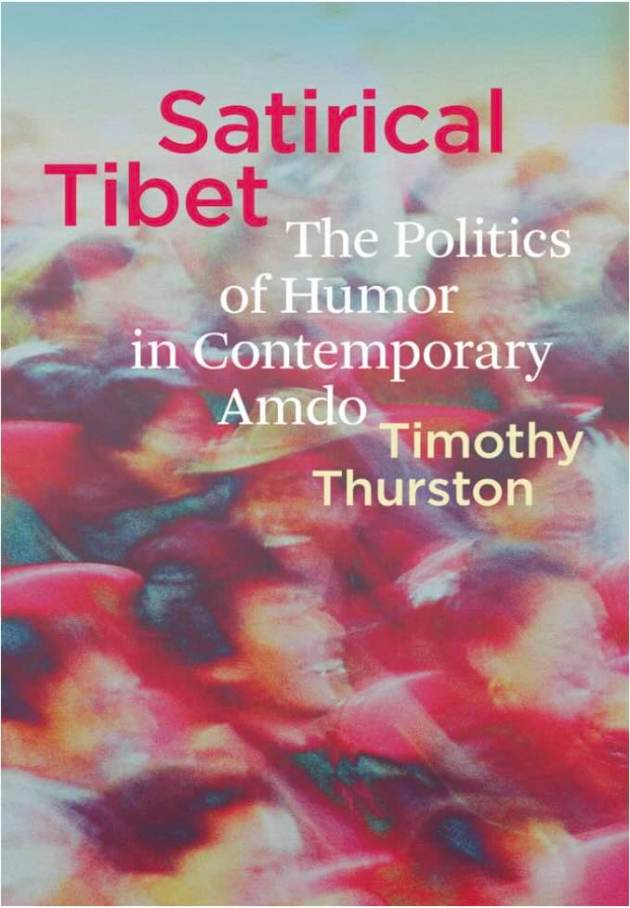
  • Timothy Thurston, Satirical Tibet; the politics of humor in contemporary Amdo (2024; open access here), in the University of Washington Press series Studies on ethnic groups in China. Here’s the publisher’s blurb:

Humour has long been a vital, if under-recognised, component of Tibetan life. In recent years, alongside well-publicised struggles for religious freedom and cultural preservation, comedians, hip-hop artists, and other creatives have used zurza, the Tibetan art of satire, to render meaningful social and political critique under the ever-present eye of the Chinese state. Timothy Thurston’s Satirical Tibet offers the first-ever look at this powerful tool of misdirection and inversion. Focusing on the region of Amdo, Thurston introduces the vibrant and technologically innovative comedy scene that took shape following the death of Mao Zedong and the rise of ethnic revival policies. He moves decade by decade to show how artists have folded zurza into stage performances, radio broadcasts, televised sketch comedies, and hip-hop lyrics to criticise injustices, steer popular attitudes, and encourage the survival of Tibetan culture.

Surprising and vivid, Satirical Tibet shows how the ever-changing uses and meanings of a time-honored art form allow Tibetans to shape their society while navigating tightly controlled media channels.

As Stevan Harrell, editor of the series, observes in his Foreword:

Because Tibetans are an oppressed people, we can easily assume that there is little joy or laughter in their lives, and that we should approach their predicament with uniform solemnity. This is wrong. Tibetans deal with the tragedy of Communist oppression as they have dealt with the vicissitudes of life on Earth for centuries—not only with “quiet desperation” or extreme religious devotion but also with uproarious comedy and biting satire.

Whereas some studies of Tibetan folk traditions sadly circumvent sensitive issues (e.g. Shépa: The Tibetan oral tradition in Choné), Thurston engages fully with modern Amdo society, illustrating periods since the reform era of the 1980s through changing popular media. As he notes, such satirical sketches (for which he uses the nuanced term zurza) always have a serious purpose, exploring a social problem of some sort: they convey important messages about contemporary Tibetan life, shaping attitudes towards issues such as language, culture, urbanisation, education, territory disputes—and the popular topic of fake lamas. Such sketches may be subversive, but they are not “underground”: though inevitably accommodating to the institutions of the Chinese state, a large part of their efficacity lies in the very fact that they can be aired in the public domain.

Thurston’s extensive quotes from the various genres are instructive, even if their broad appeal to Amdowa people is hard to convey in English. Though the book lacks images, for this post he has kindly suggested some illustrative YouTube clips, embedded below. The extensive final References are useful.

The Introduction, “Doing zurza”, provides useful context.

Zurza and the laughter that frequently accompanies it are hardly the first things most people think about when they hear the words China and Tibet in the same sentence. And why should they be? Many in the Euro-American “West” may hear the word Tibet and think of a traditionally Buddhist society, perhaps oppressed by a colonising Chinese Communist Party. The same people may think of recent news reporting about Tibetans self-immolating, and Tibet’s Nobel Prize-winning exiled religious leader. For many who have grown up in China, meanwhile, images may range from a feudal society liberated by and incorporated into the People’s Republic in the 1950s, to news spots showing Tibetans dancing happily in displays of gratitude to the Communist Party for the “gift” of modernity, to a pristine environment for young Han to conquer as they escape from China’s heavily polluted coastal metropolises. These descriptions, all carrying elements of truth, select some of the most contrasting images possible to make a rhetorical point. But the discourses of modernity and progress, and of traumatic experience and dramatic resistance, all emphasise grand narratives that leave little room for zurza.

Set against the background of these ongoing and well-publicised cultural and political tensions, a book about a topic as seemingly trivial as zurza and humour can come across as being in poor taste. And yet, laughter has served as the soundtrack to almost every one of my experiences of Tibet. This also manifests in everyday life. During dinners among friends, the seemingly endless toasting with liquor—almost always three cups at a time—often lowered inhibitions to the point at which teasing and reminiscing might devolve into uncontrolled hilarity. At traditional weddings, women from the host village may use humour and wit to demand some sort of payment or gift from the visiting representatives of the person marrying into the village (usually the maternal uncles of the bride). In the valley of Rebgong, interludes in the annual harvest festival featuring inebriated villagers—sometimes cross-dressing or wearing monks’ robes—may make fun of the behaviour of certain members of the community, to the applause and laughter of all in attendance. Tibetan communities possess a diverse vocabulary for humorous activity that mirrors the diversity of ways that laughter appears in everyday life, including kure (joking), labjyagpa (boasting), tséwa (play), and zurza. This humour frequently accomplished important social work: to entertain, mask existential pain, serve hegemonic forces, speak the otherwise unspeakable, provide a “steam-valve” for social discontent, and/or to project and reflect worldviews. […]

When famed trickster Uncle Tonpa tricks a landlord or merchant, or makes a king bark like a dog, he “does zurza.” When the seventeenth-century lama Shar Kalden Jyamtso (1607–1677) composed songs poking fun at the behaviour of monks, he was also “doing zurza.” And when a contemporary comedian mocks people whose behaviour seems out of touch in the contemporary moment, they too do zurza.

In Chapter 1, “Dokwa: ‘eating the sides’ in oral and literary traditions”, Thurston notes:

Amdo boasts an incredible array of oral and festival traditions. Just focusing on the oral ones, Tibetans in Amdo are known to perform a variety of secular and religious verbal arts, including but not limited to tamhwé (proverbs), tamshel (speeches), khel (riddles), laye (love songs), and lushag (antiphonal song duels). These sit alongside a much broader array of oral and festival practices from across the Tibetan cultural world [see e.g. under Bhutan].

He also adduces the satirical street songs of Lhasa from before the Chinese invasion (Goldstein 1982), and satirical elements in Tibetan opera, as well as in other cultures.

Not limited to the oral tradition, Tibetan poets and authors like the renowned early-20th-century polymath Gendun Chopel also traditionally used zurza in satirical poems to criticise the behaviour of others, including powerful monks. […]

Even in the most difficult moments of the Maoist and post-Mao reform eras—periods when the Tibetan language and portrayals of Tibetan traditions in media faced tight restrictions—zurza served as one valuable tool for authors, folktale collectors, and others to be seen and heard.

Chapter 2, “Khashag: language, print, and ethnic pride in the 1980s”, introduces the scripted, staged performances of khashag “crosstalk” dialogues after the end of tjhe Cultural Revolution (reminiscent of the Chinese art of xiangsheng), which satirised the politics of language and ethnicity in the emerging post-Mao order. In Chapter 3, “Khashag on air: solving social ills by radio in the 1990s”, Thurston gives detailed, astute comments on the “Careful Village” sketches of Menla Jyab, who shared “complex critiques about Tibetan engagement with modernity”.

Whereas comic dialogues had hitherto been disseminated mainly via radio broadcasts and audio cassettes, Chapter 4, “Garchung: televised sketches and a cultural turn in the 2000s”, explores the new style of garchung that extended from state TV stations to VCDs and the internet. Audiences could now see as well as hear the performers, requiring more preparation and better acting. In style and themes, these sketches continued to reflect the rapidly changing conditions in Amdo, such as (in Harrell’s words) “the increasingly precarious state of Tibetan culture, with many barbs directed at both Chinese and foreigners who began to view Tibet as a source of religious and ecological inspiration, often aided by Tibetans eager to benefit from their national and cosmopolitan connections.” The main exhibit here is “Gesar’s Horse Herder”:

With zurza providing one device in reappropriating state discourse, the chapter also addresses the Intangible Cultural Heritage system (note Isabelle Henrion-Dourcy’s perceptive article).

In the wake of the repression following the 2008 Beijing Olympics, Chapter 5 explores “Zheematam: Tibetan hip-hop in the digital world”. The emerging cultural nationalism of the previous decade now “moves online, intensifies, and becomes more frustrated. With this change, new forms of satirical cultural production emerge to articulate this critique digitally.” This new genre provided

a new generation of artists with opportunities to rework oral traditions and emerging cultural practices—in conjunction with modern concerns about linguistic and cultural loss—into new and emerging art forms. In doing so, their work builds on the trends of previous generations and articulates a new set of concerns, all during a period of increasing restrictions in Tibet’s cultural sphere.

Thurston contrasts the styles of Uncle Buddhist, such as his 2019 song City Tibetan:

and Jason J, such as Alalamo:

In such work,

artists still say they are “doing zurza,” but it ceases to be as humorous or playful. Instead, it uses indirection to articulate an (at times) almost angry cultural nationalism directed both at the current conditions of Tibetan life and of the intellectual foundations of Tibetan modernism. The example of Jason J, however, demonstrates that this inversion and indirection also ensures that zurza provides a resource of constant revision and renewal of Tibetan culture in the face of increasing political and economic headwinds.

In his Conclusion, “The irrepressible trickster”, Thurston reflects saliently:

I left Amdo in 2015, returning for short trips each year prior to 2019. Since leaving, I often struggled to describe to people outside of China—including but not limited to academics, activists, and members of the exile community—the very complex calculus of internal motivations, social pressures, and external incentives that seemed to shape the decision-making processes of the Tibetans I met. At conferences, workshops, and in casual conversations, my descriptions were frequently met with some variation of the response: “They’re brainwashed” or “They have no choice”. Others reflexively seemed to blame every problem on “the Chinese.” I cannot accept these assumptions—at least not when formulated in this way.

Tibetans in the People’s Republic undoubtedly live in and navigate a highly constrained environment, in which they must carefully monitor what they say and do (and, as I have shown in this book, how they say and do them). But ignoring the creative ways that Tibetans have maintained and even revolutionised their culture—both from within the state system and in resistance to it—denies them agency and treats them only as victims. I have shown how zurza—the Tibetan arts of indirection, sarcasm, and satire—provided cultural producers with a powerful way of actively localising new expressive resources, accessing state media to do this work, and ensuring Tibetan physical and cultural presence in some of the harshest of times. Across decades and media, the texts examined in this book record some of the ways that Tibetans have used zurza to foreground issues seen as particularly pressing for their communities in spite of the tremendously asymmetric power of the Chinese state.

Such ethnographic research on the embattled resilience of Tibetan culture within the PRC evinces an impressive maturity in Amdo studies, belying the simplistic polarised propaganda of both Party apologists and the exile community.

See also rubrics under Isabelle Henrion-Dourcy’s bibliography on the Tibetan performing arts, including the work of Anna Morcom. Cf. Tibetan jokes, and Tibetan clichés.

More Anatolian fusion

Derya Yıldırım.
Image: Steve Galli/Shutterstock. Source.

In the random way that is typical of my exposure to popular culture altogether, I came across

  • Derya Yıldırım and Grup Şimşek,

“blending Anatolian melodies with modern psychedelic flair” (see here, and on YouTube, listen here and here).

Born in Hamburg to Turkish parents, Derya Yıldırım (here, and Guardian) grew up immersed both in the diversity of Hamburg and in her family’s Anatolian roots, learning the bağlama. In 2014 she formed Grup Şimşek with international musicians.

Kar Yağar (featured on their 2019 album):

Gurbet:

Davet (to text by Nazim Hikmet):

For fans of additive metre, here’s 3 2 2 3:

Among Derya Yıldırım’s inspirations are traditional bards like Neşet Ertaş and Aşık Mahzuni Şerif. After Dost 1, Dost 2 includes a version of Şerif’s Darıldım darıldım:

From their new album Yarın Yoksa, here’s Hop bico:

And Ceylan, a far cry from Neşet Ertaş’s free-tempo original:

From my series on Turkish culture, see also e.g. Anatolian bards rock, New sounds from Anatolia, and Aynur; Love, Deutschmarks and death, and even Jazz in Turkey. While I merely dabble, it’s heartening to find glimpses of the vitality of musical cultures around the world.

Posted from Istanbul, after a trip to the Princes’ Islands

Gaoluo film: village screening!

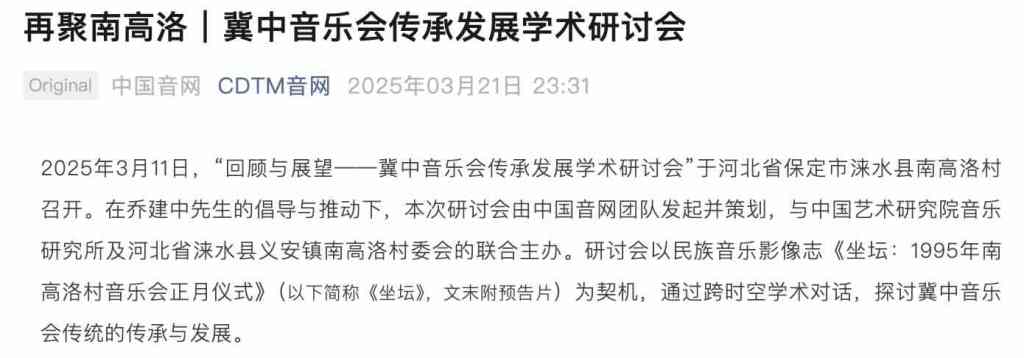
My new film on the 1995 New Year’s rituals in Gaoluo has recently been screened at a grand event (billed as a conference) in the village itself, thanks to the enterprise of Wei Xiaoshi (CDTM) in collaboration with Cai Yurun, who has long served both as leader of the ritual association and the village. A detailed review of the occasion has just appeared on the CDTM WeChat site (click here).

I’m delighted that my old fieldwork companion Xue Yibing could take part—we witnessed the New Year’s rituals in the village together for the first time in 1989, and his careful fieldnotes on Gaoluo and other villages over the next decade were invaluable (see mainly under Hebei in main Menu).

Gaoluo: our first visit to the Lantern Tent, New Year 1989.

Besides many of the villagers, delegations attended from a variety of musicological departments in Beijing, and from Hebei University. If only institutes of folk religious studies and sociology could be alerted to the significance of such ritual associations! But even if they were to venture beyond the safety of historical research into fieldwork on the condition of these groups since the 1940s, their ability to publish in China is ever more limited. 

One of my sessions with village litterateur Shan Fuyi, displayed on his daughter-in-law’s mobile.

I trust the film was well received, giving younger villagers an opportunity to glimpse their parents and grandparents in the days before the reified commodification inculcated by the Intangible Cultural Heritage began to influence their practices. With sonorous speeches inevitably the order of the day, the constraints of the occasion made me nostalgic for the informality of our fieldwork. The very setting, in a revamped Party Committee office, suggested how material conditions in the village have improved since my visits.

South Gaoluo New Year’s rituals, 2025. Images: Wei Xiaoshi.

Still, the religious context has not been lost: the New Year’s rituals still attract the village faithful, and the association still performs funerals for them. But the authoritative Cai Yurun voiced concerns that ICH support still can’t guarantee the future prospects of the association—in particular the vocal liturgy (which has been in a wider decline on the Hebei plain for many decades). It would take a further period of lengthy immersion in the villagers’ lives to learn their true perceptions (perhaps prompted by the film) on social and ritual change over these last thirty years. My film didn’t seem to prompt comments on how significantly the ethnographic perspective differs from the sanitised media approach typified by the ICH, but Zhang Zhentao has now published an intriguing review on this topic. Inevitably, whereas my book Plucking the winds stresses the constant tribulations of such villages under successive regimes, the prevailing congratulatory mood within China discourages such an approach.

Enbedded in the review of the event, the performance of the percussion suite in the courtyard, while still technically accomplished, inevitably lacks the spirit of the 1995 rendition before the gods. I doubt that this derives merely from the official secular context of the event; the total commitment of masters of yore like Cai An and Shan Rongqing seems to have been diluted.

Above: the association with helpers, 1995
Below: members of the association with connference delegates, 2025.

The Chinese version of the film will soon be available both on my YouTube channel (alongside the English version) and (in China) on the CDTM website. And do browse the posts under Gaoluo in the top Menu!

Click here for recent screenings in Leiden of my films on the Li family Daoists and Gaoluo.

With many thanks to Wei Xiaoshi!