
Uh-oh, I’ve been cajoled into giving local partygoers another burst on the erhu fiddle—* I’m more used to people asking me not to play it… This gives me another pretext to roll out my old excuses, such as “It was in tune when I bought it”, and “I just sort of… picked it up” (cf. my early days with Ray Man).
Along with Abing’s inescapable Erquan yingyue (immortalised in Yang Yinliu‘s 1950 recording), the plangent Jianghe shui (literally “River waters”, but often rendered, suitably, as “Song of suffering”) has been a mainstay of the erhu concert repertoire since the 1960s (see here, and David Badagnani’s notes).

The concert piece derives from a melody of traditional shengguan ritual wind ensembles in south Liaoning—sadly, I can’t find a rendition, so we’ll just have to imagine it from other recordings, such as the guttural shawms on #6 of my Audio Gallery in the sidebar (notes here). Soon after the 1949 “Liberation” it was adapted to the conservatoire style (for which see here, and here) as a solo for the double guanzi oboe (shuangguan)—here’s Gu Xinshan with the Lüda Song and Dance Troupe of Dalian in 1956:
Hu Zhihou on (single) guanzi, with a sparsely-inflected rendition:
and Hu Haiquan on suona shawm:
Indeed, the melody has re-entered the folk repertoire in Liaoning, as we can hear on #12 of the Ocora CD Chine: musiques de la première lune.
But Jianghe shui soon came to be known mainly as an erhu solo, accompanied by yangqin dulcimer, following Huang Haihuai’s 1962 arrangement—click here for his recording from 1963.
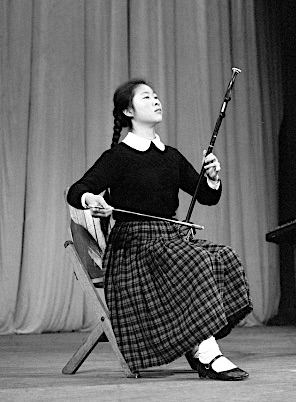
Min Huifen, 1963.
It became a signature piece of the great Min Huifen—here she is in 2007:
Even conservatoire solos were largely a male preserve until the 1980s (see e.g. the archive CD-set Xianguan chuanqi here), when women players began to dominate; see e.g. Song Fei’s lecture-demonstration on her own highly emotive interpretation.
In between the flexibility of the traditional wind ensemble style and the rigidly-prescribed conservatoire version, all I might add is that while playing Jianghe shui on erhu it’s always worth bearing in mind the plaintive timbre of the double reed. And I learn much from the sheer physical dynamism of the great players, their kinetic grace with both hands and arms. Of course I can’t even begin to emulate the sheer technical perfection of conservatoire virtuosos, but I can just about get away with it before an audience that has never heard real Chinese musicians who can actually play it. And as a change from my usual diet of rural funerals and temple fairs, it’s an interesting challenge to think myself into the heart-on-sleeve romanticism of the conservatoire style.
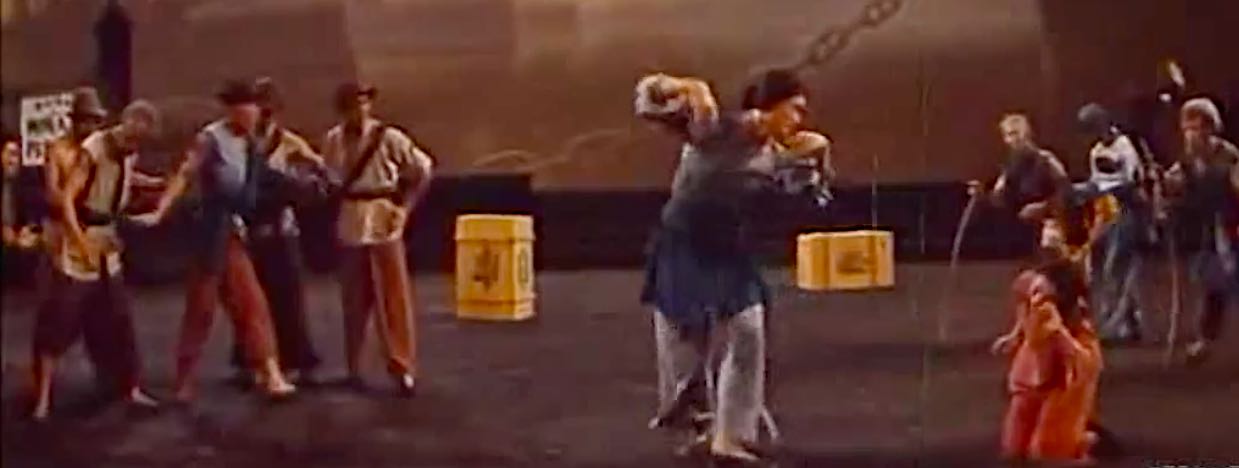
In 1965, on the eve of the Cultural Revolution, the wind version was included in the dance film The East is Red, in the overture depicting The Masses’ Sufferings under the Old Society (here, from 2.02). That conformist image may still resonate with some of the old Party faithful, but we might also hear Jianghe shui as evoking the sufferings inflicted on the people since “Liberation”, through all the campaigns of the Maoist era (see e.g. Guo Yuhua’s brilliant Narratives of the sufferers, China: commemorating trauma, and China: memory, music, society). Anyway, quite apart from conservatoire romanticism, the varied soundscape of the peasants themselves—local opera, folk-song, blind bards, shawm bands—is deeply imbued with suffering.
* Cf. my bold attempt to play Bach à la chinoise; for some real—nay astounding—erhu playing, don’t miss Sun Huang’s Saint-Saëns! Click here for an exquisite 1950s’ duet with qin zither. See also A brief guide to Chinese fiddles, and even Indian and world fiddles.
 Stephen Jones: a blog