Learning the gong

As I ponder this disturbing image of the Haunted Pencil, as a solo effort he shouldn’t find it too challenging, but it calls to mind (OK, my mind) the learning process in Chinese folk ensembles.

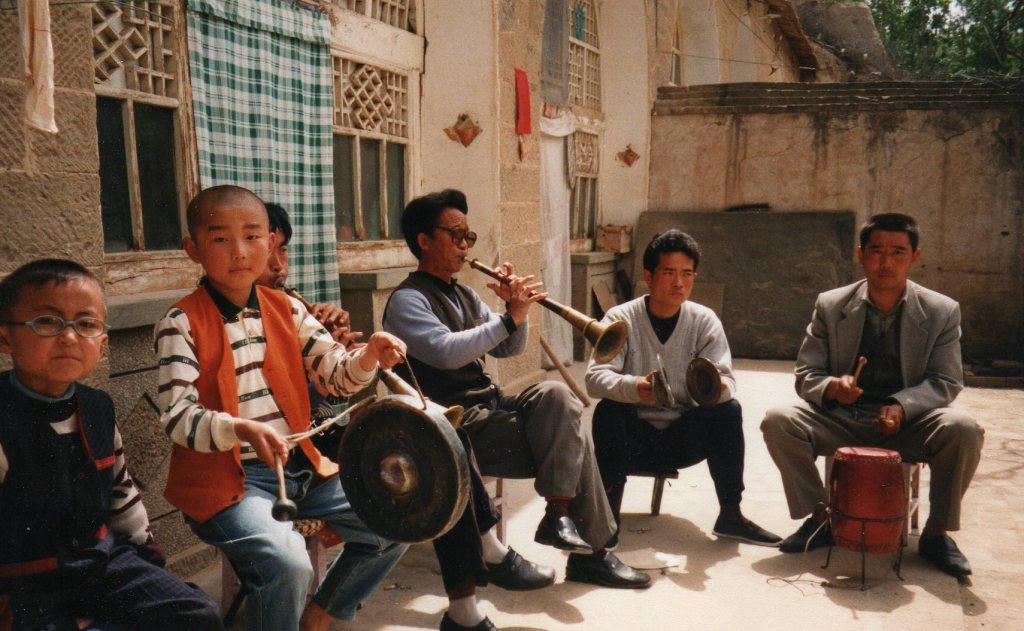
Left, Li Qishan’s band, Shaanbei.
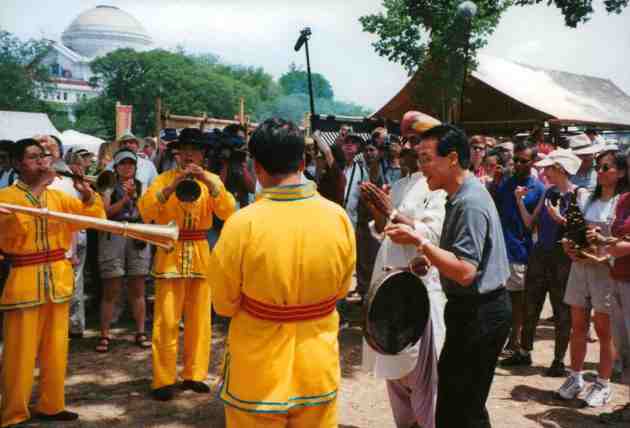
Right, I accompany the Hua family band, funeral.
Both images 2001.

Youngsters in a family shawm band begin with the gong, which merely marks the first beat of every bar as the tempo accelerates. This seems simple enough, but as the illustrious Yoyo Ma discovered at the 2002 Silk Road Festival in Washington DC, the novice still needs to acclimatise to the bewildering rhythmic patterns of drum and shawm, which subvert the regular duple metre:

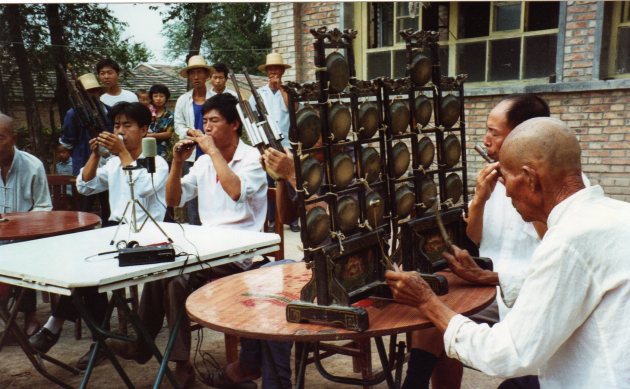
Only somewhat harder to learn is the yunluo, a frame of ten pitched gongs that makes an exquisite part of the shengguan ensemble in ritual groups of north China. While it does involve learning the outline of the melody, it’s still considered the easiest instrument to learn—as a proverb in Hebei goes, “A thousand days for the guanzi, a hundred days for the sheng; you can learn the yunluo by the fifth watch”.

Gaoqiao village ritual association, Bazhou, Hebei 1993;
one player on two frames of yunluo.

Further afield, fatuous Tory toffs like the former Minister for the 18th Century are just as unlikely to apply to join a gamelan ensemble. Cf. Batman’s mum calling him to supper.

The Heritage razzmatazz in Zhejiang

In the recent CHIME newsletter (subscribe here, under Newsletter), by contrast with Frank Kouwenhoven’s renewed project on temple festivals in Gansu, he reports on the CHIME “travelling fieldwork conference” last November under the aegis of the Zhejiang Conservatory of Music in Hangzhou.

Such a project may sound attractive, changing the focus from dry lectures to engagement with local performers. But despite the best intentions of the regional organisers, the event turned out to be at the mercy of Heritage kitsch. As Frank recalls, things were a good deal more relaxed and more open-minded in 2006, when CHIME held a similar conference in Yulin, Shaanbei. However, I suspect such brief “hit-and-run” missions with large organised gatherings of foreigners and outsiders are inevitably flawed—as Frank comments, “beset with problems, unwanted side-effects, and distortions of local culture”.

In rural China, soundscapes are based in local ritual. But

sadly, participants were mainly taken to tourist villages, which featured many sanitised and commercialised versions of local traditions. […] Perhaps the higher echelons of the conservatory leadership, who picked these targets, were keen to project first and foremost a “modern”, more glamorous image of China’s rural musical cultures. But was the idea that we, the participants, would view the tourist shows as authentic stuff? Many of us happen to be seasoned music scholars, we have already done quite a bit of field research on local genres, perhaps in other parts of China, and sometimes for years or decades on end. But the rest of us, those mainly engaged in educational work or research outside China, would clearly be just as aware that villages in China do not normally require visitors to buy entrance tickets, nor harbour folk singers who dress up in fancy costumes and make ballet-like movements while they sing.

Why not visit a Daoist temple instead, with priests performing ritual opera, a fascinating genre definitely available in Zhejiang […]? Or why not schedule one trip to a local temple fair, where one might come across a whole range of local folk rituals and ceremonies, not tampered with by professional “stage directors”, village heads, or tourist managers?

At Shengzhou the trip sampled Yueju 越剧 opera (now associated primarily with female performers, also in male roles), comparing the student performances at the professional opera school with an amateur group performing at a nearby temple.

The school students behaved rather nervously, as if they were doing auditions, whereas the amateurs seemed more relaxed. As one might expect, the amateurs sounded more folksy and flexible, more rough also in their use of dialect, their tunes were more angular, less polished, mellifluous or spun-out than the “academic” ones. The amateurs were playing mainly for their own enjoyment, or for us and a small in-crowd of connoisseurs, in contrast to the more official shows which teachers and students of the Yueju school may present at commercial stages for paying audiences. […]

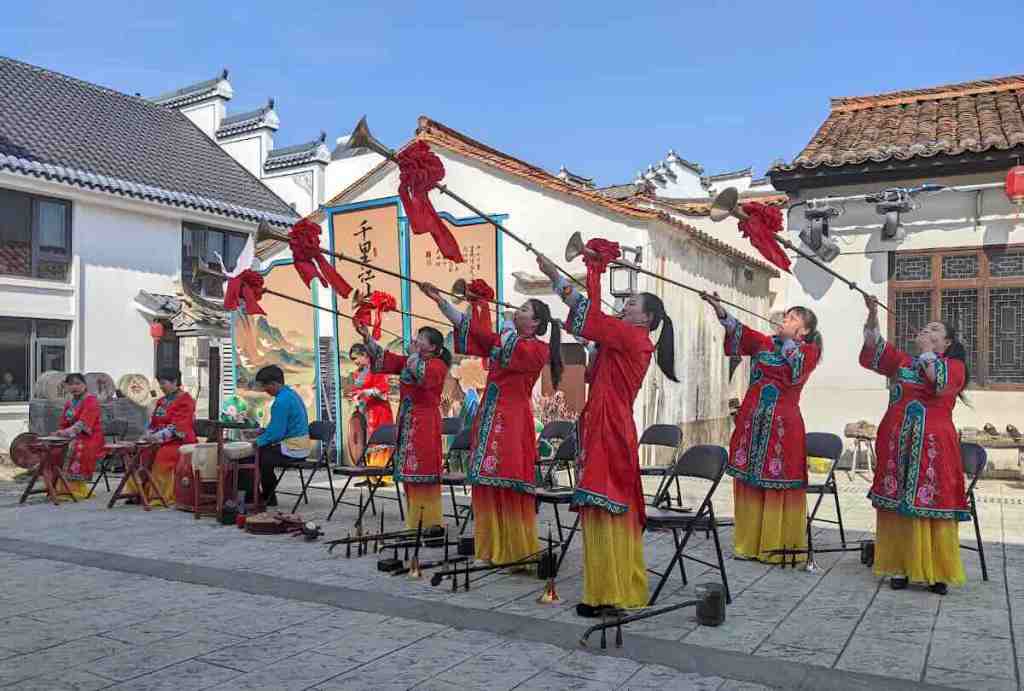
Wuju instrumentalists playing long trumpets.

In Jiangshan they also sampled Wuju 婺剧 (aka Jinhua opera). They found that dividing lines between “professional” and “amateur”, between state-funded and private enterprises, not always predictable or clearly defined.

Perhaps the most inspiring group they encountered was a group of string puppet players, again in Jiangshan.

They turned up once every two weeks at the tourist village to do some shows, which is also where we encountered them, but most of the time they’d perform puppet shows in the framework of local temple festivals.

Frank reflects ruefully:

Whether it is wise to undertake another conference on a basis of  “traveling fieldwork” in China remains a question. It may well be that the country, in its current very politicised phase, is not sufficiently open to the full potential of rural musical traditions (especially religiously inspired ones).

* * *

In Hannover and Hildesheim the previous month, CHIME held a more conventional academic conference exploring such issues, with the theme of Sustainability and Chinese music.

The splendid Xiao Mei gave a keynote speech showing how ethnic minority performers have adapted admirably to changing times, with few concessions to the traditional character of their music. Frank summarises:

Mobile phones and modern means of transport have come to play crucial roles in the organising of traditional gatherings, and in the transmission of songs and tunes. It means that the traditional spaces designated for meeting one another and joining musical rituals (e.g. temples, sacred sites, mountain tops etc) have greatly expanded: singers may now also join events online, from a remote distance.

In another fine keynote, Huib Schippers pointed out that China is currently spending more money on Intangible Cultural Heritage than any other country in the world. As he pointed out, local people frequently feel disempowered when dealing with authorities. “Only rarely do we hear stories from anywhere in the world where [members of] communities have a real sense of agency in preserving their music”.

And things may become still more difficult in China because of the strong weight attached there in state propaganda to “progress” and “modernisation”. Schippers quoted Gao Shu, a scholar who states that “when traditional musicians in various regions know they will be visited by the Ministry of Culture and Tourism, they change their performance to match what they think is expected of them, rather than playing the music they and their communities value most, in the way it is valued by them”.

What would this amount to in practice? The description might easily evoke cartoonesque images of local village heads, quickly taking action to dress up their local performers in fancy costumes and push musicians onto a stage, while adding all sorts of “extras”, synthesisers, guitars, amplification, light shows, anything that might enhance the chance of their genre being elected as ICH. After all, it could trigger financial support. One can easily also imagine the musicians themselves taking such steps. Unfortunately, this is not comic fantasy, but a plain reality. Fieldworkers in China have reported many instances of overnight transformations of traditional genres. At times they offer a rather bleak panorama of local ICH projects. Such projects, though intended to support and reinforce centuries-old local heritages, may actually distort or destroy them.

For instance, Frank summarises Gao Inga’s discussion of a group of local puppeteers in Huayin, Shaanxi:

The local authorities told them to do away with their shadow screens and shadow puppets, which the officials presumably thought of as old-fashioned or dull. Instead, the players (who had been a “sitting’”band as shadow puppeteers) were now requested to dance to music on stage, initially music from their own repertoire, but soon new music was added, infused with bass, keyboard and other pop instruments. All of these alterations were decided and directed by a local official, who was not part of the original crew.

It’s fine if local performers take autonomous decisions to modernize their own shows, but if government officials apply the ICH label to justify a complete facelift of a rural genre, as happened in Huayin, it becomes questionable. Even if the performers in this case seemed to be happy in their new roles, and with the regular incomes now allotted to them, one cannot help but judge this as a form of destruction. The case was in no way unique. Several of us have come across similar incidences of local shadow theatre cultures being destroyed by local authorities on the pretext of “developing” and “sustaining” them.

A Dunhuang symposium

On 21–22 February, to mark the closing of the exhibition A Silk Road oasis: life in ancient Dunhuang, the British Library is to hold a two-day symposium (also livestreamed online)—full programme here.

Besides religion and art, literature and languages, topics among a wide range of fascinating papers include the Buddhist slave trade, medicine, costume, and everyday life. And to follow October’s concert curated by Wei Xiaoshi (cf. the British Museum event), he will elaborate on the multi-faceted musical life of Dunhuang.

Temple festivals in Gansu

Complementing updates by Frank Kouwenhoven in the new CHIME newsletter (subscribe here, under Newsletter) on silk-and-bamboo music, I also appreciate two further field reports from him, again written in his communicative style. First he writes on huar 花儿 song festivals in Gansu and Qinghai provinces of northwest China. [1]

Part of the wider phenomenon of shan’ge “mountain songs”, huar has long been a hot topic in Chinese folk-song studies. With his late lamented partner Antoinet Schimmelpenninck, Frank made fieldwork trips there from 1997 to 2009. Do read his substantial chapter

  • “Love songs and temple festivals in northwest China” in Music, dance, and the art of seduction (2013, soon also to appear on his website), which he co-edited with James Kippen—altogether a fine volume, with a particular focus on India. 

In a rapidly changing society, Frank has recently embarked on a restudy, which he outlines with engaging vignettes in the newsletter.

Though huar (an umbrella term) has long been commodified, with leading singers recruited to regional song-and-dance troupes to perform on stage, [2] Frank characterises its local folk basis as part of “the universal triangle of music, sex, and religion”. As often, the study of such festivals should be carried out not only by musicologists but by ethnographers and scholars of ritual. They should also be incorporated into the thriving field of Amdo studies, [3] addressing a complex ethnic mix—Han Chinese, Tibetans, Hui and other Muslim groups, Dongxiang, Bao’an, Salar, as well as various Monguor-speaking groups. Under the current censorship regime within China, and for a region long troubled by ethnic tensions and poverty, one can hardly expect frank coverage of religion or sex—or indeed politics.

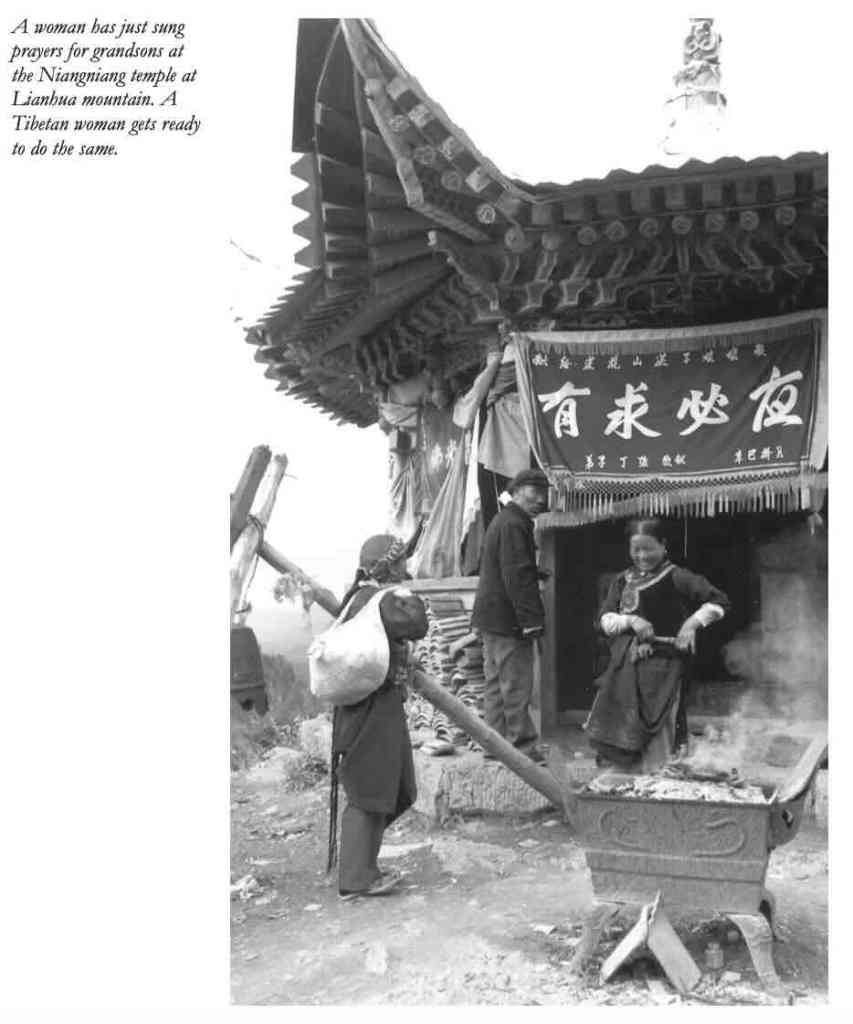
In 1993 Xi Huimin listed nearly one hundred festivals for Gansu and Qinghai (reproduced in Qiao Jianzhong, vol.1, pp.125–8); by 2013 Frank provided a map of 213 festivals in south Gansu alone (Music, dance, and the art of seduction, p.158). The largest and best-known festival is that of Lianhuashan. As he observes, the content of every festival is shaped by local needs and circumstances. Motives for attending include entertainment, contact with the gods, political affairs, and solving social problems, all closely intertwined.

Festivals are not merely places for pilgrimage, prayers, and chance encounters with strangers. They are major social events, combining markets, opera plays, disco dancing, kung fu movies, sooth-saying ceremonies, acrobatic shows, horse races, ritual processions of local gods, prayer sessions and a great deal more.

But the Chinese media

usually present these songs as a harmless form of musical entertainment, and often refer to the temple festivals in which they are sung as ‘hua’er festivals’, as if the songs are unrelated to the ritual settings, and void of religious connotations.

Still,

Some scholars who ignore or deny connections between hua’er and temple worship may do so not out of real conviction, but mainly in order to protect hua’er culture: religion is a politically sensitive topic in China, and in the past several local ritual traditions are known to have been forbidden by the authorities after details about them had been published in academic studies.

Frank also notes the Buddhist and folk-religious songs performed inside the temples, as at the Upper Bingling temple festival (pp.127–34).

As ever, it would be good to glean material on the maintenance of such local events through the Maoist decades (cf. Sparks). Even

during the Cultural Revolution, people went on singing at the risk of being arrested or attacked by Red Guards. Complete battles took place between hua’er singers and Red Army soldiers at Lianhuashan after the government had forbidden the festival there.

Frank’s chapter goes on to discuss courtship and sex, sacred singers in mythology, and fertility cults; power, authority and competition at temple festivals; and ethnicity.

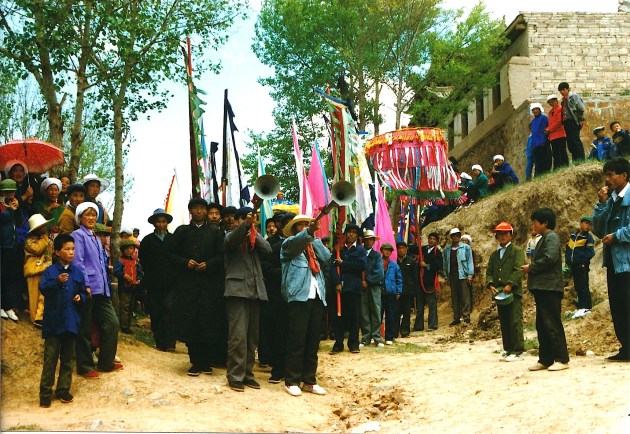
Hornblowers at the head of the annual procession of the eighteen gods in Xincheng, 1997.

His recent fieldwork focuses on the festivals at Erlangshan (Minxian) and Xincheng. As in his earlier chapter, he notes how processions of the gods often result in violence. In Xincheng,

We recorded violence between three such groups at one spot near the south gate, resulting in bloodshed, chaos, people squeezing one another, and furious quarrels flaring up between individual men. A big police force had been kept on standby. It soon arrived on the scene, some twenty, thirty men including national guards, but they were unable to calm down the mob.

A bunch of daredevils had used their sedan chair as a weapon, pushing and chasing another sedan chair down the road. It was as if the gods themselves were taking up a fight. The dense crowd began to move, shouting, gesturing, and the assembled policemen were involuntarily pushed along.

Sedan bearers start a fight in Xincheng.

Running up the stairs of the temple with a sedan chair
(cf. mediums’ sedans in Shaanbei).

Among recent changes on Erlangshan, Frank notes that some singers themselves now favour amplification:

It made their singing much louder, but obviously undermined the option for most people to join in spontaneously with a phrase or a couplet, precisely the thing that had made the whole tradition so endearing: the free-flowing exchange of lyrics, an ever ongoing battle of wits… Now, the person in a crowd holding the microphone would decide whom to give it to for a reply, with all others essentially being excluded from the sung conversation.

Frank also documented devotional songs in nearby villages. While musicological analysis is always desirable, I’m keen to see more research on the ritual aspects of these cultures in changing society.

In Minxian he also attended a grand stage show, illustrating the secularisation and commodification of local culture—leading nicely to his next topic, which I introduce here.


[1] Frank’s 2013 chapter includes a useful bibliography of works on hua’er in Chinese and English. Among publications are several surveys by Qiao Jianzhong (in vol.1 of his works), as well as studies by Du Yaxiong and regional scholars such as the folklorist Ke Yang. One should also consult the Anthology folk-song volumes for Gansu and Qinghai. Rather than the conventional rendering hua’er, I favour the form huar. Links to further posts on Gansu here.

[2]  Among such “stars” of huar was Zhu Zhonglu 朱仲禄 (1922–2007), subject of several CDs (and tracks on the archive set Tudi yu ge); this documentary, though straight-laced, is representative of the official image.

[3] Note the Amdo Research Network, and references here.

The Zen of football

It’s taken me a while to catch up on the role of Zen in football—and when I did, it took the unlikely form of of witnessing it used as a rebuke.

Last weekend, wunderkind Myles Lewis-Skelly * celebrated scoring Arsenal’s brilliant third goal against Man City by adopting a pose which mimicked that associated with Erling Haaland, underlining City’s discomfort. It turns out that meditation has become a niche avenue to footballing success, adopted by players such as Mo Salah, Raheem Sterling, and Anthony Gordon (see e.g. here). Still, I’m not holding my breath for a time when this converts footballers to regarding referees as Daoist sages, meekly accepting their decisions—as in rugby.

David Squires sums up the karmic action in cartoon form here. For more detached applications of Eastern Wisdom, see Daoism and standup, Sprezzatura and wuwei, and in sport, A god retires. Cf. Daoist non-action. See also under A sporting medley, including Philosophers’ football.


* In My Day, such a name would have been more likely attached to a mustachioed colonial brigadier…

Not quite an update

I’m not exactly hibernating, but while I have various projects on the go, new posts are few and far between at the mo—so meanwhile do keep working through my previous ouevre:

Meanwhile, to follow this update on Nicolas Magriel’s voluminous sarangi site, he continues to add precious material… (see also under A garland of ragas).

I’m trying to abandon the iniquity of Twitter by moving to BlueSky, so do follow me there.

“Normal service will be resumed as soon as possible”