Musical-joke-dating

I’m sure you know the Big Tune of the “March to the Scaffold” in Berlioz’s Symphonie Fantastique. Don’t you. Here’s S-Simon again, with the LSO in 2019:

Anyway, among all the spoof lyrics concocted by musicians to fit symphonic melodies, this is my favourite:

x

What makes it still more delightful (for the ethnographer, ahem) is that one can more or less date it to London in the late 1960s—the thrill of the new… *

For a datable viola joke about the Beatles, see here; for Berlioz on oriental music, here; and for a complete performance of the symphony, here.

Brits were still seduced by the allure of exotic cuisine in the 1990s, as parodied in the classic Goodness gracious me sketch (“What’s the blandest thing on the menu?'”).


* “Curry” appeared on the menu of a coffee house in the Haymarket as early as 1773. By the 1930s one could buy curry powder, poppadoms, and mango chutney in Portobello, and several Indian restaurants opened in Soho, as well as in Glasgow and Cambridge. By 1970 there were 2,000 Indian restaurants in Britain. See under Bloody foreigners.

Schubert

From Alan Bennett’s 1996 diaries, on his early musical upbringing:

“I also bought a record of Schubert’s Unfinished Symphony, doubly unfinished in this case as I only got one record out of a set of three, so it wasn’t until years later that I found out how it officially didn’t finish.”

Generally I don’t rate drôle ads much, but this is apposite:

Cf. Creative tribulations, and for another unfinished work, Modulation: Schubert and Coltrane.

Limerick

That first English haiku is matched by this:

There was a young man from Japan
Whose limericks never would scan
When asked why this was
He replied “It’s because
I always try and fit as many words into the last line as I possibly can”

which complements

There was an old man from Peru
Whose limericks stopped at line two

For more limericks, see here and here. Oh, and here. And now, some Portuguese- and Polish-themed limericks!

Fieldwork and textual exegesis

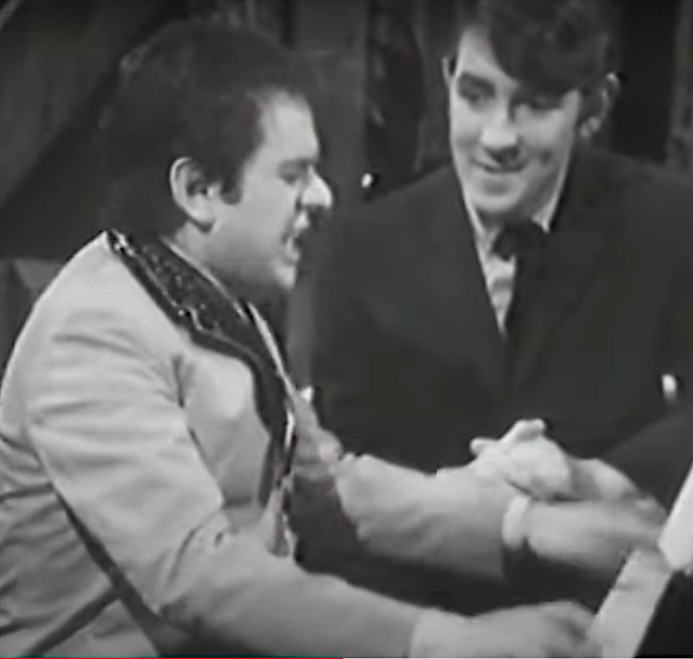
Bo Dudley

Academic interpretation gets its comeuppance:

Fieldworkers beware…

The longer audio version (on Derek and Clive live, 1973) has some pleasing further vignettes, like:

And then we hear the words “Right on baby!”…
Seems a little puzzling, “Write on baby”…
Well, let me explain: the father of the house has just walked into the wigwam, and he says “Write on baby” to the mother, meaning “write the shopping list on the baby for tomorrow morning”. […] Paper was scarce…
And then we have the line, “Get down baby!”—the baby realises that once again it’s going to be written on, and has climbed the wall. This is one of those distinctive, um, boogie, Harlem instincts…

Cf. Got my mojo working.

For more and less successful enterprises, see the fieldwork category in the sidebar. And for more from Dud, see Dud’n’Pete tag, not least the psalm, and his Britten spoof in Stella Gibbons’s brilliant Em creeps in with a pie. See also Alan Bennett’s sermon, and  Replies from the Complaints Department.

Sermon

Sermon

Reading of the long sermon that separated Parts One and Two of the Matthew Passion in Bach’s Leipzig performances, people of my generation will find it hard not to reference Alan Bennett’s classic skit:

Which just goes to show how very different our world is from that of Leipzig audiences in the 1720s…

The language, with the clergyman gamely reaching out to his flock with expressions like “Stuff this for a lark”, was so quaint as to amuse even the 1950s’ audience, then my generation in the 1970s, and still now (cf. Reception history).

In his 2014 sermon at King’s College Cambridge, AB reflects:

Like all parodies it was born out of affection and familiarity and the Anglican services that were in my bones, and there is symmetry here as the first sermon I preached on a professional stage was in Cambridge fifty odd years ago across the road at the Arts Theatre in the revue Beyond the Fringe. It was on the text, “My brother Esau is an hairy man but I am a smooth man”. That sermon apart I have never formally preached since until this morning and here I am again in Cambridge.

And with his defence of education for all, it’s a highly political sermon.

For Confucius and other boring prophets, see here.