

Under the current political regime in China, we may have doubts about the scope for in-depth field research; but in the sphere of musicology, grand compilations of previous work continue to proliferate impressively, such as a valuable recent publication from the Music Research Institute (MRI) of the Chinese Academy of Arts:
- Zhongguo chuantong yinyue kaocha baogao 中国传统音乐考察报告 [Field reports on traditional Chinese music] (ed. Zhongguo yishu yanjiuyan Yinyue yanjiusuo, 10 vols, 2022),
reproducing the MRI’s original fieldwork reports (mostly mimeographs) dating from the 1949 “Liberation” through to the eve of the 1966 Cultural Revolution. For each subject, lists of recordings made at the time are appended. For introductions to the compilation, see e.g. here and here.
Volume 1 is prefaced by an authoritative survey from the redoubtable Zhang Zhentao 张振涛. Scholars now delineate three periods in the modern history of Chinese music fieldwork: the Maoist decades, the Anthology (1980s–90s), and the Intangible Cultural Heritage (ICH) era since around 2004. As Zhang reflects, after the fieldwork for the Anthology and its publication, we didn’t know if we still needed to read these pre-Cultural Revolution “field reports” and what value they might have. The majority of these traditions were, and are, embedded in ritual life—which maintained activity, at least until the Great Leap Forward, and again in the brief interlude between the easing of the ensuing famine and the 1964 Four Cleanups. However, the bulk of these studies focuses on narrowly musical aspects, so clues to social ethnography are in short supply—over a period of great change. Interviews were often conducted during visits by folk groups to urban festivals. Nonetheless, I am as full of admiration as Zhang Zhentao for the achievements of these early scholars.
If the political climate under Maoism had dictated a cautious approach towards ritual, the Anthology era began to hint at a more mature approach to social ethnography; but under the ICH such study is again being hampered by a sanitised patriotic agenda.
In my early years from 1986 visiting the MRI archives in Zuojiazhuang—then still permeated with the atmosphere of Maoism (see under Qiao Jianzhong)—I was immensely fortunate to have access to such studies, photocopying flimsy mimeographs, and I have introduced some of them in earlier posts. They formed a basis for the Anthology fieldwork after the liberalisations of the 1980s. These volumes have long been somewhat hard to find, so I hope they will now be more accessible—as long as libraries outside China can afford to stock the compilation.
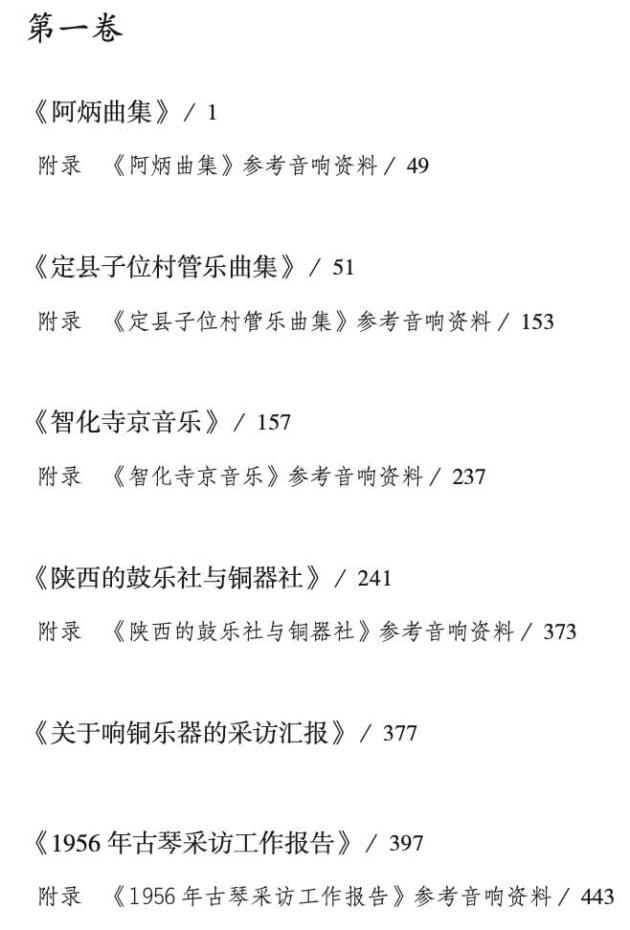
Contents, vol.1.

Zhang again stresses the crucial leading role of Yang Yinliu. Vol.1 opens inevitably with his iconic A Bing quji (1979, based on their long acquaintance before Yang’s 1950 recordings), and his equally numinous studies of northern instrumental traditions: Ziwei village in Dingxian, Hebei (1952), the Zhihua temple (1953), and Xi’an guyue (1953). Vol.5 also includes a report, new to me, on “musical life” in the rural suburbs of Beijing (cf. here). Several studies address Shanxi, such as two reports from 1953—on folk-songs in Hequ, north Shanxi (vol.4), and yangge and huagu (vol. 5).

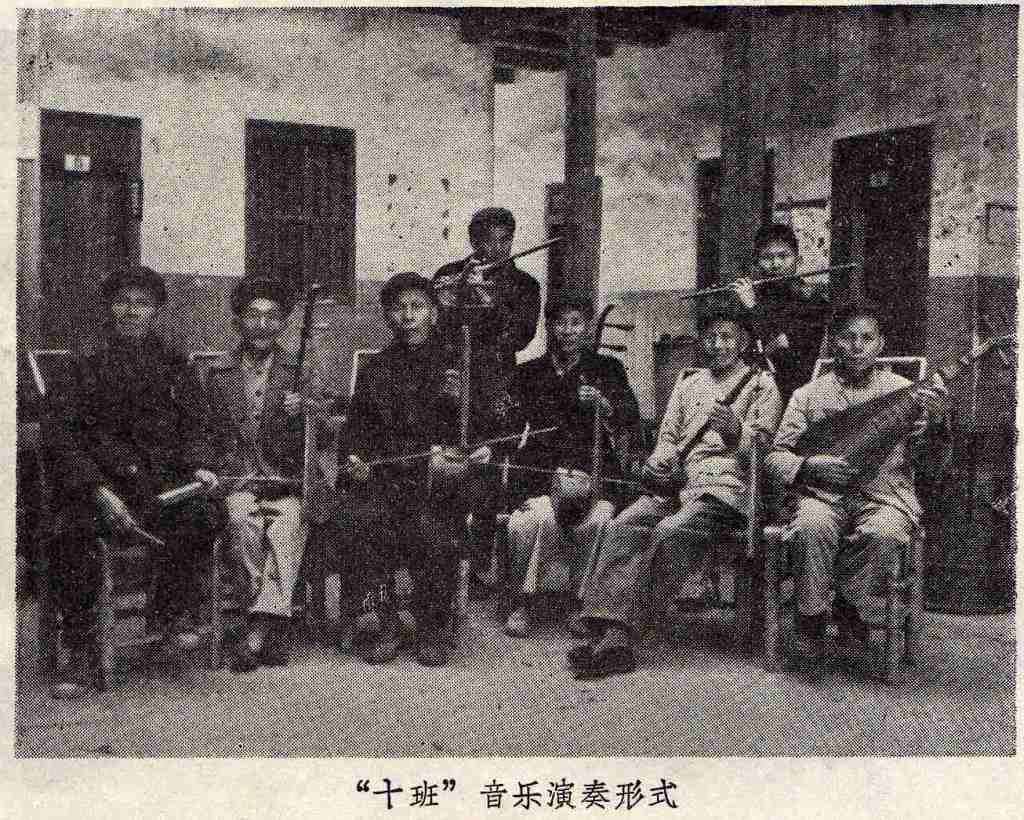
Vol.1 ends with the 1956 national survey of the qin zither scene led by Zha Fuxi. Vol.3 is devoted entirely to the extensive 1956 Hunan survey led by Yang Yinliu, and vol. 6 includes his insider’s study of the paraliturgical instrumental ensemble music of Daoists in Wuxi, south Jiangsu. Li Quanmin’s report on his 1961–62 survey around Fujian (vol.7) laid a basis for later work there. Vol.4 features an essay on issues in collecting folk-song and instrumental music; vol.10 ends with the 1963 handbook Minjian yinyue caifang shouce 民间音乐采访手册.
Vol.2 is devoted to narrative-singing: danxian paiziqu, narrative-singing in Tianjin, bajiaogu in Liaocheng (Shandong), the liqu of Pu Songling (a rare historical departure), the qingqu of Yangzhou, and Henan quzi.
Studies of the ethnic minorites also punctuate the compilation—such as folk-songs of the Dong and Miao people in Guizhou, and Baisha xiyue in Yunnan (vol.4); the lusheng mouth-organ of the Miao (vol.6), and Mao Jizeng’s 1959 pamphlets on nangma and toshe in Tibet (vol.5). Vol.7 includes further reports from Yunnan, as well as Hainan, and from national events showcasing folk dance and amateur musical life among ethnic minorities. Vols 8 and 9 contain 1958 reports on minority arts festivals, and vol.10 reports on opera festivals—including interviews with performers that give clues to social change before and since “Liberation”.
While the MRI was most prolific and prestigious, many other organisations published field reports through the period—on topics such as Wutaishan, Suzhou Daoist ritual, Yangzhou Daoist pieces, “old customs” in Wenzhou, and (in Shaanbei) the White Cloud Mountain and amateur musicking in Yulin. See under the fieldwork category, including reflections in this edited volume; as well as Images from the Maoist era.
The era came to an end by 1964 with the tense political climate that led to the Cultural Revolution, silencing both traditional culture and its study until after the reforms of the late 1970s.
 Stephen Jones: a blog