
The blending of ritual texts reminds me of Woody’s Allen’s Without Feathers:
The Great Roe: a mythological beast with the head of a lion and the body of a lion, though not the same lion.

The blending of ritual texts reminds me of Woody’s Allen’s Without Feathers:
The Great Roe: a mythological beast with the head of a lion and the body of a lion, though not the same lion.

The work of Frits Staal on Indian ritual contains much from which scholars of Daoist ritual (not least I) might benefit, confronting issues that I encounter in working with Li Manshan. Staal’s ideas about orthopraxy seem to go beyond the discussions following those of James Watson for China. There’s a lot more to Staal’s work than that, but this is a start.
In “The meaninglessness of ritual”, [1] Staal eschewed “the dewy-eyed romanticism that is pernicious to any serious study of cultures and people.”
A widespread but erroneous assumption about ritual is that it consists in symbolic activities which refer to something else. It is characteristic of a ritual performance, however, that it is self-contained and self-absorbed. The performers are totally immersed in the proper execution of their complex tasks. Isolated in their sacred enclosure, they concentrate on correctness of act, recitation and chant. Their primary concern, if not obsession, is with rules. There are no symbolic meanings going through their minds when they are engaged in performing ritual.
Such absorption, by itself, does not show that ritual cannot have a symbolic meaning. However, also when we ask a brahmin explicitly why the rituals are performed, we never receive an answer which refers to symbolic activity. There are numerous different answers, such as: we do it because our ancestors did it; because we are eligible to do it; because it is good for society; because it is good; because it is our duty; because it is said to lead to immortality; because it leads to immortality. A visitor will furthermore observe that a person who has performed a Vedic ritual acquires social and religious status, which involves other benefits, some of them economic. Beyond such generalities one gets involved in individual case histories. Some boys have never been given much of a choice, and have been taught recitations and rites as a matter of fact; by the time they have mastered these, there is little else they are competent or motivated to do. Others are inspired by a spirit of competition. The majority would not be able to come up with an adequate answer to the question why they engage in ritual. But neither would I, if someone were to ask me why I am writing about it.
[…]
Most questions concerning ritual detail involve numerous complex rules, and no participant could provide an answer or elucidation with which he would himself be satisfied. Outsiders and bystanders may volunteer their ideas about religion and philosophy generally—without reference to any specific question. In most cases such people are Hindus who do not know anything about Vedic ritual. There is only one answer which the best and most reliable among the ritualists themselves give consistently and with more than average frequency: we act according to the rules because this is our tradition (parampara). The effective part of the answer seems to be: look and listen, these are our activities! To performing ritualists, rituals are to a large extent like dance, of which Isadora Duncan said: “If I could tell you what it meant there would be no point in dancing it.”
Ritual, then, is primarily activity. It is an activity governed by explicit rules. The important thing is what you do, not what you think, believe or say.
This echoes Catherine Bell’s comment that I cited in my post on Bach and Daoist ritual—for her masterly surveys of ritual studies, click here.
Here’s a trailer for Staal’s 1975 film on the Vedic fire ritual:
Poul Andersen offers caveats to Staal in a review of volumes on Shanghai Daoist ritual (Daniel Overmyer, Ethnography in China today, pp.263–83). He highlights the interpretations of the participants (including the liturgists themselves), which “in many ways influence the actual performance. They are relevant for the way in which performances take shape, develop, and are modified over time.” Such interpretations, while important, rarely offer a detailed critique, so such a view refines rather than refutes Staal’s point.
I pursue the theme under Navajo culture.
[1] Numen 26.1 (1979): 2–22. See also Ritual and mantras: rules without meaning (Motilal Banarsidass, 1996), and (source of my quote here) S.N.Balagangadhara, “Review of Staal’s Rules without meaning”, Cultural dynamics 4.1 (1991), pp.98–106.
In my book (p.261) I glibly compared the Li band’s hymns to the arias in the Bach Passions, “where action and drama are suspended while we contemplate the deep meaning of a scene.” In most elite Daoist and Buddhist temples, liturgy is accompanied only by percussion, not melodic instrumental music. Many of the Li band’s hymns are sung thus, a cappella—including those used to Open Scriptures in the morning and afternoon.
Whereas Chinese studies of northern Daoist and Buddhist “music” often focus almost entirely on shengguan melodic instrumental music, in my book (ch.16) I try to put it within the ritual context. But does the shengguan accompaniment (notably the constant variations of the guanzi) express what the vocal text is unable to embody?
As usual, this is not a close parallel, but one thinks of Erbarme Dich:
“Language is not essential to this moment, or even adequate to it. A verbal penitence is expressed by the alto voice, but the violin expresses a more universal distress.” (Gardiner p. 422, citing Naomi Cumming).
But remember, I find nothing akin to word-painting in the Li band’s vocal repertoire (my book p.277):
I can find no matching of melody to textual content. There is nothing akin to word-painting, no illumination of the meaning of the text through music. Vocal liturgy is capable of arousing emotion, as for instance it should do in the Song of the Skeleton (see Yesterday…), but this is achieved through the general style of delivery rather than the specific text-setting. In musical style the Song of the Skeleton is no different from other hymns, and even its desolate text is not comprehensible when sung.
So expression is conveyed mainly through timbre. The more I listen to Li Manshan and Golden Noble, the more impressive I find the mournful nasal quality of their voices; I can sing some hymns, but can’t emulate this. They have utterly absorbed the meaning of the texts into their voices. And when the shengguan accompanies, Wu Mei complements them perfectly on guanzi, managing to combine a deeply mournful tone with an almost playful way of weaving in and out of the melodic line, ducking and diving, sometimes soaring. The singers recognize that a good guanzi player is a great help to them in rendering the text.
Anyway, both the decorations of a Daoist on guanzi and Bach’s oboe lines are spellbinding—an intrinsic part of the realization of the text. So I both demote and stress the shengguan accompaniment.
Beyond the transition of the Passions from liturgical to concert performances, the staged versions of recent years can also be compelling (for us):
And we’re already in tears (along with Peter) from the recitative of the Evangelist that introduces it. The shuowen introits of the Daoist also introduce arias…
Those of a sensitive disposition may wish to avoid reading my Textual scholarship, OMG.
I have outlined the importance of the Song of the Skeleton in the rituals of both north and south China (In Search of the folk Daoists pp.233–4). It’s a common theme throughout the north—mainly as part of the yankou, both Daoist and Buddhist.
In Yanggao Daoist ritual (Daoist Priests of the Li family, pp.274–5), several hymns are related. The Mantra of the Skeleton (Kulou zhenyan 骷髏真言, more commonly known here by the melodic label Wailing to Sovereign Heaven, Ku huangtian 哭皇天) is prescribed, a cappella, for Opening Scriptures on the first afternoon of a funeral.
It’s a kind of catalogue aria, with seven long verses for the visits to the stations of purgatory over seven days. Its melodic material overlaps substantially with that of other hymns, beginning with the opening of the Diverse and Nameless melody (Daoist priests pp.267–8). The melismatic “Ah, Skeleton” (Kulou) refrain, and the coda in pseudo-Sanskrit (also in common with Diverse and Nameless), are not written here in the manual. My film (from 56’08”) shows the sixth verse:
Ah Skeleton! Skeleton!
On the sixth day he reaches Netherworld Souls Village
His sons not to be seen
Starving and parched, at his wits’ end,
Desperate to sup broth.
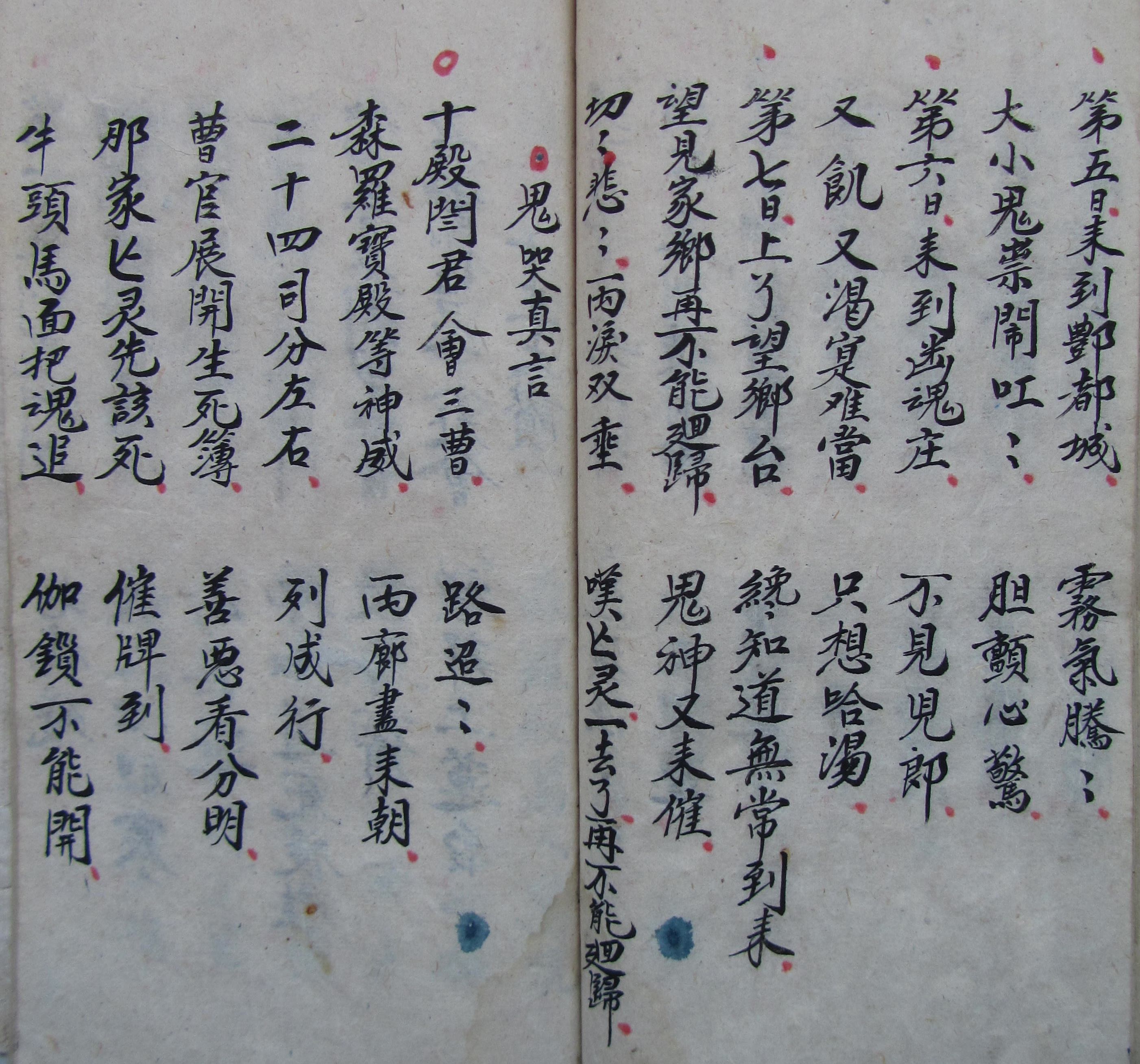
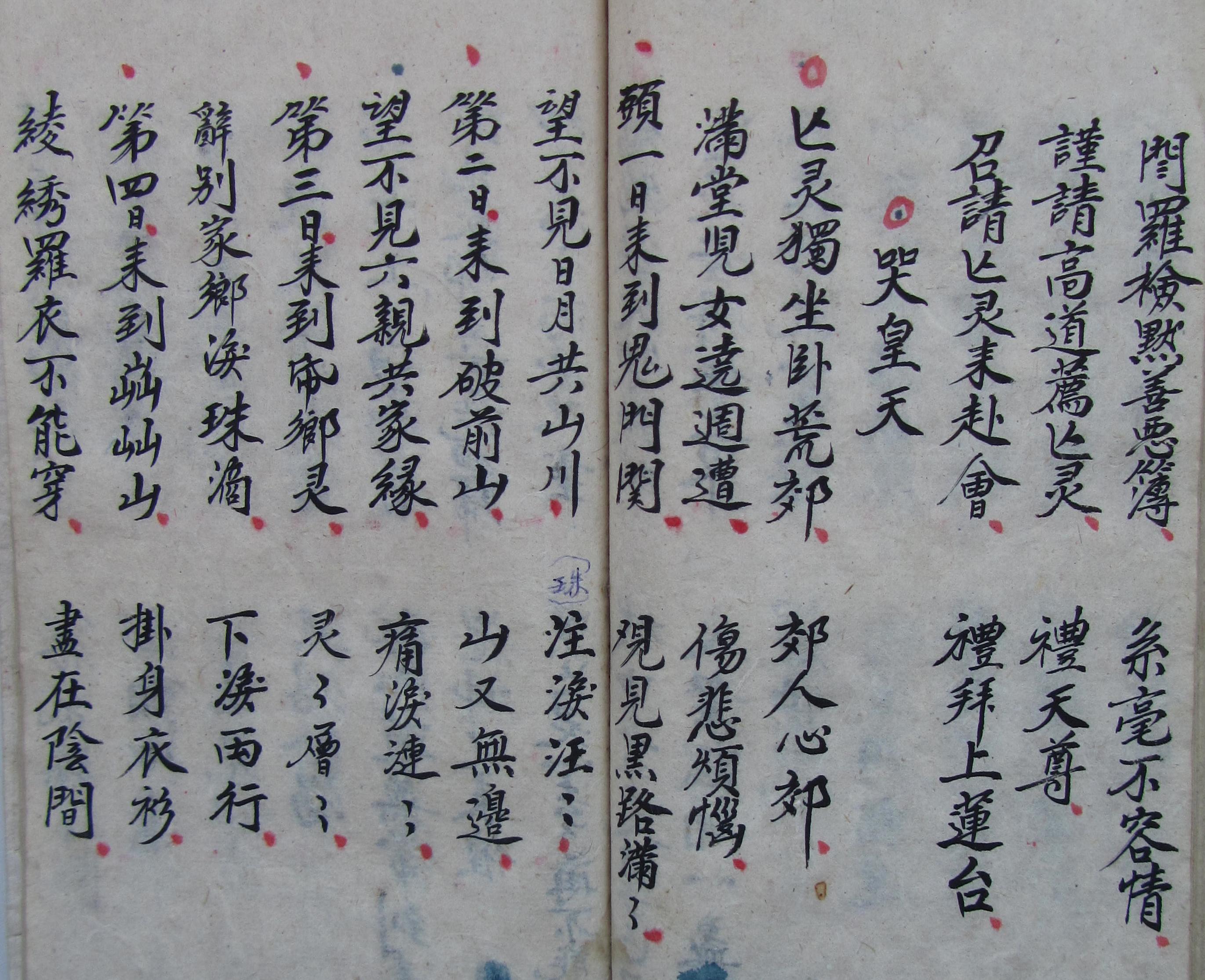
From Li Qing’s hymn volume, 1980. The final folio on the left has the opening of Mantra to the Wailing Ghosts—my book p.266, also featured in the film, from 1.03.56).
* * *
For most such hymns one hardly expects an “emotional” response from audiences—in Yanggao, after all, it shares both melodic material and style with many others in the repertoire. But in his brilliant ethnographic studies of ritual practice in old Beijing, Chang Renchun notes how the renditions of two celebrated Buddhist monks moved their audiences to tears. Performative tears feature in many posts on this blog—links here.
Some common versions open:
昨日去荒郊玩游 Yesterday, seeking diversion roaming in the barren outskirts…
So talking of “Yesterday”, Paul McCartney heard his own version in a dream, like Aboriginal singers.

Though secular, it’s deeply moving. Here’s an early solo rendition, live (and Paul’s unaffected style is a major element of the song’s impact—no cover versions come close):
Here’s the remastered version from 2009:
As I observe in the introduction to my series on the great Beatles albums, analysis, while optional, can supplement our response; again it’s instructive to read Wilfred Mellers and Alan W. Pollack. Dating from the same period as A hard day’s night, Mellers considers Yesterday a “small miracle”:
Although the opening words tell us that yesterday his troubles seemed far away, the music in the second bar immediately enacts these troubles with a disquieting modulation from tonic, by way of the sharpened sixth, to the relative. The first bar, with its gentle sigh, seems separated, stranded, by the abrupt modulation; and although the troubles “return to stay” with a descent to the tonic, the anticipated modulation sharpwards is counteracted when the B♮is flattened to make an irresolute plagal cadence. […]
The immediate nostalgia of the song is without suspicion of sentimentality, and the corny accompaniment of string quartet can be employed, with validity, to reinforce the music’s frail bewilderment.

George Martin’s manuscript for Yesterday, on display at Abbey road studios.
Pollack’s analysis is also insightful. And as he notes (also in my roundup), the opening uses a device here that Paul was to use regularly in some of his great songs: a declarative word, followed by a pause, and then rhythmically active ascent.
I can be quite confident about our own emotional responses to this song; less so about the responses of various types of Chinese mourners to the Skeleton, over time.
In the recent, ongoing, fieldwork project continuing our work on the Hebei ritual associations, led by the energetic Qi Yi 齐易, most welcome for me so far is new material on Hubenyi 虎贲驿 village (see e.g. here).


In Plucking the Winds (pp.90–92) I told how the beautiful surviving copy of the Houtu scroll of Gaoluo village was copied by Ma Xiantu, a cultured teacher and sectarian from Hubenyi village just further northeast. Then teaching in Beijing, he first borrowed the old copy of the scroll from South Gaoluo “to supplement the deficiency of my village’s Hongyang Holy Association”. His brother-in-law, South Gaoluo villager Shan Hongfu, was also staying in Beijing, and watched Ma Xiantu copying the scroll; he then bought more paper and asked Ma to make another copy for South Gaoluo. So Ma Xiantu copied it every day after school. He started copying the scroll in the 6th moon of 1942, and completed it in the 1st moon of 1943, finally adding the punctuation in red while he visited South Gaoluo to hand it over formally to the Association for the New Year’s rituals.
The 2015 fieldwork at Hubenyi, though not mentioning Ma Xiantu or the Houtu scroll, revealed further Hongyang scriptures, including an old copy of the Hunyuanjiao Hongyang zhonghua baojing 混元教弘陽中華寶經. Qi Yi and Song Yingtao 荣英涛 have collected basic data, so with bated breath I await a study from scholars of folk sectarian religion, for whom this whole area should be such a rich field… And who will supplement our work on the foshihui 佛事會 ritual associations around Yixian county?
For Hunyuan and Hongyang sects in the region, see my In Search of the folk Daoists of north China, Part Three.
Alan Bennett (him again) recalls his early music education attending concerts at Leeds Town Hall—making an ethnographic point that is as valid for Daoist ritual as for WAM (Untold Stories p.412):
So it is not just music that I learn, sitting on those harsh benches, Saturday by Saturday. Music in the concert hall is also a moral education, and watching the musicians at close quarters, I realize that it is not just ecstasy and inspiration but that there is drudge to it too. Sometimes, the players would be on the same tram coming home, and I see that they are just like everybody else—shabby, in dirty raincoats and sometimes with tab ends in their mouths, ordinary people who, half an hour ago, were artists and agents of the sublime.
See also Mozart in the jungle, The Commitments, and cf. The purgatory of the tennis circuit.
In 1980, when Li Qing began recopying the family ritual manuals as Daoist activity gradually revived, the very first manual that he copied was the hymn volume of funerary texts.
Within this volume, Li Manshan loves, and identifies with, the beautiful long meditation on impermanence titled Kangxi yun—actually attributed to Kangxi’s father the Shunzhi emperor (1638–61), and Buddhist in language. The standard version is known by names such as as Poem on returning to the mountains (Guishan shi 歸山詩), Poem on entering the clergy (Chujia shi 出家詩), or Gātha in praise of the sangha (Zanseng jie 贊僧偈).
The Li family’s ritual manuals are largely superfluous to their ritual practice today: those rituals that are still required they perform from memory. The Kangxi yun is one of many texts in the manuals that are no longer performed; and the Daoists never read the manuals as silent literature. But as I began to go through them with Li Manshan, I found that he was most taken by the poem. It shows how drawn he is to the retreat from worldly cares; household Daoists don’t necessarily evince this, and you might not notice this contemplative aspect of his character.
Li Manshan says parts of it were formerly performed as a shuowen 說文 solo introit within particular ritual segments. He has a distant memory of hearing the Daoists reciting it for a temple ritual when he was 8 or 9 sui, around 1953–54, but he only began taking note of it when he came across it in his father’s hymn volume in the 1980s.
Indeed, it is among several rather long texts grouped together in the hymn volume that could be used thus; but there are no longer any suitable ritual segments in which to recite them. The shorter solo introits still used, like those for Presenting Offerings, are now mostly recited by Golden Noble.
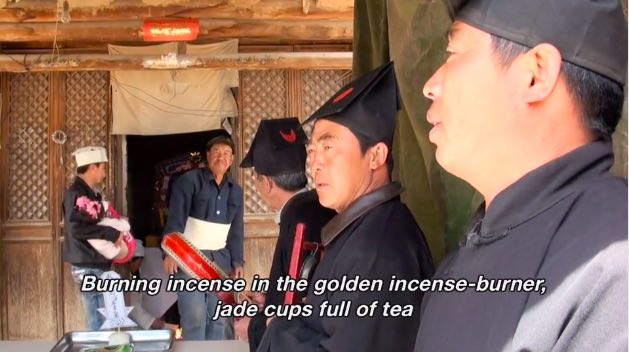
From my film: a shuowen introit from the shanggong ritual.
I’ve long wondered how, and when, this long poem found its way into the ritual manuals and ritual practice of the Yanggao Daoists. We discussed this further during my stay with Li Manshan in 2018 (under “Pacing the Void”).
* * *
For readers less than fluent in classical Chinese (of whom I hope there are many!), below I offer a very rough translation (for the challenges of translating the Li family texts, see here). I can’t find an English rendition of Shunzhi’s standard text (anyone?), but here I use the variant in the Li family manuals, only resorting to the original where sense requires. But often Li Qing’s variants seem no less elegant than the original, and sometimes I even find them preferable.
When we have a more widely-distributed “classical” source with which to compare the ritual texts of household Daoists (as is often the case), one often finds minor discrepancies. Many manuals (including most of those of the Li family) were recopied from memory in the 1980s, so a certain amount of variation was likely. However, while sometimes the Daoists might remember how to recite or sing a phrase or character but not how to write it, in general Li Qing’s manuals are remarkably accurate. Moreover, it’s also likely that variants had entered into the ritual manuals of household Daoists long before that. So it’s hard to tell when and how the variant of this poem arose.
The poem is not just about the emptiness of worldy cares, but refers to Shunzhi’s own struggle between his responsibilities as emperor and his personal inclination to Buddhist transcendence:
The forest of temples throughout the empire offers sustenance like a mountain
Everywhere the monastic bowl depends on the lord to provide.
There is no value in yellow gold and white jade
Only to don [1] the monastic cassock is difficult.
I, as great lord of the land of mountains and rivers
Am concerned for the nation and the people, serving to deflect their troubles.
One hundred years, thirty-six thousand days [2]
For a monk, don’t amount to [3] half a day’s rest.
Confusion on arrival, bewilderment on departure [4]
Travelling in vain for a while among men.
Better not to arrive and not to depart
With neither pleasure nor pain.
Before I was born, who was I?
Who was I at the hour of birth?
I only became an adult after I grew up
And once eyes are closed in the void, then who am I?
In this world the only good is to enter the clergy
With pure heart and peaceful mind, who is to know?
The mouth having taken its fill of eating harmonious flavours
One can always wear restitched robes from cast-offs.
The five lakes and four seas make a superior guest
Roaming free in the God Palace, lodging at will.
Do not call it easy to attain the dharma by becoming a monk
Let us talk only of the various bodhi of bygone ages.
I, as great lord of the land of mountains and rivers [5]
Seek the body of Crop Founder descended to earth.
Bright as is the cassock of the Western Quarter
Why has it descended upon the imperial family?
Just because at first my recitation was deficient
I had to exchange my purple cassock for a humble new robe.
For eighteen years I have been dreaming—
When can I rest from the great task of mountains and rivers?
Today, clapping my hands, I return to the mountains
How can I be expected to control the thousand, myriad autumns?
I’ve largely refrained from adding the Teutonic scholarly footnotes that the text suggests, but:
[1] Using the original 披肩.
[2] Chinese poetry has a lot of lines like this, and they read better in Chinese!
[3] Using the original不及.
[4] Referring to life and death, of course—but please feel free to provide your own joke about the airline of your choice.
[5] Here Li Qing repeats the earlier phrase, whereas the original couplet has “Even without being a true luohan, one also dons the triple vestments of Sakyamuni.” The following couplets of Li Qing’s version depart further from the original, and my translation is even more approximate.

Along the lines of
here’s a seasonal entry from Alan Bennett’s 2001 diaries:
15 December. Words only used at Christmas: Tidings. Abiding. Swaddling. Lo! Abhors.
Indeed, as a boy chorister it always felt embarrassing having to sing “Lo, he abhors not the virgin’s womb”—despite having only the vaguest idea what any of these words might possibly mean (and once you do understand the line, it becomes problematical—it has attracted much comment, notably this). But that’s ritual for you, eh…
AB goes on:
A card from Victor Lewis-Smith with a sanctimonious picture of Jesus and printed underneath:
Jesus loves everyone—except you, you cunt.
This makes me laugh helplessly.
What makes this entry so funny, apart from the content of the card itself, is both that AB was delighted to receive it and that he saw fit to tell the tale. For a related exhortation from Fascinating Aida, see here.
Conversely, the way AB is portrayed in Love, Nina is hilarious precisely because his persona there is so boring.
Some readers can be so literal… This article by the glorious Philomena Cunk prompted quite a few BTL comments from readers unaware that it’s a spoof, or that she’s a fictional creation (“Like, hello?”)—thus inadvertently making the comments hilarious too.

Fieldwork reports on local Daoist ritual continue to amass. Note the growing series Daojiao yishi congshu 道教儀式叢書.
In my book I described the main instigators of this impressive movement—C.K. Wang, John Lagerwey, and Lü Pengzhi—as a “holy trinity”. Then I thought maybe that should be the Three Pure Ones (Sanqing 三清)—but actually (since they are not so much objects of veneration as witnesses to marvels), a better metaphor might be the Three Wise Men:
“…Creeping around a cow shed at two o’clock in the morning? Doesn’t sound very wise to me…”
“We were led by a star!”
“Led by a bottle, more like!”
(Sorry, can’t help it…)
Now I’m wondering if they had a list, perhaps from Fortnum and Mason—how embarrassing if they’d all brought myrrh. “Sorry, your choice is already taken, please choose gold”.
For related irreverence, see Jesus jokes.
Household Daoists tend to know about performance, not doctrine. I focus on practical knowledge—right down to which cymbal patterns to use as interludes for which hymns, and when to use them, or not. What the Li family don’t know, or do, is things like secret cosmic visualizations.
They don’t necessarily know how to write the texts, or if they do so (for me) they may write some characters a bit approximately because they already know how to recite them.
They know nothing of Laozi’s Daode jing, so central to Western images of Daoism. When I quote the pithy, nay gnomic, opening two lines to Li Manshan and his son Li Bin:
道可道非常道 The way you can follow is not the eternal way;
名可名非常名 The name you can name is not the eternal name.
they don’t quite get it, and I have to translate it into colloquial Chinese for them! Hmm…
We have a bit of fun playing with feichang, which in modern Chinese is “very”, rather than the classical “not eternal”. Actually, in their local dialect they don’t use feichang at all, though of course they know it. In Yanggao the usual way of saying “very” is just ke 可, pronounced ka—thus “dao kedao feichang dao” might seem to be “The way is soooo waylike, I mean it’s just amazingly waylike”…
Still, Daoists like Li Manshan will have picked up a broad understanding of the texts they sing every day, even if they have never been taught their “meaning”. They know Laozi not as the author of the Daode jing but as a god.
As I wrestled with translating the Hymn to the Three Treasures (Sanbao zan), used for Opening Scriptures in the morning (Daoist priests of the Li family, pp.262–3, and film from 22.01), Li Manshan explained it to me.

Hymn to the Three Treasures, from Li Qing’s hymn volume, 1980.
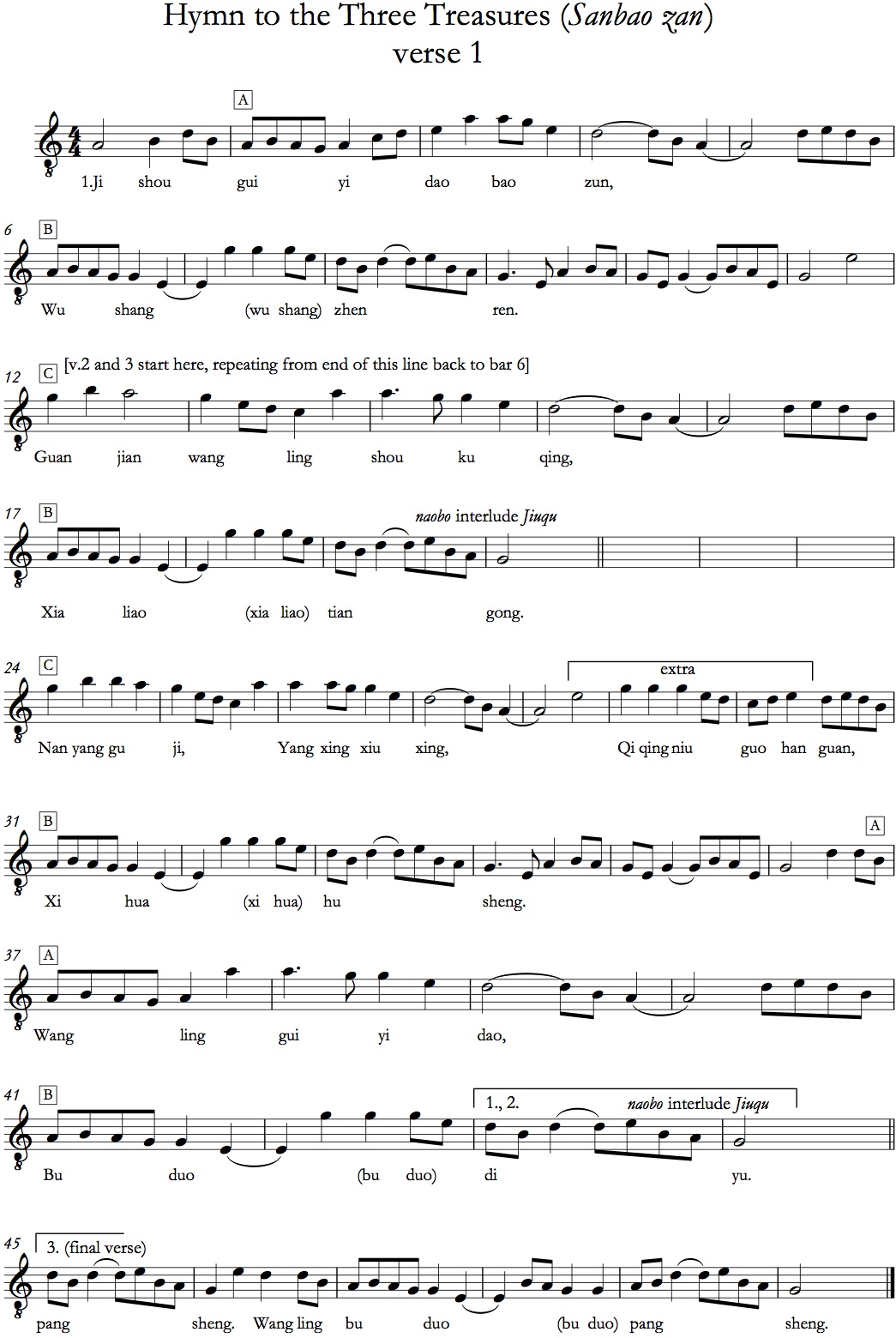
The subject of the first verse to the dao, “We bow in homage to the worthy of the dao treasure, Perfected One without Superior” (Jishou guiyi daobaozun, Wushang zhenren) is Laozi himself, so it is he who is the subject of the remainder of the verse: “He descended from the heavenly palace” (xialiao tiangong) refers to Laozi descending from the heavenly palace after beholding the sufferings of the deceased spirit (guanjian wangling shou kuqing)—it’s all about Laozi! So you see, Li Manshan does get the texts…
As for any ritual tradition, where does the “meaning” reside, when texts are unintelligible to their audience? When we translate and explain ritual texts, we are radically altering them as experienced by their audience. True, the performers, the priests, certainly “understand” them, to various degrees, if not in the same way as scholars translating them. I don’t suggest limiting ourselves to the consideration of how people experience rituals, but that should surely be a major part of our studies. Experience lies beyond textual exegesis, consisting largely in sound and vision.
I am reminded of Byron Rogers on an American version of the New Testament (Me: the authorized biography, p.268):
Pilate: “You the King of the Jews?”
“You said it.” said Christ.
There’s another one for the Matthew Passion (cf. Textual scholarship, OMG). “What is truth?”, indeed…
Mercifully, there is no movement to translate the ancient texts of Daoist ritual into colloquial modern Chinese. Of course, for northern Daoist ritual a modern translation wouldn’t make the texts any more intelligible anyway, given the slow tempo and melisma.
Laozi does appear in one of our favourite couplets for the scripture hall (see Recopying ritual manuals, under “The couplet volume”; cf. my book pp.194–5—not easily translated!):
穩如太山盤腿座 Seated in lotus posture firm as Mount Tai,
貫定乾坤李老君 Old Lord Li thoroughly resolves male and female aspects.
For a basic roundup of posts on the Li family Daoists, see here.


In ch.18 of my book (p.342) I reflect on the Li band’s recent concert tours and Intangible Cultural Heritage status:
All this may sound like a typical story of adaptation to modern secular contexts. But it’s not. Let’s face it, the Li family is never going to become the next Buena Vista Social Club. Year in, year out, their livelihood remains performing for local rituals. Li Manshan’s recent nomination as Transmitter of the ICH brings him a modest extra income for now, but the Daoists continue to rely on doing funerals around their home base; their ICH status and foreign tours are only a minor element in their reputation, which is an accumulation of local charisma over many generations. They still lack disciples, either from their own or other families; and crucially, local patrons no longer pay much attention to the niceties of ritual practice.
It all reminds me of the elderly fiddle player in the Romanian village band Taraf de Haidouks, reflecting on his meteoric rise to global success on the world music scene:
A little fairy granted me my wish to be happy in old age. Now I have suits in terylene.
For more on adapting Daoist ritual for the concert stage, click here. For a populist fantasy, see Strictly north Chinese Daoist ritual. See also World music abolished!!! For Paris as pedagogical Mecca, see Nadia Boulanger, and Kristofer Schipper.
In my book (p.280) I observed a subtlety of Yanggao Daoist ritual that may elude us:
Novices soon pick up the short pattern in rhythmic unison on drum, small cymbals and yunluo that opens and closes every item of liturgy, an accelerando followed by three beats ending with a damped sound. This is known as luopu (“cadential pattern”) and it turns out that the number of beats is fixed, 7 plus 4—unless the guanzi player needs a bit more time to prepare his reed!
See also Tambourin chinois, and Drum patterns of Yanggao ritual .
Much less impressive is Beethoven’s take on this, the four soft quarter-note beats that open his violin concerto (less creative than the EastEnders Doof Doof). The quote from my book is itself just a prelude to the popular story of a famous conductor rehearsing his orchestra in the concerto. Though he was notorious for nit-picking, one might suppose that at least here the band would get up a bit of a head of steam before he started correcting them. But no, sure enough he brings them to a halt even before the oboe can come in.
Turning to the bemused timpanist, he says,
“Can you play that with a little more… magic?”
The timpanist looks back at him sullenly, beats out the four notes again, and goes,
“Abra-ca-fucking-dabra”.
* * *
In Daoist ritual there’s nothing quite akin to “rehearsal”, but during a ritual Li Manshan maintains standards by the subtlest of facial gestures, with a little glare if the ensemble is less than perfect. As I learn, I benefit from such hints.
And the roar of Moses’ Triumph is heard in the hills
Without even knowing how I feel about the White Cloud Temple in Beijing, my adorable cat Kali (R.I.P.) threw up over my copy of the Jade Pivot Scripture, which I had bought in an edition printed at the temple.
One ritual title that features only fleetingly in the ritual manuals of the Li family Daoists in north Shanxi is Thunder Lord of Three-Five Chariot of Fire (Sanwu huoche leigong). This is among the attributes of the deity Wang Lingguan, and a trace of the thunder rituals of Divine Empyrean Daoism. [1] In the Li family manuals it appears only in the Mantra to Lingguan and in the Xijing zayi manual, no longer performed and thus no longer familiar to them: [2]
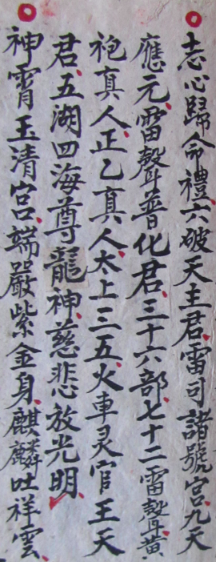
From Xijing zayi manual (Sanwu huoche Lingguan on line 3), copied by Li Qing
So my excuse to discuss it here is flimsy as ever, but we all need a bit of light relief every so often. This also relates tenuously to my comments on hearing Bach with modern ears.
Huoche “chariot of fire” (glossed as “fireball”) may prompt titters at the back, since in common modern parlance it means “train”. Whereas “And the roar of Moses’ Triumph is heard in the hills” is a translation that has been inadvertently amusing only since the spread of the automobile [mental note: must get that exhaust fixed], [3] huoche is an ancient original which could have been affording chuckles to Daoist scholars since the term became common usage for “train” in the late 19th century. When you’re immersing yourself in the abstruse mysteries of the Daoist Canon, you have to take such diversion where you can find it.
What’s more, we may giggle impertinently at another of Lingguan’s attributes, Sanwu (Three-Five)—erstwhile a brand of cigarette that Chinese people associate with Englishness (much to my perplexity, since I’ve never heard of them outside China) just as much as London fog. (For “the smoking substances of non-nationals”, see More from Myles).
So here we appear to find Lingguan smoking a posh foreign cigarette on a train journey through his spiritual domain—being a high-ranking Daoist cadre, he would get to travel soft-sleeper (cf. Fieldwork and textual exegesis).
[1] The appellation may commonly be found in the Daoist Canon, but, more relevant to “texts in general circulation” (my book pp.218–24) and the practices of the Li family may be its appearances in Xuanmen risong: Xuanmen risong zaowan gongke jingzhu 玄門日誦早晚功課經注, chief editor Min Zhiting (Beijing: Zongjiao wenhua chubanshe, 2000), pp. 166–7, 244–5. See also Rethinking Zhengyi and Quanzhen.
[2] My Daoist priests of the Li family, p.376, cf. p.381; for the Divine Empyrean, see also pp.219–20.
[3] A substantial irreverent online industry in such Biblical quotes has arisen.
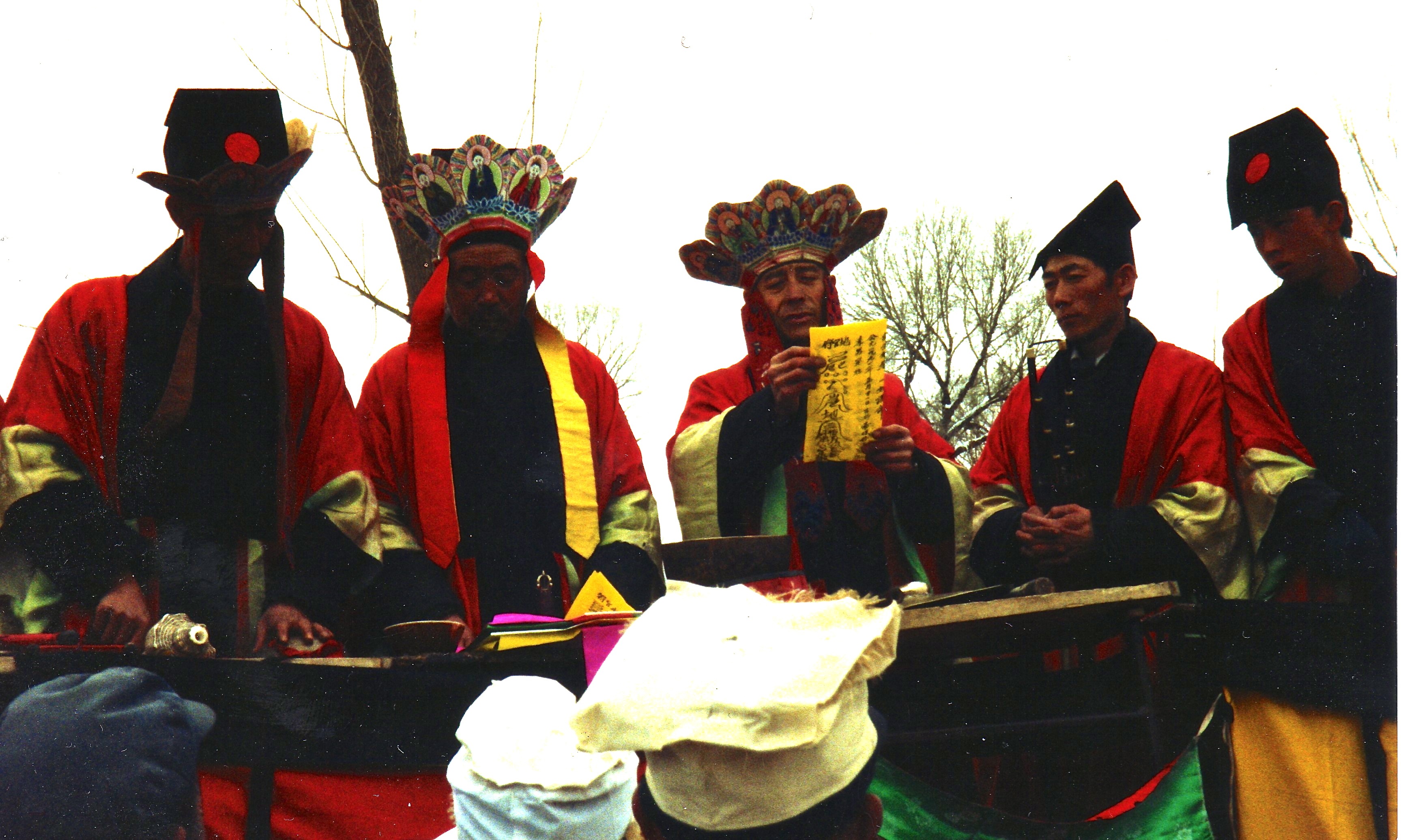
The Pardon ritual led by Li Qing (2nd from left), Yanggao 1991 (my film, from 48.34).
As a change from my literary party game, here’s an arcane spinoff from the game of picking a fantasy world football team, or chamber orchestra.
Let’s choose our all-time most amazing group of Daoist ritual specialists, including both liturgists and instrumentalists. Of course, the list of candidates is endless, so I’d seek to refine the search by selecting those known mainly for their ritual performance, rather than for compiling vast compendia of manuals.
Thus the list could include early luminaries like Kou Qianzhi 寇謙之 (365–448) (who might speak a dialect similar to that of Li Qing, except that they lived over 1500 years apart), Tao Hongjing 陶弘景 (456–536), and Du Guangting 杜光庭 (850–933) (see their entries under Fabrizio Pregadio ed., Encyclopaedia of Taoism).
Churlishly fast-forwarding a millenium, among modern Daoists we could include Chen Rongsheng 陳榮盛 (1927–2014) from Tainan, [1] Zhang Minggui 張明貴 (1931–2016) of the White Cloud Temple in Shaanbei, and our very own Li Qing 李清 (1926–99); among a host of great drum masters one might recruit An Laixu 安来緖 (1895–1977) from Xi’an and Zhou Zufu 周祖馥 (1915–97) from Suzhou.


Above: left, Kou Qianzhi; right, Tao Hongjing;
below: left, Zhang Minggui; right, An Laixu.
For once, we can leave historical change to one side: it remains to be seen how effective Pelé and Messi would be together as a forward line-up, or Saint Cecilia and Bach (in the orchestra, or indeed in the football team; cf. the Monty Python Philosophers’ football). A more basic difference is that—more than football or the WAM canon—the performance of Daoist ritual is always specific to a small locality. Even if their ritual manuals may have a lot in common, household Daoists from different places can hardly work together. Never mind Daoists from Shanghai, Fujian, and Hunan; even within north Shanxi, the whole ritual performance of the Li family in Yanggao is significantly different from that of groups in Hunyuan or Shuozhou counties very nearby.
Fun game, though. See also Strictly north Shanxi Daoist ritual.
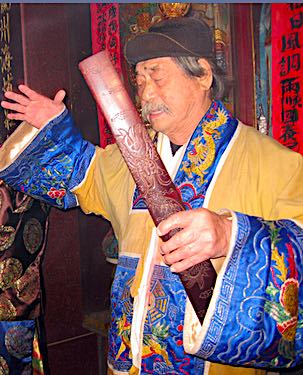
Chen Rongsheng.
[1] Until quite recently, much of our knowledge of modern Daoist ritual (despite its great diversity) was based on the tradition of Chen Rongsheng, meticulously documented by Kristofer Schipper and John Lagerwey. Here’s a tribute, with precious clips of Master Chen’s ritual practice:
Links to lengthier ritual sequences here. Alas, Michael Saso’s early clips of his Master Chuang no longer seem to be in the public domain.
This, from a youthful Stewart Lee, would make light relief in a talk on Ritual redundancy:
Discuss…
There’s a tag in the sidebar for Stewart Lee, y’know—so you can admire the later development of his ouevre.


 Stephen Jones: a blog