
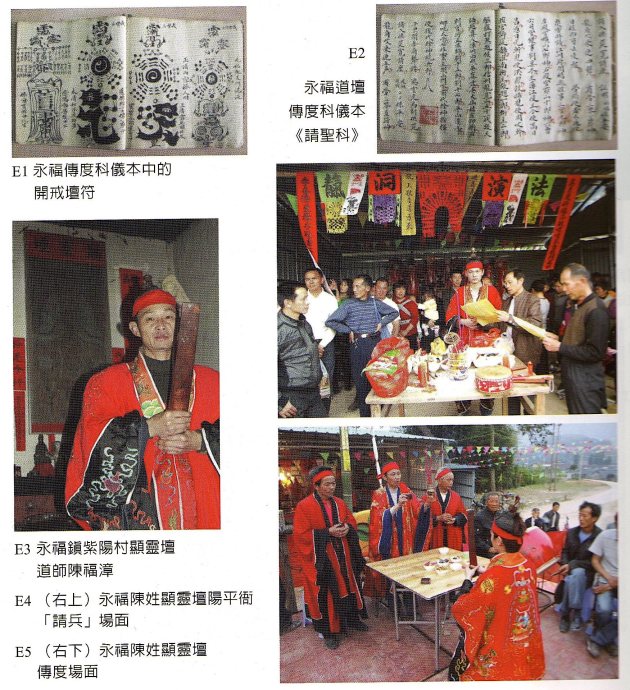
From Ye Mingsheng 葉明生, Minxinan Yongfu Lüshanjiao chuandu yishi yanjiu
閩西南永福閭山教傳度儀式研究 (2017).
.
If you want to study Chinese culture, then China’s a good place to do it
“Heritage” pundit Tian Qing has a good story for every occasion (such as this, and this). On the resilience of traditional culture under all kinds of assaults (notably in the hands of “obstinate” zhizhuo 执着 peasants, as they’re often described) , he likes to cite Granny Liu’s epithet in chapter 6 of Cao Xueqin’s epic 18th-century novel The story of the stone (The dream of the red chamber):
瘦死的駱駝比馬大
—in Hawkes’s translation,
a starved camel is bigger than a fat horse.
It’s commonly used to show that families fallen on hard times will still manage better than the chronic poor. But in the wake of all the assaults from Maoism in the PRC—when “authentic” Chinese culture on the mainland was apparently a poor relative to the overseas communities where transmission was supposed to have been maintained untainted (notably Taiwan)—the maxim made an apt metaphor as field reports since the 1980s on local ritual began to reveal the sheer enormity of tradition. Of course, as with research on southeastern Daoist ritual on both sides of the strait, we should learn by collating all such material, as did Kristofer Schipper, Ken Dean, and John Lagerwey (see also Daoist ritual in north Taiwan).
Among many further instances are the rich material on baojuan “precious scrolls”, the ritual traditions of Qujiaying and Gaoluo just south of Beijing, and the ongoing project of Hannibal Taubes on temple murals in north China.


For representations of Tibetan culture within and outside the PRC, click here.
 Stephen Jones: a blog
Pingback: Ritual in The dream of the red chamber | Stephen Jones: a blog
Pingback: Notes from Beijing 1: some fine ethnographers | Stephen Jones: a blog
Pingback: Notes from Beijing, 2 | Stephen Jones: a blog
Pingback: Calligraphy of a Manchu imperial scion | Stephen Jones: a blog
Pingback: A 1956 fieldtrip to Hunan | Stephen Jones: a blog
Pingback: The Confucian ritual in Hunan | Stephen Jones: a blog
Pingback: Fujian, 1961 and onwards | Stephen Jones: a blog
Pingback: Ritual artisans in 1950s’ Beijing | Stephen Jones: a blog
Pingback: Coronavirus 2: songs from Gansu, and blind bards | Stephen Jones: a blog
Pingback: Labrang 1: representing Tibetan ritual culture | Stephen Jones: a blog