Berlioz: a love scene

Berlioz Romeo

If you’ve recovered from the fiddlers of the Dauphiné, my main passions in French music are for Ravel and Messiaen, not forgetting Rameau and Debussy, Michel Legrand, Françoise Hardy, and Barbara Pravi. But Berlioz makes guest appearances on this site too:

Berlioz CD

And I just recalled the pleasures of playing Berlioz’s “dramatic symphony” Roméo et Juliette with John Eliot Gardiner in 1995. Here he conducts it complete at the 2016 Proms—long after my time:

The Scène d’amour is enchanting—I’m also attached to Esa-Pekka Salonen, as much for his wise and forensic conducting as for the wonderful story of his interview for the LA Phil job, so here’s a 2023 concert:

While our EBS repertoire with Gardiner revolved around Bach, Handel, and Mozart, pieces of later early music that I enjoyed playing with him and the ORR include the Brahms German Requiem and Verdi’s Four sacred pieces.

Ability and potential

Ability
Source.

Neatly combining my side dishes of football and the idyllic Istanbul mahalle of Kuzguncuk
(see under A sporting medley, including Futbol in Turkey, then and now;
posts on Kuzguncuk are listed here, with more here)…

This outline of the amateur Knc Yapı Kuzguncuk Spor Kulübü offers a blunt appraisal, which I’m tempted to adapt for my own CV:

Ability 0%
Potential 0%

The team’s average attendance of 100 also reminds me of Philomena Cunk‘s “the sort of viewing figures BBC4 still dreams of”.

Despite all this, the plucky Kuzguncuk side seems to be doing really well, and is clearly THE club to follow—roll over Fenerbahçe (now cajoled by Mourinho the Morose One)!

Kuzguncuk football

Blindman Ali of Kuzguncuk

Screenshot

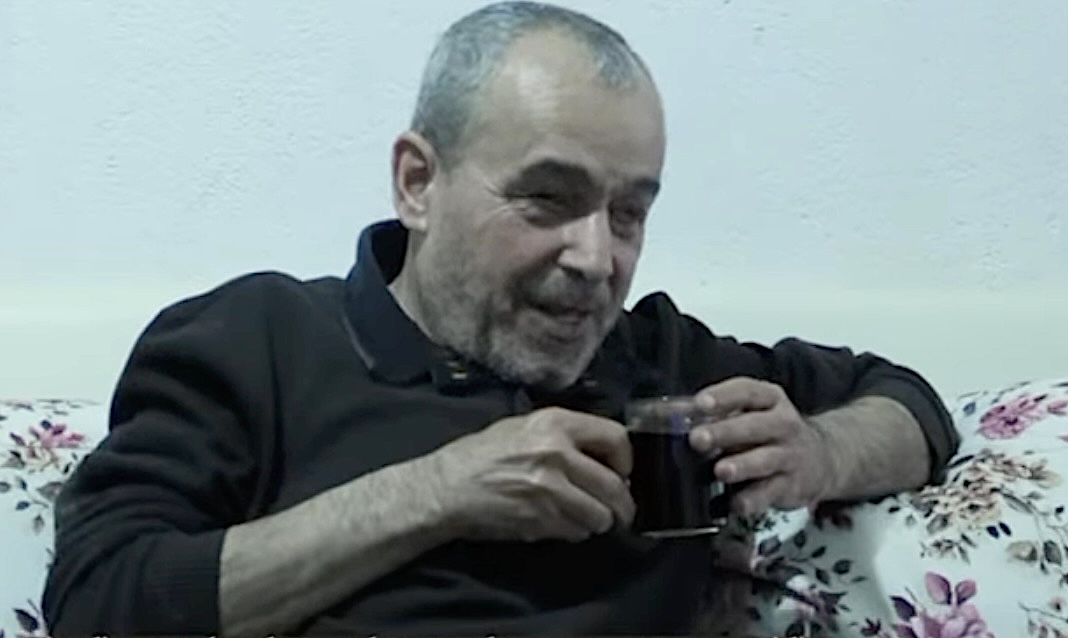
As you may have noticed, I feel drawn to blind musicians, in China and around the world—notably shawm players and bards. And my jottings on the wonderful Kuzguncuk mahalle of Istanbul have grown into a series (listed here, with more here). Ali Çoban makes a genial presence on the main street, perching unassumingly with his little barrow of knick-knacks. His Facebook page has a good short video; with Augusta we sometimes have a gentle chat over tea, learning a little about his story.

Ali was born blind in 1971, the oldest of five children from a village in Amasya in the Central Black Sea region. “An older friend bought me a bağlama [plucked lute] when I was young, realising my love and aptitude for music. I played well, learning songs by heart just by listening”. But he lacked the support to take it further.

When the family migrated from the village to Istanbul they moved into a run-down place in Esenyurt. Ali couldn’t leave the house for ten years—he felt like a prisoner. After his mother died in 1996, things became difficult between him and his father, but their relationship improved once he learned to be more independent by getting around with a stick. “Today I think his rejection was a good thing as it taught me to fend for myself and have some sort of a life. I’m in a much better position now than I would have been had my father taken care of me then.”

Ali met a blind woman called İnci at a summer camp in Balikesir. Herself a civil servant, she accepted when he told her that he wouldn’t be able to offer her an adequate standard of living. But after marrying in 2009 they lived together in her flat in Kuzguncuk.

Ali is not a practising Alevi, though he occasionally attended cem ceremonies at Karacaahmet. Still, the tenets of Alevism run deep, and eventually religious differences surfaced in his marriage with İnci. She came from a Sunni Muslim family, whereas for the Alevis the human dimension is always uppermost. While Ali stresses the duty to regard others charitably, perhaps he perceives a certain conflict between the noble ideal of Islamic prayer and the sometimes flawed ethical and political behaviour of mainstream society. He hasn’t directly experienced the discrimination that Alevis suffer, but by contrast with Turkey, he is impressed by the German Ministry of Education’s tolerance for Alevi teachings.

I ask how he feels about the call to prayer. “As Alevis we are not against the ezan—it’s just that some muezzin don’t perform it so well! Their level of training is important. Sometimes it’s really beautiful—not that I understand it because it’s in Arabic…” He likes our wise local imam Aydin Hoca and knows that he is well disposed towards him too even though he doesn’t attend the mosque.

Ali’s father eventually returned to the village, dying in 2019. The next year Ali and İnci separated. “It was a difficult period, but I’m thankful to be able to get about, and to be here.” He remains friends with İnci and they help each other when needed.

He tells us, “Never having seen colours, I can’t imagine or understand what they’re like. Everything comes via sound—even my dreams are like sound recordings.” As to his listening tastes, he admires the great bards of yesteryear such as Aşık Veysel and Neşet Ertaş (some tracks here), as well as Aşık Mahsuni Şerif (compilation). He loves the songs of Sezen Aksu and her protégées like Sertab Erener. He mentions the MFÖ band. Of course he knows of the blind accordionist Muammer Ketencoğlu and his radio programmes exploring Balkan music. Ali also enjoys foreign music, like Stevie Wonder, Michael Jackson, and the Beatles. In the video clip he tells how he was stimulated by the song Pes etme (“…never give up”).

Blind Ali x

Besides Ali’s meagre income from selling trinkets on the street, he receives a pittance from his father’s pension; he’s not in the best of health, and his siblings, all in different places, rarely visit. Still, he never offers a hard-luck story; indeed, he feels fortunate. However modest his apartment, “I love living in Kuzguncuk and wouldn’t want to leave.” He feels part of the mahalle community, and appreciates all the help provided by shopkeepers and others, feeding him or giving him a reduction. Sometimes locals even help him out with the rent.

Ali is a kindly soul. “I am so glad to be here, to be alive, and independent.” As he says in the film clip, “I seek spirituality, understanding, tolerance, and love”.

Blind Ali xx

A German requiem

How we respond to any music has a lot to do with the associations of our personal reception history.

The Brahms German Requiem (Ein deutsches Requiem, nach Worten der heiligen Schrift, 1865–68)—humanist rather than Christian—was one of the first major choral works that I got to know, playing it quite regularly around suburban London with amateur orchestras and choral societies while I was at school (just as I first performed the Bach Passions, far from the HIP performances of my later “career”).

Finnegan 245

From Ruth Finnegan, The hidden musicians (1989).

I went on to play the German Requiem at Cambridge—where a group of us liked to stagger back from the pub to be amazed by Barenboim’s 1972 LP, with the LPO and the Edinburgh Festival Chorus, Edith Mathis and Dietrich Fischer-Dieskau:

concluding here (followed by the Vier Ernste Gesänge): *

By the time I was playing professionally in London, the Requiem had (sadly) become a rather routine experience, with (happily) minimal rehearsal (cf. Ecstasy and drudge), a bread-and-butter gig akin to doing a Messiah in Scunthorpe.

I write this post because until quite recently I felt twice removed from such works—after all those years in the early music business, with the further distraction of becoming immersed in Chinese fieldwork, I might expect to have grown out of such romantic warhorses. But somehow early bonds remain deep.

* * *

Klemperer’s 1961 recording is widely praised, with the Philharmonia Chorus and Orchestra, Elisabeth Schwarzkopf and Dietrich Fischer-Dieskau:

After this recording of Mengelberg’s 1940 concert (with the Concertgebouw and Amsterdam Toonkunst Choir, Jo Vincent and Max Kloos), here’s Furtwängler in 1948, with the Stockholm Phil and Chorus, Kerstin Lindberg-Torlind and Bernhard Sönnerstedt:

and Celibidache, live in 1981 with the Munich Phil and Choir, Arleen Auger and Franz Gerihsen:

In 1984 Tennstedt made two recordings with the LPO and Choir—a studio recording with Jessye Norman and Jorma Hynninen:

and a live performance from the Proms, with Lucia Popp and Thomas Allen:

As the early music movement became flavour of the month (see here), musos like me, who had washed up on the shores of baroque music as a refuge from the stormy seas of symphony orchestras, again found themselves playing some of the same pieces from the mainstream repertoire—now re-invigorated by a notional cachet of “authenticity”.

Brahms Requiem JEG

I was glad to revisit the German requiem for John Eliot Gardiner’s first recording of the work in 1990, with the ORR and the unmatchable Monteverdi Choir, Charlotte Margiono and Rodney Gilfry:

For Gardiner’s second recording (with Katharine Fuge and Matthew Brook, recorded in 2007–08), click here.

Assessing the balance between intense and ponderous will be subjective, depending on one’s own reception history and degree of veneration for particular maestros (note The art of conducting). Now, I’m keen on slow tempi, emphasised by most conductors here; but I find the choices of Furtwängler or Barenboim far more convincing than those of Celibidache—though FWIW, among the singers, I am moved by Celi’s team of Arleen Auger and Franz Gerihsen.

Anyway, it’s taken me all this time to feel blessed (selig) by the soul of Brahms. **

Among a wide range of scholarship, see e.g. chapter 5 “Performance issues in A German Requiem” of Performing Brahms: early evidence of performance style, cited in Brahms, tempo and timbre. See also Hélène Grimaud‘s renditions of the piano concertos; Der englische grußand *don’t miss* Kleiber’s Brahms 2!!! Try also the Mozart Requiem, and Funeral music. For other forays into later early music, cf. Berlioz’s Symphonie fantastique and Roméo et Juliette, the Four sacred pieces of Verdi, and even The Rite of Spring.


* which sounds more, well, serious, than “Four serious songs” (cf. Richard Strauss, here and here). Cf. What is serious music?!.

** It’s always worth consulting Slonimsky’s Lexicon of musical invective for withering reviews of the day. George Bernard Shaw in 1892:

Brahms’s Requiem has not the true funeral relish: it is so execrably and ponderously dull that the very flattest of funerals would seem like a ballet, or at least a danse macabre, after it.

Philip Hale in 1900:

Page after page of his Requiem is saturated with indigo woe, and the consolatory words are set to music that is too often dull with unutterable dullness.

Cf. More musical criticism.

Perplexity

Not so much moaning as perplexed:

Two of my main themes are Bach and Mahler, and you recently made history by showing an impressive lack of interest in my post on the John Passion Prom with Masaaki Suzuki and the Bach Collegium Japan, even with its fantasy of a world-music version of the Passions! And readers (or rather, non-readers) have been even more underwhelmed by my post on S-Simon Rattle’s Mahler 6 Prom—my first ever totally-unread piece!!! I realise Western Art Music has a rather niche clientele, but WTAF!

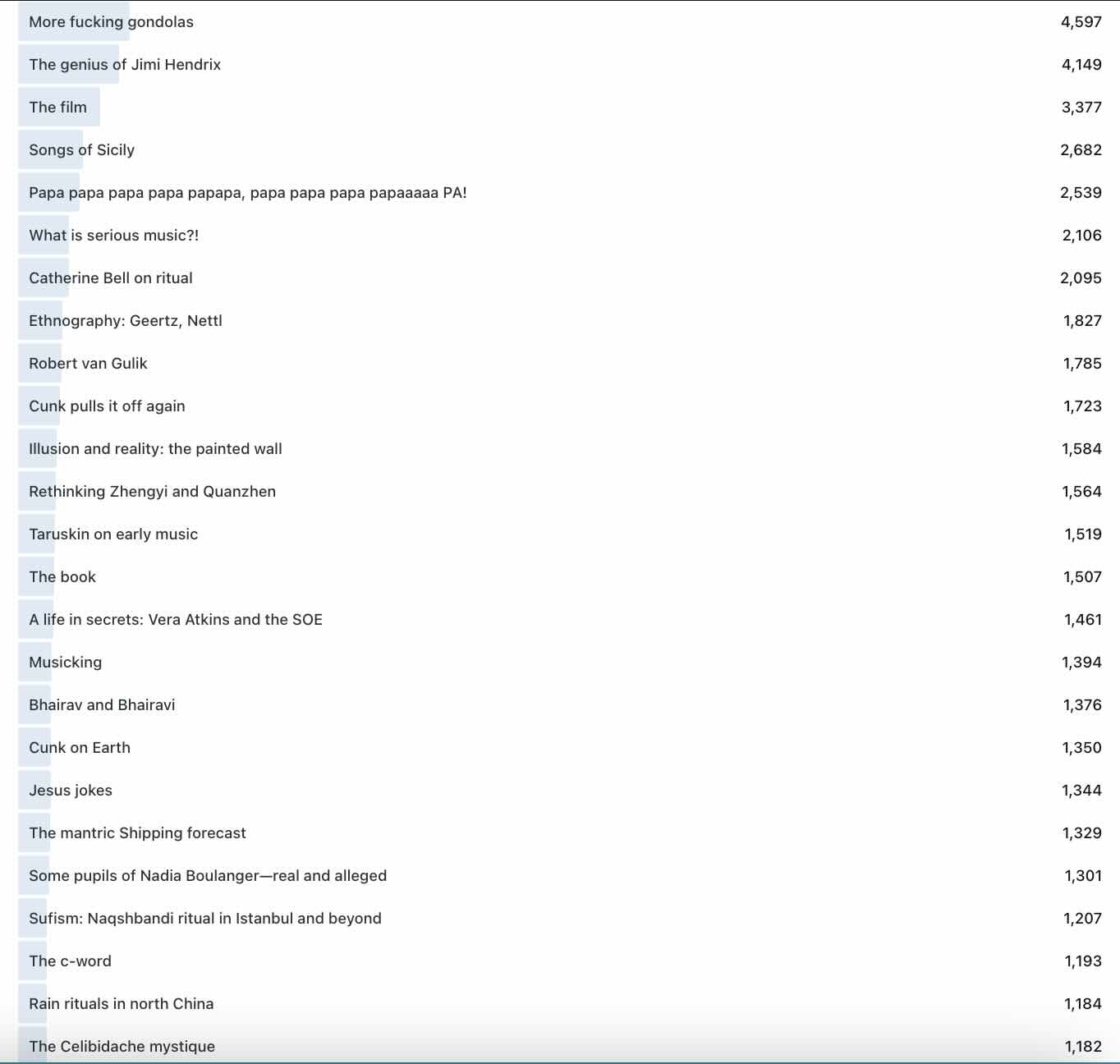
Many subscribers to this site may be interested mainly in my China coverage, but other topics usually attract a certain attention too, such as Western Art Music, jazz, world music, film, and so on—as shown in this list of my most popular posts, pleasingly diverse:

posts

I listed some of my own favourite posts here, including A playlist of songs and That is the snake that bit my foot. While I’m here, I note that very few people take advantage of my playlists and roundups to click on the copious links—but hey…

Twitter (as I still like to call it) is now just as disappointing as a vehicle to spread glad tidings. I understand that it has become totally useless under deranged new management, and that people only go there to scroll for cute pics of cats and racist bigotry (ideally combined); but still, one would think that just a few readers might be drawn to such posts by hashtags like #SimonRattle, @BRSO#Mahler, #BBCRadio3, @bbcproms, #Bach, @MSuzukiBCJ, and #worldmusic. But far from it!!! Hey-ho…

Billie Holiday, a sequel

Billie

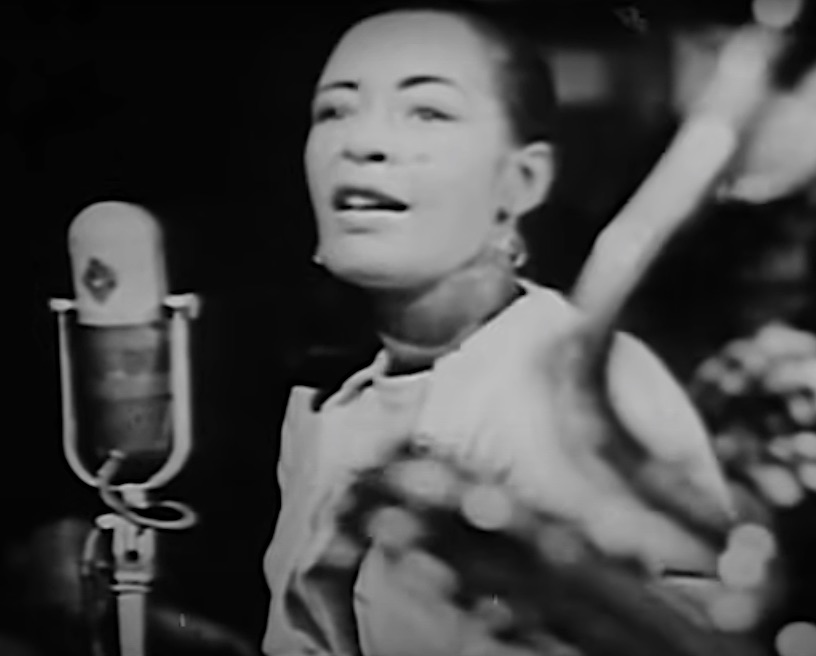
Always spellbound by the 1957 TV appearance of the astounding Billie Holiday, I assembled an essential selection in tribute to her some years ago (as well as a separate post for Crazy)—but I never stop listening to her music, and the tracks below are no less essential!

While I’ve accumulated something of a library on her life and work, I’ve only just got round to reading a smattering of the vast literature—not exactly that I think it’s enough to “let the songs speak for themselves”, more that it’s become such a huge industry. Such books include

  • Donald Clarke, Wishing on the moon (1994)
  • Leslie Gourse (ed.), The Billie Holiday companion: seven decades of commentary (1997)
  • Farah Jasmine Griffin, In search of Billie Holiday: if you can’t be free, be a mystery (2001), an astute study with the benefits of a black woman’s perspective, unpacking “how we know what we think we know” about her—referring to sources such as Angela Davis, Blues legacies and black feminism
  • John Szwed*, Billie Holiday: the musician and the myth (2015) (review), which I’ll cite below
  • and of course the “autobiography” Lady sings the blues (1956), ghost-written by William Dufty (well covered by Griffin, pp.45–55, and in Szwed’s first two chapters; cf. this LRB review).
    The 1972 biopic (watch here), with Diana Ross as Billie, is even more fictitious; though much criticised, it’s all part of the myth-making (e.g. Szwed, pp.83–94, and wise words from Griffin, pp.56–64).

Billie is just as popular a subject on film. The BBC documentary The long night of Lady Day (John Jeremy, 1984) is highly regarded—although Griffin rightly balks at the entitled white male pundits, still controlling her (and yes, now I’m getting in on the act too…):

I can only apologise for adding to the endless attempts to encapsulate Billie’s genius—but at least there’s lots of great music coming up.

* * *

John Szwed writes:

Given her acknowledged stature as a musician, it is odd that many of the books on Holiday have only secondary interest in her music. But then again, maybe not so odd: music writing today is increasingly focused on lifestyles, as if the events of artists’ lives are enough to explain their music, and the songs they record are treated primarily as documents in support of a given biographer’s argument. […]
Most biographers look for those moments in an individual’s life that unlock its secrets or at least sum it up, then weave a narrative that focuses on these moments and ignores or downplays those that don’t support their analysis. […]

My intention was not to deny or gainsay the tribulations and tragedy of her life, but to shift the focus to her art. The consistency and taste she brought to nearly every performance, even those when her body was failing her, display a discipline, an artist’s complete devotion to her work, and a refusal to surrender to the demands of an insatiable world.

Billie’s voice, dreamy but never sentimental, had a unique blend of vulnerability and toughness. Once the microphone became more widely available in 1933, Billie adapted to a more intimate way of using her voice. Her tempi (like those of jazz generally) were partly a function of context—recording, or live; and if the latter, then the position of the song in the programme, and her mood on the night, influenced by that of the audience. Still, even in her early years listeners found her slow tempi a challenge, and as she grew older she tended to sing more slowly, more innig, dwelling on the pain.

Some features of her distinctive style (which among her many imitators can sound like mannerisms):

  • The way she combined speech and song (far from the contrived sprechstimme of art music—see also Szwed, pp.161–3), bending notes, with pitches often indeterminate; **
  • Her timing—rhythms lagging behind the beat or just outside it (Szwed pp.156–9), floating freely around the band’s regular metre—and the spaces in between, like the ma of Japanese culture, or Miles;
  • Jazz musos have a fine sense of how and when to use vibrato (e.g. Miles again). Szwed cites Billie: “When I got into show business you had to have the shake. If you didn’t, you were dead… That big vibrato fits a few voices, but those that have it usually have it too much. I just don’t like it. You have to use it sparingly. You know, the hard thing is not to do that shake.” Her use of vibrato was carefully calibrated—Szwed notes how she would often set a single note in motion by increasing the width of vibrato just before moving on to the next note or phrase.

For every aspect of learning, style, and creativity, it’s always worth returning to Paul Berliner, Thinking in jazz, often cited in my series on jazz.

* * *

So here’s a second playlist to follow my first post—every song a true gem.

I’ll get by, 1937 (Szwed, pp.192–3), the breezy instrumentals belying Billie’s minimalist singing:

All of me, 1941:

Billie’s blues live at the Met in 1944—slower than her 1936 recording (Griffin, pp.134–8):

Cf. Live at Carnegie Hall in 1956.

Three versions of Yesterdays—1939:

1952:

and 1956, again live at Carnegie Hall, with extreme contrasts:

Three recordings of My man, 1937 (Szwed, pp.249–50):

1948:

and 1952:

Very often her style evokes the Chinese concept “the Great Music is sparse in sound” (dayin xisheng 大音希声, often applied to the qin zither)—such as the lapidary How am I to know?, 1944:

with the horns commenting softly on the action “like a Greek chorus” (Will Friedwald, in Gourse, p.126) (contrast Jack Leonard 1939, or Frank Sinatra 1940).

Also from 1944, and just as entrancing in its minimalism, is I’ll be seeing you (Szwed pp.238–40)—where her free-tempo meditation over the band’s slow pulse “almost seems as if she is treating each word as a separate phrase” (again, contrast Jo Stafford, Frank Sinatra, Bing Crosby):

The arrangement is by Eddie Haywood, whose noodlings on piano remind me of Messiaen. Possibly it would only occur to Deryck Cooke that the song’s opening phrases suggest the finale of Mahler 3!

Both songs are highly reminiscent of Embraceable you, featured in my first post on Billie. And yet another 1944 recording, for those stuck in the Casablanca groove—As time goes by.

Gloomy Sunday, 1941 (Szwed, pp.226–9):

I mentioned Strange fruit in my post on Nina Simone, with links to Billie’s 1939 recording and 1959 performance. While I debate whether to impertinently write more in a separate post, the song is much discussed—perhaps starting with Szwed and Griffin, not to mention David Margolick, Strange fruit: Billie Holiday and the biography of a song (2001).

Pundits feel a need to defend or lament the singing of Billie’s last few years. The string backings of Lady in satin (1958) divided fans (Szwed, pp.260–64); though some songs work better than others, her voice will still enchant those without doctrinal axes to grind. And always watch in awe that 1957 TV appearance!

* * *

Bandleaders like Teddy Wilson, Count Basie, and Artie Shaw, as well as a host of pianists and horn players, were unanimous in their deep admiration for Billie (besides Szwed, see Griffin, pp. 17–20). Her own appreciation of them is significant too, shown most movingly in the 1957 TV show. Much has been written about Billie’s deep bond with her musical soulmate Lester Young. Amidst all the myth-making, Griffin (pp.84–93) finds particular value in the recordings of 1955 rehearsals on Songs and conversations (playlist here; cf. Nat Hentoff, in Gourse, pp.108–10).

Szed cites Artie Shaw:

I gave her a record of Debussy’s L’après midi d’un faune. She could sing the whole thing, the top line: Da, da-da-da-da-da-dee***—she could do the whole thing. Didn’t have the range for it—but she had a very good ear.

and adds:

It must have meant as much to her as it did to him: she still had the recording until she died, and often played it for guests.

One afternoon, the harpsichordist Ralph Kirkpatrick invited her to his apartment (Szwed, pp.52–3):

While Billie put away the better part of a bottle of rum, I played Bach for her. Her face registered everything, and no manifestation of the music seemed to escape her… I could have used her like a precision instrument to monitor my performance of the G minor English suite simply by watching the subtle variations of expression on her face show me with an infinitely sensitive instrument to monitor what was coming off and what was not. Her own performances, heard through the haze of cigarette smoke in a nightclub, gave heartrending glimpses of a raw and bleeding sensibility condemned to exploitation on every side, unsustained by the protective bulwarks that education and privilege could have given her, and destined, as I knew from the day I first saw her, to end in the gutter.

Later, the two of them sat together at the keyboard. Since Billie could not read music, he played a piece through once, but only once, so she could sing it. “Holiday had the most extraordinary gift of phrasing that I’d ever heard in a singer”, he said. “Once she heard it, she knew exactly how the tune should go”.

Most jazz musicians have never relied on notation, but find it a useful tool to augment their oral/aural training; but for a singer like Billie it was a blessing to be unhampered by little black dots on the page, both in pitch and rhythm. And having internalised an original song, she would then constantly re-compose it (cf. Unpacking “improvisation”). Her finely-tuned ear is further evinced by Leonard Feather’s blindfold test, where Billie comments on twelve tracks by a variety of performers (Gourse, pp.57–62).

OK, I’ll keep listening, and I trust you will too. My Playlist of songs has some amazing tracks, but no-one, in any genre, can ever compare to Billie…


* Also the author of biographies of Miles Davis and Alan Lomax that I must read.

** I’m not inclined to make too much of Paul Bowles’s comment after hearing her 1946 Town Hall concert, describing her voice as “like modern Greek song, Balkan song, conto [cante!] jondo… Her vocalisation is actually nearer to north Africa than to west Africa”.

*** One too many “da”s has crept in there, but hey!

Another Mahler 6 at the Proms!!!

*Yet another post in my Mahler series!*

Rattle Prom 2Source.

At last season’s Proms S-Simon Rattle conducted a moving Mahler 9 for his final concert as Musical Director of the LSO. Since leaving the UK for Germany, he has become chief conductor of the Bavarian Radio Symphony Orchestra. Last week in the first of two visits to this year’s Proms they played Bruckner 4 and a UK premiere by Thomas Adès. The next evening I went to hear them in Mahler 6 (listen on BBC Radio 3).

Rattle Mahler 6 CDI wrote about the symphony here, after a performance at the 2017 Proms, and featuring recordings by Mitropoulos, Barbirolli, Bernstein, Tennstedt, and Abbado.

The Bavarian orchestra is just as deeply immersed in Mahler as S-Simon, having regularly performed the symphonies over many decades (from the cycle with Kubelik, here‘s the 6th, from 1966) and in recent years with Mariss Jansons and Daniel Harding. S-Simon has been touring it with the Bavarians this year (on You Tube, their recent live recording starts here—finding the other movements there is more of a challenge).

After the first movement, with its juxtaposition of prophetic jackboots (cf. Mahler 10), “yearning” Alma theme, and Elysian cowbells, for the two central movements S-Simon (like most conductors) favours Mahler’s revised movement order, with the wonderful Andante second; but I still feel there are sound musical reasons for placing it third, as explained in my original post. And then the immense, tragic finale, with its extraordinary hallucinogenic opening. In his revision Mahler removed the controversial third hammer-blow:

Mahler 6 MSSource (cf. here).

I always feel that S-Simon’s rapport with his players—and audiences—is much enhanced by his conducting from memory. The Bavarian players sound wonderful, like every orchestra he conducts.

Rattle Prom 1

I ran out of superlatives for Mahler long ago—do keep consulting my roundup!

* * *

Some other Proms that I relished this season:

For previous years, scroll through the Proms tag; and it’s always worth browsing the Proms Performance Archive. See also The art of conducting.

French music at the Proms

French PromStéphane Denève accompanying Laurence Kilsby in Lil Boulanger’s Vieille prière bouddhique.
Via Twitter.

Always enthralled by French music, at the Proms earlier this week (following the Orchestre de Paris playing Berlioz, Debussy, and Stravinsky) I went to hear Stéphane Denève conducting the BBC Symphony Orchestra and Chorus in a programme of Lili Boulanger, Fauré, and Ravel, with vocal solos by Golda Schultz, Laurence Kilsby, and Jacques Imbrailo (listen on BBC Radio 3).

Lili B

Despite her sadly short life, the music of Lili Boulanger (1893–1918) has grown in reputation—her name now ranking alongside that of her sister, the influential pedagogue Nadia. The concert opened with Lili’s Pie Jesu, dictated on her deathbed to Nadia (whose 1968 recording with Bernadette Greevy and the BBC Symphony Orchestra can be heard here).

Boulanger was a pupil of Fauré, and her Pie Jesu made an apt bridge to his Requiem, at whose heart is a setting of the same text. The Requiem is so over-exposed that it deserves to be heard with fresh ears. A subjective comment: whereas for some works like the Brahms German Requiem I can overrride my youthful experience of accompanying amateur choral societies, in this case I still can’t fully engage, even if I can now appreciate Fauré’s originality.

More from both composers after the interval: Fauré’s Pelléas et Mélisande, a popular theme for composers of the day—notably Debussy, Schoenberg, and Sibelius. Then came Lili Boulanger’s Vieille prière bouddhique, with tenor and choir * singing a text translated from Pali—a “prière quotidienne pour tout l’univers” whose goal is as distant now as it was in 1917. Dominated by a somewhat portentous tritone interval, it adds to our list of fin-de-siècle orientalism.

Chloe design

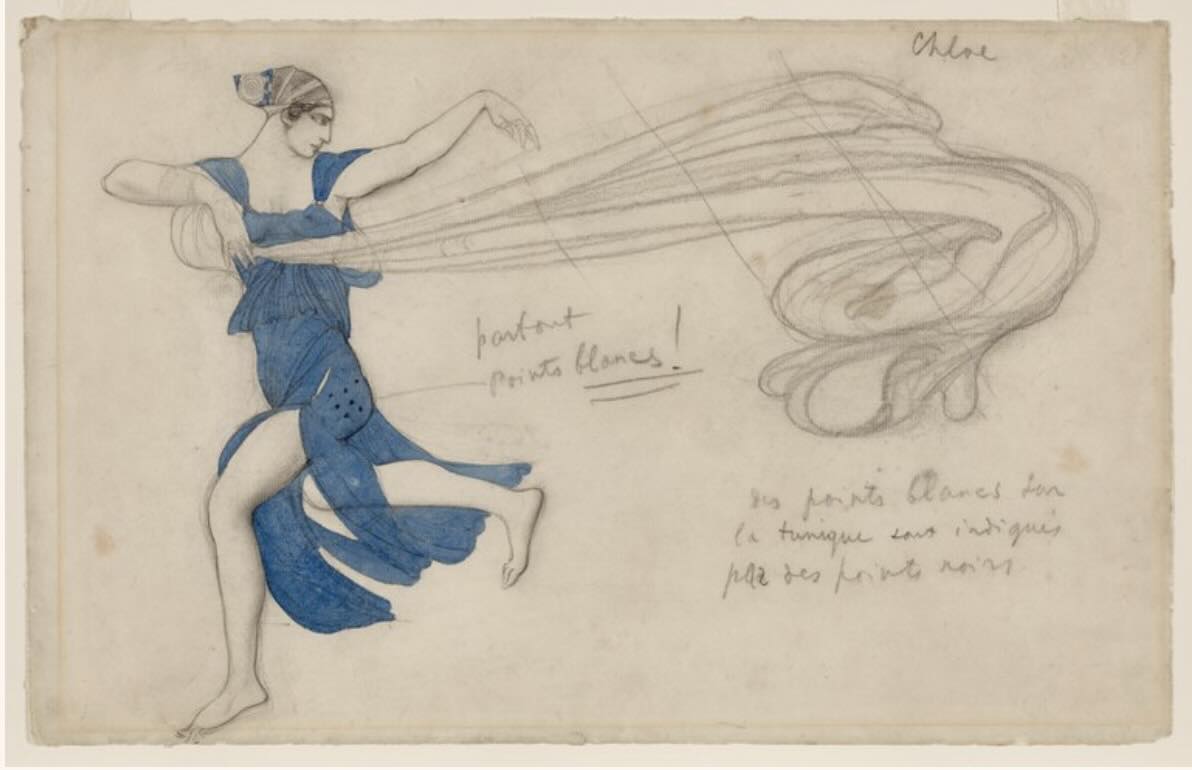
Léon Bakst, costume design for Tamara Karsavina as Chloé, 1912. Source

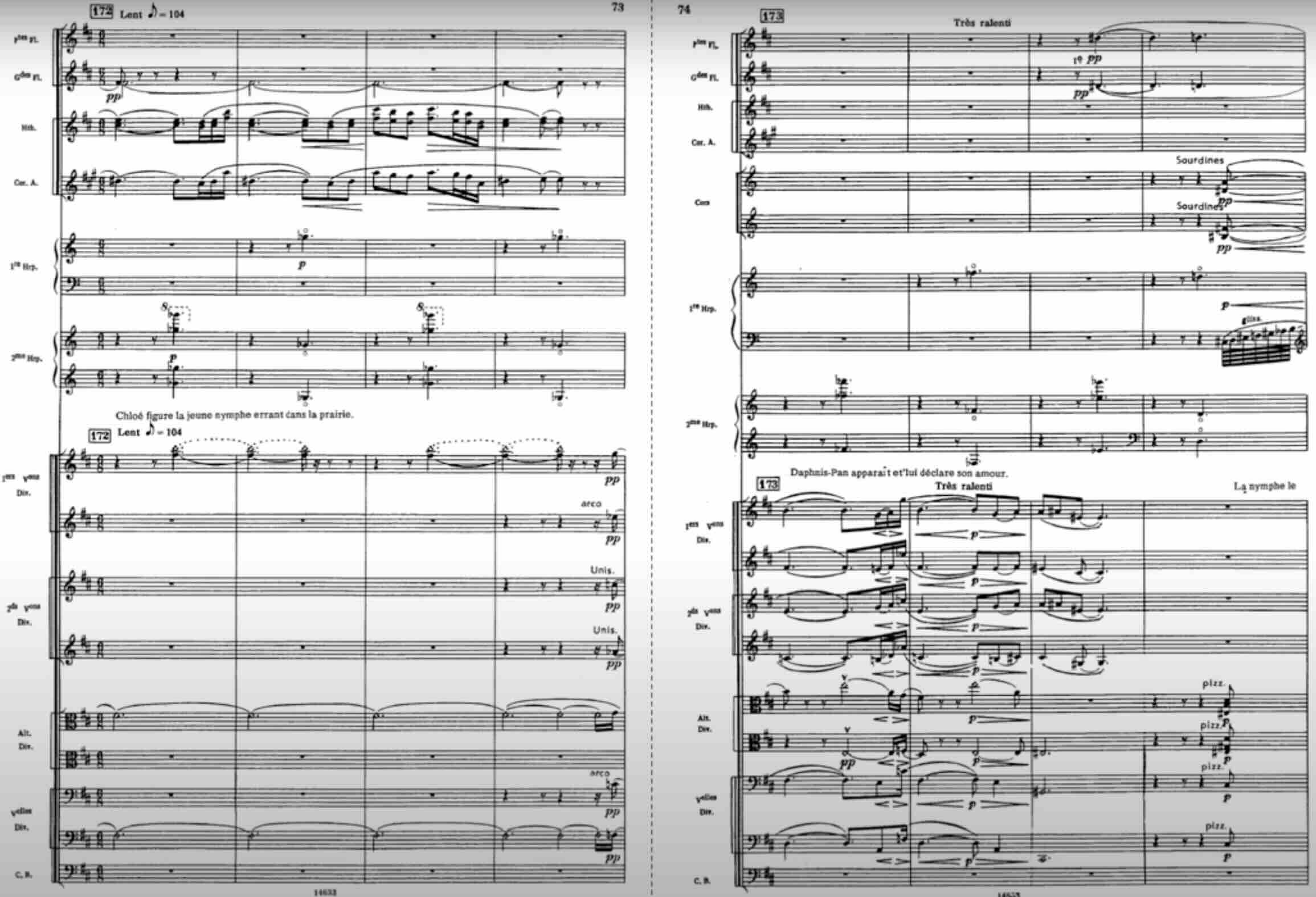
Just predating both the Boulanger pieces, Ravel’s Daphnis and Chloé (see my main page on Ravel) is exquisite. Ideally it should be heard in the complete version, but the 2nd suite makes a popular concert finale (here it was enhanced by wordless choir, usually considered too extravagant). The opening is always enchanting—I like this story (anyone have an original source?):

Ravel, when asked how it was that his famous musical evocation of sunrise had been penned by someone who never got up before 10.30am, replied, reasonably enough, “I used my imagination”.

To follow the flute solos of Pelléas and the Prière, Daphnis and Chloé is a glorious showcase for the woodwind, with Stéphane Denève at last free to conduct with balletic nuance and bacchanal abandon.

Screenshot

A most exquisite passage—from 5.43 in S-Simon Rattle’s live performance with the LSO here.


* The late lamented Nicolas Robertson was part of the Monteverdi Choir for John Eliot Gardiner’s 1999 recording, inspiring him to create one of his most moving anagram tales—192 anagrams of Lili Boulanger that he wove into yet another fantastical plot (the title Nubile gorilla an anagram that vies with Gran visits York for Igor Stravinsky!).

Yanggao: a distant Daoist connection

Pardon 1991The Li family Daoists perform the Pardon ritual at village funeral, Yanggao 1991.

My first visit to Yanggao in 1991 began an enduring relationship with the Li family Daoists and other ritual specialists of the otherwise unprepossessing county in north Shanxi. The great Li Qing (1926–99) was the seventh generation of household Daoists in the lineage, his son Li Manshan the eighth (besides my film and book, posts are rounded up here, including More Daoists of Yanggao, and Yanggao personalities).

Earlier this year I wrote about the venerable Buddhist monk Miao Jiang, also born in Yanggao. Now, thanks to Yves Menheere, I’m intrigued to learn of another native of the county: Li Wencheng 李文成 (no relation to our Daoist lineage!), an “old revolutionary” who miraculously became General Secretary of the Chinese Daoist Association in his 60s. He has just died at the age of 97, prompting nationwide memorial ceremonies (clearly secular services!).

Focused on the PRC, the Bitter Winter website’s coverage of (abuses of) religious liberty and human rights is important, even if I sometimes quibble with its stance (such as here). To augment its obituary of Li Wencheng I’ve gone back to the (selectively) detailed interview by the Chinese Daoist Association in 2021 (and this shorter eulogy, even more conformist). Bitter Winter is indeed frosty:

The former General Secretary of the Chinese Daoist Association knew nothing about religion but was made by the CCP first into a Catholic and then a Daoist leader. […] Li was a crucial figure in the history of government-controlled Daoism. His life and career shed a light on how the CCP selects the personnel it calls to lead the country’s religious organisations.

There can be no doubt about the subservience of state religious departments to the Party. Normally I would give short shrift to such high-ranking apparatchiks; while CCP religious policy is a perfectly valid research topic, it may obscure grassroots practice. Since Li Wencheng’s life makes an intriguing contrast with those of my Daoist masters in the county, here I will intersperse his story with that of the Li family Daoists on the eve of Liberation, under Maoism, and since the 1980s’ reforms (again, covered in my book and film); as well as with that of the eminent Miao Jiang. Despite my own aversion to officialdom, my interpretation will be rather less polemical than that of Bitter Winter.

* * *

With my field experience in Gaoluo, I was keen to document the early years of revolution on the plain just south of Yanggao county-town (for the disparity between my fieldwork methods in the two sites, see here). But I never found any “old revolutionaries” there who could describe the period in detail.

One could hardly expect upright cadres like Li Wencheng to volunteer frank reminiscences of the events surrounding the trauma of land reform. But his account makes a rather more personal supplement to that of the 1993 Yanggao county gazetteer. [1]

Some sites in the partial overlap between Li Wencheng’s war years and
(in red) household Daoist bases. Cf. map here.

Li WenchengLi Wencheng in 2021. Cool trousers, eh. Source: Weibo.

Li Wencheng was born in Gucheng village in 1927, the year after the great Li Qing. From July 1945, just before the surrender of the Japanese invaders, he “engaged in revolutionary activities” further south in Yanggao,  joining the motley armed militia of 2nd district, a mere couple of dozen men. The militia was soon disbanded, whereupon he was transferred to the county lianshe 联社 association (forerunner of the gongxiaoshe Supply and Marketing Cooperatives). He gained admission to the CCP in March 1946.

Ritual life in Yanggao had persisted even under Japanese occupation. A 1942 stele commemorating the Zhouguantun temple fair lists the names of five Daoists from the Li family, who dutifully “offered the scriptures”—including Li Qing, then 17 sui. Li Qing recalled, “Our ritual business didn’t suffer during the occupation—the troops, themselves devout, even made donations when they came across us doing Thanking the Earth rituals! The local bandits didn’t interfere either”. He married in early 1945; his son Li Manshan was born in 1946. Li Qing’s Daoist father Li Peixing was shot dead accidentally by Nationalist troops in 1947.

After the Japanese surrender the Communists briefly took over Yanggao town, but by autumn 1946 Li Wencheng joined them in retreating south to the hills to engage in guerilla activity when Fu Zuoyi’s forces occupied the area. Fording the Sanggan river, they traversed the mountains of Guangling and Lingqiu counties to reach safety in Fanshi. Though travelling in only two trucks, they had to take cover from bombings by KMT planes. In Fanshi Li Wencheng took part in the initial stages of land reform, training for three months in Hunyuan county-town, base of the North Shanxi district committee.

All these counties also had active groups of household Daoists, intermittently serving the ritual needs of their local communities (Guangling, Hunyuan, as well as the household Buddhists of Fanshi).

Li Wencheng’s first mission to implement land reform was doomed to failure, sent all alone to a mountain village on the very southern border of Yanggao county. In December 1947, while still involved in guerilla warfare, he was deployed to Yanggao 1st district, serving as financial assistant (cailiang zhuli 财粮助理) for the imposition of land reform in Upper village (Shangbu 上堡) just north of Dongjingji.

The CCP county administration had moved south of the Sanggan river, but the district base was just south of Gucheng at Dongxiaocun, a large village of over a thousand households, its Upper Fort (where they set up) towering over the Lower Fort. But it was sandwiched nervously in between the KMT strongholds of East Jingji township, just 20 Chinese li (10 km) east, and Xubu to the west. The guerillas often had to flee from KMT cavalry raids.
Li Wencheng xiaodui

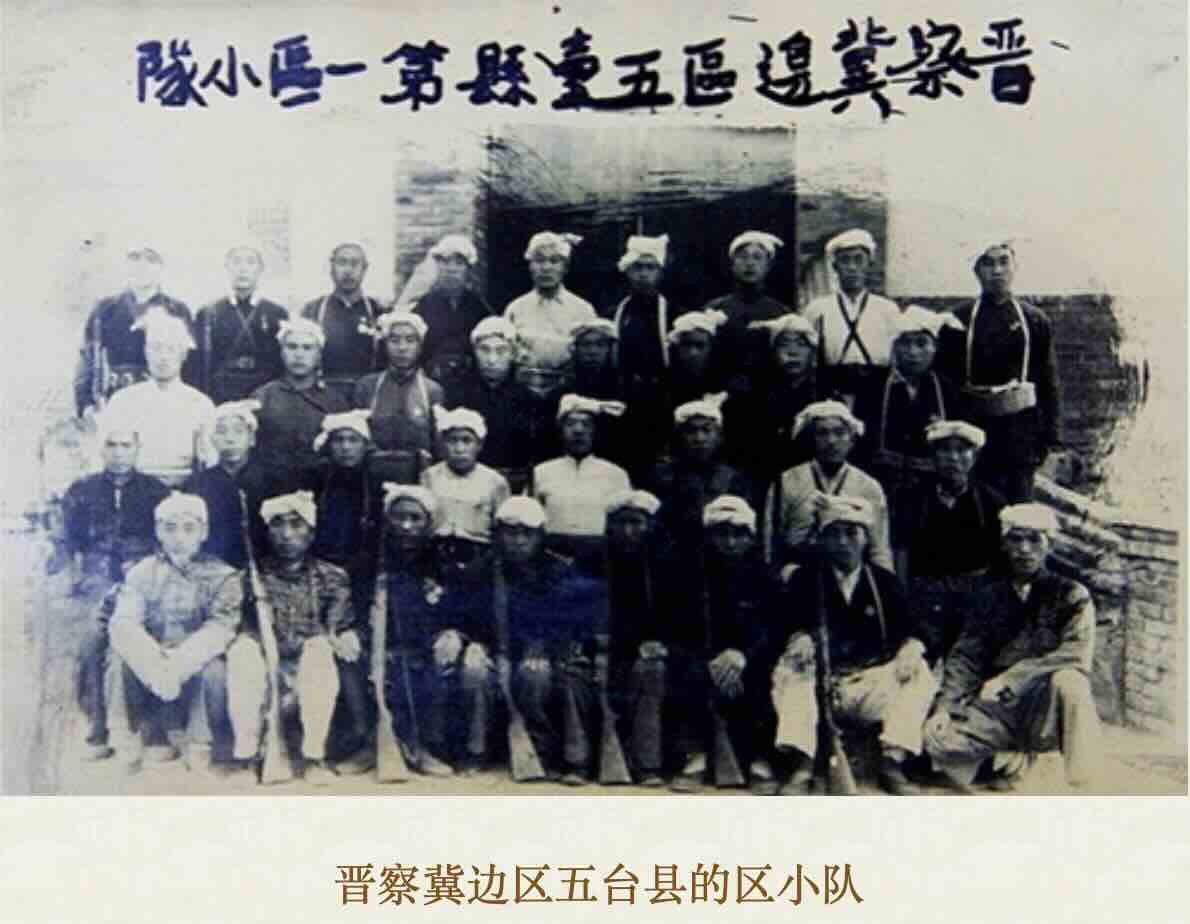
Shanxi-Chahar-Hebei frontier zone, Wutai county 1st district “small team” militia. Source.
Note the headscarves, archetypal emblem of the revolution.

By 1948 the Communists could look forward to victory, and the Party government was able to move back to Yanggao town. In the autumn, with Yanggao already “liberated”, Li Wencheng was sent to “support the front line” (zhiqian 支前), providing supplies for the troops around the Sanggan river, Fengzhen and Jining further north, and Zhangjiakou.

LPS and wife

Li Peisen and his wife Yang Qinghua, late 1940s?

In 1947 in Upper Liangyuan, household Daoist Li Peisen, former village chief, perhaps realising that land reform was imminent, quietly moved his family to his wife’s natal village of Yang Pagoda in the hills just south, taking his sets of ritual instruments and costumes, as well as two trunks full of scriptures handed down in his branch of the lineage. People from “black” families tended to encounter less scrutiny outside their home village. The family of Li Peisen’s wife were well-off and well connected; both he and his wife are remembered as highly intelligent. Their move was clearly an astute way of sidestepping any investigations into his background—his economic standing, and his connections with the vilified Japanese and Nationalists. Yang Pagoda might make a safer base from which to survey the lie of the land under the new regime—the potential sensitivity of practicing ritual would have been a minor issue.

Yang PagodaLi Peisen’s cave-dwelling in Yang Pagoda village.

Anyway, Li Peisen wasted no time in displaying his political correctness. Amazingly, he now gains an honorable mention in the county gazetteer. In March 1949—just as family members back in Upper Liangyuan were being stigmatised with a “rich peasant” label—he was the very first in the whole county to organise a mutual aid co-op, consisting of three households. Li Peisen’s move to this tranquil village, and his wife’s careful assertion of local status, were to play a major role in enabling the lineage to preserve its Daoist traditions.

Most of the household Daoist traditions in Yanggao county were based on the plain just south of the county-town; in the hills further south in the county, such groups seem to have been quite few even before the 1950s (I listed some groups in my book, p.63).

Under Maoism
From early 1949 Li Wencheng took up a series of administrative posts in Yanggao, then part of Chahar province, serving as secretary of county and regional propaganda departments. In 1950 he married Zeng Hua in Yanggao town. She came from East Chang’an bu village, just southwest of Upper Liangyuan. Their three children went on to find work further afield, whereas Li Wencheng’s four siblings continued tilling the land in Yanggao.

By 1952 Li was assistant editor of the financial team of the Chahar Daily, but later that year Chahar province was abolished and he was transferred to Beijing with over twenty other journalists, where they found themselves under-employed. With two others he was soon selected for the Religious Affairs Department of the Cultural and Educational Committee of the State Council. For six months in 1954 he was trained in “religious history, religious policies, and the domestic and foreign religious situation”. He then took part in a study class for Catholic clergy in the Church of the Saviour (Xishiku) in Beijing, along with over a hundred priests and bishops. As he recalled, they mainly studied patriotism and anti-imperialism, on the basis of articles opposing religion by Fang Zhimin 方志敏, a Red Army military commander executed by the KMT in 1935. Whatever the truth of the incident leading to Fang’s execution, [2] this hardly made a promising introduction to the subject. Li Wencheng now worked loyally for the Chinese Patriotic Catholic Association and the Religious Affairs Bureau. Bitter Winter:

By his own admission, he was a Marxist who knew precious nothing (sic) about religion.

But in contrast to all the detail on the War of Liberation, the interview has a typically glaring lacuna between 1954 and 1984. Through successive political campaigns, even Party loyalists had to be very cautious; serving as a cadre was an unenviable task that could easily lead to labour camp, even before the violence of the Cultural Revolution. The interview doesn’t broach Li Wencheng’s duties in monitoring Catholicism through the 1950s and early 60s—a stressful period. After the arrest and imprisonment in 1955 of Bishop Gong Pinmei along with several hundred priests and Church leaders, the official Chinese Catholic Patriotic Association was founded in 1957, marking a schism with the Vatican, but underground house-churches continued to function. Nor does the article mention Li Wencheng’s experiences during the Cultural Revolution. We may never learn the story of how he weathered the period.

church

 The Catholic church, Gaoluo (just south of Beijing)—built in 1931, destroyed in 1966.
The village’s Catholic families maintained their faith through the decades of Maoism,
reviving since the 1980s but still resistant to the “Patriotic Church”.

Back in rural Yanggao, Miao Jiang (b.1953) came from a devout Buddhist family in West Yaoquan village, somehow maintaining his faith through campaigns, having his head shaved in Datong to become a monk at the extraordinary time of 1968.

While the Li family Daoists kept performing after Liberation, encroaching collectivisation led to ever more desperate poverty, and by 1958 Li Qing was happy to take a state job in the North Shanxi Arts Work Troupe based in Datong city, even though their tours of the countryside were tough. He returned home when the troupe was cut back in 1962, after the worst of the famine. Despite a brief revival, Daoist ritual was silenced by 1964, and through the Cultural Revolution the Li family lived in fear, vulnerable by virtue of their “black” class background.
Minghui

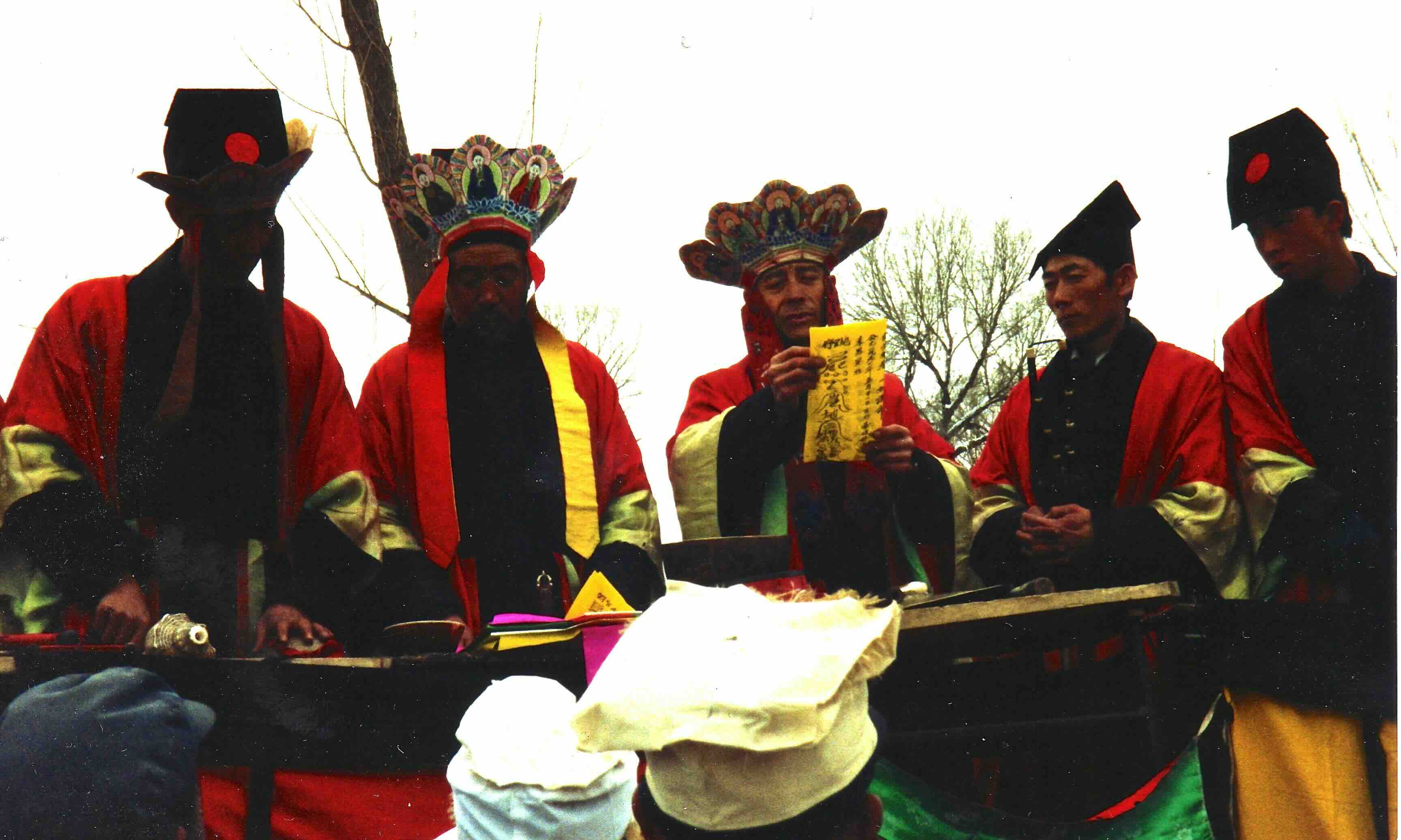
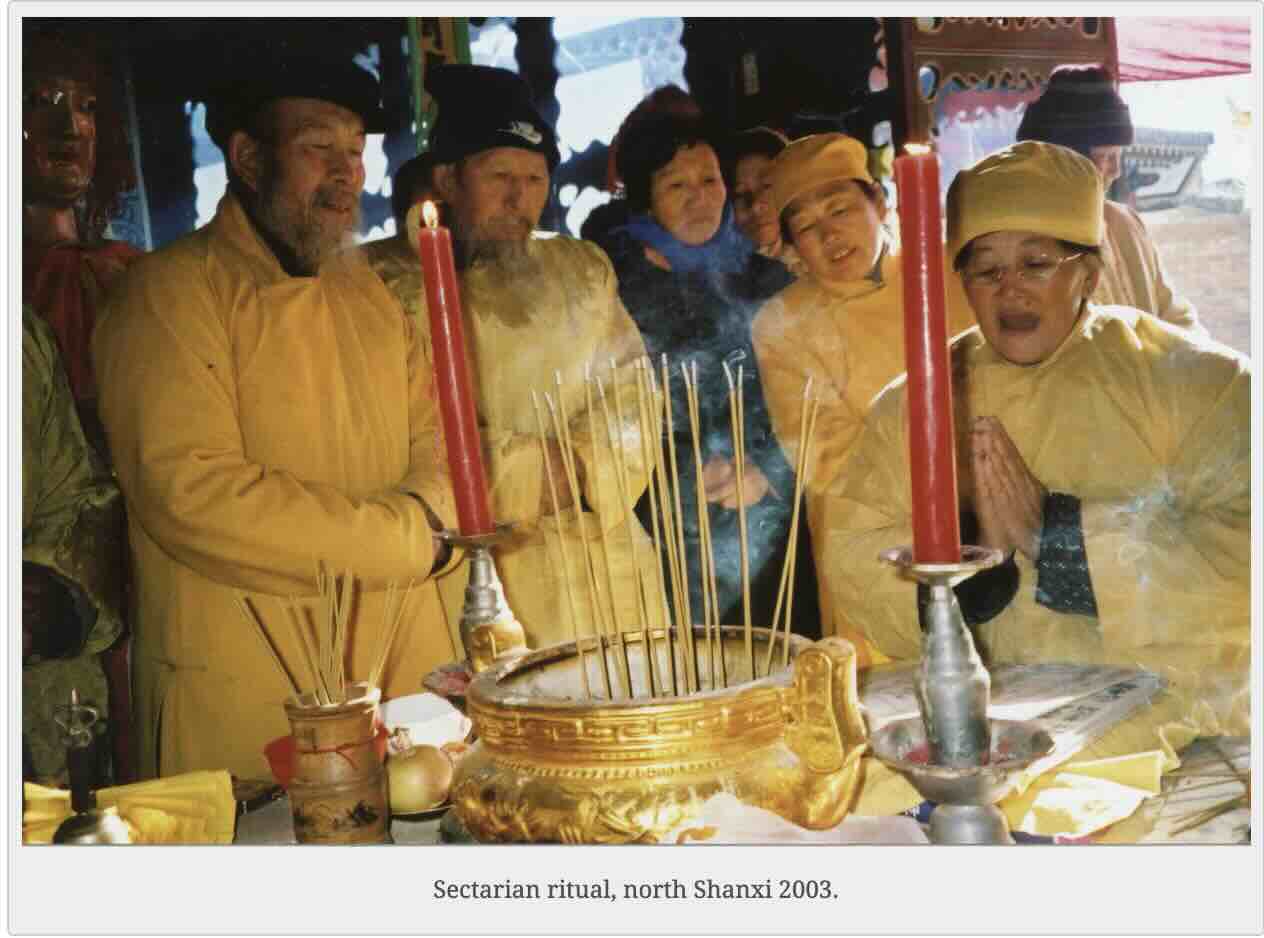
Even less palatable for a Party stalwart like Li Wencheng would be sectarians and spirit mediums, many of whom somehow maintained clandestine activity under Maoism despite campaigns to suppress them soon after Liberation. In Yanggao, village adherents of the Bright Association (Minghui) and Yellow Association (Huanghui) recited lengthy “precious scrolls” as part of rituals for their own followers; the leader of one such group even transmitted the liturgy to his teenage son early in the Cultural Revolution. Since the death of Mao and the downfall of the Gang of Four, both sectarians and mediums revived, broadly tolerated by the local authorities.

Since the reforms

Miao Jiang x

Miao Jiang has been based at the Buddhist mountain complex of Wutaishan since 1980, as the mountain opened up to a massive reinvigoration of “incense fire”after the depression of the Maoist era. His devotion to restoring temple life there was soon recognised as he was fêted with official titles.

But in utter contrast to Li Wencheng, he has remained aloof from worldly affairs: his allegiance has always been to the dharma, and any organisational responsibilities grew out of his faith. Eschewing the lifestyle of official banquets, he adheres to a simple Buddhist diet, while sponsoring charitable and relief projects. Still, religion needs organisers…

The Li family Daoists had begun to resume activity from around 1980 (see Testing the waters, and Recopying ritual manuals), and were soon busy “responding for household rituals”. In autumn that year, Li Manshan took his first train trip to Beijing, with his cousin Li Xishan. They wanted to buy a sewing machine, not available (or at least substandard) in Datong, but in the end they couldn’t find a good one in Beijing either—so Li Manshan bought a big bag of socks instead.

As Li Wencheng recalled, as he approached his 60th birthday he was expected to retire. But somehow in 1986 he was chosen to serve as General Secretary of the Chinese Taoist Association. Though at first reluctant, being in good health he was happy to keep working. He stayed in the post for thirteen years until retiring in 1999.
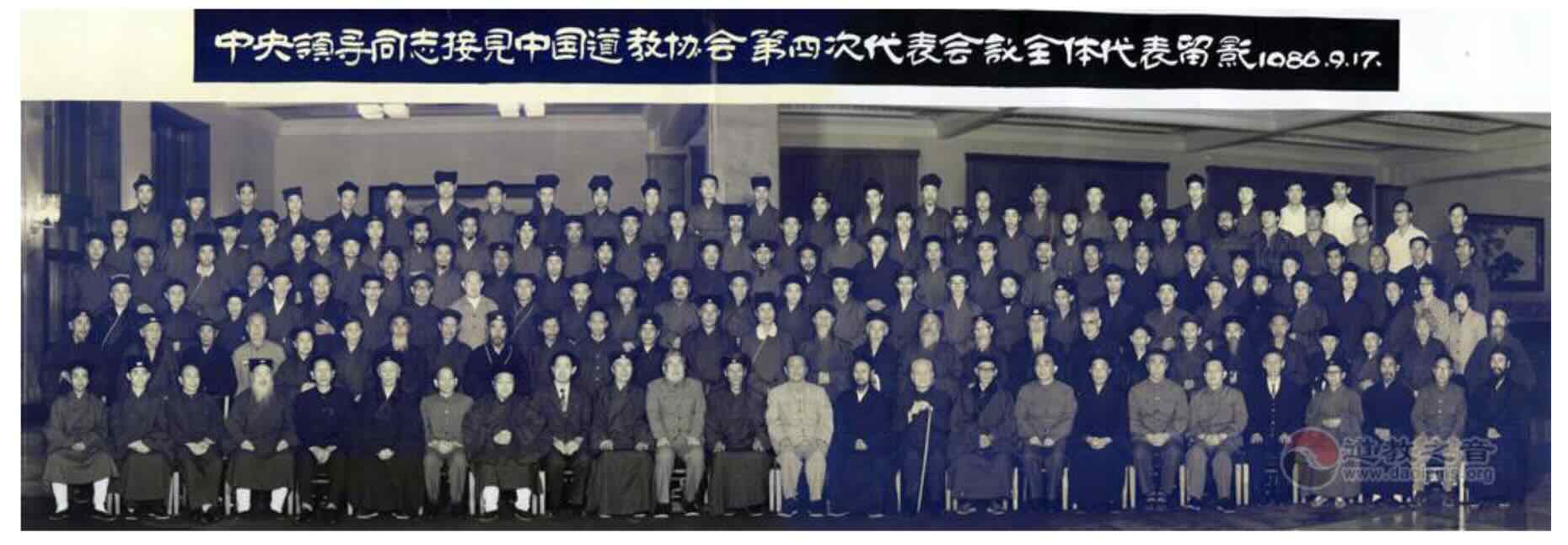
Daoxie 1986

Fourth conference of the Chinese Daoist Association, 1986. Source.

Through his early years around Yanggao, first as guerilla, then as cadre, Li Wencheng can hardly have had any contact with folk ritual activity—and like his comrades, had he chanced upon it, he would surely have disdained it. Once on the Party ladder in Beijing the only experience he gained of religion was overseeing CCP policy towards Catholicism. While many devout and prestigious Daoist and Buddhist clerics were recruited to official religious bodies after Liberation, they were often “mobilised” (coerced) as figureheads.

Li Wencheng now found himself responsible for state policy towards Daoism at a time of a spectacular religious revival (for a fine study of the grassroots revival in Fujian, click here). He helped found the Chinese Daoist Academy and the magazine Zhongguo Daojiao, mouthpiece of Party policy; he re-established the system of ordination in Beijing and elsewhere, working with Wang Lixian 王理仙, respected abbot of the Eight Immortals temple in Xi’an. But he doesn’t mention the great Min Zhiting, who was also summoned to the White Cloud Temple around this time (cf. Zhang Minggui, abbot of the White Cloud Temple in Shaanbei, whose efforts to maintain worship on the mountain ever since the 1940s have always involved negotiating local politics).

In 1990 Li Qing led a group of his Daoist colleagues to perform at a major festival of Buddhist and Daoist music in Beijing. The Li family Daoists were lodged in the White Cloud Temple along with several other Daoist groups from elsewhere in China invited for the festival, doing five performances (not rituals) for private invited audiences over fifteen days in the temple and at the Heavenly Altar. Some apparatchiks were opposed to the event, but influential senior ideologues like He Jingzhi and Zhao Puchu supported it. In the end, the Religious Affairs Bureau and the Chinese Daoist Association must have been among the official bodies sponsoring the festival. I wonder if Li Wencheng attended—would he have been curious to encounter Daoists from his old home of Yanggao, or would he have distanced himself from such household ritual specialists?

And I wonder how often he returned to Yanggao to visit his siblings and their children. For funerals there since the late 80s, it has again become routine to hire Daoists to perform rituals—events that Li Wencheng’s relatives would doubtless often attend.
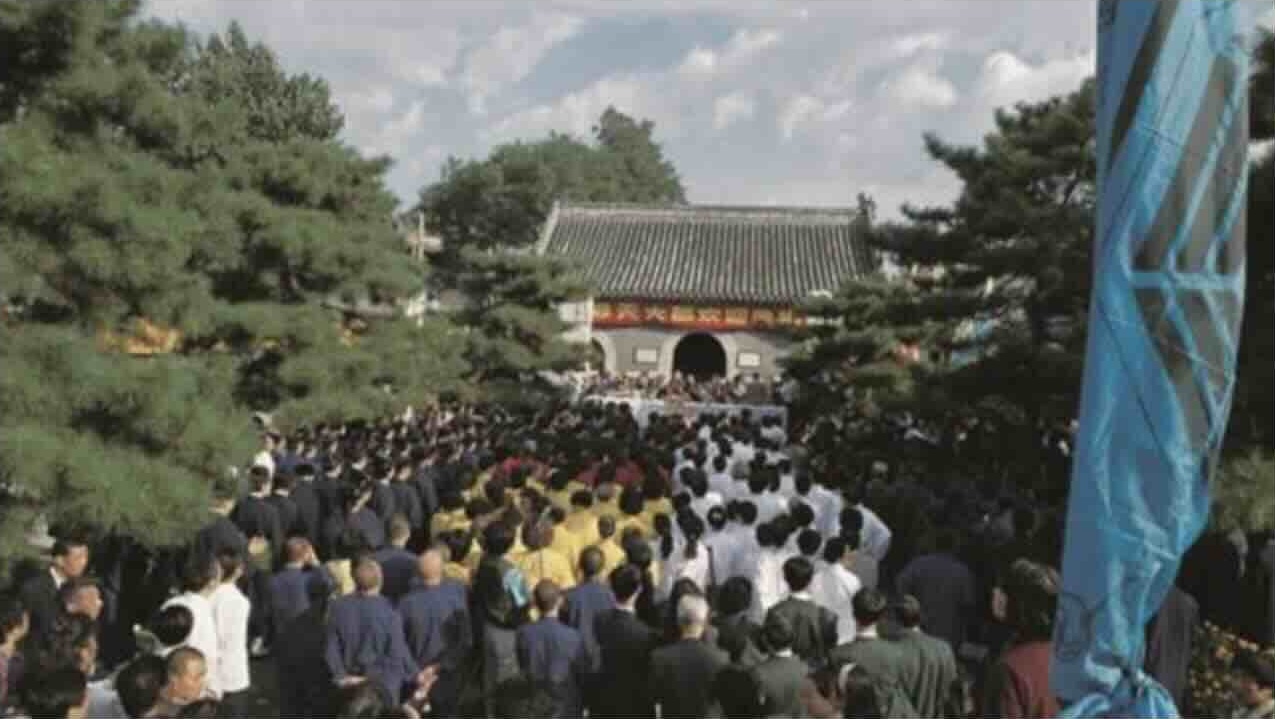
1993 jiaoGreat Open-air Offering ritual, White Cloud Temple, Beijing 1993.
Source: Weibo.

Another comment in the Bitter Winter article that I find rather too stark: perhaps not exactly that Li Wencheng “used Daoism to spread CCP propaganda in Hong Kong and Taiwan”, rather that Daoism could indeed make a useful tool to further diplomatic rapprochement. To this end a significant step in 1993 was his organising of a Great Open-air Offering (Luotian dajiao 罗天大醮) ritual at the White Cloud Temple, bringing together Daoist priests from temples around the PRC—with representatives from Hong Kong and Taiwan. Clips can be found online, such as this by the Daoists of the Xuanmiao guan temple in Suzhou.

Li Wencheng 2015

In 2015, for the 70th anniversary of victory in the War of Resistance against Japan,
Huang Xinyang (left), Deputy Chief of the Chinese Daoist Association,
presented Li Wencheng with a commemorative medal. Source.

Shi Shengbao 2018

2018: Li Manshan with Shi Shengbao (b.1948), ritual director of Yangguantun village, Yanggao.

* * *

Li Wencheng’s responsibility in later life for marshalling CCP policy towards Daoism was quite serendipitous. Bitter winter again:

What is most interesting in this biography is that Li changed religions as others change shirts. He was first non-religious, then Catholic, then Daoist.

Interesting indeed, but the comment is somewhat misleading. Li Wencheng was surely never “religious”, and his task of monitoring Catholicism and then Daoism didn’t imply “belief”, any more than it does for ethnographers of religion; no conversion was involved (and anyway, Buddhist and Daoist deities can happily coexist in folk pantheons!). The article goes on:

This did not really matter since his job was to serve the CCP, not religion. He was sent to different religious organisations to “implement the Party’s religious work policies”. He was a typical example of the bureaucrats the CCP selects for the five authorised religions. Many of them do not believe in God or religion. They are there just to control religion on behalf of the Party.

Most appropriately, the official press release celebrated Li as somebody whose life was “an unremitting struggle for the cause of Communism”—not of Daoism or any other religion.

The Party’s efforts to control temple clerics were extensive, and effective; Buddhism was always based mainly in temples, and temple-dwelling Daoist priests too could be efficiently overseen too. But the life of Daoism depended less on temples, and the countless household Daoists throughout the countryside were harder to control—even if Li Wencheng was doubtless involved in the successive efforts to register them.

* * *

One could find similar grassroots religious activity in the home county of any secular Party apparatchik (all the way up to Chairman Mao and his Hunan origins)—I’ve just given these vignettes from my experience of Yanggao. The Li family Daoists remain busy performing rituals in the nearby villages; Miao Jiang, a devout Buddhist since his early youth, found himself becoming a revered master on Wutaishan; Li Wencheng, who never had any sympathy with religion, somehow ended up overseeing major Daoist projects from his Beijing office.

Conversely, Party overseers often lament cadres’ persistent adherence to “feudal superstition”. At the local level, it is perfectly routine for village cadres to consult household Daoists (like Li Manshan) or spirit mediums to “determine the date” or identify an auspicious site; some such cadres may even be ritual specialists themselves. But cadres higher up the Party ladder too may consult  “superstitious practitioners” (e.g. here).

Even among those who were earmarked to represent Party religious policy, we find a range of ideology. Some, like Li Wencheng, were entirely secular in their thinking, their sole mission to serve the Party. Temple priests invariably have to pay lip service to the CCP cause; like the broader population, they are used to compartmentalising public and private spheres. Back in the countryside, “faith” may play a certain role for some household Daoists (such as Jiao Lizhong in Hunyuan) but for others it is a minor issue, compared to the mundane exigency of feeding their families while serving the local community. 

As evoked movingly in Tian Zhuangzhuang’s 1993 film The blue kite, everyone was trying to survive, subject to the whims of Party campaigns. Some were able to escape the poverty of rural life by finding an “iron food-bowl” with a Party career, while others remained tied to the land and its rituals. Both were common trajectories. And both the CCP and religious observance, in all their diverse manifestations, are part of the fabric of life in China.


[1] Though I haven’t yet found Li Wencheng’s name in the county gazetteer, it’s a useful source for both the civil war and “revolutionary heroes”, with considerable detail on the period (mainly on pp.15–20 and 50–54), which I haven’t attempted to collate with Li’s own account.

[2] Bitter Winter notes that charges against Fang Zhimin had included the beheading of an American Christian missionary and his wife in 1934—although doubts have been raised whether Fang was directly involved (e.g. here, and here), and even whether the couple’s abduction and execution was among the KMT’s charges against him.