John Gittings on words and photos

Among journalists based in China through the early years of reform, I admire the work of John Gittings, whose books such as Real China: From cannibalism to karaoke (1996) and The changing face of China (2005) make useful background to our studies.

Stories that appear to be told by still images are beguiling yet facile. I’ve been appreciating Gittings’ recent blogposts (here and here) in which he reflects on the relationship between words and photos in his coverage for the Guardian from 1978 until he retired in 2003.

Looking through my selection, I can see that many fall into one of three different types. There are those that contain visual pointers or signals—perhaps missed by me at the time they were taken—which add meaning to what is shown and what is remembered. A second type invites the viewer to reflect on the hidden history behind their subject matter—a more speculative delving into the past. Then there are a small number that cast retrospective doubt on what I wrote at the time: that can be unsettling.

Alongside telling images of Tiananmen in 1980 and 1989 are photos of his trips further afield. At the Qilin temple, Shandong, in 1997:

Many of the attenders were elderly women such as these, who had been brought from other villages on open-backed tractor-trailers. They burnt incense in front of the temple, and each was given a box of cookies. Studying their faces now, I can see that they are very tired: it may have been a long way back to their homes. And I wonder about their long, hidden, history too. Age is always hard to estimate but the oldest ones may have been born not long after the fall of the Qing dynasty. They would have experienced warlord upheavals, floods and famine, Japanese atrocities, revolutionary war, land reform, the Great Leap Forward, the Cultural Revolution and more. What memories from the past were revived when they attended the re-opening of the Qilin temple?

Anhui, 1982:

The old village houses are built in rows, with packed mud walls, tamped mud floor, and a thick thatched roof now dripping in the spring rain. Small children peer out of front doors, buffalo and oxen huddle close to the back doors. A few chickens scurry in the liquid mud. Fengyang County in Anhui province has always been desperately poor, and is only slowly beginning to change. There  had been some improvement after the 1949 Communist victory, but Mao’s Great Leap Forward was a disaster. People ate dogs to survive, and in 1959–61, one in six of the population died “in an irregular manner”—the euphemism for starvation. I have been taken to Kaocheng, till recently a People’s Commune but now part of a pilot experiment for the Commune to be replaced by a new structure that returns power to the local area. It has already been the pace-setter for the rest of Anhui province, trialling a new “responsibility system” that allows peasants some freedoms to farm the land. They are assigned a plot of state-owned land and have to contribute a fixed quota of their produce, but can decide what else to grow and sell it for themselves. The traditional village markets have re-appeared—I saw a huge cattle-fair under way on a dried-up river bed—and small-scale businesses are no longer banned as “sprouts of capitalism”.

Urumqi, 1978:

Sometimes the images that I revisit now do not chime with the words that I wrote then, and the retrospective doubts that this raises are hard to resolve. On my first solo trip to China, I interviewed the imam of the main mosque in Urumqi, which had not long re-opened, and I then took the photo above of him at the mosque entrance, together with members of his committee. In the story I wrote at the time, I described the imam as having given a “cheerful” account of the mosque’s revived fortune. That adjective could not be applied to this photo. Were they just being solemn for the camera, or had I been misled by the “short introduction” (carefully prepared with the relevant authorities) that the imam had just delivered?  The photo would not have been developed till I returned to England, and probably after I had written up the story. Does it suggest a rather less “cheerful” situation?

Another image from 1978:

The Muslim minorities, Uighur and Kazakh, in this farthest west corner of China had a hard time during the Cultural Revolution. “They closed the mosques, and would not let people wear their caps”, I am told in late 1978. The Arabic script had been replaced by a Roman alphabet that few could understand, and the history of the minorities was suppressed. Local organisations including street committees were only now being “restored”. I am taken to a new “workers’ home” to see how life is so much better. The bearded patriarch Tuerdi had 82 direct descendants down to his great-grandchildren. His youngest daughter has returned from teacher training college in Wuhan (she is on the right). On the left are Tuerdi and his wife; next to them is the head of the Street Committee whom I describe in my notes as “trying to interrupt whenever possible”. Behind her is a friendly neighbour, the only person who is smiling. The positions adopted in the photo are revealing: the Han Chinese cadre is in the centre background; his Uighur colleague next to him. I also note that Uighur cadres behave “with an air of deference” towards their Han superiors.

Considering a photo he took on a trip to Qinghai in 2003, Gittings reflects:

High up on a dusty plateau in the village of Taktser, Qinghai province, lies the only shrine to the Dalai Lama to be found in China. It is in the house where he was born, and is lovingly cared for by his nephew (shown here). On the altar is a letter written in the Dalai’s own hand. “I was born here with the name of Lhamo Dhundup,” it reads. “I was discovered to be the reincarnation of the previous Dalai Lama and went away. I have never forgotten my home village. I pray for its people and hope they are safe.” A wide valley stretches in the distance to Mount Tsongkhapa whose peak, say the villagers, resembles the Buddha’s head. The balcony outside the house looks across a courtyard decked with prayer flags to a village that has changed very little since 1938, when a search party of high-ranking lamas found the three-year-old Dalai. In 1986 the Chinese government rebuilt the family home, which had been destroyed in the Cultural Revolution, as a gesture in its dialogue with the Tibetan government in exile. Yet no agreement has ever been reached: the house is closed to pilgrims (and as a foreign journalist I am not supposed to be there).  “The people of Tibet weep every night and pray for him to return”, I am told. “We are five or six million Tibetans, scattered over a vast land. We can do nothing without him.”

Cf. roundups of my posts on Uyghur and Tibetan cultures; as well as Maoism and the famine, and Images from the Maoist era.

Like journalists, ethnographers often resort to “hit-and-run” visits for surveys of a region. Even when they make a base in one locale over a longer period, photos may give a misleading impression of timelessness—and this is just as true for images of ritual performance. We should always connect “snapshots” to their broader context, as I have sought to do for Gaoluo and the Li family Daoists. Against the backdrop of changing society, there are always personal stories to tell.

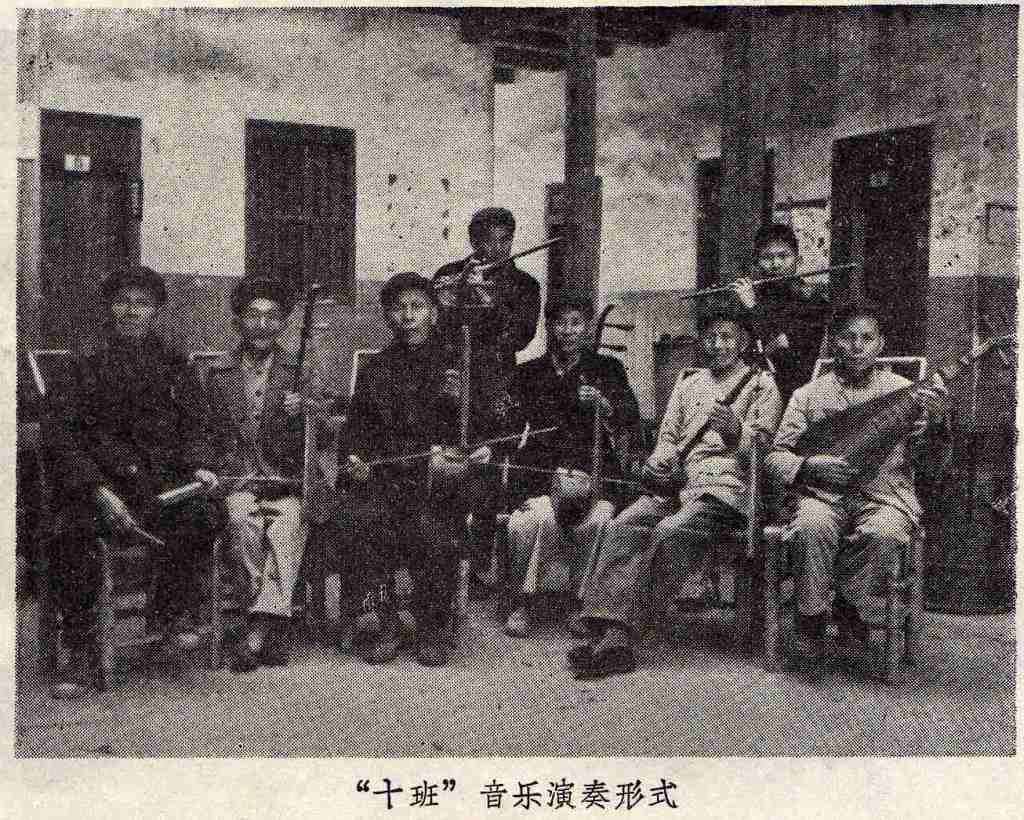
North Xinzhuang, Beijing suburbs 1959.

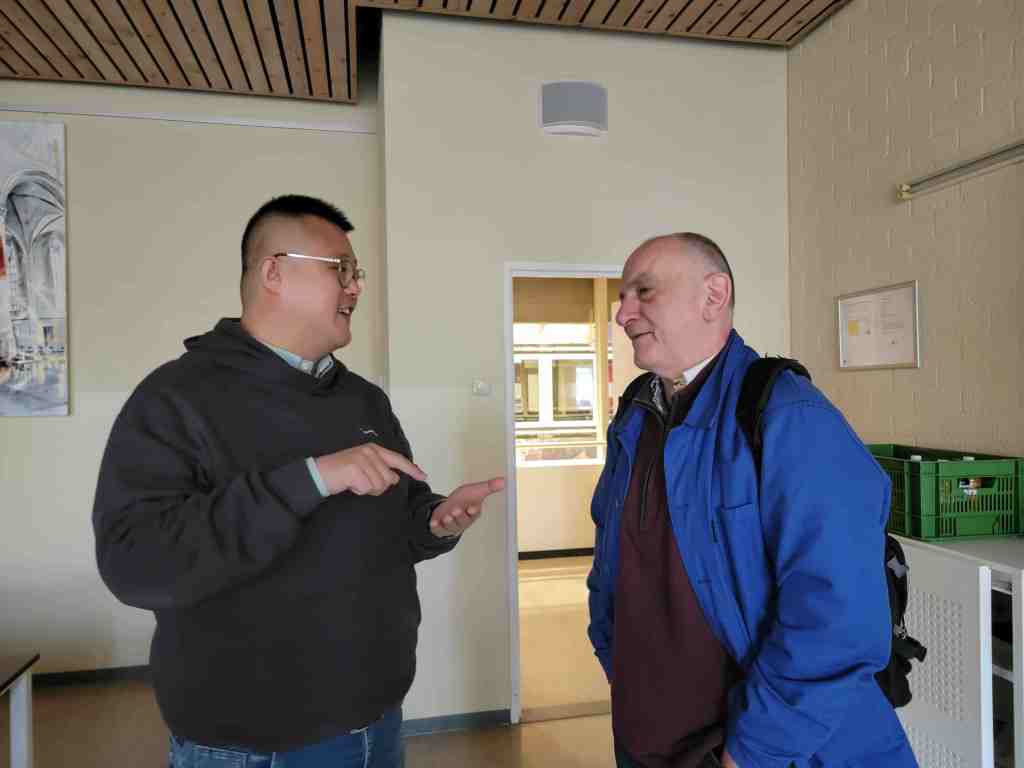
Presenting my films in Leiden

With Barend ter Haar (left) and Frank Kouwenhoven (right). Image: Yves Menheere.

Following the online publication of my recent film on the 1995 New Year’s rituals in Gaoluo, its public world premiere was at a grand event last week in the village itself. Shortly afterwards I visited Leiden University to present the film, as well as my portrait film on the Li family Daoists in Shanxi, as part of Yves Menheere‘s course on Chinese religion, and in collaboration with Frank Kouwenhoven of CHIME.

As I often stress (e.g. here), the study of both topics belongs firmly within the realm of religious studies, even if it has been dominated by Chinese musicologists. Sure enough, the distinguished sinologist Barend ter Haar graced us with lively comments, and I was delighted to see Tao Jin, formidable authority on Daoist ritual, on a visit from Beijing via Paris (see under Ritual life around Suzhou, and here).

With Tao Jin.

With both films concerning ritual life in north China, their subjects and soundscapes may appear somewhat similar, but the differences are significant (click here for differences in approach that emerge from studying with the two types of group). The Li family Daoists are

  • occupational, in a small group of five or six
  • active in a small radius around their home village; constantly busy, mainly for funerals,
  • with dense ritual sequences,

whereas Gaoluo is

  • among many amateur devotional associations, village-wide (cf. Xi’an, Yunnan, Jiangsu, and so on)
  • mostly serving the village itself, and not busy except at New Year,
  • its ritual sequences less dense.

My most focused fieldwork with the Li family Daoists was from 2011–18, with previous trips in 1991–2 and 2001–3; the film mainly shows footage from 2011 to 2015.  My fieldwork in Gaoluo took place from 1989 to 2003, the film footage showing three weeks in 1995.

While the impact of the Intangible Cultural Heritage on the Li family Daoists has been negligible (cf. here), in village ritual associations like Gaoluo it has been major—which makes the 1995 footage even more significant.

I look forward to introducing both films further to live audiences in the coming months. Meanwhile, do watch them online!

Dhrupad at the Bhavan!

*A reminder of my series on north Indian raga!!!*
with some highlights on my YouTube channel

The depth of the art of dhrupad singing never fails to entrance me—from the Dagar lineage through to Uday Bhalwalkar, whom I was blessed to hear this weekend in a recital at the Bhavan Centre in west London.

Through the slow, lengthy exposition of the alap, one hangs on every inflection, all the nuances of timbre, as Udayji expounds the pitch relationships—eventful, constantly creative, with a richly calibrated structure. Without neglecting the changing social context, one is drawn back to Hazrat Inayat Khan‘s 1921 book The mysticism and sound of music. The previous day Udayji led a workshop in which he reminded us of the power of singing as a spiritual discipline.

* * *

Perhaps through some imponderable quirk of algorithm, the only widely-viewed post in my raga series is Bhairav–Bhairavi. All the posts are worth consulting, but if any deserve promoting in particular, for me it has to be the one on Yaman Kalyan.

As I marvel at the variety of solo singing styles around the world, dhrupad has a unique aura. For me, Udayji ranks alongside Billie Holiday and Mark Padmore.

Click here for more dhrupad in the UK. For more from the Bhavan, see Indian and world fiddles, Learning raga at the Bhavan, and Bhairav to Bhairavi at Bhavan. Cf. Voices of the world, and A playlist of songs.

Night and day

*Part of my extensive jazz series!*

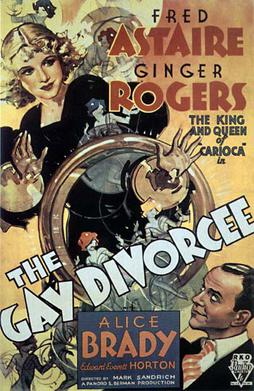
Cole Porter’s gorgeous song Night and Day achieved instant fame through Fred Astaire and Ginger Rogers’ iconic dance scene in The gay divorcee (1934; the UK release reverted to the 1932 musical’s title The gay divorce!):

While the scene is often adduced as an archetype of romantic love, and the dancing is of course stunning, it’s tricky reacting to the art of bygone ages with modern eyes and ears. Audiences today may find the couple’s “chemistry” elusive, their dynamics pointedly cold. His insistent “wooing”, and her reticent, never-rapturous compliance (“Cut the crap—oh well, at least he can dance”?!), may be standard for the time, but some may find the mood somewhat coercive.

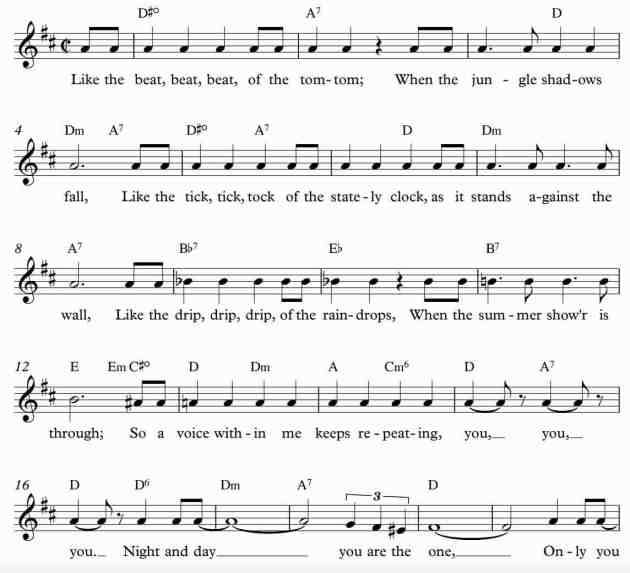
Still, the song itself is brilliant—so we might listen without getting confused about the dance’s sexual politics (cf. racial politics in the filmed version of Only you). As wiki explains, the song’s melody, harmony, and structure are all unusual. In the obsessive opening (often omitted, understandably), after 35 repetitions of the same note (emulating Beethoven?) over a narrow range of chords, the pitch boldly rises twice by a semitone for more repetitions before sliding back to the original pitch for the melody proper. Among several accounts of the song’s origin, this is presumably the source of the reductive orientalist claim that it was inspired by the call to prayer in Morocco (cited here):

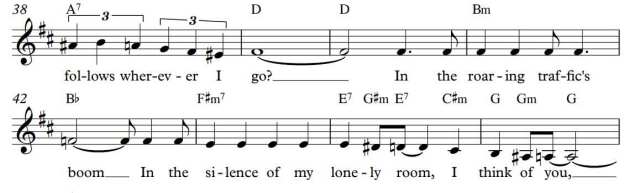
The song proper thrives on descending chromatic motifs (cf. Unpromising chromaticisms)–even when we think a regular melody might surface, in bars 44–5 the downward slide continues:

What might be a glorious climactic major 7th leap (making—love, from 1.37, bar 60) may hardly register:

In the dance, just as glorious is the way the band relishes all the rhythmic and melodic flourishes. After the dance, at the very end of the scene, when Astaire asks “Cigarette?”, Rogers still seems underwhelmed—if only she could have anticipated Lesley Nielsen’s immortal riposte in Airplane “Yes, I know”…

Recalling the Lexicon of musical invective is a story that when Porter first played the song for his friend Monty Wooly, Wooly sniffed, “I don’t know what this is you are trying to do, but whatever it is, throw it away. It’s terrible.”

* * *

Among other classic versions, apart from the likes of Ella Fitzgerald and Frank Sinatra, I always treasure Billie Holiday. Encapsulating the heartache of infatuation, she creates a new, angular melody unconstrained by the song’s original chromaticism—here’s her 1939 recording (the band including her constant soulmates Lester Young and Buck Clayton):

Charlie Parker, 1952:

Here’s a lengthy rendition by Stan Getz, live in Kildevælds Church, Copenhagen, 1960:

And Bill Evans in 1959, entirely eschewing the romance of the original—with Philly Joe Jones’s opening drum riff replacing the tom-toms of the lyrics:

An anthology of Chinese fieldwork reports

Under the current political regime in China, we may have doubts about the scope for in-depth field research; but in the sphere of musicology, grand compilations of previous work continue to proliferate impressively, such as a valuable recent publication from the Music Research Institute (MRI) of the Chinese Academy of Arts:

  • Zhongguo chuantong yinyue kaocha baogao 中国传统音乐考察报告 [Field reports on traditional Chinese music] (ed. Zhongguo yishu yanjiuyan Yinyue yanjiusuo, 10 vols, 2022),

reproducing the MRI’s original fieldwork reports (mostly mimeographs) dating from the 1949 “Liberation” through to the eve of the 1966 Cultural Revolution. For each subject, lists of recordings made at the time are appended. For introductions to the compilation, see e.g. here and here.

Volume 1 is prefaced by an authoritative survey from the redoubtable Zhang Zhentao 张振涛. Scholars now delineate three periods in the modern history of Chinese music fieldwork: the Maoist decades, the Anthology (1980s–90s), and the Intangible Cultural Heritage (ICH) era since around 2004. As Zhang reflects, after the fieldwork for the Anthology and its publication, we didn’t know if we still needed to read these pre-Cultural Revolution “field reports” and what value they might have. The majority of these traditions were, and are, embedded in ritual life—which maintained activity, at least until the Great Leap Forward, and again in the brief interlude between the easing of the ensuing famine and the 1964 Four Cleanups. However, the bulk of these studies focuses on narrowly musical aspects, so clues to social ethnography are in short supply—over a period of great change. Interviews were often conducted during visits by folk groups to urban festivals. Nonetheless, I am as full of admiration as Zhang Zhentao for the achievements of these early scholars.

If the political climate under Maoism had dictated a cautious approach towards ritual, the Anthology era began to hint at a more mature approach to social ethnography; but under the ICH such study is again being hampered by a sanitised patriotic agenda.

In my early years from 1986 visiting the MRI archives in Zuojiazhuang—then still permeated with the atmosphere of Maoism (see under Qiao Jianzhong)—I was immensely fortunate to have access to such studies, photocopying flimsy mimeographs, and I have introduced some of them in earlier posts. They formed a basis for the Anthology fieldwork after the liberalisations of the 1980s. These volumes have long been somewhat hard to find, so I hope they will now be more accessible—as long as libraries outside China can afford to stock the compilation.

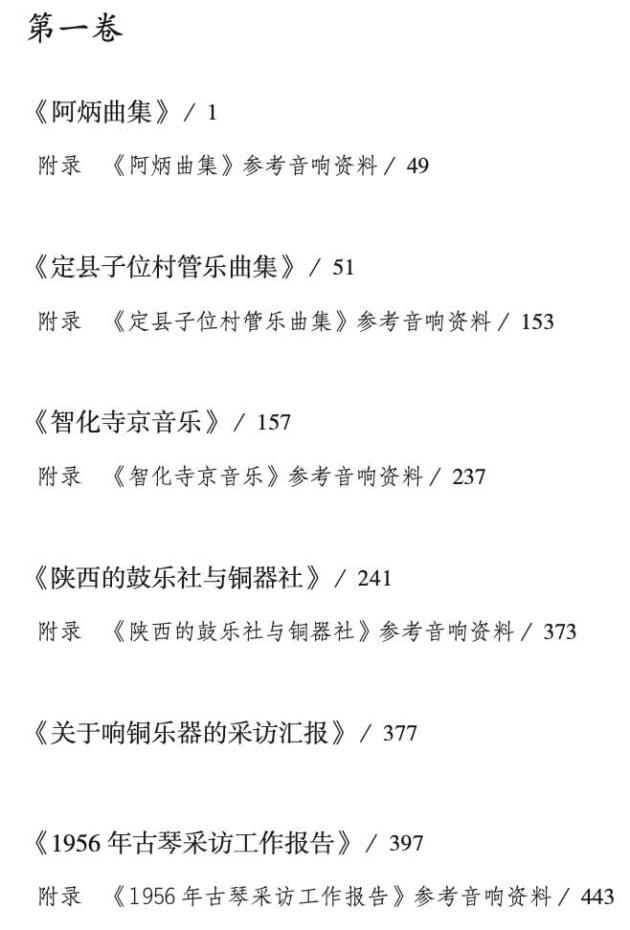
Contents, vol.1.

Yang Yinliu 1950.

Zhang again stresses the crucial leading role of Yang Yinliu. Vol.1 opens inevitably with his iconic A Bing quji (1979, based on their long acquaintance before Yang’s 1950 recordings), and his equally numinous studies of northern instrumental traditions: Ziwei village in Dingxian, Hebei (1952), the Zhihua temple (1953), and Xi’an guyue (1953). Vol.5 also includes a report, new to me, on “musical life” in the rural suburbs of Beijing (cf. here). Several studies address Shanxi, such as two reports from 1953—on folk-songs in Hequ, north Shanxi (vol.4), and yangge and huagu (vol. 5).

Vol.1 ends with the 1956 national survey of the qin zither scene led by Zha Fuxi. Vol.3 is devoted entirely to the extensive 1956 Hunan survey led by Yang Yinliu, and vol. 6 includes his insider’s study of the paraliturgical instrumental ensemble music of Daoists in Wuxi, south Jiangsu. Li Quanmin’s report on his 1961–62 survey around Fujian (vol.7) laid a basis for later work there. Vol.4 features an essay on issues in collecting folk-song and instrumental music; vol.10 ends with the 1963 handbook Minjian yinyue caifang shouce 民间音乐采访手册.

Vol.2 is devoted to narrative-singing: danxian paiziqu, narrative-singing in Tianjin, bajiaogu in Liaocheng (Shandong), the liqu of Pu Songling (a rare historical departure), the qingqu of Yangzhou, and Henan quzi.

Studies of the ethnic minorites also punctuate the compilation—such as folk-songs of the Dong and Miao people in Guizhou, and Baisha xiyue in Yunnan (vol.4); the lusheng mouth-organ of the Miao (vol.6), and Mao Jizeng’s 1959 pamphlets on nangma and toshe in Tibet (vol.5). Vol.7 includes further reports from Yunnan, as well as Hainan, and from national events showcasing folk dance and amateur musical life among ethnic minorities. Vols 8 and 9 contain 1958 reports on minority arts festivals, and vol.10 reports on opera festivals—including interviews with performers that give clues to social change before and since “Liberation”.

While the MRI was most prolific and prestigious, many other organisations published field reports through the period—on topics such as Wutaishan, Suzhou Daoist ritual, Yangzhou Daoist pieces, “old customs” in Wenzhou, and (in Shaanbei) the White Cloud Mountain and amateur musicking in Yulin. See under the fieldwork category, including reflections in this edited volume; as well as Images from the Maoist era.

The era came to an end by 1964 with the tense political climate that led to the Cultural Revolution, silencing both traditional culture and its study until after the reforms of the late 1970s.