
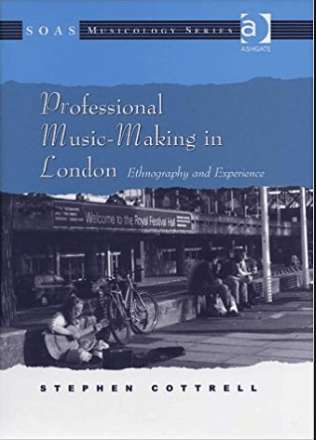
- Stephen Cottrell, Professional music-making in London: ethnography and experience (Ashgate, 2004)
takes a proud place among studies of more “exotic” cultures in the splendid SOAS Musicology series. Complementing the work of Bruno Nettl and Christopher Small, as well as Ruth Finnegan’s classic The hidden musicians, it strikes many a chord with my work on Chinese ritual groups.
As I observed under WAM, it’s not that Western cultures, of any kind, should be a benchmark for discussing other societies (note Is Western Art Music superior?, and What is serious music?!); to the contrary, it’s fruitful to integrate them into a “Martian” view of world cultures, wearing both emic and etic hats. Many of Cottrell’s themes resemble those that an ethnographer like me would explore in studying Daoist ritual specialists:
- The practical aspects of earning a living
- The importance of “on the job” training, sociability, and oral/aural experience in what seems like a narrowly text-based tradition.
- The importance of timbre (pp.44–55), little theorised even in WAM but quite prominent in China for the qin zither, deserves recognition in Daoist ritual and shawm bands.
- His account of “depping” (57–76) augments the parallel that I draw for household Daoists (Daoist priests of the Li family, pp.319–26), not least the insecurity of the freelance living—and it’s fascinating to read (Cottrell p.60) an account of depping from 1760s’ Britain.
- The modification of dreams: the tensions or discord between early training and ideals (based on solistic individualism and creativity) and the delicate social/practical negotiations, frustrations, and grinding routine of professional orchestral life (42–4, 103–21; cf. also Scunthorpe and Venice, and Ecstasy and drudge); personalities and crisis management within an ensemble (89–90). I should add that household Daoists, as hereditary (almost ascriptive) artisans, don’t experience such a conflict, never setting out with such a spiritual ideal; but the practical exigencies of occupational routine are shared. Here I also think of Yang Der-ruey’s study of the changing training of Shanghai temple Daoists. Cottrell cites a telling comment:
We’re artisans rather than artists. What an orchestral musician is doing is taking someone else’s creative idea which they put down as dots on paper and actually turning it into sound. So we’re more like bricklayers—the architect would do the plan and then they actually put the bricks into place.
- And his dissection of the performance event, subsuming ritual, theatre, and play (149–82)—continuing from Small’s account, about which he expresses reservations. He observes diversity within the audience and in their responses (159–64)—a feature that for Chinese ritual is clearly germane, not only today but even in (supposedly more homogeneous) pre-Liberation society.
- Cottrell’s discussion of myth and humour (123–47), citing Merriam’s paradigm of low status, high importance, and deviant behaviour—“licence to deviate from behavioural norms” (137, cf. 143)—often reminds me of the Li band (cf. my book p.23); one might also think of other embattled freelancers like actors (“luvvies”). Like household Daoists, musicians are poorly paid. I might add that muso humour (particularly that of the classical muso—or the ritual specialist?!) further serves both to defuse pressure and to deflate pretension. A lot of our stories immortalise hooligan behaviour on tour. Such deviant behaviour—or at least deviant self-image—is a kind of “No, I won’t be a paragon of elite culture for you”, however childish.
- Good too to see Cottrell drawing attention to “conductor-baiting”—better described as “maestro-baiting” (cf. his discussion of musos’ sarcastic use of the term maestro, p.139), recounting the famous story “You think I know Fuck Nothing—but I know FUCK ALL!” (135–6) (for variations, see my post on Visual culture). He attributes it to Celibidache, but I’ve heard it about Böhm (both are perfect candidates!); and outside the orchestral context it is usually attributed to director Michael Curtiz. Conductors are an authority figure par excellence. Here’s another story about George Szell:
Talking to Peter Gelb, General Director of The Met, someone was defending Szell against the charge of being a bully, remarking “Of course Szell is his own worst enemy”—to which Gelb replied “Not while I’m alive he isn’t”.
- He cogently discusses viola jokes (131, 136, 142, 144–6)—for which whole websites have arisen, of course. In Plucking the winds (p.233) I cited this one:
What two things have the Beatles got in common with the viola section of the BBC Symphony Orchestra?
Most of them are still alive; and they haven’t been together since the 1960s.
This dates from a time in the 1980s when at least the first part of the punchline was more applicable; though still funny, the joke now has an added period charm (cf. Musical joke-dating). I’ll limit myself to one more:
What’s the difference between a viola player and a supermarket shopping trolley?
The trolley’s got a mind of its own.
Anyway—in all, such ethnographic enquiry is routinely applied to all kinds of world societies, and scholars of Daoist ritual can of course learn much from studies of the “usual suspects” like south Asia or Africa. But it may be stimulating for us to see such approaches applied to an apparently familiar (prestigious? literate?) culture that is easily taken for granted. As with the “great composers” myth, reified ancient Daoist texts can also somehow be taken for granted, tending to dominate scholarly attention at the expense of real changing social performance and experience.
See also Mozart in the jungle, Perfection is NOT the word for it, and under Perfect pitch.
 Stephen Jones: a blog
Pingback: Money money money | Stephen Jones: a blog
Pingback: Intonation | Stephen Jones: a blog
Pingback: Ecstasy and drudge | Stephen Jones: a blog
Pingback: Social commentary | Stephen Jones: a blog
Pingback: A flat miner | Stephen Jones: a blog
Pingback: Conducting | Stephen Jones: a blog
Pingback: Jazz solo | Stephen Jones: a blog
Pingback: Parks and recreation | Stephen Jones: a blog
Pingback: Punk and feminism | Stephen Jones: a blog
Pingback: A tongue-twister for the household Daoist | Stephen Jones: a blog
Pingback: The beauty of the sheng | Stephen Jones: a blog
Pingback: The Catechism of Orchestral Cliché | Stephen Jones: a blog
Pingback: Trauma: music, art, objects | Stephen Jones: a blog
Pingback: An orchestral classic | Stephen Jones: a blog
Pingback: Early bird | Stephen Jones: a blog
Pingback: A tribute to Francis Baines | Stephen Jones: a blog
Pingback: Our modern ears | Stephen Jones: a blog
Pingback: Corpsing: Inuit culture and Haydn | Stephen Jones: a blog
Pingback: Depping with master singers | Stephen Jones: a blog
Pingback: Practice makes perfect | Stephen Jones: a blog
Pingback: A ruse for fiddlers | Stephen Jones: a blog
Pingback: Taruskin on early music | Stephen Jones: a blog
Pingback: Diary of a household Daoist | Stephen Jones: a blog
Pingback: More orchestral drôlerie | Stephen Jones: a blog
Pingback: On visual culture | Stephen Jones: a blog
Pingback: Mozart in the jungle | Stephen Jones: a blog
Pingback: Conducting from memory | Stephen Jones: a blog
Pingback: The joys of indexing | Stephen Jones: a blog
Pingback: Useful putdowns | Stephen Jones: a blog
Pingback: Schubert | Stephen Jones: a blog
Pingback: Performance ethnography | Stephen Jones: a blog
Pingback: Recording and editing | Stephen Jones: a blog
Pingback: Nicknames | Stephen Jones: a blog
Pingback: At home with a master Daoist | Stephen Jones: a blog
Pingback: A fine turn of phrase | Stephen Jones: a blog
Pingback: Jottings from Lisbon 2 | Stephen Jones: a blog
Pingback: Armchair ethnography: Chiswick | Stephen Jones: a blog
Pingback: Deviating from behavioural norms | Stephen Jones: a blog
Pingback: Ashiq: the last troubadour | Stephen Jones: a blog
Pingback: Flamenco, 2: gender, politics, wine, deviance | Stephen Jones: a blog
Pingback: Sardinian chronicles | Stephen Jones: a blog
Pingback: Musicking | Stephen Jones: a blog
Pingback: The Mary Celeste | Stephen Jones: a blog
Pingback: Musical self-defence | Stephen Jones: a blog
Pingback: Musical self-defence | Stephen Jones: a blog
Pingback: Mahler 3 at the Proms | Stephen Jones: a blog
Pingback: Which maestro was known as Noddy? – Slipped Disc
Pingback: Musical-joke-dating | Stephen Jones: a blog
Pingback: Musical cultures of east Europe | Stephen Jones: a blog
Pingback: Das Land ohne Musik | Stephen Jones: a blog