Travel: our changing times

Morgan

In Morgan: a suitable case for treatment (Karel Reisz, 1966; see also here), Morgan’s mother (the magnificent Irene Handl), a 1930s Communist who “refuses to de-Stalinise”, asked for news of her son, exclaims incredulously:

Got a postcard from ‘im, from Greece… I mean, what is there in Greece?

This was pretty much my parents’ attitude to my fieldwork in China.

Here they are paying respects at Marx’s grave:

Studying the cello

Ladykillers

“People often say to me…”

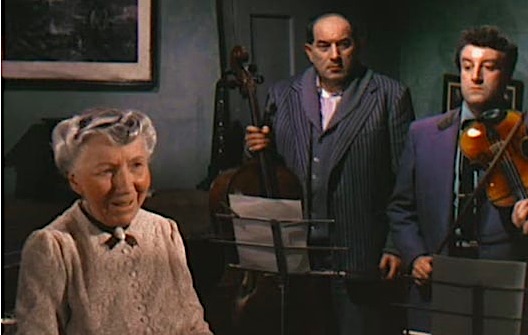
When I am asked how I came to play the violin, I’m inclined to cite The Ladykillers (1955):

As the gang is plotting their robbery, posing as a string quintet while they play a recording of the Boccherini Minuet, sweet little old Mrs Wilberforce (Katie Johnson) takes them by surprise—so to maintain the deceit they have to hurriedly pick up their instruments (which they can’t actually play). The magnificently obtuse One-round (Bernard Bresslaw) is clutching a cello like a sledgehammer:

Mrs Wilberforce: “May I ask you where you studied?”

One-round: “…Well, I didn’t really study any place, Lady… I just sort of… picked it up.”

I still can’t help thinking of the scene whenever I hear that minuet.

This leads nicely to Muso speak: excuses and bravado. For more convincing mastery of the cello, see here; and for Hugh Maguire leading the Allegri quartet in another Boccherini minuet, here. See also Learning the piano.

Faqu tu 2, or tutu

At Cambridge, Paul Kratochvil was not alone in enjoying a bit of drôlerie.

Here’s another jeu d’esprit on the faqu 法曲, from a precious old letter that I just found from my teacher Denis Twitchett, sent (by post!) from Princeton in 1986. A tad more wacky than his magnum opus Financial administration under the T’ang dynasty, it deserves to take its place among his magisterial writings on Tang history:

Dear Steve,
Some further ruminations on that mysterious term faqu. I am reminded of the hypothesis (first adumbrated in my alas-as-yet-unfinished “Preliminary proleptical remarks proving beyond Reasonable Doubt that Li Bai [aka Patrick O’Leary] was the earliest Irish poet”) that faqu is a rough-and-ready transliteration of the greeting shouted at tax-collectors in the medieval Irish countryside, and also commonly exchanged by rival drivers of donkey carts involved traffic accidents. The etymology of its common form in Chinese is obscure; under the Liao dynasty a folk etymology suggested that it meant “May the Law twist [your private parts]!” It should not be confused with the alternative writing (found in non-Buddhist contexts) fa-k’iu 發具 (explained by Karlgren as “Get out your [ritual] implement!”). This is quite distinct from the forms fakefu 法可夫 or 伏軻䮛 (the latter writing mistranslated by Legge as “Kneel by the hubcap of the Prince Consort”), meaning, according to Admiral Ting (first Chinese to be trained in the Royal Navy), “Be on your way, Jack!”

“French pieces” were surely more normally written in Tang Chinese as faji 法伎 or more colloquially as fashi 法式 “French models”. The title of the well-known Song-dynasty work Yingzao fashi 營造法式 is now attached to a rather boring work on architecture which explains how to construct yourself a baroque dog-kennel without mod cons. This work, however, is clearly a forgery by a Ming author, horrified to the depths of his neo-Confucian sensibilities by the original contents of the book, originally a Song DIY handbook “Make yourself a French model”.

The French presence long predates the Tang, and surely explains Zhuangzi’s Frog in the Well (a fine metaphor for the petty self-interest of the French). This also explains the title of the Tang Li Wa zhuan 李蛙傳, “The story of Froggy Li [the French model]”, and how the word wa “frog” came to have its other meaning “lascivious” or wanton”.

Empirical language acquisition

Pilsen

Frances Wood, a distinguished former student of the late great Paul Kratochvil, reminds me of another of his stories.

Paul liked to tell us this as we grappled with the use of classifiers (measure words) for Chinese nouns. The nearest equivalent in English is for collective nouns, like a gaggle of geese or a school of fish. In Chinese a basic all-purpose one is ge (“a person” is not yiren but yige ren), but one needs to use all kinds of classifiers before different types of nouns, like ben for a book (not yishu but yiben shu), or (if you wanna get pleasantly obscure—as I do) zuan for a sheng mouth-organ (yizuan sheng).

Anyway, Paul was just a kid when American GIs liberated his home village in Czechoslovakia in May 1945. They were kind of heroes, and he began hanging out at their barracks, gradually picking up English—entirely through daily aural experience.

After some time a grammatical rule subliminally formulated in his young mind: English nouns must invariably be preceded by the classifier fuckin’. No-one ever said “Gimme a beer!”, it was always “Gimme a fuckin’ beer!”; never “Open the window!”, always ““Open the fuckin’ window!”

Paul’s spoken English came along rapidly, and his father, realising he had a real gift for language learning, somehow managed to arrange for him to go up to Prague to take an English oral proficiency test.

Paul knocks on the door. Commanding English military type shouts out, “Come in!”, and finding a scruffy kid in short trousers standing before him, barks,

“Yes boy, what do you want?”

Paul, hesitantly:

“Hey bud, I come to take ze fuckin’ exam in fuckin’ English.”

At Cambridge such stories made a change from my encounters with scholars of a more classical bent, like Laurence Picken and Sir Harold Bailey. See also Language learning: a roundup.

Healthy eating: Sleeper

Meanwhile we lapped up the early films of Woody Allen, like Sleeper.

Two doctors are monitoring the owner of a health food store who has been cryogenically frozen in 1973 and defrosted 200 years later:

Dr Melik: This morning for breakfast he requested something called “wheat germ, organic honey and tiger’s milk.”
Dr Aragon: [chuckling] Oh, yes. Those are the charmed substances that some years ago were thought to contain life-preserving properties.
Dr Melik: You mean there was no deep fat? No steak or cream pies or… hot fudge?
Dr Aragon: Those were thought to be unhealthy—precisely the opposite of what we now know to be true.
Dr Melik: Incredible.

A funky address

To follow Five easy pieces, a very different kind of oeuvre of that époque—less verité—is Jacques Rivette’s 1974 film Céline et Julie vont en bateau (here, on vimeo).

One abiding memory is my favourite address, where much of the “action” (if that’s the mot juste) takes place:

7 bis, rue du Nadir-aux-Pommes

I often used this a forwarding address.

What an age—Rafaelson, Bertolucci, Godard, Chabrol… (more here). At the time [historical note—Ed.], the way to see all these films was to do something called “going to the cinema”. Late-night Marx brothers films at the Arts Cinema were a rite de passage too…

In my imagination I tend to reduce my student years to the Tang dynasty, violin, and Adnams, forgetting how important (and how modern) my wider education was—film, art, literature. But the lacunas were remarkable too.

Meanwhile, Li Manshan and his fellow Daoists were languishing in silence and hunger (my book, p.133):

“We just sat around at home, but we could never feel at peace”—always fearing a knock at the door.

Five easy pieces

Somewhat akin in alienated mood to Jia Zhangke’s Platform is Five easy pieces (Bob Rafaelson, 1970).

The diner scene (“No substitutions”, “Hold the chicken”) is iconic:

But there’s far more to it than that. Among its many virtues, it’s a moving exposé of the pressures and frustrations of the classical musician’s life. In an abrupt change of mood, when Bobby finally reaches the family home, he enters to hear the Andantino of the E flat piano concerto K271 in an arrangement for two pianos, played in a ponderous style that matches the stifling, oppressive mood of the house:

—far from the charm of Robert Levin:

Just as exquisite is the Andante of the E flat concerto K482, also in C minor:

Bobby’s alienation is confirmed when he is cajoled into playing a Chopin Prelude, a piece that holds similarly disturbing childhood memories for me—note the powerful effect of the family photos:

In those heady times (The king of Marvin gardens, The last detailthose were the days) before Jack Nicholson began impersonating himself, his final monologue before his mute father is overwhelming (sorry—far better if you can watch the whole film, of course!):

Here’s a wise review for the fiftieth anniversary of the film in 2020.

For Augusta…

Platform

Platform

In connection with my film on the Li family Daoists, I already recommended the verismo fictional films of Jia Zhangke 樟柯 about the alienating changes of life in small-town Shanxi through the reform era. Of many appreciations, this is good, and this. For antedecents of his style, see Chinese films of the early reform era.

His brilliant Platform (Zhantai 站台, 2000) shows how the members of a now-rootless arts-work troupe experiment with changing fashions as they struggle to adapt to the loss of their “iron rice-bowl”.

In one of many moving scenes (from 1.21.45) the illiterate Sanming, desperate for a job, turns up at a doddery coal mine to enlist for a daily wage of 10 kuai. His friend reads out for him the brief, shocking, contract he has to sign, opening:

Contract of life and death: 1) Life and death are a matter of fate, prosperity depends on Heaven. I am willing to work in Gaojiazhuang mine. Management accepts no blame for accidents.
生死合同。第一,生死由命,富贵在天。本人自愿在高家庄煤矿采煤,如遇万一,与煤矿无任何关系。

Just that opening phrase Life and death are a matter of fate, prosperity depends on Heaven resounds with the peasant mindset, if less so with modern law. The contract, and Sanming’s uncomprehending acceptance of it, are at once convincing and tragicomic.

Do go on to watch his other films, including Xiao Wu 小武 (1997), Unknown pleasures (Ren xiaoyao 任逍遥, 2002), The world (Shijie 世界, 2004), and Still life (Sanxia haoren 三峡好人, 2006). Now we also have an open-access volume of his interviews with Michael Berry. See also the films of Wang Xiaoshuai.

* * *

Shanxi province (apart from its fine household Daoists!) is also notable for its mining accidents. From my book on neighbouring Shaanbei:

Back in the county-town, returning to our hostel one evening, we switch on the TV to find a documentary about coal-mining accidents, which are reported nightly. There are some rather fine investigative programmes on TV these days, and the main theme of this one is how the response of the village Communist Party leadership to the disaster, rather than considering improving safety measures, has been to give funds to construct a new village temple in the hope of divine protection. OK, in this case the programme happens to fit into an agenda of rationalism against superstition, a view we sometimes feel inclined to challenge, but tonight I can only go along with the presenter’s lament.

Only later did I put together further pieces of a grisly jigsaw. Under the tradition of posthumous marriage (minghun), revived in northwest China, within five years after the death of an unmarried male over the age of 15 sui, a suitable dead unmarried female is found. Indeed, shawm bands often perform, and a Daoist may officiate. The unnatural deaths of many men in unregulated mines were bad enough, but newspaper reports in 2007 revealed that women (often disabled, or from poorer provinces) were being murdered to cater for this market.

For “ghost marriages”, note this article.

Another translation

sizhu 87

À propos translation:

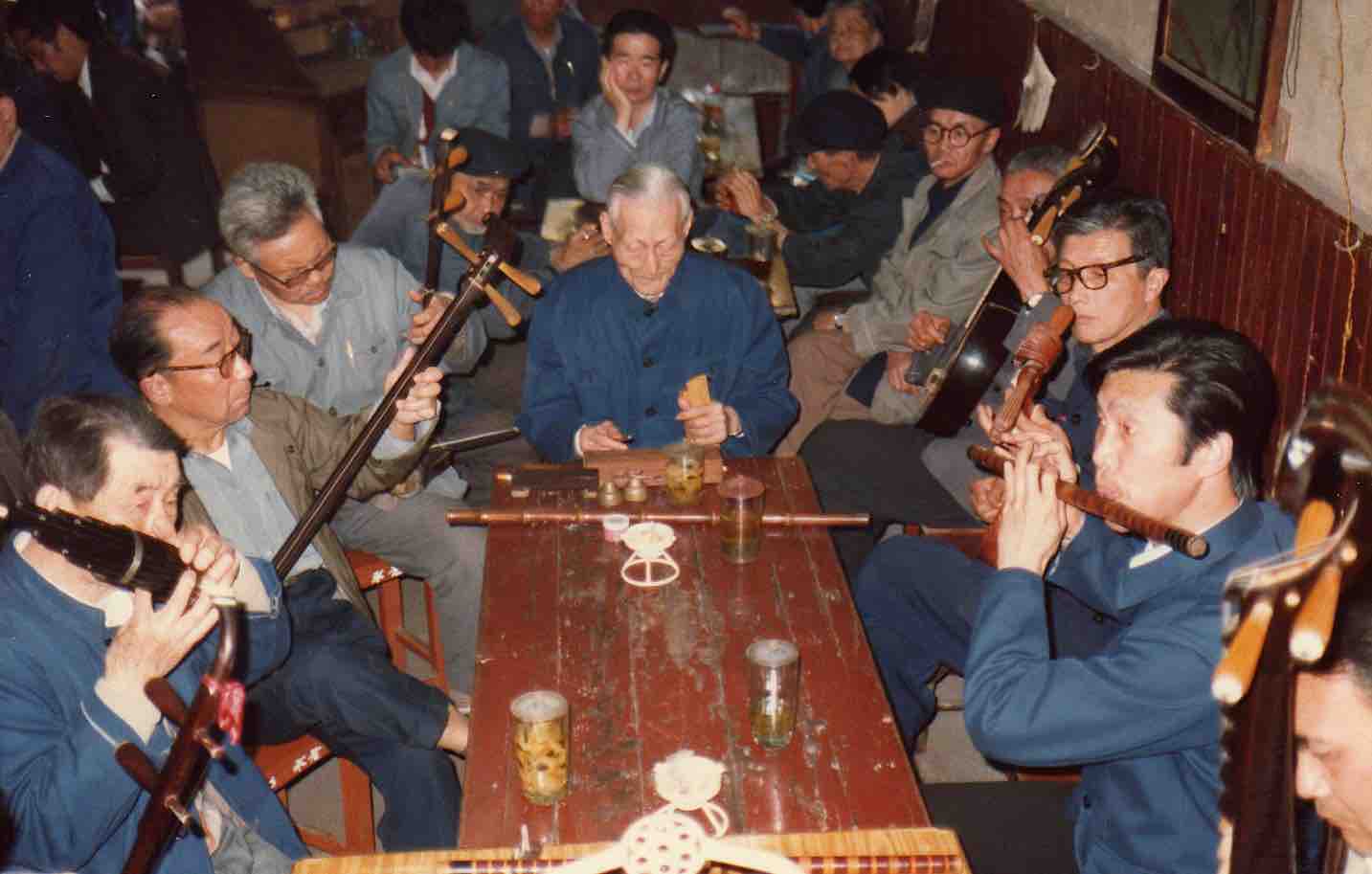
In the silk-and-bamboo ensemble music of the Shanghai teahouses, the wonderful piece Xingjie 行街—properly rendered as something like “Street Parade”— appeared on one Chinese cassette as “The streetwalker”.

BTW, Call Me Old-Fashioned [You’re old-fashioned—Ed.], but Xingjie is one of those pieces that is much more satisfying, not in the short version common on stage, but in its full form, working through all the tempo divisions (see my Folk music of China, pp.278–80). “But that’s not important right now.”

At the dentist

LiffThe inspiration of the brilliant The Meaning of Liff series was that “it seemed a waste to have words cluttering up signposts when they could be usefully attached to something namelessly familiar”. Two related definitions:

Gallipoli. Of the behaviour of a bottom lip trying to spill out mouthwash after an injection at the dentist. Hence, loose, floppy, useless.

Ljubljana. What people say to the dentist on the way out.

See also More vocab for the dentist’s.

More conducting

group

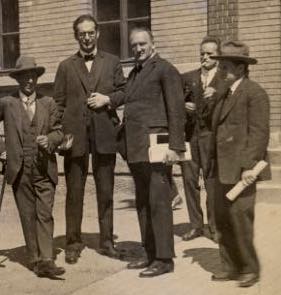
Left to right: Arnold Schoenberg, Otto Klemperer, Hermann Scherchen,
Anton Webern, Erwin Stein, 1924

The late great Hugh Maguire told me that Hermann Scherchen’s conducting technique was described as

like milking a flying gnat.

For a fleeting glimpse of this method, see the wonderful film Gennadi Rozhdestvensky—conductor or conjuror?, from 00.26, under Noddy: the art of conducting.

Noddy: the art of conducting

A tribute to the great Gennadi Rozhdestvensky (1931–2018)

We musos may be critical of conductors (cf. Norman Lebrecht, The maestro myth: great conductors in pursuit of power), but don’t get me wrong, we deeply admire great ones—such as Boulez, Tennstedt, Gardiner, Rattle (unlikely bedfellows…). See under The art of conducting.

Apart from Boulez, another highlight of depping regularly with the BBC Symphony Orchestra was working for Rozhdestvensky (known in the trade as Noddy).

Gennadi Rozhdestvensky—conductor or conjuror? (Bruno Monsaingeon, 2003) is a wonderful film:

In a work that otherwise requires little imaginative filming, do watch the brilliant scene from 32.40—the traffic cop Marcel Mehala should take a bow too.

Believing in a kind of spontaneous combustion, and trusting his players to match his own mastery, taking risks together, Noddy was renowned for his aversion to rehearsal—greater still than that of orchestras. Once, turning up for the first of a couple of whole days’ scheduled rehearsals for a fiendishly difficult and unfamiliar modern piece, he conducted the first few bars and then told the band nonchalantly, “Good, see you at the concert”. In a rare reversal of the musos’ philosophy of “It’ll be all right on the night”, the leader took him to one side and asked him if he wouldn’t mind just taking them through the whole piece once.

Even on stage, his style doesn’t look like much—inscrutable, even casual, his gestures by turn minimal and flamboyant (in the film, from 22.24, he explains his economical solution to conducting the opening of the Symphonie fantastique (cf. Yet more conducting). But his concerts were electrifying. Doing Petrushka, it was as if we were all composing it, living it, together with him. And the Scriabin piano concerto with his wife Viktoria Postnikova was exquisite too—here’s an audio recording:

We can also relish them together in Rachmaninoff’s 4th concerto:

In Historical ears and eyes I feature Noddy conducting Rachmaninoff’s gorgeous 2nd symphony. And do listen to his Tchaik 6. The documentary ends with an illuminating sequence where he rehearses and reflects on Tchaikovsky’s Romeo and Juliet. If only we could see more of the archive footage below—the curious camerawork shows him only briefly, though with characteristic gestures:

Monsaingeon’s Notes interdites (aka Red baton) also features another film in which Noddy reflects on the political vagaries of the Soviet system.

Noddy

For obituaries, click here and here. See also The art of conducting; and Lives in Stalin’s Russia.

A great Daoist priest

Today is the first anniversary of the death of Zhang Minggui 张明贵 (1931–2016). He was one of the most exceptionally enlightened Daoists I have had the honour of meeting, a fine authority not only on Daoism but on all aspects of local culture, and indeed life. [1]

zmg

With Zhang Minggui, Baiyunshan 2001. Photo: Zhang Zhentao.

He served his local community as long-term abbot of the White Cloud temple (Baiyunguan, known as White Cloud Mountain Baiyunshan) temple complex of Jiaxian county in Shaanbei, bordering the Yellow River that divides Shaanxi from Shanxi.

One of many determined local temple managers, [2] with his archetypal long white beard Zhang Minggui couldn’t help becoming a poster-boy for official Daoism, and was honored with high positions in the state Daoist hierarchy. We spent a few days as his guests during the 4th-moon temple fair in 2001. In informal chats between receiving a constant stream of pilgrims and visitors, freed of the necessity to churn out the usual empty clichés, he was far from the bland diplomacy of the modern Daoist priestly leadership or the simplistic patriotic eulogies to be found on Chinese websites. [3]

Zhang Minggui was tireless in his work on behalf of his local community under both Maoism and the reforms. His life reminds me of the continuum between temple and folk life. Baiyunshan has been a rather popular topic in Daoist research. In recent years his prestige hasn’t protected the temple from the Busby-Berkeley-esque stage commodification of its Daoist practice demanded by “cultural” officials—but we should look beyond that, and beyond the temple, to study the wider picture of folk ritual activity in Jiaxian county.

The temple complex is now an isolated outpost of institutional Daoism in the region, with its Longmen Quanzhen tradition whose priests have long performed both jiao and mortuary rituals among the local people. Founded in the 17th century from the Baiyunguan in Beijing—though links with Huashan and Shanxi may have been just as significant in its early history—it is a zisunmiao “hereditary” temple. [4]

The temple Daoists were first given permission to marry in the Republican period (one Daoist there told us it was in 1924), apparently creating competition (presumably including ritual competition) between the married priests and those unable to find wives. [5]

From their biographies, [6] we find that the priests listed for the 20th century were all local, indeed from the county itself—unlike the priests of many large metropolitan Quanzhen temples, who come from many areas, notably south China. Their numbers since the 1940s have stayed at around a dozen. Coming from poor families—inevitably, since Jiaxian is the poorest county in a chronically poor region—most of them entered the clergy “from infancy”, or in specific cases between the ages of 7 and 14 sui.

Zhang Minggui was exceptional, coming from a scholarly family; since he was ill, his parents pledged him to the temple when he was 5 sui old, but they bought him back after a couple of years, only giving him back to the temple when his illness recurred at the age of 11. Notwithstanding the destruction of the temple’s precious Daoist Canon by the occupying PLA in 1946, Mao’s 1947 famous visit to Baiyunshan to hear the opera there [7] was the beginning of the local CCP’s efforts to recruit Zhang Minggui as a schoolteacher. He reached a deal whereby he could also take care of temple affairs. He was already a fine vocal liturgist by the age of 18, and went on to steer the temple through the choppy waters of Maoism.

Throughout this period there was also Byzantine intrigue among the priestly adherents of the Hunyuan and Yaochi dao sects for control of the temple. This continued through the 1950s, just as they were being targeted in campaigns, with sectarian Daoists plotting against the more orthodox clerics; some activity is still said to continue today. [8]

The temple complex (and the sects) managed to keep active through the 1950s until 1963, with vast crowds attending the temple fairs. More open worship resuming gingerly around 1979. Through this period Zhang Minggui worked tirelessly to restore the temple. Since then there has been a political tug-of-war for control of the temple and its substantial funds between the Daoists and the mafias of the secular county departments—the temple income is a major factor in the economy of this poor county.

The main temple fair on the mountain is held over the week leading up to 4th moon 8th, with smaller fairs on 3rd moon 3rd and 9th moon 9th. Throughout the county there is an active tradition of performing major jiao Offering rituals. The jiao is held four times in the spring: in three specific villages in the 1st and 2nd moons, apparently not a recent tradition; in the temple itself during the 4th-moon temple fair; and eight times earlier in the winter, sponsored by a group of many villages in a parish (she) clubbing together, rotating the host village over many years. [9] The latter system consists of a group of 48 villages to the south of the temple, and 12 villages to the north; to the west, the smaller jiao is a niuwang jiao for the Ox King. Apart from the temple Daoists, there are other less costly lay Daoist groups performing similar rituals in the nearby countryside. [10]

A major aspect of devotional activity at the Baiyunshan temple fairs is a group of eight (five in the 1950s, now in practice more than eight) regional associations (hui), which serve mainly to organize the large groups of pilgrims, though they appear to include few groups of ritual specialists. [11]

candlelit altar

Pilgrims of a regional association listen to a bard, Baiyunshan 2001.

Apart from the temple fairs, the Daoists’ income comes mainly from performing funerals outside the temple.

Sincere and broadly curious, Zhang Minggui’s tastes extended to writing articles on Beijing opera and stars of world ping-pong. [12] Far from a mere figurehead, he was an active ritual performer, deeply concerned with the welfare of his community. He will be much missed.


[1] These notes are based on my In search of the folk Daoists, pp.96–101; further detail in Zhang Zhentao, Shengman shanmen, pp.178–209. See also Yuan Jingfang, Li Shibin, and Shen Feixue, Shaanxi sheng Jiaxian Baiyunguan daojiao yinyue (1999); for Abbot Zhang, see pp.40–41. On the temple’s history, note the writings of Fan Guangchun. We await further work from Liu Hong of the Shanghai Centre for Ritual Music.
[2] For an ethnography of a temple in southern Shaanxi, cf. Adeline Herrou, A world of their own, and await further work from her.
[3] Cf. my “Reading between the lines: reflections on the massive Anthology of folk music of the Chinese peoples”.
[4] Despite the claims of Yuan, Li, and Shen (1999: 26), their shengguan music cannot have been acquired from the Baiyunguan in Beijing, which never had any; it is possible that it came from contact with Buddhist monks, as local scholar Shen Feixue suggested to us.
[5] See also my Ritual and music of north China, vol.2: 97 n.11.
[6] Yuan, Li, and Shen 1999: 30–42.
[7] Among many bland reports, see e.g. http://crt.blog.ifeng.com/article/35721644.html, http://blog.sina.com.cn/s/blog_551d0f8c010005r3.html,
http://www.360doc.com/content/16/0603/15/3196639_564749991.shtml.
[8] Yuan, Li, and Shen 1999: 28; Zhang, Shengman shanmen, pp.182–4. Zhao Jiazhu, Zhongguo huidaomen shiliao jicheng (2004) contains many refs. to both sects; those to the Yaochi dao are mainly for counties in Shaanxi and Gansu (see also his general introduction, p.14)—indeed, I haven’t found it in areas of Hebei and Shanxi that I have visited.
[9] For the parish, see the indexes of my various books.
[10] For more on the jiao in Jiaxian, see my Ritual and music of north China, vol.2: 98–101; Zhang, Shengman shanmen, pp.187–9. Several Chinese websites for Shaanbei show photos and videos of jiao rituals around Jiaxian.
[11] For these groups, see refs. in Ritual and music of north China, vol.2: 85 n.20; Zhang, Shengman shanmen, pp.172–5.
[12] Zhang, Shengman shanmen, p.180.