Dressing modestly

Fan
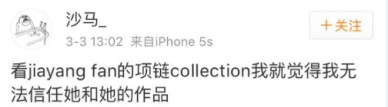
The splendid Jiayang Fan recently found her thoughtful TV interview on the flapdoodle over the 19th Party Congress and Uncle Xi subjected to an impertinent appraisal from an unreconstructed commentator on Chinese Twitter. As she comments,

My fav Chinese social media criticism: I can’t trust anything Jiayang Fan says or writes due to the ugliness of her necklace collection.

Fan Tweet

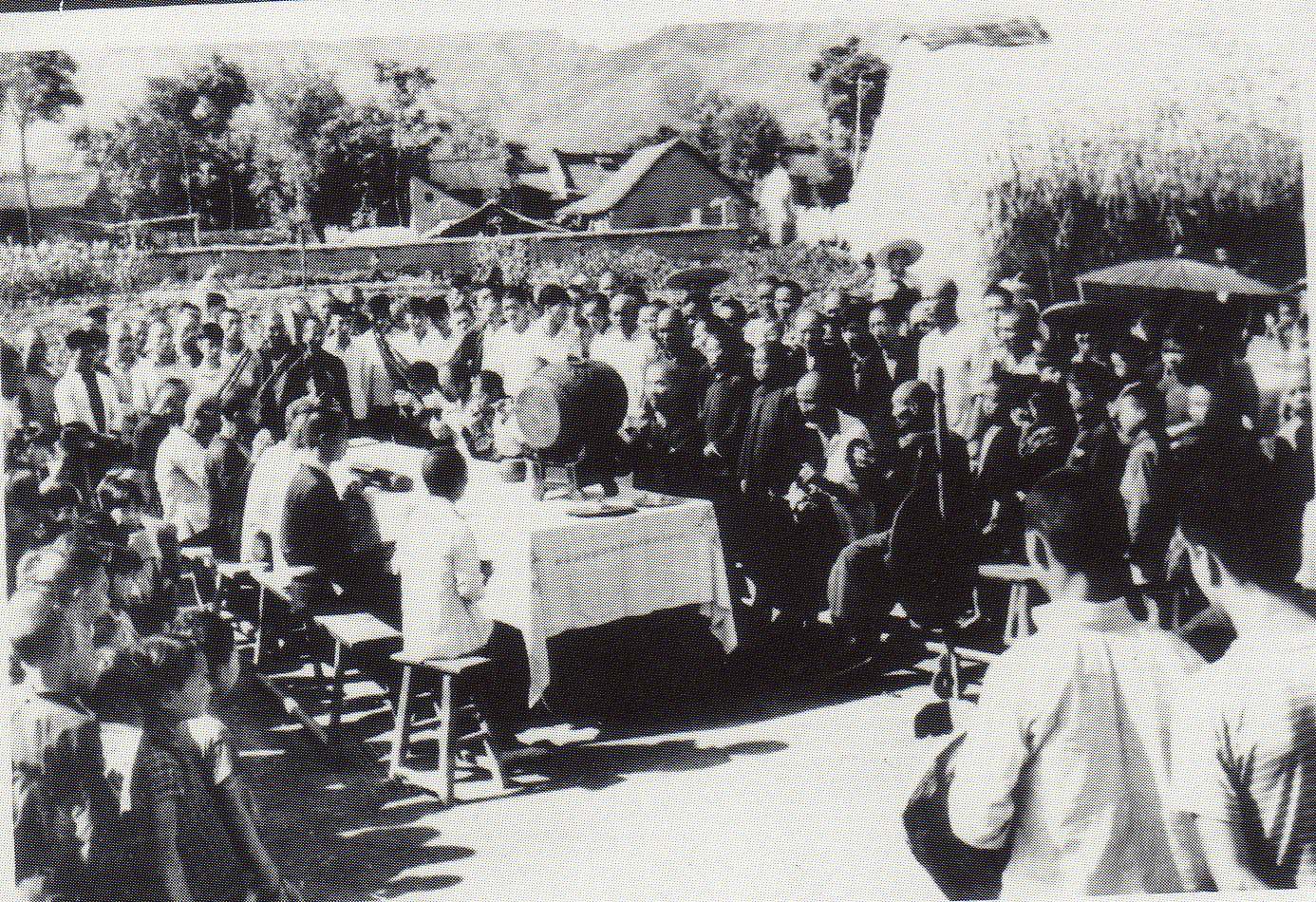
Perhaps the Twitter pundit might consider this entirely representative sample of the Chinese population more trustworthy, with their tasteful neckwear:

CCP

Of course, this photo doesn’t tell the whole story, since also modestly “holding up half the sky” are a charming and tastefully attired Red Detachment of Women silently and obligingly serving tea—so that’s all right then.

tea ladies

While one hopes there was an element of tongue-in-cheek about the Chinese comment, it evokes the fatuous appraisals of female politicians’ accessorising favoured by the Daily Mail. Perhaps Ms Fan might try wearing a full burqa next time, to further obviate any criticism of the shade of her eye-liner—even if it arouses the ire of Boris Piccaninny Watermelon Letterbox Johnson. Gah, choices…

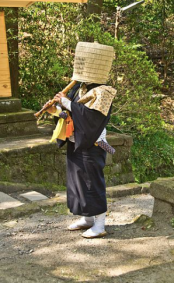
komuso
Another option might be to adopt the old ruse of Japanese komusō 虛無僧 monks playing the shakuhachi end-blown flute—which they might also use as a weapon. I note that many komusō were spies for the Shogunate, and some were merely disguised as priests; and they were abolished in 1871 for “meddling in earthly affairs and not the emptiness of being”. Anyway, it beats me how wearing a basket on your head might be considered an effective disguise, but hey, maybe I should stick to Chinese culture.

A judgement such as the Twitter comment may seem to be based merely on grounds of taste, but it shades into still more fatuous opinions on decency. Since we’re not holding our breaths for wise guidance on dress-codes from the Chinese or US leaderships, study sessions may be in order—based on the Everyday Sexism project, Hadley Freeman (note her fine article “Why not just ban women?”; Hell, Tweety McTangerine could have worn a mankini for his inauguration—we couldn’t possibly think less of him), perennial discussions on BBC Radio 4’s Woman’s hour, and comedians like the great Bridget Christie. That’s just a random sample of UK media—not to mention a wealth of research and websites on the beleaguered status of women in China.

Like I’d know.

Cultural revolutions

17 troupe 1959

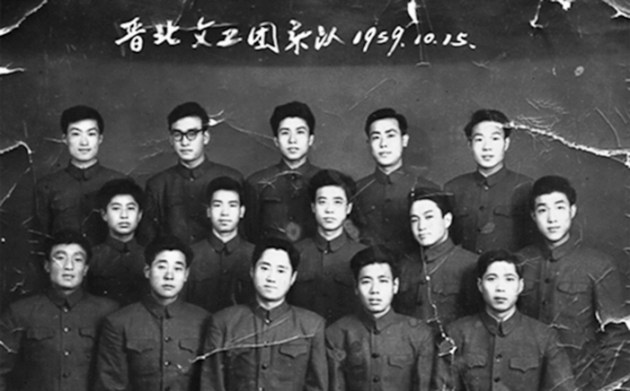
North Shanxi Arts Work Troupe, 1959. Li Qing front row, far right. His four years there (1958–62) were a brief interlude within a lifetime of ritual practice.

For some reason, I found Frank Dikötter’s book The Cultural Revolution far more rewarding than the two previous volumes in his popular trilogy on the Maoist era, The tragedy of Liberation and Mao’s great famine.

Ritual and religious life under Maoism
From the perspective of my own fieldwork on local ritual, there has been no single decade in history where culture has been independent of society— as observed by none other than Confucius and Chairman Mao (see the Coda to my book Plucking the winds), in what may seem like reproaches to the “living fossils” fallacy.  To be sure, Gaoluo villagers themselves failed to admit a connection between their ritual association and society:

“The association has nothing to do with politics”
“The association has nothing to do with the Boxers
“The association has nothing to do with the history of the revolution“.

But all the while they were providing rich material that contradicted their assumptions.

So I would hope that ritual studies can fit into our picture of social change. As I suggest in Appendix 1 of my recent book, scholars of Tang Daoism expect to relate it to the wider history of the period; so why would we who document local ritual groups, whose material derives largely from contemporary fieldwork, not also do so? However deep we probe, the social, economic, and political history of the past century is the air that ritual specialists and their patrons breathe—so what kind of air might scholars breathe by downplaying it?

By failing to study the nuances of the period through which we and our Daoist masters have lived, we ignore precisely the kind of material that historians of earlier periods would die for. Sometimes we fall back on facile clichés about the eternal nature of tradition until the 1940s, and the subsequent destruction of cultural practices (after 1937? 1949? 1966?). All, supposedly, before the untrammelled restoration since the 1980s ushered in an equally timeless and transcendent new Golden Age—unless urban migration and the new pop culture have rendered further study superfluous by destroying tradition further?!

And vice versa, work like this on the changing lives of local communities should also be a contribution to modern historiography—a convenient prism through which to view the “negotiation of identity” (a hoary cliché that I generally avoid!).

With some noble exceptions (such as ter Haar, Ruizendaal and Mueggler), religious life under Maoism is not the strong suit of scholars of religion, but I find it crucial. So I write this partly with a view to reminding those documenting folk ritual in China—and even those who do fieldwork mainly in order to reconstruct the culture of previous ages—that the whole Maoist era is an indispensable part of our background reading and enquiries in the field.

Religion features in many accounts mainly as protest against campaigns (for the 1950s, see The tragedy of Liberation, pp.196–206; Mao’s great famine, pp.227–8), but it’s also worth documenting the “obstinacy” of everyday practice (e.g. The Cultural Revolution, pp.294–6; see also the revival on the eve of the Cultural Revolution, pp.31–2). I belatedly note incidents in places where I did fieldwork innocently in the 1990s, such as the 1966 massacre in Daxing county outside Beijing (p.78).

Maoism
As Dikötter observes (p.119),

Many ordinary people had accepted liberation with a mixture of fear, hope, and resignation. There was widespread relief that the civil war had come to an end. The proclaimed values of the regime, including equality, justice and freedom, were genuinely appealing, and the Part tirelessly trumpeted the New Democracy, a slogan promising the inclusion of all but the most hardened enemies of the regime. Above all, the communists promised each disaffected group what it wanted most: land for the farmers, independence for all minorities, freedom for intellectuals, protection of private property for businessmen, higher living standards for the workers.

Classic studies of local life through the whole Maoist period, a model for detailed local fieldwork, are

  • Chan, Madsen, and Unger, Chen village under Mao and Deng (1992) (see also the works of Jonathan Unger, here) and
  • the two volume study by Friedman, Pickowicz, and Selden, Chinese village, socialist state (1991) and Revolution, resistance, and reform in village China (2005).

I think also of biographical accounts like Huang Shu-min, The spiral road (1989) and Peter Seybolt, Throwing the emperor from his horse (1996), as well as Jing Jun’s The temple of memories. But on the Maoist period perhaps the most important work of all is that of Guo Yuhua, with her detailed ethnography and critique of “Communist civilisation”.

As a counterbalance to such authors, I like to cite William Hinton (whose Through a glass darkly grinds a leftist axe against the latter), as well as Mobo Gao’s fine ethnography Gao village.

Short of expecting ourselves to read detailed scholarly accounts of the period, such works are important preparation. For our own local studies, apart from works in Western languages, the modern county gazetteers (xianzhi 县志) are an indispensible resource; and I’ve discussed documents on expressive culture here. Note also

  • Sebastian Veg (ed.), Popular memories of the Mao era: from critical debate to reassessing history (2019).

A lot has been written about the Cultural Revolution; the period often stands as a simple and misleading soundbite for the whole three decades of Maoism—indeed, ironically, as a shorthand for the first couple of years of extreme violence up to 1968. So since the details of the first seventeen years of the People’s Republic are less well known outside academia, Dikötter’s first two volumes should be more illuminating; in Mao’s great famine individual chapters focusing on topics like agriculture, women, and accidents are well chosen and revealing. But for all the undoubted iniquities that he gruellingly parades, I found the first two books inevitably impersonal, suggesting a lack of empathy that may seem merely to follow a wider pattern in foreign studies of simplistic Commie-bashing.

Dikötter’s study of the famine years around 1960 is part of a growing body of material from both foreign and (laudably) Chinese scholars, on a par with other state-engineered famines like that of Ukraine in the 1930s—as Anne Applebaum’s recent study reminds us. Basic sources include

  • Jasper Becker: Hungry ghosts: China’s secret famine (1996)
  • Yang Jisheng, Tombstone: the great Chinese famine, 1958–1962 (English translation 2012)
  • Wu Wenguang’s memory project
  • the works of Xun Zhou
  • Ralph A. Thaxton, Catastrophe and contention in rural China: Mao’s Great Leap Forward famine and the origins of righteous resistance in Da Fo village (2008)
  • Erik Mueggler, The age of wild ghosts: memory, violence and place in southwest China (2001)
  • websites such as China famine 1959–61, and
  • China Unofficial Archives.

See also under China: commemorating trauma, Gansu: connecting social trauma and expressive culture (and sequel), with comparative sources under Famine: Ukraine and China.

But the whole period preceding the Chinese “years of difficulty”, to adopt a bitter euphemism, was no picnic either.

The Cultural Revolution
Conversely, we already know more about the Cultural Revolution, but Dikötter explores and augments such material in a communicative way. The Cultural Revolution seems to me less plainly propagandistic. It’s not that the insanities he documents are any more flagrant; rather, perhaps, the account seems more personal. Dikötter effectively meshes central and local perspectives, while showing clearly how the period, often dismissed as a “ten-year disaster” was not one undifferentiated black hole. But as we break up the whole Maoist era into manageable chunks, they bleed into each other—a sadly apt metaphor.

Despite revolutionary fervour being whipped up among naïve youths, cynicism, boredom, and lethargy had set in as early as 1967 (p.165). Any idealism among those students sent down to the countryside to learn from the peasants was short-lived, as they encountered the sheer destitution there (ch.15). As I also learned in Yanggao, severe food shortages continued right until the 1980s.

In the countryside, as organisational chaos spread, market enterprise—which had previously revived in the wake of the famine—also persisted early in the Cultural Revolution; despite a re-imposition of collectivization in 1968, private initiatives were increasingly widespread (pp.225–8). By the “grey years” from 1971, private trade began to expand further. Still many regions were mired in desperate poverty, like Ziyang in south Shaanxi (pp.262–5).

Notwithstanding a late rearguard action (ch.23), Dikötter describes the “silent revolution” in the final years of the Cultural Revolution (chs.21–22) that continued the process of abandonment of the commune system which had come in waves ever since the early 60s. In Henan (pp.274–5) blockades to prevent the private sale of grain were easily evaded:

A weakened state was no longer any match for determined individuals who had honed their skills over many years of hardship. Villagers who had survived the horrors of Mao’s Great Famine were not about to be intimidated by a tax officer hanging about at a roadblock in a conspicuous uniform.

Urban migration, too (a crucial social factor under the 1980s’ reforms), began early. Dikötter even shows an early revival of traditional culture (opera, poetry, story-telling, and so on: p.276).

As in Eastern Europe and the Soviet Union, a hidden, underground, largely invisible society lived in the shadow of the former political system. (p.287)

Still, it’s always worth consulting Mobo Gao’s book Gao village, where with personal experience he gives a more positive, less adversarial picture of Maoism.

Anyway, when the commune system was officially dismantled from 1982, it was largely a fait accompli.

For the Cultural Revolution in Tibet, see here and here; and for a comparison with the Soviet Union under Stalin, see The whisperers.

A case-study
I discussed the whole Maoist era in some detail in both Plucking the winds and Daoist priests of the Li family. In the former, since Gaoluo village lies rather near Beijing and Baoding, the members of its ritual association, themselves active participants, were able to give a rather detailed account of factional warfare and people’s lives through the Cultural Revolution (Plucking the winds, ch.6). But here I’ll just give a few vignettes from my work on the Li family Daoists in Yanggao county of north Shanxi (from my book, ch.6)—who were less actively involved in wider events.

With hindsight, surveying the apparent thriving of religious activities today, the Cultural Revolution period—perhaps even Maoism as a whole—may seem like a blip; but both are crucial elements in the transformation of peoples’ mindsets under the more liberal religious landscape since the reforms of the 1980s.

Household Daoist families in Yanggao had continued performing their liturgy for funerals intermittently for the first fifteen years after Liberation, although the domestic ritual Thanking the Earth was rendered largely obsolete by escalating collectivization from 1953, and temple fairs were silenced.

The immediate precursor of the Cultural Revolution was the Four Cleanups campaign. In many areas of China, “superstitious” artefacts had already been taken off and destroyed in the 1940s as the Communists came to power, but in Yanggao villages Daoist families seem to have kept most of their old ritual manuals until the mid-1960s. Meanwhile Yanggao was still in the grip of ongoing natural disasters.

The Four Cleanups must have come as a real shock for kindly Li Qing; having weathered the tribulations of the early 1950s, and then landed a prestigious and secure job in Datong (see photo above), he was even more revered after his return in 1962, and able to practice his beloved ritual again. But so it went for innumerable victims of the “class struggle” system. After the respite of the early 1960s, the mood was now to be grim right until the Cultural Revolution broke out in 1966. Li Qing’s rich-peasant “hat,” though enforced as early as 1948, hadn’t had any great effect until now—not even disqualifying him from joining the prestigious arts-work troupe. But early in the Cultural Revolution he was again classified as a rich peasant.

The Smash the Four Olds campaign from 1966 was the culmination of two decades of measures to limit religious practice. At the same time, campaigns were sporadic.

Following a Four Cleanups re-inspection, late one night in 1966 Li Qing sneaked out to bury his most precious ritual manuals in the sorghum fields just east. Next day, to allay the suspicions of the Red Guards, he burned a large pile of other volumes in his courtyard—he had a large collection of printed volumes and almanacs, not necessarily ritual manuals.

The callow Red Guards paraded Li Qing a few times in a high white dunce’s hat with the characters “ox demon and snake spirit” written on it. But, just like hapless village cadres all over China who were now victimized too, the degree of punishment of so-called landlords and rich peasants depended a lot on their character and reputation. While privately retaining their sympathy for Li Qing, villagers had no choice but to go through the motions of “struggle meetings” dictated from above. Li Qing and his wife bore their sufferings with dignified silence throughout.

When Li Qing’s sensitive sheng mouth-organs were confiscated and deposited in the brigade office, kids messed around with them. Poor peasant Kang Ren was not under suspicion, so he managed to keep his sheng. But here no-one dared ask friends or family to help hide suspect items for them.

Meanwhile in Yang Pagoda, Li Peisen continued to weather the storm. The son of his wife’s younger sister was a Red Guard chief, so they discreetly agreed he would just take off a few scriptures for show—Li Peisen would have chosen decrepit or duplicate volumes that he considered less important.

Li Qing’s son Li Manshan, 21 sui in 1966, had gained an impression of the liturgy before his father left for Datong in 1958, and after he returned in 1962 he had nearly two years of relative freedom to continue learning. After the Four Cleanups campaign of late 1964, though there was no pressure on the children of bad elements to “draw the class line” from their fathers, he felt seriously depressed. At least he didn’t have to join the Red Guards—his status as son of a “black” family disqualified him. One day in 1966, just as the Cultural Revolution was breaking out, Li Manshan found himself in the county-town, and had his photo taken there. He hinted to me that it was virtually designed as a farewell to the world; exhausted by constant labor on the reservoir, with his family’s so-called “rich peasant” status boding ill as an ominous new campaign was brewing up, he could see no future.

In 1960, when Li Manshan was 15 sui, he had “studied Russian for two whole days” at school. Later, when the Red Guards found his notebook with a few Russian words written in it, they confiscated it and cursed him for being a spy. In many parts of China, the innocent possession of a mere scrap of supposedly reactionary material, or a careless comment, could condemn people to long spells in labor camp.

Whereas the neighbouring county of Tianzhen was described as more “barbaric”, the relative peace in Yanggao didn’t mean that Daoists there somehow had any latitude to keep practising. In some parts of rural China traditions were maintained more or less furtively even through the Cultural Revolution, but here the Daoists were forced into total inactivity from 1964 to 1978. Daoist arts went into hibernation. Li Qing’s family, with their black class label, suffered more than other Daoists, but everyone was pretty desperate.

Villagers weren’t becoming any less “superstitious”. Public rituals might be impossible, but there was still a clandestine demand for determining the date, under cover of darkness. For a daring couplet pasted up in the period to satirize the poverty of their conditions, see here.

In 1967 Li Manshan was among a group of Upper Liangyuan team members who had to walk to the commune seat of Greater Quanshan, in the hills to the west, to take part in one of a series of huge public criticism meetings of the disgraced Party Secretary of Yanggao county before his incarceration. By now this model commune had been eclipsed by Dazhai further south in Shanxi, but it still had to host visiting delegations and mass meetings. Ten thousand people from five communes attended the struggle session, all arriving on foot. Although Li Manshan was a “rich peasant,” he had no choice but to go, or else people would accuse him of being counter-revolutionary.

The Sojourn of Educated Youth

Shoulders unable to carry, hands unable to grasp, soft and sensitive skin…

Coming across this phrase in 2013 as I made inept attempts to help Li Manshan with the autumn harvest, I thought it might have been coined to parody my efforts. Rather, it is a standard expression used to describe the travails of urban “educated youth” in performing physical labour after being sent down from the cities to the countryside in the Cultural Revolution to “learn from the peasants.” The experience was a rude shock for such groups all over China; brought up in relatively comfortable urban schools to believe in the benefits of socialism, and often protected from understanding the tribulations of their own parents, they were now confronted not just by the harshness of physical labour, but by medieval poverty (see also my Shaanbei book, p.9).

From 1967, large groups of secondary school students were sent down to live in many Yanggao villages. Over thirty stayed in Upper Liangyuan for a year or so, but Li Manshan had no contact with them. A group from one Beijing school descended on Golden Noble’s village of Houying in 1967, then another batch the following year; most managed to leave around 1972. Golden Noble’s cousin married one of them in 1971, condemning her to rural life; desperate to escape, she eventually divorced him, getting back to Beijing around 1980.

These groups of students brought their musical and acting skills to some villages where they were based, performing revolutionary songs and model operas to dour bemused peasants. Li Manshan never heard them sing or play, but in nearby Shizitun Older Li Bin learned the modern system of cipher notation from educated youth billeted there.

Just when convulsions seemed to have eased, Li Qing’s rich-peasant status was re-imposed in the Cleanse the Class Ranks campaign of 1968. If there had been a certain basis for the original classification around 1949, by now—in a ravaged countryside where everyone was virtually destitute—the label caused his fellow villagers bitter mirth, who ribbed him, “Call yourself a rich peasant?!” After the chaotic first couple of years, things quietened down by around 1969, but there was always tension. As Li Manshan recalls, “We just sat around at home, but we could never feel at peace”—always fearing a knock at the door.

Life Goes On
Even then, life was not entirely about campaigns. Having had four children by 1954, Li Qing and his wife had been separated for four years while Li Qing was in the Datong troupe, but in 1967 they had a third daughter, and then in 1969 a third son, Li Yunshan (known as Third Tiger), twenty-three years Li Manshan’s junior. For the lovely little wooden folding stool that Li Manshan made in the late 1960s, see here.

Then, in the winter cold late in 1971, Li Manshan married, aged twenty-six sui. The new couple lived in Li Qing’s courtyard complex, part of which had been allocated to another family after land reform. In the Cultural Revolution Li Qing “bought” it back, but village cadres accused him of illegal trading, and confiscated it again. Anyway, from 1948 right through till 1980 their conditions were cramped. In 1972 Li Manshan had to spend another six months away laboring on the reservoir project, only returning for the autumn harvest. The couple’s oldest daughter was born in 1973. That year Li Qing and his wife took their youngest son Third Tiger, five sui, into town for a group photo—now nowhere to be found. Around that time Li Qing managed to get his mother’s ashes back from Inner Mongolia, reburying her with his father’s coffin in the family graves outside Upper Liangyuan—though without any ceremony, of course.

All this was around the time of the campaigns to Study Lei Feng and Criticize Lin Biao and Confucius. The latter, prompted by the mysterious 1971 death of Lin Biao in a plane crash in Mongolia, caused major convulsions in Party and army ranks, but Li Manshan has only the vaguest memories of these campaigns.

Whereas through the 1950s and 60s the Party had somehow managed to whip up enthusiasm for further campaigns despite constant abuses, by the 1970s people had thoroughly lost their appetite for the constantly changing directions of policy. Indeed, in Yanggao people were largely unaware of the machinations at the heart of the Party in distant Beijing.

I would gladly qualify all this gloom with reminders of the benefits of Maoism such as are offered by apologists like Bill Hinton and Mobo Gao. But I can find no-one in Yanggao who can think of any. There were some harbingers of reform, like a certain freeing up of markets in 1972. Education too was expanding again. A sporadic supply of electricity eventually reached villages like Upper Liangyuan by the mid-1970s. Before that people used kerosene lamps, but they slept soon after it got dark—except, of course, when there were rituals to perform. The electricity supply in the countryside remains unreliable.

By the 1970s the national population was increasing rapidly, but that of villages like Upper Liangyuan grew little. Under Maoism there was hardly any new house building in Yanggao; by the 1970s, over ninety percent of houses in the county had been built before 1937. By the mid-1970s a few villagers managed to buy watches; even by the end of the decade only a few cadres enjoyed the luxury of riding bicycles.

Traditional culture was still on hold. Without the benefit of hindsight, there was no end in sight to the depression of the commune system. And people—not just the Li family, but the whole population—were still seriously hungry.

* * *

For local Daoist ritual, I must stress that none of this obviates the need for the study of early textual history of ritual manuals, which should continue to play a major role. However, the life stories of Daoists (and all kinds of religious practitioners) are just as important for the modern era as for the imperial period—but with careful and sensitive fieldwork they are much more available. And they can not only clarify aspects of textual transmission, but also (more crucially?) illuminate the changing performance of ritual. So it seems to me that whether sinologists and ethnographers like it or not, our subject has to embrace both early and contemporary periods. At the same time, modern historians may even find our discussions of ritual life in living times to be of some relevance to wider histories.

Daoists of Hunyuan, Shanxi

***Link to this page!***

The connection of our Li family Daoists with the temple Daoism of Hengshan may be spurious, but household Daoists in Hunyuan county-town at the foot of the mountain have their own traditions. Our visits in 1992 and 2011 showed a considerable change over the intervening years.

For some time I have been finding the distinction between Orthodox Unity and Complete Perfection somewhat academic with regard to ritual practice. For what it’s worth, so far in north Shanxi I have found the distribution of the two branches roughly following county boundaries, with household Orthodox Unity Daoists in Yanggao and Datong counties, and Complete Perfection Daoists (also household, but more clearly derived from temple traditions) in Tianzhen, Guangling, and Shuozhou.

But the case of Hunyuan town is particular, and that of its most distinguished ritual specialist Jiao Lizhong even more so. It seems to be a case of recent conversion from a local household Orthodox Unity tradition to a national temple Complete Perfection one, but there is more to it than meets the eye (and ear).

Hunyuan yankou 1

Buddhist ritual in south Shaanxi

***Link to this page!***

Most of my accounts of local ritual in north China (under “Li family Daoists” and “Hebei” in main menu) concern Daoist practice. This new page mainly concerns folk Buddhist ritual traditions transmitted by former temple monks around Yangxian county in south Shaanxi.

It’s even more sketchy than my introductions to some other areas that I haven’t visited, but again, as I continue to regret the superficiality of the ICH material, I’m hoping to entice people to go and do some serious research. I’ve also revised the introductory page on Buddhist ritual.

Yangxian nianjing

Daoist ritual and football

Daoist football

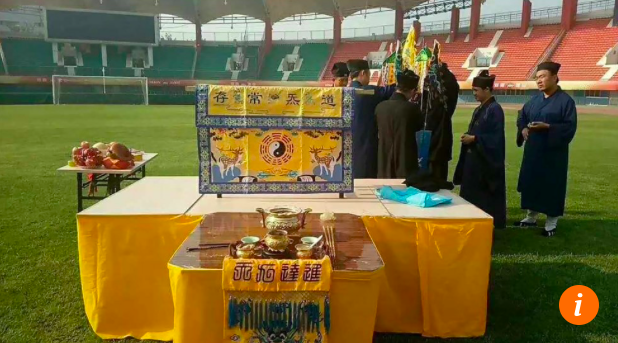
WOW. Following my post on the Haka, Chinese football has just gone one better. On 23rd September a Henan team had a Daoist ritual performed on the pitch, going on to get their first home win in months—and getting a slapped wrist from the Chinese FA, what’s more:

http://www.scmp.com/sport/soccer/article/2112866/football-no-place-religion-chinese-soccer-club-warned-after-conducting

Sure, unlike the Haka, in this case it’s not the players themselves who perform the ritual—yet.

Chinese Twitter is buzzing with discussion. Daoist fans aren’t taking the stern rebukes lying down: pointing out that Daoist ritual is protected under the brief of the Intangible Cultural Heritage, they deftly play the old “culture, not feudal superstition” card.

有道教网站转发新闻办的微博称:来来来,我给建业支个招,各地的道教音乐中包括全真十方韵,全国很多地方都有批准为非物质文化遗产, 建业去问问那次的道长是传承自哪里,在比赛前进行音乐演奏,非遗文化表演。是受非遗法保护的。《中华人民共和国非物质文化遗产法》里 面有支持其参与社会公益性活动。这么喜闻乐见不如看怎么合理弘扬?

Others worry that it may give rise to competitive rituals in which the other team employs their own ritual specialists to break the magic of the opposition’s Daoists. Of course, it has long been common to hire two or more groups (Buddhist, Daoist, Tibeto-Mongol lamas…) for a single ritual event—competing between each other but not for rival patrons.

Another article defends the move by pointing out various international instances of teams seeking divine assistance (for a recent one, see here).

For a related debate, see here; note also the rebuttals of local government’s restrictions on funeral observances in Shandong.

Early Chinese versions of football were popular, though I’m not going to devote much time to searching for specific blessing rituals in Song-dynasty ritual compendia… Not will I detain you here with a discussion of the constant historical adaptations of Daoists to their patrons…

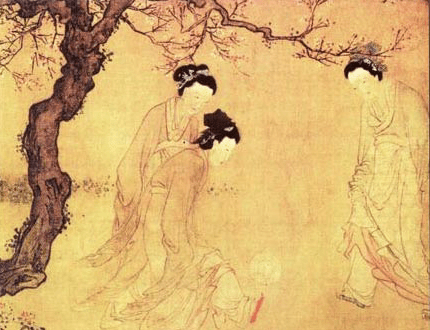
football painting

Chinese women’s football. Du Jin, Ming dynasty.

I note that during the Song dynasty only one goal post was set up in the centre of the field—now that would be an intriguing modification to the FIFA rules. Further to the magnificent ripostes of young female footballers to the British FA, at a match in the Tang dynasty

records indicate that once a 17-year-old girl beat a team of army soldiers.

YAY! Could it have been after this match that the men shifted the goalposts? Typical!

Under Maoism a leading CCP apparatchik (can anyone put a name to this fine pundit?) observed twenty-two players chasing around after one ball, and in a spirit of egalitarianism, unhappy with the conventions of what he supposed was a misguided capitalist invention, declared grandly:
“We’re a socialist country now—why not give them a ball each?”

Anyway, my new dream is for the Li family Daoists to perform a ritual to help Arsenal win the Champions’ League.

For more on women’s football, see here.

Daoists of Tianzhen, Shanxi

***Link to this page!***

Click above for the latest in my surveys of household Daoist groups in north Shanxi, including Shuozhou and Guangling (not to mention Yanggao, main subject of this blog), as well as Changwu in Shaanxi. They’re now grouped in a sub-menu “Local ritual” under the “Themes” menu.

Here I outline the history and ritual practices of three families of Complete Perfection Daoists in Tianzhen county—a tradition derived from the Nanmen si temple in Huai’an just northeast.

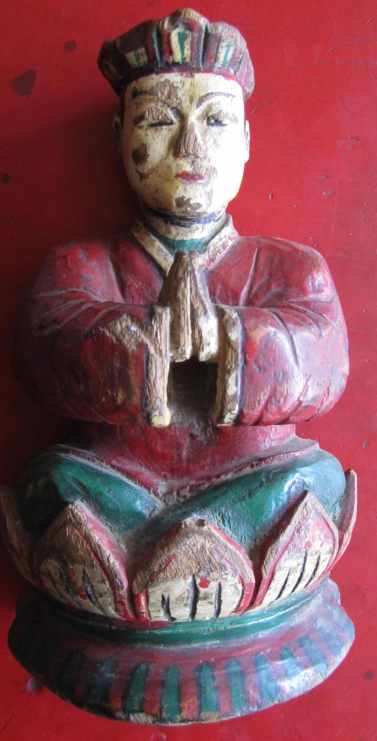
Ning statuette


The brief of ethnography

Gaoluo 1989

Recently on Twitter, following a post on my work with the Gaoluo village ritual association, an urban Chinese worker sent me a succinct and intriguing reaction:

中国农村地方的风俗,我不喜欢!— I don’t like local Chinese rural customs!

Well, tough! 罗卜青菜各有所愛, chacun à son trou, “it’s a free country”… But actually it’s a valid point, highlighting an important issue.

Rural customs are what rural dwellers do; it’s hard to belittle the former without rejecting the latter. It’s not just a lack of tuanjie solidarity within the Labouring Masses, between the gong workers and the nong peasants; there has long been a more general alienation anyway among the urban educated. This feeling that Chinese tradition is “backward” dates back well before the 20th century, despite the efforts of Chinese folklorists since the 1920s to document the, um, heritage.

Today those older urbanites who endured banishment to impoverished villages under Maoism (like Kang Zhengguo, or the countless, and hapless, zhiqing educated youths from 1968) have good reason to feel ambivalent about rural culture (see also here).

Younger cityfolk may not have had to endure rural life like their elders. But steeped in pop music and video games, when they are dragged back to the poor countryside to attend the funeral of a grandparent, they too may find village customs irrevocably tainted by poverty and backwardness.

Moreover, apart from those duped by the media into regarding folk culture as a theme park, those younger cityfolk (not least those bravely seeking social justice) have been further alienated by rosy state cultural propaganda—quite understandably.

Of course, the arcane concerns of academia generally may not float their boat. Anyway, they’re unlikely to be excited by the links of some Daoist ritual to manuals from the Song dynasty.

But ethnographers don’t have to be misguided mouthpieces for official patriotism. It’s not about praising traditional culture—more about documenting it, complete with all the problems of rural life. Ethnography aims for the descriptive, not the prescriptive. I’ve already given some traumatic examples of participant observation in fieldwork—Germaine Tillion’s notes on her own incarceration in Ravensbrück concentration camp, and Sudir Venkatesh’s work among Chicago street gangs.

So it’s always worth documenting society, and history, without romanticizing it as some ideal “living fossil” of an illusory golden age. Along with any grandeur that pundits may impute to ritual in rural China, there belong power struggles, violence, the plight of women and blind outcast shawm players, and all kinds of tribulations under imperial, Maoist, and modern regimes. And while studying folk culture, it’s proper to note the alienation of younger urban dwellers from it, as I do. Indeed, I’m not naturally thrilled by Morris dancing—but when you get to know a little about it, you can see how it fits into the changing social culture of rural England.

However rapidly the Chinese rural population has been diminishing since the 1980s, documenting rural life is just as important as studying urbanites, of all classes—including the workers’ struggle and their expressive culture. We don’t have to “like” ♥ (grr) the songs of either those workers or household Daoists, but they all need documenting.

Descriptive ethnography doesn’t necessarily imply standing aside entirely from judgment. Now, as it happens I do indeed admire many aspects of village ritual, but that’s not the point. More adventurous fieldworkers (like De Martino) may seek to spell out some respects in which ritual is life-enhancing, offering consolation and cohesion; or, conversely, ways in which it serves to entrench delusion and conflict, or fortify irrational power. Or—quite likely—they may entertain both hypotheses at once. And both need to be tested, not assumed.

So to that underwhelmed Chinese worker on Twitter, I might say: as the great Tsinghua-university-based anthropologist Guo Yuhua can tell you, far from obstructing the quest for social justice, ethnography can be a contribution to it. Apart from urban workers, if anyone has been downtrodden, it’s the peasantry.

However much the official version may seek to reify and sanitize culture, yet factory workers, household Daoists, village cadres, spirit mediums, army recruits, sectarian groups, vagrants, and entrepreneurs are all part of the social spectrum, whose lives deserve to be documented.

All this reminds me of another gem from Nigel Barley. Arriving at his field site in rural Cameroon, he grapples with police bureaucracy (The innocent anthropologist, p.38):

The commandant turned out to be a huge Southerner of about six foot five. He summoned me into his office and inspected my documents minutely.  What was my reason for being here? […] He was clearly very unhappy as I tried to explain the essential nature of the anthropological endeavour. “But what’s it for?” he asked. Choosing between giving an impromptu version of the “Introduction to Anthropology” lecture course and something less full, I replied somewhat lamely, “It’s my job.”

Spiritual and marvellous mysteries

I recall with deep admiration the unsung scholar Yuan Quanyou 袁荃猷 (1920–2003).

Wang and Yuan
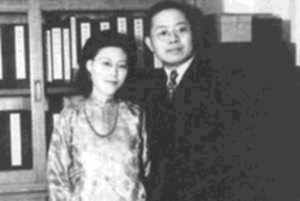
While a student in Beijing she studied with her future husband, the great Ming scholar Wang Shixiang 王世襄 (1914–2009) (see wise and affectionate tributes by Craig Clunas [1] —another great Ming scholar—and now here). After Yuan Quanyou graduated in 1943, they married in 1945.

Yuan Wang wedding

Yuan Quanyou had studied the qin zither with Wang Mengshu 汪孟舒 from the age of 14 sui. Through the 1940s she took part keenly in the activities of the Beiping qin society, among a dazzling array of illustrious qin masters. She later became a disciple and colleague of the great Guan Pinghu.

Wang Shixiang soon found that his wife’s skills focused on the traditional literati accomplishments of “qin, chess, calligraphy, and painting”, to the exclusion of more mundane activities like cooking. So it was he who became a fine chef; and he considered himself her “qin servant” 琴奴. Several online pages about the couple describe their lifelong rapport by the term zhiyin 知音 “kindred spirits”, a bond whose etymology derives from music.

Complementing Wang Shixiang’s refined literati tastes, through his enthusiasm for falconry, badger hunting, cricket rearing, and pigeon fancying he had gained what Craig Clunas calls “a raffish reputation” (as you do…). I also learn that he loved football, “as anyone who has tried to make conversation while he is watching soccer on the television can confirm”—cool by me. He retained a rare passion for both elite and popular culture.

From the early 1950s Yuan Quanyou worked tirelessly in the archives of the Music Research Institute (MRI) in Beijing, alongside the great Yang Yinliu and Cao Anhe, as well as a whole host of qin masters like Guan Pinghu and Zha Fuxi, and their students—including Xu Jian 许健, and the fine female qin player and scholar Wang Di 王迪 (1926–2005). [2]

GPH and students

60th-birthday photo of Guan Pinghu with his students, 1957:
(left to right) front row Xu Jian, Guan Pinghu, Zheng Minzhong;
back row Wang Di, Shen You, Yuan Quanyou.

By 1957, while her husband was also busy publishing ground-breaking research, Yuan Quanyou’s close collaboration with Yang Yinliu resulted in the publication of the fine iconographical series Zhongguo yinyueshi cankao tupian 中国音乐史参考图片 [Reference illustrations for Chinese music history] (see also here).

CKTP best

Some treasured volumes in my library.

Yuan Quanyou 1950s lowres

All this activity took place under extremely trying conditions. As Craig notes:

The published curricula vitae of Chinese scholars often give a false idea of the continuity of their employment, and conceal the long periods of frustrating idleness caused by periodic political campaigning.

After the 1949 “Liberation”, Wang Shixiang was employed at the Palace Museum, but he was wrongly jailed for ten months and expelled from the museum in 1953. In 1957, he was branded a “rightist”, a stigma he bore for twenty-one years. Craig’s account of the couple’s enforced inactivity during the Cultural Revolution is also worth citing. Despite Wang’s undoubted sufferings after being sent down to a “Cadre school” in Hubei province, he could “make the experience sound positively bucolic”. While callow young Red Guards were duped into destroying as much of the heritage as they could find, the exiled Wang wrote poetry in the classical style (“much of it on his work as a swineherd and cowherd, which draws on deep-rooted traditions of verse by those who were out of office and out of favour at court”), and even managed to cook gourmet delicacies.

But the mental pressure cannot but have been considerable, since no term was set to the period of banishment, and little or no news was available as to the fate of family or friends.

Old portrait photos are all the moving when we consider the troubled stories behind people’s lives (intellectuals, urban and rural dwellers alike) under Maoism, as evoked by films like The blue kite and To live (see also my tribute to Li Jin). Craig’s aperçu about Wang Shixiang’s renewed energy in the 1980s, “as if making up for lost time”, also resounds in both Chinese music studies and folk culture. Meanwhile, a discreet amnesia took over. (For the concurrent tribulations of Czechoslovak scholars and artists, see here.)

ZGYYSTJFrom 1986 I used to visit Yuan Quanyou in her office at the dilapidated yet numinous MRI compound at Dongzhimenwai, her beaming face greeting me between high stacks of ancient documents. There, with unassuming industry she was still producing further volumes in the MRI’s wonderful annotated series of iconographical collections on Chinese music history, such as the 1988 Zhongguo yinyueshi tujian 中国音乐史图鉴 [Illustrated history of Chinese music].

Even as my interests were moving from Tang history to the modern transmission of folk culture, I relished her detailed article on the medieval konghou harp.

Remarkably, after the end of the Cultural Revolution Wang Shixiang had managed to reclaim much of their precious collection of Ming and Qing furniture and artefacts. By the 1990s he and his wife began the process of bequeathing it to the Shanghai Museum, where it now forms a major and prestigious exhibit.

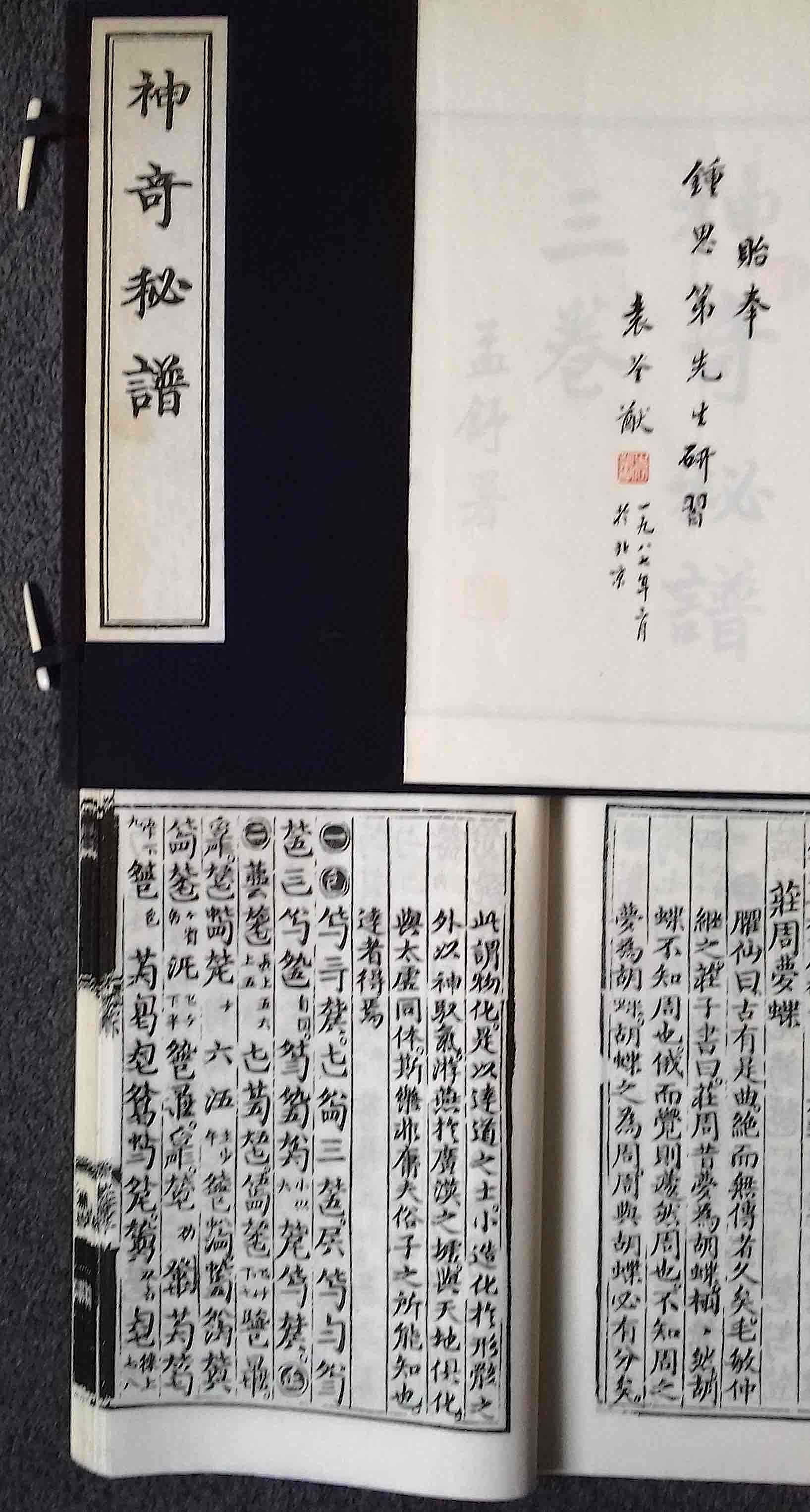
With her calm acuity and beautiful accent, Yuan Quanyou exemplified the refined virtues of old Beijing. She was closely involved in the remarkable work documenting the history and changing performance practice of the qin zither—including research on the 1425 Handbook of spiritual and marvellous mysteries (Shenqi mipu, aka Wondrous and secret notation), most numinous of all tablatures for the qin, compiled by the Emaciated Immortal (as the early Ming prince Zhu Quan styled himself).

In 1987 Yuan Quanyou was able to devote a tenth volume of the Zhongguo yinyueshi cankao tupian to the qin:

Now, this may hardly atone for my recent challenge to the mystique of the qin, but I treasure the precious copy of the 1956 reprint of the Shenqi mipu tablature (1425) that Yuan Quanyou inscribed to me in her elegant calligraphy in 1987, for me to “study and practise”.

SQMP

BTW, having chosen that lower page rather casually (mainly for the numinous Daoist title “Zhuangzi dreams he is a butterfly”), I now find myself moved by Zhu Quan’s wisdom—in utter contrast to the “living fossils” flummery of recent years, culminating in the befuddled Intangible Cultural Heritage. The opening of his introduction reads:

The Emaciated Immortal says: “The ancient version of this piece has long since been lost.”

These days it’s all “The ancient version of this piece has been transmitted continuously for 2,000 years.” [Expletives deleted—Ed.].

Jinfeixibi 今非昔比 (“Things ain’t what they used to be”), as Li Manshan reflects at the end of our film.

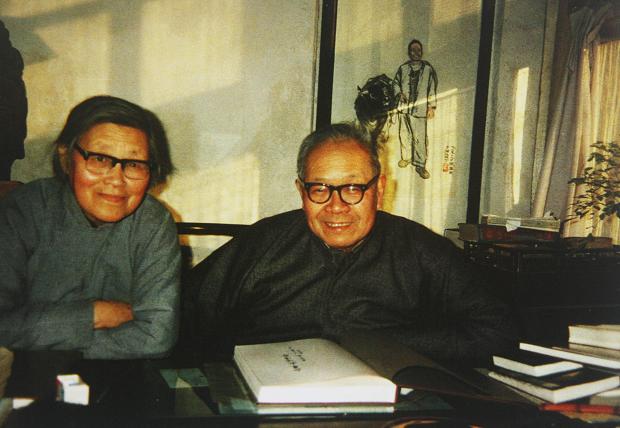
Wang and Yuan later

This post complements my series on the qin in Beijing under Maoism; see also Tang culture: a tribute to Ren Erbei.


[1] See https://www.academia.edu/34156645/The_Apollo_Portrait_Wang_Shixiang_Apollo_127_November_1987_pp._350-1, and https://www.academia.edu/34156683/_Wang_Shixiang_Spiritual_Resonance_and_the_Ten_Thousand_Things_in_Fariba_de_Bruin-Derakhshani_and_Barbara_Murray_eds._The_2003_Prince_Claus_Fund_Awards_The_Hague_2003_pp._17-23.
Among many other reports, see e.g. http://www.china.org.cn/english/NM-e/170145.htm, https://www.thepaper.cn/newsDetail_forward_2580161, and this tribute from Yuan’s granddaughter: https://kknews.cc/culture/2ao24jz.html, with further lovely old photos. Among several biographies and collections is Chen Zhou 晨舟, Wang Shixiang 王世襄 (2002).

[2] For an English introduction to the (pre-ICH) Beijing Guqin Research Association, successor to the Beiping qin society, see Cheng Yu, “The precarious state of the qin in contemporary China”, CHIME 10–11 (1997). Zhang Zhentao 张振涛 has written fine tributes to Guan Pinghu and Wang Di.

Ritual life around Xi’an

Xi'an miaohui lowres

A new page (under Themes in Menu) introduces changing ritual life around Xi’an, setting forth from my visits since 1986 and the work of the late great Li Shigen.

It accompanies the new track 11 on the audio playlist, with comments here.

As so often for north China, all the musicological studies are very desirable, but there should be far more to it than that. It can’t be left only to musicologists—it’s just as much a topic for historians, ethnographers, and scholars of religion.

Women of Yanggao 3/3: singers

At a tangent from female members of Daoist families, or sectarians and spirit mediums, are the female vocalists who serve weddings, funerals, and celebrations—now mainly singing pop. As ethnographers we can no more ignore this than we can neglect pop music in our own cultures.

First I should give a little overview of gender roles in Chinese performance. [1] In their worthy goal of reinstating women into the story of Chinese music, the two articles by Cynthia P. Wong and Su Zheng in The Garland Encyclopaedia of Music: East Asia volume leave no space to spell out women’s historical and ongoing submission in society (cf. Lulu).

Though I’m happy to accept Zheng’s portrayal of Confucian culture as misogynistic, her “radical view” shouldn’t mean airbrushing the evidence of the submission of women. This is as serious as (and not unrelated to) ignoring the ever-backward supply of water, healthcare, electricity, literacy, and transport available to much of the population. Along with celebrating women’s musical contributions, and for all the complexities of women’s ongoing struggle, it is worth stressing their ongoing exclusion from power and choice in public society, underlining the persistence of patriarchal tradition and the limited scope of modern progress.

Both Wong and Zheng illustrate women’s contributions to early Chinese music history by referring to archeological excavations that show that female musicians were buried alive along with their dead master. A disturbing (if remote) echo of this is in posthumous marriage, which has been reviving in northwest China since the 1980s.

When women were allowed to survive their masters, they often worked as prostitutes. Zheng goes on to observe that, in ancient China, women could also be bestowed as a gift, and bought and sold—another enduring tradition today. What a lot of categories of prostitute upright Confucian men had to choose from—and some were even chosen to be concubines! We should indeed incorporate all this into our account of Chinese music history, but I struggle to see what there is to celebrate here.

Wong and Zheng briefly point out women’s progress in the 20th century. To be sure, foot-binding was successfully stamped out, and arranged marriages became exceptional; female education was no longer limited to a tiny elite.

Yet despite government campaigns, female babies are still routinely murdered or abandoned. Under siege from the draconian birth-control policy, women and men alike attend rituals to pray to the gods to be granted a healthy son. Girls are a burden: since upon marriage they will be lost to another family, rural parents invest mainly in the welfare and education of sons. Economic progress has been uneven since the reform period. Scholars note many instances of regression in women’s status: decollectivization and urban migration have been a mixed blessing. Women are still abducted and sold to poor older disabled men in less impoverished provinces; they continue to be subject to domestic abuse and are largely barred from public roles. Female leaders remain rare—at village, township, county, provincial, and national levels. Prostitution is rampant, though some women now rise to the artistic heights of working as karaoke hostesses.

Our accounts of women’s roles in Chinese music cannot assume that readers know all this. Any study of gender and music in China must include a broad assessment of women’s progress, or regression, and this must be based on detailed local ethnography (both for expressive culture and the society that nourishes it), rather than plucking out instances of female stars. In my chapter (n.1) I further outlined some issues of gender and class, violence and power.

Rural performance: overview
As in all areas of study, we should beware describing gender in performance mainly through the prism of urban state troupes.

At the bottom of the social pile, opera performers (xizi), like shawm bands (chuishou), were traditionally part of a litany of outcasts, and also in most places all-male until the 1930s. Along with other low-status men like grave-diggers, coffin-bearers, and cooks, they all play essential roles at life-cycle and calendrical events.

Since at least the 1930s women have gradually played a larger role in opera for life-cycle and calendrical rituals, though they have still little power within the troupe—the troupe bosses are male, making the arrangements with the male temple committee and controlling the fees. And by displaying themselves thus in public women are always vulnerable to moralistic criticism.

The vast majority of narrative-singing traditions in the countryside, given their public nature (not to mention their primary ritual function of invoking blessings from the gods), are still performed by men. Bards in Shaanbei, for example, are traditionally blind and male (see my Ritual and music of north China, vol.2). For Shanxi, Liu Hongqing’s harrowing tale of the dysfunctional families of blind itinerant performing groups in Zuoquan county is revealing of the wretched fate of poor people generally and the burden of care on women. [2]

At weddings and funerals, though laments sung by the female kin (once a means of venting frustration against the Confucian system, however impotently) have become rarer, women are often among small itinerant groups of beggars performing songs, accompanying themselves on clappers and erhu fiddle.

beggars

A group of beggars sing auspicious songs facing the coffin before offerings of sheep heads, 2001.

XX: a piece of (field)work
Most visible, vulnerable, and innovative on the public stage are the pop singers who perform on a truck outside the gate of the mortuary home (my film, from 30.32 and 1.07.32). These singers, both male and female, have become increasingly accomplished since the 1990s, performing arrangements of local vocal music and pan-Chinese pop as well as sophisticated skits. [3]

pop better

Pop outside the mortuary home, 2011.

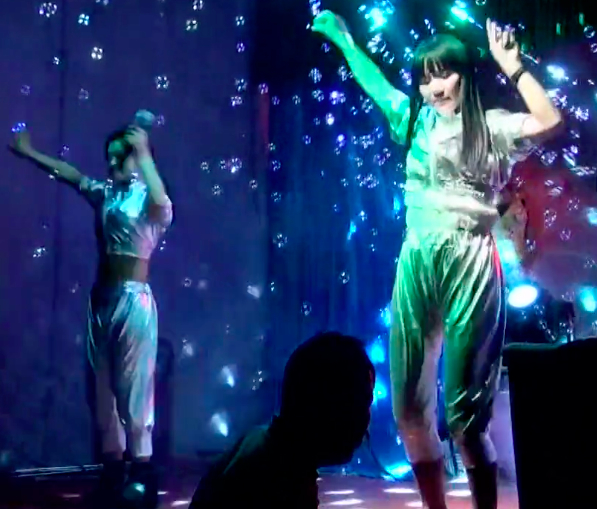
Pop duo

The evening session, 2015.

On one of my occasional excursions into town, Li Bin has arranged for us to meet up for supper with young star gujiang shawm-player Bobo. I first met him way back in 2003 when he was a teenage pupil of a wonderful cultured gujiang shawm player. Then, he seemed shy and I could never find a way of chatting with him, but now, once we realize we can chat together, he is sweet, relaxed, and funny.

Then femme fatale singer XX shows up, all glammed up. So a Daoist, a shawm player, a pop singer, and a WAM muso take a convivial meal together. Endless joking, largely revolving around the theme of the local beauty (meinü) and the foreigner (laowai). While XX is adept at orchestrating the flirting, she is intelligent, sincere, clearly aware of the delicacy of her public position as a singer, yet not afraid to be seen in our company. Accomplished at presentation—outfit, make-up, hair, perfume—she acts the part, but behind it all there is an alert woman, strong by necessity. Allergic as I am to the word “feisty”, here it is the mot juste: she has to be considered a kind of feminist.

She enjoys showing me the vast library of photos on her smartphone, mostly but not all glam.

XX and friend

The selfie mania: two popular Yanggao singers.

I’m not quite understanding the rules here. My attitude to XX is different from that of my Yanggao friends, who see her at funerals all the time. They’re used to the local language of flirting: she can read their signs and knows how to handle them. Sure, I enjoy it—I can’t shake off my ethnographic instincts, but the context isn’t conducive to getting to know people better, so I go with the flow. My best chat-up line:

You’re nearly as beautiful as Li Manshan!

Knowing my devotion to Li Bin’s father, she takes this in good spirit.

While XX and I enjoy the banter, we’re both a bit wary since we realise our signs may differ. So she backs off—as even I do; as we stagger out of the restaurant I kiss her hand in farewell, which even after all the banter still takes her aback.

On my next trip into town we all meet up again for supper. One reason for my visits to town is to take a shower at Li Bin’s place—much needed after ten days traipsing round village funerals. XX turns up in her posh black car—“I didn’t even have time to wash my face, only the car!” Still, she’s pretty dolled-up (tiny hot pants, black tights, heels, red coat), yet enigmatic as ever. Other diners come over to our table to share a toast, musicians who know all about me—people still thanking me for introducing Yanggao culture to the world. The son-in-law of a revered Daoist, whom alas I never even met, discreetly pays our bill and goes off before we can protest.

XX is even busier than Li Bin and Bobo, since she does weddings too, as well as acting as hostess for various gigs like yuansuo coming of age parties (see my film, from 5.26). So she drives off to get some sleep before embarking on a heavy series of three days of back-to-back wedding gigs.

By 2017 she had remarried, was pregnant, and no longer singing.

Pop at Yanggao life-cycle events continues to evolve, with both male and female performers constantly innovating; singers like XX are at the vanguard of local modernity, forging a role, negotiating old values.

For a further update, see here.

Conclusion
The tiny corner of China that is Yanggao county reminds us that we need grass-roots study, beyond simple images of educated urban milieux. As long as we remain mesmerised by urban stage performances, and by Confucian and Communist propaganda, we will never comprehend gender roles in the expressive cultures of the myriad local communities. But one point is clear: however much we unearth women’s varied roles in local cultures, and for all their “subversive strategies”, as long as girl babies are murdered or abandoned, as long as women are kidnapped from poorer provinces and sold to older (sometimes disabled) men unable to afford a local bride, and as long as women remain excluded from public power, their ability to contribute to expressive culture in the public sphere is likely to remain limited.

[1] Again, much of this is adapted from my “Gender and music in local communities”.

[2] Liu Hongqing, Xiang tian er ge: Taihang mangyiren de gushi (Beijing chubanshe, 2004). Still, the role of women is clearly increasing: see e.g. Zhang Yanqin, “Zhangzi shuoshu jiqi xijuhua qingxiang,” Minsu quyi 151 (2006), on narrative singers in a county in southeast Shanxi.

[3] See also the stimulating article by Zhang Zhentao, “Nü yueshou yu nü changjia,” Xinghai yinyuexueyuan xuebao 2009/3, pp.43–9.

A forfeit for theorists

coal

As I noted in my book (p.366), while in many ways my work on the Li family Daoists has rather little in common with the numerous Chinese field reports on local Daoist ritual, one feature (blessing or curse) that it shares with them is its economy with theory.

Theoretical reflections on Chinese ritual come largely from Western scholars—though they speak mostly not to such disciplines as performance studies or visual anthropology but to the realm of the sinological historian. To be sure, such discussions may be instructive, such as Helen Siu’s theory of ritual fragmentation, or the recurring discussions following from James Watson’s ideas on orthopraxy or the Wolf–Freedman–Weller debate on unity and diversity in Chinese culture.

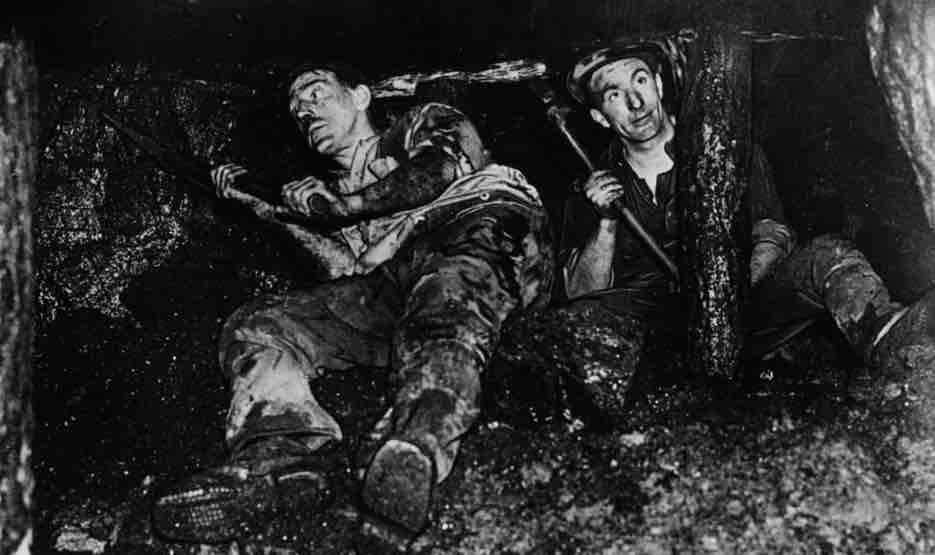
Theoretical discussion, “like cunnilingus, is dark and lonely work, but someone’s got to do it”—to cite Joseph Heller on tending sheep (in England the bon mot is usually applied to coal-mining). Don’t get me wrong, when done well it can yield great rewards (and Heller’s analogy still applies).

For thoughtful integration of theory with ethnographic detail, one thinks of Clifford Geertz, or (closer to my field) Adam Chau, and Rachel Harris. And indeed Catherine Bell, whose two fine books Ritual theory, ritual practice and Ritual: perspectives and dimensions provide a useful overview of the gamut of polysyllables—phenomenological, redemptive hegemony, and so on—and how useful they may be. Allegedly.

BTW, I like to think of “Bourdieu’s habitus” as a tiny sylvan dwelling, made out of twigs, where elves live; and I imagine him in a little red pointy cap, poking his head out.

Again, such terms (like local, emic ones) can be instructive, as long as they are thoughtfully adopted and adapted. Anyway, anthropologists should hope both to “do things” (fieldwork) and to theorise; but (as with religion) some excel at, or prefer, one or the other. And I guess they themselves will identify “ludic” qualities to their own language.

In the introductions of earnest PhD theses the homages to Foucault, Bourdieu, Gramsci, and so on, often seem like an obligatory kowtow to the God of the Soil (拜土地爺). We also liked to use this expression in our early days of fieldwork, when courtesy visits to the local officialdom were a sensible precaution before “going down” [sic] to the villages.

* * *

As a forfeit for such polysyllabic obfuscations, I hereby decree that henceforth, whenever scholars wish to introduce any abstruse theoretical perspective (“negotiation of identity”, “dialectic of objectification and incorporation”, and so on), they should have to add a line from Wei Hui’s 2001 novel Shanghai Baby (“a story of love, sex, and self-discovery”. Grrr), a trail-blazer in the budding, nay pert, genre of Chinese chick-lit:

 she moaned, as he nimbly slipped off her CK panties. [1]

That’ll learn ‘em. Apart from the exotic foreign brand-flaunting, I may add that just for extra racist value—the potent Other—her lover is German. Anyway, you get the gist—it makes Jackie Collins look like Wittgenstein, and the Chinese people may justly be offended that the book wasn’t shortlisted for the Bad Sex Awards.

As a litmus test of our noble conceptual terms, we might try translating them for our peasant friends, or The Plain People of Ireland. Their bemused expressions may remind us of the limitations of such theories, rather than discrediting them.

But “I didn’t get where I am today” [at home with a bottle of Bombay Sapphire—Ed.] by peddling such flapdoodle. Conversely, do consult the wise reflections of Catherine Bell on ritual studies.


[1] The translation, otherwise less reproachable than the book itself, gives “underpants”, surely less idiomatic.

Platform

Platform

In connection with my film on the Li family Daoists, I already recommended the verismo fictional films of Jia Zhangke 樟柯 about the alienating changes of life in small-town Shanxi through the reform era. Of many appreciations, this is good, and this. For antedecents of his style, see Chinese films of the early reform era.

His brilliant Platform (Zhantai 站台, 2000) shows how the members of a now-rootless arts-work troupe experiment with changing fashions as they struggle to adapt to the loss of their “iron rice-bowl”.

In one of many moving scenes (from 1.21.45) the illiterate Sanming, desperate for a job, turns up at a doddery coal mine to enlist for a daily wage of 10 kuai. His friend reads out for him the brief, shocking, contract he has to sign, opening:

Contract of life and death: 1) Life and death are a matter of fate, prosperity depends on Heaven. I am willing to work in Gaojiazhuang mine. Management accepts no blame for accidents.
生死合同。第一,生死由命,富贵在天。本人自愿在高家庄煤矿采煤,如遇万一,与煤矿无任何关系。

Just that opening phrase Life and death are a matter of fate, prosperity depends on Heaven resounds with the peasant mindset, if less so with modern law. The contract, and Sanming’s uncomprehending acceptance of it, are at once convincing and tragicomic.

Do go on to watch his other films, including Xiao Wu 小武 (1997), Unknown pleasures (Ren xiaoyao 任逍遥, 2002), The world (Shijie 世界, 2004), and Still life (Sanxia haoren 三峡好人, 2006). Now we also have an open-access volume of his interviews with Michael Berry. See also the films of Wang Xiaoshuai.

* * *

Shanxi province (apart from its fine household Daoists!) is also notable for its mining accidents. From my book on neighbouring Shaanbei:

Back in the county-town, returning to our hostel one evening, we switch on the TV to find a documentary about coal-mining accidents, which are reported nightly. There are some rather fine investigative programmes on TV these days, and the main theme of this one is how the response of the village Communist Party leadership to the disaster, rather than considering improving safety measures, has been to give funds to construct a new village temple in the hope of divine protection. OK, in this case the programme happens to fit into an agenda of rationalism against superstition, a view we sometimes feel inclined to challenge, but tonight I can only go along with the presenter’s lament.

Only later did I put together further pieces of a grisly jigsaw. Under the tradition of posthumous marriage (minghun), revived in northwest China, within five years after the death of an unmarried male over the age of 15 sui, a suitable dead unmarried female is found. Indeed, shawm bands often perform, and a Daoist may officiate. The unnatural deaths of many men in unregulated mines were bad enough, but newspaper reports in 2007 revealed that women (often disabled, or from poorer provinces) were being murdered to cater for this market.

For “ghost marriages”, note this article.