More recent is a highly praised film from Zacharias Kunuk, Atanarjuat: the fast runner (2001)—click here for a trailer. It enacts an ancient legend while lavishing great anthropological care in evoking early Inuit culture.
But Nanook of the North is to some extent a fictional creation too, blurring the lines between documentary and drama. It is an early case-study in a substantial discourse in the ethics of visual anthropology that leads on to Jean Rouch, representations of the Yanomami, and so on.
As to vocal styles, in katajjaq throat-singing (e.g. Voices of the World, CD 1 §12), the duet is considered to come to an end when one of the singers laughs, loses her breath, or breaks concentration (LOL).
Hard to imagine a performance of such charm at certain other recent swearing-in ceremonies…
Now I’d like to seek ethnographies of changing life in Inuit communities since the time of Nanook (preferably not containing the words “traditional way of life” or “vanishing culture”—“but that’s not important right now“). This is a lively topic in ethnomusicology—there are many studies to add to my reading list, such as Maija M. Lutz, The effects of acculturation on Eskimo music of Cumberland peninsula (1978), Beverley Cavanagh, Music of the Netsilik Eskimo: a study of stability and change (1982), and studies of throat singing by Nicole Beaudry and others—as an introduction to the detailed work of Beaudry, note her thoughtful reflections in Shadows in the field. See also First Nations: trauma and soundscape.
Here’s a trailer for the short film Throat song (2013), in which a young Inuk woman, lost in a community that has been tragically separated from its past, begins to connect with other victims of violence in her community, and seeks to reclaim her voice:
Throat singing also inspires a lively experimental scene, with singers such as Tanya Tagaq.
* * *
Corpsing is one of the pleasures of musical life in WAM too—we’ve all done gigs like that. I can’t suggest here the numerous ways in which fiddle players try to corpse their desk partners by a tiny little gesture of resignation at the repeat of a minuet, or a fake sforzando attack on a pianissimo entry.
Generally “the show must go on”, but once, the Allegri string quartet were performing the intimate, intense slow movement of a Haydn quartet when the viola player let out an extended and voluble fart.* The leader giggled sotto voce, and as the mirth spread (even to the miscreant, who’s generally the first to keep a straight bat) all four of them were soon so helpless with laughter that they just couldn’t keep going, and had to leave the stage to compose themselves.
To be sure, this is at a certain remove from Inuit culture. In the latter, as if you haven’t worked this out already, corpsing is intrinsic to the performance event; in WAM, it’s an illicit part of the muso’s “deviant behaviour“. For corpsing in the crucifixion scene of the Matthew Passion, click here; and for the suave Charlotte Green on BBC radio, here.
* I’m reminded of the old Punch cartoon:
Host (to guest who has just perpetrated an embarrassing histrionic effect) “Gad sir, you’ve farted in front of my wife”.
Guest, with air of studied nonchalance, “Oh, I’m most frightfully sorry, I didn’t realise it was her turn.”
Further to my thoughts on festivals, today is the focus of the round of Bach Passion performances, now a kind of secular pilgrimage very different from the original liturgical context—not just of Good Friday but of the whole calendar (note John Eliot Gardiner, Music in the castle of heaven, ch.9, “Cycles and seasons“). Different too are our ears, bodies, world-views, experiences, sanitation…
Mark Padmore, incomparable Evangelist in the Passions, makes some thoughtful points here (cf. this article). Do watch his Matthew Passion as staged by Peter Sellars. And here he is in the John Passion (cf. Passion at the Proms)—how he sings und ging heraus und weinete bitterlich (from 33.48), and how Bach composed it, is miraculous:
Also in the John Passion is one of Bach’s most moving arias is Zerfließe, mein Herze:
Zerfließe, mein Herze, in Fluten der Zähren Dissolve, my heart, in floods of tears Dem Höchsten zu Ehren! to honour the Almighty! Erzähle der Welt und dem Himmel die Not: Tell the world and heaven your distress: Dein Jesus ist tot! your Jesus is dead!
While Protestants do their thing, let’s not forget Holy Week in Spain, with solemn hooded processions, soaring trumpets, and saeta devotional songs for the images of Christ and the Virgin (for more saeta, along with other moving cante jondo songs, see here):
Indeed, for me one of the benefits of being a touring muso was being able to combine both Bach Passions and flamenco. In southern Spain flamenco only tends to get going in the small hours, but concerts also begin at 10pm or later. So by the time we had played the final chorus of the Matthew Passion in Seville, there was plenty of time to stroll over the bridge to the wonderful Anselmas bar in Triana, downing a few G&Ts before the flamenco began to get in the groove.
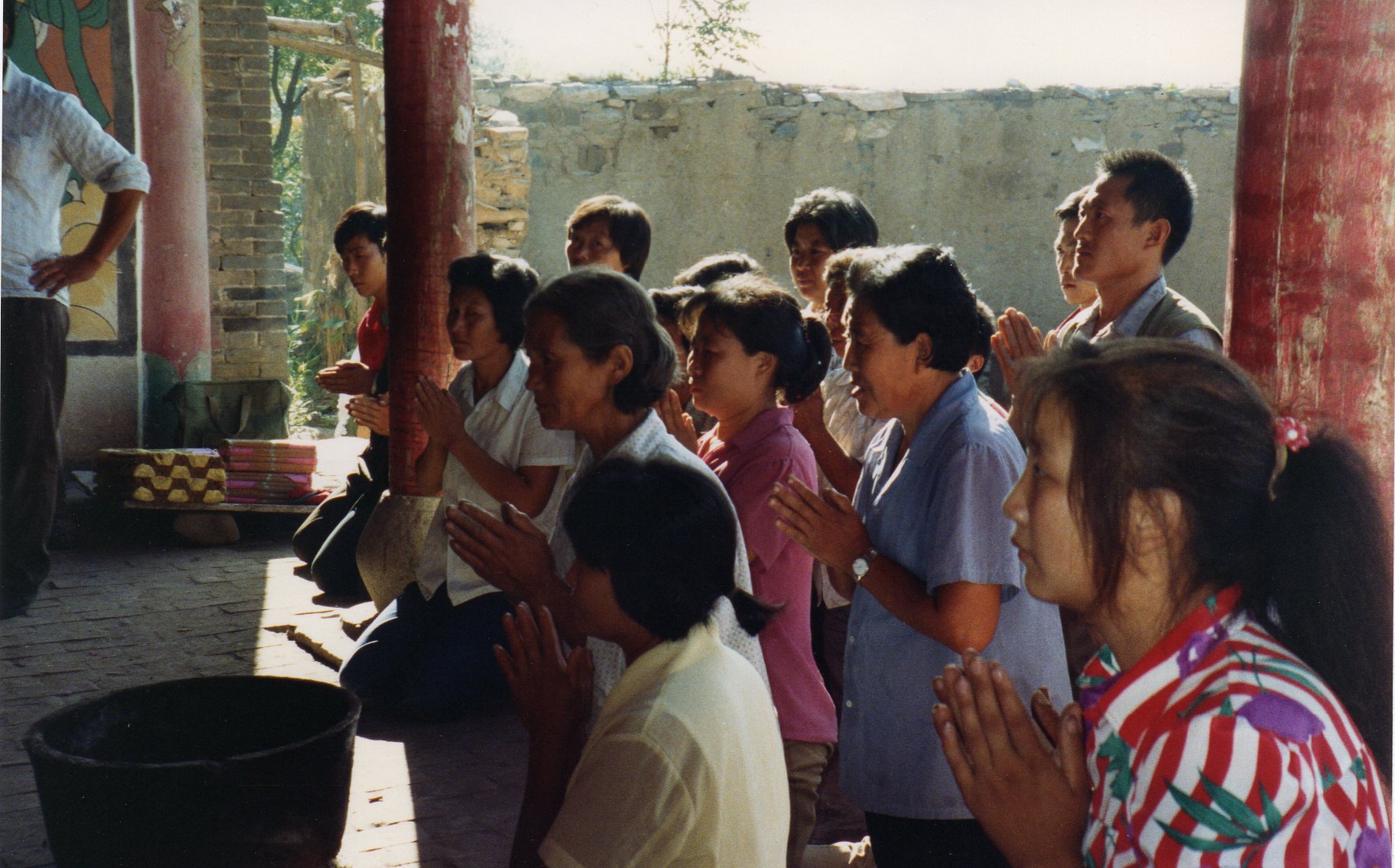
Meanwhile it’s a busy period in the Chinese ritual year calendar too. [1] On the Hebei plain, apart from everyone taking part in the lineage observances for the Qingming festival, Catholics are busy holding Masses and making pilgrimages—not least evading police road-blocks (see here, and for the Gaoluo Catholics, here). It is also the time of the 3rd-moon festival for the goddess Empress Houtu, when many villagers go on pilgrimage to the Houshan mountain temples to revere her.
The Houshan pilgrimage, which under the commune system had been observed only by a tenacious minority through the 1960s and 70s, began reviving in the 1980s; by the 1990s it was attracting around 100,000 pilgrims for its 3rd-moon temple fair. We met several village ritual associations on the mountain for the festival in 1995, though Gaoluo village no longer organizes a group; in recent years “people’s hearts are in discord”, as association leader He Qing lamented. In some places the Houtu festival has been revived within the village: for the 3rd-moon festival in 1996, for instance, we visited Shenshizhuang, south of Yixian county-town, whose four ritual associations all celebrate the Houtu festival in their separate ritual buildings in the village.
Altar to Houtu, Shenshizhuang West association 1996.
Many villagers make the pilgrimage in small groups on their own initiative. Their vows are pledged to Houtu. One can climb to the Houshan temples to offer incense and pledge a vow, or just make it at home; the vow often used to include a promise to “look after a banquet” for the ritual association.
So the red flag which one often sees adorning truckloads of villagers in the 3rd moon now heralds a group of pilgrims rather than any political campaign—another sign of the changing times. But despite the lengthy impoverishment of ritual and faith, the power of Houtu is still strong: even in 1997 Gaoluo friends reminded me “Here we believe in the Empress Houtu, so a lot of people offer incense”.
* * *
For the dispassionate (sic) observer, some photos may distinctly suggest a stress on masochism in Easter observances around the world. Meanwhile on a visit to the Saudis, celebrated defenders of religious values, our Prime Minister gets herself embroiled in a futile dispute about Easter eggs with the notoriously subversive National Trust. Indeed, this “We’re not even allowed to celebrate our own culture any more” fatuity is itself becoming an annual ritual. Hey-ho.
Below I cite a review by Stephen Bennetts (Weekend Australian, Review section, 28–29 January 2006) of
Ernesto De Martino, The land of remorse: a study of Southern Italiantarantism (pdf of original Italian edition here).
First published in 1961, The Land of Remorse is a classic of anthropological detective work. Was this bizarre phenomenon really caused by the bite of the tarantula, or was it instead a mere “superstitious relic”, or a localised form of psychosis prevalent among illiterate Southern Italian peasants? Almost sixty years ago, in 1959, a group of scholars arrived in the small town of Galatina to unravel the riddle. They comprised a historian of religion (De Martino), neuropsychiatrist, toxicologist, psychologist, anthropologist, ethnomusicologist, social worker and photographer.
It soon became clear that the research team was documenting the last vestiges of the cult, which by now had retreated to an isolated pocket of peasant society in Salento, the stiletto heel of Southern Italy. Tarantism still persisted in its classical form in the music and dance therapy sessions conducted in the home, whilst the partly Christianised form of the cult, amputated of its musical and dance component, continued in the grotesque and histrionic displays at the Chapel of St Paul, as possessed tarantati arrived for the feast day of Saint Paul to ask the saint for healing.
In De Martino’s analysis, the mythology of the taranta and the catharsis of the possession state provide a framework in which personal psychological tensions common throughout Southern Italian peasant society could be publicly dramatised. Private sufferings caused by unhappy love, bereavement, sexual frustration, or subaltern social status were transfigured into annually recurring possession states which were culturally determined, rather than being the result of a real spider bite. The ritualised healing through dance and music provided victims with psychological closure and reintegration back into the community, at least until the summer of the following year.
[According to one Salentine authority, the last episode of tarantism involving actual possession took place in 1993, but the last living practitioner died in 2000. Yet “tarantism” has recently taken on another curious form. The current Southern Italian folk revival and associated pizzica dance craze incorporate a grab bag of different impulses: re-emergent Southern regionalism, the reevaluation of a peasant past which is now distant enough for young Southern Italians to romanticise rather than feel ashamed of, and a rejection by the Italian anti-globalisation movement of the television-fixated “cultural homogenization” of Berlusconian Italy. De Martino’s book has now achieved cult status beyond the academy; go to many folk concerts in Southern Italy today and you will find it on sale alongside tambourines, castanets and other accoutrements of the recently exhumed Southern Italian past. In a process which has been aptly described as “proletarian exoticisation”, De Martino’s plain female peasant tarantate have given way in contemporary reworkings of the theme to video clips featuring dissociated but picturesque young beauties writhing to the latest tarantella folk hit. Within the current Salentine folk revival, De Martino functions as a kind of symbolic fetish, validating an isolated area of Southern Italy which almost nobody had heard of until the “rediscovery” of tarantism and tarantella ten years ago suddenly put Salento on the map.]
Along with more detached ethnographic observations, one easily discerns severe social problems here—not least poverty, and not just the role of the church. Urban Chinese observing rural Chinese ritual may be beset by similar, prescriptive, responses—which will be secondary for foreign fieldworkers, more entranced by the persistence, perhaps exoticism, of religious practice there. That’s partly why study of the practices of “primitive” ethnic minorities are so fashionable.
De Martino’s work, though focused on religion, makes a successor to Carlo Levi’s 1945 book Christ stopped at Eboli, and even James Agee’s 1941 Let us now praise famous men, with the photos by Walker Evans. Accounts like these are a world away from the idealizing of peasant communities often implied in Chinese cultural studies. But both types have their own agendas. Meanwhile, brave Chinese journalists have blazed a trail, with village surveys like those for Anhui, and a substantial body of work on the famines around 1960.
We may contrast the anthropology/ethnography of religion with pious insiders’ views of religion. Of course a participant or “believer’s” own account will be important material. But if in the description the ethnographer promotes her own “belief”, that is dangerous: more like propaganda. Empathy is to be desired, evangelism to be avoided. Good histories of Christianity or Islam are unlikely to come from the standpoint of proponents for such beliefs.
So what is, or should be, the anthropologist’s view on religion? While showing how it works in the society, one doesn’t have to promote it as entirely beneficial there, or to that of other societies. Of course our picture is blurred by the quest for ancient oriental wisdom, which may even follow on from hippy mysticism. It is remarkable how commonly this still plays a role in studies of Daoism.
Some scholars make a case for the superiority of Daoism as a world view, over other religions and other world views. Not only is this not the job of the ethnographer, but it may flaw the whole research enterprise. What we learn from such accounts is what a Western scholar, of a particular upbringing and taste, thinks about Daoism; not what Daoism in society is like.
To repeat, it is different to develop a certain empathy with one’s subjects than to come from a standpoint of evangelical zeal. In the course of an ethnographic relationship one will doubtless begin to explain their mindset, their backstory, and so on. But the study of Daoists is mainly to be done with the same kind of anthropological curiosity that one would bring to the study of any other group, such as Party cadres or sex workers (funny how those two random examples seem to make suitable bedfellows. I didn’t say that).
Participant observation brings many benefits. In the case of religion, to participate fully in the life of Daoists will certainly confer insights—but there is no single type of Daoist, and even participation is only one aspect of the duties of the scholar. One should observe not only how religious activities inspire local patrons, or bring social cohesion, but how people may ignore or oppose them. I’m not even arguing with evangelism, necessarily; just that it blurs proper scholarship.
Study of oriental religion risks exoticizing. Even if the scholar avoids the trap of “Just look at this rare ritual I’ve stumbled across/gained unique access to”, rituals may yet be portrayed as “special”, ancient, mystical, and so on—whether they are or not, and downplaying their routine nature. This kind of social behaviour is normal. The visitor may stumble (once) across something supposedly rare, but more likely it will be repeated again and again—always adapting over time.
Note also this documentary from 1952, with funeral laments from Lucania:
The work of Frits Staal on Indian ritual contains much from which scholars of Daoist ritual (not least I) might benefit, confronting issues that I encounter in working with Li Manshan. Staal’s ideas about orthopraxy seem to go beyond the discussions following those of James Watson for China. There’s a lot more to Staal’s work than that, but this is a start.
In “The meaninglessness of ritual”, [1] Staal eschewed “the dewy-eyed romanticism that is pernicious to any serious study of cultures and people.”
A widespread but erroneous assumption about ritual is that it consists in symbolic activities which refer to something else. It is characteristic of a ritual performance, however, that it is self-contained and self-absorbed. The performers are totally immersed in the proper execution of their complex tasks. Isolated in their sacred enclosure, they concentrate on correctness of act, recitation and chant. Their primary concern, if not obsession, is with rules. There are no symbolic meanings going through their minds when they are engaged in performing ritual. Such absorption, by itself, does not show that ritual cannot have a symbolic meaning. However, also when we ask a brahmin explicitly why the rituals are performed, we never receive an answer which refers to symbolic activity. There are numerous different answers, such as: we do it because our ancestors did it; because we are eligible to do it; because it is good for society; because it is good; because it is our duty; because it is said to lead to immortality; because it leads to immortality. A visitor will furthermore observe that a person who has performed a Vedic ritual acquires social and religious status, which involves other benefits, some of them economic. Beyond such generalities one gets involved in individual case histories. Some boys have never been given much of a choice, and have been taught recitations and rites as a matter of fact; by the time they have mastered these, there is little else they are competent or motivated to do. Others are inspired by a spirit of competition. The majority would not be able to come up with an adequate answer to the question why they engage in ritual. But neither would I, if someone were to ask me why I am writing about it. […] Most questions concerning ritual detail involve numerous complex rules, and no participant could provide an answer or elucidation with which he would himself be satisfied. Outsiders and bystanders may volunteer their ideas about religion and philosophy generally—without reference to any specific question. In most cases such people are Hindus who do not know anything about Vedic ritual. There is only one answer which the best and most reliable among the ritualists themselves give consistently and with more than average frequency: we act according to the rules because this is our tradition (parampara). The effective part of the answer seems to be: look and listen, these are our activities! To performing ritualists, rituals are to a large extent like dance, of which Isadora Duncan said: “If I could tell you what it meant there would be no point in dancing it.” Ritual, then, is primarily activity. It is an activity governed by explicit rules. The important thing is what you do, not what you think, believe or say.
This echoes Catherine Bell’s comment that I cited in my post on Bach and Daoist ritual—for her masterly surveys of ritual studies, click here.
Here’s a trailer for Staal’s 1975 film on the Vedic fire ritual:
Poul Andersen offers caveats to Staal in a review of volumes on Shanghai Daoist ritual (Daniel Overmyer, Ethnography in China today, pp.263–83). He highlights the interpretations of the participants (including the liturgists themselves), which “in many ways influence the actual performance. They are relevant for the way in which performances take shape, develop, and are modified over time.” Such interpretations, while important, rarely offer a detailed critique, so such a view refines rather than refutes Staal’s point.
[1]Numen 26.1 (1979): 2–22. See also Ritual and mantras: rules without meaning (Motilal Banarsidass, 1996), and (source of my quote here) S.N.Balagangadhara, “Review of Staal’s Rules without meaning”, Cultural dynamics 4.1 (1991), pp.98–106.




 Stephen Jones: a blog