Roundup for 2023!

As I reflected in last year’s roundup,

like a suburban Sisyphus doing and undoing a jigsaw, having gone to great lengths to mix up the daily sequence of my diverse topics in a stimulating fashion, it’s that time of year when I try and reassemble them into some kind of thematic order.

In order for this exercise to be worthwhile, you’ll have to click on the links! Ideally, spread the word by reposting on one of those “Social Media” Thingies They Have Nowadays… Even if you only read a dozen of these posts, then my labours will not have been in vain!

I’m going to adopt Stella Gibbons’ drôle device in Cold Comfort Farm, drawing attention with *** to passages (mostly posts, in this case—indeed, the book’s protagonist is Flora Poste) Not To Be Missed. And this list isn’t even exhaustive—the committed masochist can consult the monthly archive in the sidebar, scrolling waaay down.

I’ll begin with Nicolas Robertson, who alas joined the Heavenly Choir in November (see my tribute). His extraordinary anagram tales (introduced and listed here***), a kind of fantasy Esperanto fiction, are among the highlights of this blog, and in further tribute to his brilliant mind I have recently added two more:

So here are listings under some main themes (many, of course, belong under several themes, which is the point of giving them categories and tags, listed in the sidebar):

China (culture and ritual, Maoism and politics):

East Asia, other:

This year’s additions to my education in Tibetan and Uyghur cultures:

Turkey and West/Central Asia (see roundup):

Modern Europe:

Ethnomusicology and world music:

Jazz (see roundup***):

Pop:

Western Art Music:

Sport (see roundup):

Film/TV:

Loft best new

Arising from the transformation of my home:

Other:

For roundups of previous years’ musings, see 2018201920202021, 2022. And here’s a roundup of roundups! The homepage is always useful for navigation.

And it’s always worth reminding you to watch my portrait film***
on the Li family Daoists,
 raison-d-être of this whole blog!

Guest post: Salzburg

by Nicolas Robertson

For links to the complete anagram series, click here.

Prelude—SJ
Since Nick has Ascended to the Great Pinball Table in the Sky, I’ve found two more of his mind-blowing anagram tales. Alceste, which I posted recently, is relatively economical; this one—among stiff competition—is surely his most virtuosic, fantastical (and lengthy) creation. Even the introduction is highly challenging, before we reach the “story” and the final gnomic anagram tale itself. In the absence of Nick’s eagle eye, formatting his text has also been a severe challenge.

Nick’s penchant for tombstones as a medium to connect with the spirits of the past, especially evident here, now seems all the more poignant.

* * *

SALZBURG

Leonore, first version of opera by Beethoven, 1805; shelved and reworked in 1814 as Fidelio.

Fidelio was one act shorter with reordered music; and had a brand new overture. Beethoven commented “almost no musical piece remained the same, and more than half of the opera had been completely reworked”—a description I’ve attempted to reflect.

Staged performances by soloists, Monteverdi Choir and Orchestre Révolutionnaire et Romantique, directed by John Eliot Gardiner, including at Salzburg Festival 1996. Archiv recording, issued 1997.

An introduction, the “story”, and lastly the anagrams themselves, of Beethovens “Leonore” followed by Beethovens “Fidelio”.

[Elements written recently—between 2017 and 2020—principally the “apparatus”, are set in blue to distinguish them from the original 1996 text, augmented in 2012. There are three textual notes, marked in red. Photos were taken later, in 2012 and 2014—one did not have phones with cameras in 1996.]

______________________________________________________________________________

“I hope we English will long maintain our ‘grand talent’ pour le silence”
—Thomas Carlyle, “On Heroes and Hero-Worship”, vi.

Salzburg, summer, Festival and Festung. By day, monsoons and the heavy sun of Mitteleuropa; fading into night, a great still, bulging moon, hanging like a distant punchball, haunting the baroque fountains of a city with too much to remember. Here, one dreams—and sings—of escape: Mozart, from Archbishop Colloredo; Florestan, from prison, and Leonore from half-life to bliss.

Perhaps it was no more than normal for the times, but I could not but be torn by the silent witness of those who escaped far too soon, from a world which had hardly begun to hold out its arms to them. St Sebastian’s Friedhof is a lovely shaded cemetery in a cloister on the other side of the Salzach, and just look what memories call to us from it: of Constanze Weber, Mozart’s wife, yes, and his father Leopold too, but also of the great-grandchildren (I surmise) of stone-cutting master Johann Doppler:

Maria and Anna, born 2 November 1859, died 23 November and 4 December 1860; Otto, 17 February 1868–30 January 1870, and Rudolf, 13 April 1865–5 February 1870 (Johann could have had the melancholy task of engraving their stones, had he not died, aged 45, in 1838). And look, too, Therese Patera, b.1859, d.1861, “geliebtes Kindlein”,

3

and, without even such ado, “Egbert Almeric Henry-Henry / born Feb 22 1859 / died March 22 1859” (the stone, high up and reticent, is inscribed, without any other words than these, in English).

4

What was happening in Salzburg in the mid-19th century? Paracelsus, buried in the same St Sebastian’s church in 1541, would have plunged in, reckless of his own health, to fortify the unprotected, even though he well knew that

All, what is, lives.
Nothing is annihilabl,
even Mouldering is transition to new life.

5

(Tomb of Dominic Oberlechner, d.1821 aged 23, St Peter’s Friedhof, Salzburg—and in English, though you will find a similar text on the same monument in German, French, Latin, and Greek…)

6

This has, to me, a profound assonance with these words of Claude Lévi-Strauss (as quoted by Douglas Hyde, and printed in the latter’s Guardian obituary, where I read them on the day I wrote this, 22 September 1996):

“Nothing is settled; everything can still be altered. What was done but turned out wrong can be done again. The Golden Age, which blind superstition had placed behind (or ahead of) us is in us.” [1]

[1] “Si les hommes ne sont jamais attaqués qu’à une besogne, qui est de faire une société vivable, les forces qui ont animés nos lointains ancêtres sont aussi présentes en nous. Rien n’est joué; nous pouvons tout reprendre. Ce qui fut fait et manqué peut être refait: «L’âge d’or qu’une aveugle superstition avait placé derrière (ou devant) nous, est en nous.» I’m not sure from where Lévi-Strauss is quoting (Rousseau?); the whole passage in context is cumulatively inspiring. [Tristes Tropiques, 1955, p.471.] The English version above is as used for the epigraph to Alexander Cockburn’s book of essays The Golden Age Is In Us (1995).]

What is this but the quiet request of the Zen master, Hōgen Daidō: “Why not here? Why not now?”, which translated into the high art terms of the western world would find its parallel in the manifesto of Hölderlin quoted by Geoff Boycott later in this story. But, though I happen to be writing these last (preliminary) words in Japan, I find it more appropriate to round the little life of this squib with the Biblical version of that long sleep which was written on the very slab of Johann Doppler (Steinmetzer, der unvergesslicher Gatte)’s descendants; for it’s worth knowing where we came from, even if we don’t know where we’re going (an apothegm which could well apply to this whole anagram lark):

“Der Herr hat sie gegeben, der Herr hat sie genomen,
der Name des Herrn sei gebenedeit!
Wie es dem Herrn gefallenhat, alsoistesgeschehen.” (Job 1.21.)

* * *

There’s a more dynamic, equally important, side to this theme, though:
 “Soltai os encarcerados!” (“Let loose the prisoners!”)—when Lídia (die ferne Geliebte) sang these words of Gil Vicente in the tiny eponymous theatre in Cascais in 1969, she was banned, along with the play (“Um Breve Somário da História de Deus”) and the recording made of the songs, by Salazar’s nervous jackboots. But now we’re in the realm of heroes (and heroines, I prefer not to draw the distinction, after all Hero was—is—a girl’s name): the world of Carlyle, of Nietzsche’s Übermensch—not remotely, let us be clear, to be equated with the dummkopf Siegfried whose only quality is that he is “freer than the god”: Nietzsche, and his superman, win their status by thought—as well as, rather engagingly, superior nutrition. (Paracelsus to a T.) *

* [What do I make of the fact that in Salzburg I am staying in the outreach of Himmelreich?—is this not Paracelsus?—whose given names are, Theophrastus Bombastus von Hohenheim. What a place to site an airport… “Ich fühle Luft von anderen Planeten”—so wrote Stefan George, Rosicrucian, Paracelsan poet; another Stefan, Zweig, author of Beware of Pity (thank you to the one who lent me this book those years ago, a lucid notion on her part) eviscerated the Hapsburg heritage, counted the human cost of the dereliction immanent in those huge Tartar plains, and has a -Weg named after him, directly overlooking St Sebastian’s Friedhof, on the Kapuzinerberg where he lived.

7The bust, now, to be found at the airport, of Christian Andreas Doppler (can I guess him to be a relative of Johann?—I haven’t been able to do all the necessary research, there must be allowed some holes, to breathe through)—born within metres of Mozart’s Wohnhaus, in 1803, died in Venice fifty years later—is cast however in bronze, not the familiar stone. Furthermore his phenomenal description, known to the English as the “Doppler Effect”, is here called “Doppler-Prinzip”. Cause and effect are not as automatic a sequence as we’d like to think. Cause and effect (I descend from A440 to A430 as the repeating sound waves lengthen) are not as automatic a sequence as we think we’d like… as likeable a sequence as we automatically think…]

I was talking about heroes, heroics. Napoleon was once a hero to Beethoven, until he declared himself Emperor and had to be scratched from the title page of the Eroica—written at the same sort of time as Leonore. It’s maybe not so curious, then, to find echoes of this preoccupation with great men (and women) amongst the jumble of possibilities offered by a shake-up of Beethoven’s Leonore and Beethoven’s Fidelio (to be roughly precise, 230 shake-ups, Fidelio having the tiny edge). Less to be expected, though logical enough if you care to dwell on it, is that one should begin in an atmosphere half-Carlyle (“The Hero can be Poet, Prophet, King, Priest or what you will, according to the kind of world he finds himself born into”—Heroes and Hero-Worship, iii.) and half-Kipling. I append, first, a “translation” (one of finitely many possible) of the jumbly text, and, last, the (re)strained artefact itself.

I owe thanks, indirectly to Nicholas McNair and John Eliot Gardiner (who laid on the raw material), directly to Charles Pott, consistent finder of most of the best individual anagrams (including the title), and essentially to Louis d’Antin van Rooten, author of Mots d’heures, gousses, rames, to Georges Perec, of course, and to those—or the One—responsible for Himmelreich.

Finally, for any who wonder if I shouldn’t indicate the point where “Leonore” anagrams give way to “Fidelio”—I draw the line at that.

____________________________________________________

O BENEVOLENT HEROES

Stalky & Co. M‘Turk, perhaps, is sounding forth about national values, and after teasing poor Beetle pours derision (in his Irish accent) on the Corsican stomach-marcher. Shoving the hapless Beetle forward, he suggests that a music-loving Roman emperor would draw the line at fellow Italian modernists: too subversive, and what’s more unacquainted with Nordic countries.

The same, apparently, could be said for the gifted, unhappy rulers of Ferrara, not least the lovely one who became married to Gesualdo. The only thing to do is concentrate on the job in hand, whittle a snowy-weather vacuum-cleaner which runs on glue. Tony Benn, who’s certainly not to be likened, in his loose diction, to C.S. Lewis’s wonderful talking horse, boy do you stir things up:
“The only pershon to be compawed to Newo ish Beethoven!”
He’s not listened to: there’s more urgent matter. The very vacuum-cleaner’s been nicked: I don’t believe it, I retreat into my shack (the super cabana I staked out myself) and weep.

A multi-national cricket (hockey? football?) competition is a severe rival to track athletics, especially when the star Kenyan’s injured his foot. He goes so far as to contemplate suicide, in Grecian mode, but Helen, dear reposeful one, rules this out, on pain of calling off her Anglo-Saxon lessons. This threat is not esteemed by a couple of more-or-less heavyweight members of the ecclesiastical hierarchy, who call upon a patriarch for help, but it’s left up to the Stage Manager, [2] alert, honourable, to pace around scenting trouble and sorting it out. When I say “pace”, I properly mean “jet”: he checks out Lancashire, the Home Counties, young navvies in south-east Asia, Italy, Africa… where an Afrikaner, salivating with envy, asks if he’s stayed in an Ibis hotel. Of course he has—but not in Egypt, probably only on the outskirts of a French provincial capital.

[2] The Monteverdi stage manager at this time was Noel Mann (see * below).

The African connection turns up a more sinister figure: a Ugandan dictator, whose hurly-burly discourse bears nasty connotations of genocide (though pertinently pointing out that Beethoven’s heroine is not in fact Italian), hardly mitigated by attempts at Shakespeare. His interlocutors, perhaps maliciously taunting him with the Othello role he’d have loved, callously ditch him when another mountainous actor drops by. Trans-sexual badinage involving Spartan slavery and a voracious Russian threatens mayhem; but you only need to regard one bordel, one low-cut tee-shirt, to see that eroticism and spiritual affection aren’t remotely separate—they’re the same thing, whether in English or ancient Greek!

* * *

Behold an oboist at rest: except he never is, worrying about his reeds, his obbligato, the last to be heard still practicing in his hotel room before the bus leaves [this passage is inexplicably interspersed with culinary quotidia, as well as uncalled-for speculation on intra-musical relationships]; opining on tempi in what passes for early music nowadays, multiple instrument-making by an eccentric on the South Coast. Lazily he exhorts Sven (who will reappear) to rock on, man (though mistrusting the quality of his sound system, which appears antiquated), calls on my brother to drink to Robert Burt’s exhilarating song to freedom—and, to placate the authorities, ends up paying homage to the author of “La Disparition”, where no “e” is used, proposing a variety of fun lipograms, including “o” and “c”, all of which are turned down, most forcibly by an American law-enforcement agency:
“You can’t trust your alumni, dammit, they can’t spell and they cover up their sloth by using the duplicating machine.”

A Belgian woman, her accent influenced by long residence in the southern hemisphere, says Davie [3] —a friend of hers—gets very upset by not being able to use another vowel, but reckons he’s nothing better than a golfer who can’t complete a round, having played the first 7/18 of the course like an automaton.

The Ryder Cup captain, recalling unexpected speculation on waterbirds, agrees. So much for Divie.

[3] See n.9 and ** in second part, amongst the anagrams.

* * *

Less is known than should be, perhaps, about the Gothic king who was born an Australian woman, descended from the celebrated gin family: who despite his/her facility for dismembering Celtic émigrés gained a reputation as a good man (/woman). Thus do sanguinary impulses and high culture go hand in hand; even the most austere of Japanese art-forms is welcomed.

Yet the threat of plague hangs over his house. Bovine spongiform encephaly has been identified in one of his pet hares—surely it can’t have reached Cornwall? A jumble of thoughts whirls around Otho’s brain, thus:
“Get rid of that rodent Sussexman [4] on TV, he must of done it, I’ll make the old retainer sort him out. Or… was it an insect bite in Nevada? or the early closing times in Rostock? One’s friends’ girlfriends? Disappointment on Merseyside? Devil take it, even the best come to grief. Ooh…” (here a lateral thought carves a wolfish smile across his/her care-worn features) “Game, eh? Well, if not hare, then hoopoe? three poussins? tandoori venison?… oh, praise my Yugoslav aide’s heavenly logic! We dream of Eden, where the classics are easily available in authoritative parallel texts, and great Venetian painters’ (yes, including the one who did St Antony preaching to the fish) works can be enjoyed inalienably, without fear of predatory preemptions by the Getty Museum.” It’s an honourable vision.

[4] Noel Osborne, distinguished Chichester publisher, bass singer and Cathedral volunteer (see n.10, among the anagrams)

* * *

 “Is it really you?” Eve gasped.
“It is,” Noel replied, “but do you mind if I call you Joyce? You’ve come to my help at such moments of need, as he did.”
“Then – let me call you Dedalus! You’re so good to cyclostomes out in Dublin Bay, and you single-handedly keep the bar running. I’m only sorry you haven’t persuaded them to do dawn sugar-cups.”
“You’re not telling me – oh, that cupbearer, ye Gods! She’s Greek, you see, she doesn’t seem to understand what I say. But – don’t take it into your own hands – ” Too late. Eve flung her bouquet of roses at Noel’s face, and, missing him, caught Liz, standing isolated apart, snagging her shirt.
“Eve, don’t!” she cried, “these chapel flowers ruin my outfit!” And it’s ruined alright.
“Yes, Eve, it’s all very well…”
Ethel broke in adventitiously, “ ’Ere, I do think Noelene idealises Noel, don’t you?” But Noel, intent on Eve, and spotting that the sun was over the yard-arm, offered her crustaceans; and, giggling, she was his.

* * *

I wish it weren’t the case that traditional Japanese theatre left even distinguished bass singers cold. But, mi love, don’t take it as a slur on west country mores, for there’s more at stake than you think – I speak now für Elise

______________________* * ______________________

It’s Elise who enters, but she stands for all Beethoven’s unrealisable loved ones, poetesses, countesses, nephews, ideals, half-perceived splendours, renunciations… Elise has the dubious advantage of being here, in the flesh; knowing herself to be paradise personified…

Well, she lived dangerously, while he never risked enough. Was the din of the spheres sufficient compensation for his half-hearted amorousness? First, let’s consider the problem of right and wrong. The latter: Satan, yes, and wretched diseases like Aids (it has been suggested that a hot mustard bath might help); Satan’s hand is seen too in the beef crisis—but I resist, I’m determined to keep on eating meat, be it only well-hung vermin.

Ben asked if I didn’t know a thing or two about fish, as a matter of fact. This is mere provocation. I refuse to plump for one side or the other, between the totems of sky and earth, land and water; I prefer like Jonah to rest my weary head under a grape trellis.

There’s always going to be men who’ll interfere with even this harmless pleasure, who’ll shred the arbour rather than let someone else enjoy it—yet still a dove could fly with an olive leaf in its beak, to find resting place on a sedged nest cocooned by bees. And in the course of time, this first testimony of freedom from the vengeful god expanded. The hive’s roof became covered with ornament; people worked at the reclaimed soil, patiently levelling out the acres granted them, they took the fruit of the olive trees and stoned them, in generations to come they drew out the sting from angry films made by their own offspring. These sturdy, self-reliant people, they thought little of Wall Street reports, they’d be happy that their already pregnant daughters show themselves in public, and would contentedly wear galoshes because they make sense. The marsh folk.

Quite a different world was inhabited by E. Nesbit, author of Five children and it. Lewisham was her background, the bricky parapets of bourgeois southeast London, its gardens full of buddleia run to seed, rudely kempt hortensias amidst sandpits of nettles. But she escaped, at least once, to one of the best hotels in Venice, in search of some clarity of mind. “ ‘Keep apart’, I told myself,” (she wrote) “ ‘if not, you’ll go mad. Could I have joined in union with the Irishman? Would my faith bear it?’ ” Then, there was the cost of the abysmal accommodation, serried ranks like cows. And yet – she knew of a phoenix, she knew of a miraculously-transforming Psammead, she knew of many things…
Allow me a reflection on hotels. “Old Faithful’s Guide” says you can eat well in one upmarket continental chain. Pity me! if that’s the case my public school was a sheep’s bedroom. I ran, when I saw that silky red sheen on the veal—a sure sign of putrefaction, cancel that meat INSTANTER. There’s always wholemeal bread. Just watch the film German TV made about the state of cows’ meat!

Some food, I’m glad to say, is not only healthy but also delectable. Amongst such I include Simon Davies’ buckwheat dropscones, piled up with raw onion, sour cream and caviar. Theo tried this recipe on Eve, as a way of persuading her to drop her silly eating restrictions, not least her refusal to contemplate pied de cochon—Valéry Giscard d’Estaing’s favourite dish, after all.
But Steven has opinions about French public figures. He accuses the incumbent of unnatural toilet practices, as well as political immaturity –
“Look at your enemy: don’t do what he does!” But falling into the same error, he invokes an early historian of western Christianity, only to discover him to be as flawed as the rest; and with a guttural, choking cry Steven admits that really it’s the romantic Jewish–Teuton poets whom he adores, thus allying himself with the libertine movement and so, according to some, the party of the Enemy.

I don’t think it’s so, fair-headed Steve, but perhaps it’s not your fault in thinking that passion inextricably involves sleeping with people half your age, that that’s where love is; some American states have endorsed this, after all, and so has a British columnist. Adam, though, the first man, has the right to say: “Eve! Self-indulgence running riot! – is your blood boiling? – then feed the dog. Are you obsessed by your circulation?”
“Yah,” cries Steven, catlike in his happy acceptance of the public’s disapprobation, “Ho!” He’s like a teenage pin-up himself now, do you remember the sort of hero-worshipping books one used to read, “The Story Of A Boy”—a boy who certainly went on to public school –
– but there’s dirtier work afoot. A cover-up, no less, disguised by a performance of The Beggar’s Opera, and further prevarications as to the use of Latin in Robinson Crusoe—a conversation with van Gogh’s long-suffering brother reveals a mutual dissatisfaction with Defoe’s meisterwerk. And yet, Theo admits to a devotion to Ben Gunn, the Treasure Island hermit, admits it even to the FBI whose job it is to eradicate any such romanticism –
“Yeah. We know about this ‘passion’ business. It won’t do, it’s the same as sentimentality about cows: sing your sonnets as you will, we say it’s safer to drink powdered milk.”

* * *

   “Do you think life is worth living?” Frustrated, somehow, he plugged on. “I mean—can’t you say life is good, and death is, well – ”
I was too tired to follow up this argument, I watched the sports. The wonderful Scandinavian would get my vote every time, but ‘No’ snaps the snake-master, my great- uncle Ionides, 5 I look after his outrigger, am careful about giving him the respect he deserves.
“You wish to placate the Evil One? – OK, but be quiet about it, there are certain Tokyo spin-offs to be taken advantage of, just remember that when a priest says ‘Credo’ you repeat the words loudly and IMMEDIATELY, all right? We don’t want to be involved with sea-food poisoning or Dutch food embargoes.”

By implication: root out the pupil who won’t behave, even if he’s jealously holding onto a pentatonic recorder (which he won’t play), even if he’s got no spots, prefers to spend his pocket money on deodorants –

– but he’s an innocent beside Sven, Sven’s appetite. Why, Sven alone could retake Thebes, yes, I know that seven were required, but what’s one “e” between friends… Here we have (as well as Sven-Olof):

Fido, the Faithful Hound
Eli – who gives Biblical credibility
Seth – similarly, a son of Adam to boot
Fidel – to remind us this is a genuinely revolutionary enterprise
Niobe – because, finally, it’s always the women who suffer, who lose their children and have to continue doing the housework, shot through with arrows as they are –
and a Presidential candidate who proposes himself for this task, alas, which requires seven-times-over godly efforts –
well, good luck, Robert Dole, let’s just hope you were doing what a man’s got to do.

_________________________________________________

A   “Did you lose yourself in summer’s heat?
B    Slump to slumber in the Lisbon sun?”
A    “Well, perhaps you could call it a treat,
B    To blow on aeroplanes the fees you’ve won.”
C   “But surely – pictured on the glowing screen?”
D   “You think one TV payment pays one’s lunch?
C   What if Fidelio’s source had only been
D   A dream, a joke, a scream (yes, after Munch)?”

E   Some German singers merit more applause
F   Than is afforded by a hostile trade:
G   They’re chosen, do their best, let’s hope their skin
E   Is tough enough to weather what their flaws
F   Imply, like English colleagues, thus afraid:
G  “At least I brake my shakes with wine, not gin.”

[5] Well, he was family, by marriage—and an extraordinary character, game-hunter-turned-snake- protector, in East Africa, whom it would be a shame to forget.
[SJ: I can’t For the Life of Me find the note cue here, but I cant bear to sacrifice the note… Some intrepid reader might like to supply it…]

Another try at this sonnet (and this time, with a more properly Burgessian rhyme scheme, in feeble honour to another hero):

A  “Did you lose yourself in summer’s heat,
B   Slump to slumber in the Lisbon sun?”
B  “Then waste on aeroplanes the pay I’d won?
A  It’s doubtful even you’d call this a treat.”
A  “But if you’re dining ’mongst the screen’s elite?”
B  “Eating your own wallet’s not much fun.”
B  “You’re telling me ‘Fidelio’ couldn’t run
A  To sponsoring your ‘gourmand appetite’?”
C  “I’m German. Speak in English, if you please.”
D  “Your skin’s that thin? Go on—Beethoven knew
E   That ‘slow of hearing’ doesn’t mean ‘obtuse’.”
E  What prejudices blight one’s hope for truce
D  ’Tween sheep and goat (and cow!) – your thought’s askew:
C  They’re all washed down by wine (there go one’s fees).

_____________________________________________________

I was sitting in front of the TV in the Long Room, with Ray, Fred, Geoff, the late Brian, E.W. and the lads.
“You see?” groaned Ray, “he never gave his all, the wretch. He preferred the theatricals, the palm-slapping and name-dropping, to a decent job of hard work.”
“But if you only go by the satellite image,” I reasoned, “you may stop them getting away with daylight robbery, but you’ll go to the grave without winning the Ashes.”
“That’s just it,” broke in Geoff—the scope of the discussion was widening—“you put the right bloke in the wrong place, like Wagner in Bloom’s, and you’ll soon find something’s a-missing – ”
“You’re the one who’s missed out, thee…” cried Fred…
“Wait—can’t you feel it?” I said, “there’s a C sounding somewhere…”
“It’s that violinist the committee hired for concert intervals,” Geoff told me. “She gets a ridiculous salary, but there you are! At least when there’s a barn dance she’ll get ’em jumping!”
“That reminds me, it’s time for evensong,” intoned John Arlott. “A manuscript Latin hymn in fa, and an anthem by Délibes.”
“Did you know Délibes was a Foreign Office spy?”
“Got a gong for supporting freedom movements, so I heard.”
“I heard that your brother-in-law’s setting of a Robert Graves poem was found in the Indian laundry!” [6]

Shades of Ravel’s Introduction and Allegro! Careful as he was, obsessive even, rigidly counting each bean, keeping fellow Basque gastronomes one short of a quorum while sating them with extra virgin cold pression olive oil…

[6] & * William Godfree’s song cycle Her restless ghost, settings of Robert Graves, includes the poem whose first line is “O Love, be fed with apples while you may”. I mixed this with memories of “dhobi” and the Ravel story—one doesn’t often find two laundry items in one place (not my responsibility—it was the anagrams, guv) (see * below).

   “Look, could Beethoven really not hear? ” asked “Jim” Swanton.
“By that stage he wasn’t Beethoven at all, he’d been swapped for a Russian nabob who used deafness as an excuse to write just anything…”

I looked out of the window, watching the afternoon sun slant across the Lords’ turf. At this hour, I reflected, the Grecian mainland was drenched with the deep shades of late afternoon, the last rays of sunlight touching that so-fought-over town with a glance of lavender… And inwardly looking, as I was, there crept over me a shiver of unspeakable joy.
“But he loved Hölderlin, didn’t he?” I heard Geoff saying. “Just hear this – oh Diana, do you mind putting out the silage for the buffalo? – ‘Thus enlightened and unenlightened must finally join hands, mythology must become philosophical for the people to become reasonable, and philosophy must become mythological in order to make the philosophical sensuous. Then eternal unity will reign among us. Never again the contemptuous glance, nor the blind trembling of the people before its wise men and priests. Only then will equal development of all powers, of each and every individual, await us. No power will be suppressed any more.

‘Then general freedom and equality of spirits will reign ! – A higher spirit sent from heaven must found this new religion among us, it will be the last, greatest work of mankind.’ [7]
“Grand, eh? That’ll make ’em sit up in the Yorkshire committee room!”
“Actually,” said Di, breaking the spell that had settled over us with this uncompromising declaration, “the buffalo’d probably have preferred tuna.” 
Well, I might prefer honey. What’s that to do with us now? “Give the food to our Scandinavian friend,” I said.
“Do you think I should? Will he hit me if he doesn’t like it?”
“Who are you asking?” Thinking about it, I wasn’t thrilled with this reply, but was exonerated by the Swede himself, who entered spreading his hands and generously crying, “Anything you can find to eat is fine by me!”

Fine? Does he “love” food in the same way one “loves” one’s pets – buffalos, fish, be they what they will – or Beethoven? If there were no “E” in the language suddenly, or in the musical scale, you might be surprised to find you loved it too, had done all along. “Liebend ist es mir gelungen, Dich aus Ketten zu befrei’n.” It’s through love we know which are the chains, the assumptions, we can break apart – and those we accept –

like, knowing you’re tired, and retiring

(believe, once and for all, every ambiguity is deliberate, exact, even the ones I haven’t noticed)

Not just fine, but,

Fin

(It’s th’ end.)

[7] I’m aware this manifesto is attributed also to Schiller; from what (little) I know of both of them, I feel instinctively its sunlit airiness belongs more properly to Hölderlin, as Nicholas McNair’s original programme article describes, though it’s possible Schiller took it up (as who wouldn’t?). I ́m also aware its presence here isn’t strictly generated by the anagrams, but it is by the opera.

8

O BENEVOLENT HEROES

“Vote Nelson be hero! Even one-horse, Beetle… Nepoleon? Bonee? SHET!” ’E shove Beetle on. “Nero vetoes Nono [8]: rebel he, he nev’r been to Oslo.”
“Nero? Este, love. Bone, hone, bore the solvent sleet hoover” – E. Benn. (O thee, no sloven Bree.) “Nero’s lone Beethoven.” “Hoover? ’E been stolen.”
“E’en Hoover been stolen?” Enter hovel, sob: “No! ” Best hovel ore, e’en one Robertson hoe; eleven elevens bother Rono, sever heel bone too.

“O, see the obol.”
“No, never. Lethe snob? Oo, never.”
“Eh?”
“Verboten. Else no OE,” vetoes Helen, o the serene love.
“Then boo! ”
“No!” – Leon the obese. Rev. ‘Elven’ Oberst: “Ho! Noé!” ’E bother Noel* even so: ’e hover tense, noble, o, ’e rove N. Bootle, E. Sheen, Esher, Bolton even, o, E. Borneo teen shovel, ’e been Vérone, Lesotho…
Boer: “He seen Novotel?” So – Novotel – been here. Thebes rôle even? Noo. E. Rennes hovel.
Obote: “One Serb hotel oven, Eve – ” (best ‘Leonore’: no ‘eh’) “o three-oven Belsen, seventeen-hobo role. To be or no… ”
“E’en shelve Robeson? Loth. Eee…” (Nev.)
“Ben, Nev’s here!” (O’Toole.) “He’s Renée…”
“Novel. Boot even seen Helot boor, even no hetero-lesbo, Ebeneser Leontov.”
“Ho. See one brothel, one vee, Eros, love – both one!” (ἕν..)

[8] I seem to have swapped vowels between adjacent anagrams, as indicated. I’ve left it, for clear reasons, but sorry, it won’t happen again.

* * *

Robson, toe élevé, lone NH oboe Everest: shove oboe, relent, ennerve, hone solo. (“Beet broth,Selene?” “O no, Eve.”)
 O, lento ne’er behoves eleven neo-theorbos. Tenor – love Nobes? Hee… R. Holton v. Nobes? Eeee… Svelte horn, oboe, e’en no bore-hole (vet lens), lone Hove nose-beret. Throb on, Sven, olé!
“Eee ! He be no novel stereo, honest. (Role, one ‘beve’?) Even the Rob solo, ‘Nee…’?”
“O no. See throne? Bevel revel behest: no ‘E’, no ‘O’.”
“No ‘see’?”
“Veto ‘ ’hernobel’.”
“NO ‘SEE’??”
“ ’heviot…” FBI led [9] revolt. “ ‘See’! Oh, none be honest élève. Roneo be sloth veneer.”

Boone (Esther Boone, Loeven) : “Divie bleets of no ‘eh’ ** – boo, seventeen-holer, e’en seven-hole robot.”
Seve: “ ’E bet heron, loon.”
Severe.

* * *

Otho ‘le Bon’, né Noelene Booth, sever Slovene Breton, ho! Eesee. “Noh? Bon.”Oleveret, one BS Eleveret, oh no! ’e BSE even North Looe? Evern Lee, OBE, shoots Noel Osborne [10] (he be TV vole, honest): Reno bee, no Slovene beer o’ the Elbe (o sh, Oenone, Trev – e’en Everton lose…). Hob seethe, von Bono leer. Soon Evoe, treble hen, stone-oven-Rehe, loben Evo’s Booléen ether. Eothen, so noble rêve! Loeb, Veronese (no, the ‘eel’ Veronese, both on ‘no veer’ behest).

[9] and ** The two preceding 17-letter anagrams belong to the second, “Fidelio” half. I can’t tell at what stage they became incorporated here, but, here they are. Perhaps the game with “c”, unavailable in either anagram set, was too absorbing to interrupt.

[10] See note 4 above.

** Here, as promised, the line is drawn.

* * *

“O, Noel !”
“O, Eve! Lebensnot hero!”
“Steven Hero, eel boon, lover to one shebeen! No sherbet levée.”
“O no? Hebe never on toes. Lo!”
“Eve, no!” Beth sore, lone: thorn been sleeve, oo.
“No, Eve – no Bethel rose!” Oo, her bonnet sleeve!
“Bon, Eve…”
Ethel: “ ’onor, ’e’s Noelene Booth’s rêve…”
“Eve?… Noon. Lobster?”
“Heee…!”

O. Noh even bore Steele. Severn blot, o honee? O no.

ENTER SHE, BELOVE *|* D OF BEETHOVEN

’Lise: “I : the visible Eden.”

Oof, she fêted oblivion: ’e lived ’s if he been too feeble. Doth noise vie his fèble devotion? Define evil: Hob, so, et HIV (défense: boil toe), the Devil! Beef! Soon I even bit vee of solid, foetid vole.
 Ben: “Is he noble fish devotee?” I heed not visible foe. Odin/Eve fé shiboleth, footle beside vine.
“Fie! Bleed vine shoot!”
Bon, i.e. the dove flies to solid fen beehive: festoon beehive lid, hoe, bevel finite sod, bone olive, de-fetish bolshie teen video. FT feeble shine, ovoid fen deb, shoe ‘E’.

Tivoli, Vénise: be ’loof, Edith Nesbit – “O folie! He, Dev? I bet he’d love sin – o fé…” Hotel bovine Dis fee, beside.

Novotel: “If he envies food elite…” (H.B. ‘Fidelis’.) “Oh vé! Eton be ovine shed. Flee bit o’ beef, too livid sheen: believe nosh foetid, beef deletion.” Hovis; Holstein beef video.
Theo fed blini. “So, Eve, diet be foolish? Even edible hoof? I…”
 Steven:
“He, fool, envies bidet. Behold foe: évite sin.” Fool, he invites Bede – o the evil sin of Bede! – (sob’d, tief ) – “Love Heine!” Evident Soho belief, i.e. be son of the Devil!

O, blond Steve! If thee, oh, if love is teen bed, fondle, Steve, be Ohio – Levin’s Ohio bed fête…
“Eve! Hedonist foible! – Vein seethe? lob Fido blood. Vein fetish?”
“Ee, the boos feel divine,” boo’d feline Steve, “hi!”. Teen idol he,‘Bevis’ of Eton. “Hide files, be vobis ‘Felon Thieve Ode’.”
“ ‘Vobis ’ ?”
“ ‘Thine’. Defoe, el Isle…”
“O, Defoe be v. thin, Theo.”
“I love Ben, Feds, I – ”
“ – in love ?? Shit. Beef ode. I? I beve Nestlé food.”

* * *

He: “Life is ’bove deth, no?” ’E be foiled – oh, invest. “Life is v. bon – deth? O – eee… ”
I behold Eton fives: Sven-Olof, bei thee I’d…

“Veto!” (Ionides – befehl boot, defensive ‘heil’.)
“Soothe Devil – be fine!”
“Sh! I love Edo benefit. Oh, no deist ? (f) BELIEVE! Hob denotes evil, fie! iodine fob het vlees.”
Boot fiendish élève: he’d five silent oboe, e’en he, divest of boil (b.o. – I’ve invested hole). Ee, the libido of Sven. One v. Thebes? Fido, Eli, Seth, Fidel, Niobe – o vé! Seven-folio Thebeid, sevenfold Hebe, Io, it…”
“… it behoves Dole – fine.”

She: “Fed été oblivion?”
He: “O, I’ve fêted Lisbon.”
“The Lisbon video fee?”
“Vision: hotel feed be.”
“So – if Beethoven lied?”
“So ? ’E felt bovine hide.”
“Oh – is Detlef bovine?”
“Ee! – ist vine flood he be!”

* * *

“Oi, Devon, feeble shit! He believe in soft do : ‘Hi five!’ D. Boon, Steele…”
“Heed television, fob thieves, die of Nobel.”
“O, if Beethoven’s deli void ‘E’ – ” (the ‘E’ snob file…)
“I feel tense doh vib…”
“O, bête violin fee, dosh – hoedo’n: visible feet!”
“Be Ovid in F (sheet), Léo Délibes.”
“The FO envoi!” (Ed.: ‘leftish envoi, OBE’.)
“ ‘O love, be fed’ is in the dhobi.”* O, tensile fève! – eleven foodies bit his oil. “Beethoven def?”
“He Leonid B., Soviet effendi.”

(O Thebes, olive-violet be she.)

“O fine. Di, love, feed the bison.”
“ ’E’d fish volonté.” I, bee
“Feed Bo.”
“Is he violent?”
“Isn’t he?”

Bo: “I love feed!”

He love? ’E??

To bed.

Finis.

May–November, 1996
Nicolas Robertson

9

Gansu: a sequel

This complements Gansu: connecting social trauma and expressive culture (which includes links to my other posts on Gansu)—as well as my post on a young bard during Covid. *

Seeking clues in the monumental Anthology of folk music of the Chinese peoples, in my first post I cited the Monograph on Opera for Gansu; here I address the Monograph on Narrative-singing (Zhongguo quyi zhi, Gansu juan 中国曲艺志,甘肃卷)—with less than satisfactory results.

In studying Chinese expressive culture, the neat categories of folk-song, narrative-singing, and opera are porous, and best understood as a continuum, from solo singing through small-scale dramatic storytelling to fully-staged drama—onto which we might also map the spectrums of ceremonial–entertainment and amateur–occupational (see also my roundup of posts on narrative-singing).

I introduced the Anthology at length in

  • “Reading between the lines: reflections on the massive Anthology of folk music of the Chinese peoples”, Ethnomusicology 47.3 (2003), pp.287–337.

As I outlined in my review (NB §4.8), whereas much of the other volumes is dominated by musical transcriptions whose value it is hard to assess in the absence of recordings, the monographs on narrative-singing and opera contain some of the richest material for the imperial and modern histories of a wide variety of folk genres.

Across all volumes of the Anthology, the abilities and enthusiasm of collectors and editors varied widely by province (see e.g. Hebei, Liaoning). Of course the general tone of PRC publications is sanitised, but whereas some volumes of the monographs afford glimpses of the social trauma that people suffered under Maoism, my high hopes of the Gansu narrative-singing volume were deflated; there’s a remarkable lack of references to the single defining period in people’s lives, the famine and political terror of the late 1950s.

To understand such variations in coverage and tone, one would have to learn about political conditions in Gansu cultural departments over the period it was compiled—the allegiances of officials and their stance towards the Maoist era. The opera monograph (which alludes only a little more frankly to political traumas of Maoism, as you see from my previous post) was published in 1995, and the volume on narrative-singing music (Zhongguo quyi yinyue jicheng, Gansu juan 中国曲艺音乐集成, 甘肃卷) in 1998. However, the work for the narrative-singing monograph was fruitlessly protracted. It began in 1986; a draft was produced by 1996, but the work was interrupted from 1997 to 2003, and not until 2005 was a final version completed, its 855 pages published at last in 2008 (see Afterword, pp.827–8). Still, the text appears to contain no dates since 1985. From here I can’t assess the balance of lethargy and controversy in the long delay, but one suspects that political ghosts from the early reform era still lurked—even before the more thorough clampdown on expression under XI Jinping.

* * *

Gansu QYZ 15

On early 1950s’ attempts to “reform” the old occupational troupes (Overview, p.15)—
one of numerous passages requiring us to read between the lines.

The Overview (pp.3–21) outlines historical periods from early imperial times right through to the 1980s’ reform era. The style of the section on the early years of the PRC is bland, falling entirely within the boundaries of acceptable CCP historiography. Upon Liberation, cultural officials made efforts to register and control the mass of locally active groups (notably “narrative-singing festive bands and itinerant artists” quyi shehuodui yu liusan yiren 曲艺社火与流散).

During the campaign to Eliminate Feudal Superstition, some ancient genres and traditional items ceased to be performed. In the struggle against Anti-Rightists, some artists and narrative-singing workers were classified as Anti-Rightist elements and suffered politically. These abnormal phenomena were not corrected until 1962. (p.18)

As elsewhere (e.g. Gaoluo in Hebei, such as here, under “The 1961–64 restoration”) there was indeed a brief lull in the early 60s between extreme leftist campaigns, but any “correction” was highly precarious. Most glaringly, this section avoids any mention of the famine.

Official sources have long been more able to make limited acknowledgement of the casualties of the Cultural Revolution than of the preceding fifteen years of Maoist campaigns. Still in standard terms, the Overview goes on to describe the assault on traditional culture and its representatives from 1966—the closure of teahouses, the banishing of cultural workers to the countryside, the destruction of a wealth of material collected since Liberation, and some cases of victimisation and murder.

In particular regions, the phenomenon appeared of people being paraded, sentenced, and even persecuted to death for secretly performing, secretly watching, secretly narrating, or secretly listening to traditional narrative-singing.

At least this suggests that there were plenty of people indulging in such illicit activities—indeed, they must have been commonly taking such risks ever since the mid-1950s. An instance, again from the Cultural Revolution: like errentai performer Guo Youshan in Inner Mongolia (see Xu Tong‘s film Cut out the eyes), in the section on Liangzhou xianxiao (p.73, see below) we learn that the blind performer Zhang Tianmao 张天茂 (b.1935) was struggled for “singing in secret” (touchang 偷唱). (Zhang survived to become a celebrity of the genre in his 80s, lauded for the reified Intangible Cultural Heritage (ICH) project (see e.g. here), performing on stage and issuing many CDs. Such reversals of fortune were commonplace throughout the society).

Rather than documenting the escalating desperation throughout society as collectivisation and the commune system were enforced, CCP historiographers have always found it far more comfortable to toe the line by latching onto the firm dates of prestigious official events. As in the opera monograph, the “Major events” section (pp.25–52) documents the grand official festivals, with new troupes performing new items throughout the whole period—when the only major events that could have mattered to people were constant hunger and threat of arrest. By contrast with the revealing material in the Appendices of the Hunan (and Henan, n.1 there) volumes, I learn little from the few documents between 1956 and 1962 from the Gansu Bureau of Culture (pp.815–20).

Gansu baojuan
Dai Xingwei, transmitter of the Hexi baojuan tradition, copying a scroll. Source.

A major context for rural narrative-singing, obscured by the propaganda of state modernisation, is ritual. Gansu is among the main regions where “precious scrolls” (baojuan 宝卷) are still performed (see e.g. recent studies by Li Guisheng 李贵生 and Wang Mingbo 王明博, Cheng Guojun 程国君, and Liu Yonghong 刘永红; see also under Ningxia; cf. Hebei). Known in Gansu as “reciting scrolls” nianjuan 念卷 (pp.67–70, 625–6) or “morality tales” shanshu 善书, since 2006 these genres have been reified for the ICH project, resulting in the publication of many early manuscripts (see e.g. this survey by Cheng Guojun 程国君; for largely literary perspectives in English, see the work of Victor Mair and Wilt Idema)—while avoiding references to the traumas of their senior transmitters.

Similarly religious in content and context are the “virtuous and filial” xianxiao 贤孝 genres,  notably “Hezhou xianxiao” (pp.95–7) around Linxia, and “Liangzhou xianxiao” (pp.71–3) around Wuwei (such official names, coined since the 1950s, are generally misleading—e.g. Xi’an guyue, Jiangnan sizhu, Hebei chuige). Meanwhile “religious music” was cannily redefined as instrumental ensemble music for performance on stage.

The Monograph proclaims the CCP cultural authorities’ attempts to reform and “develop” the ritual genres of Gansu, but as fieldwork in Shaanbei shows, such efforts were sporadic, and traditional contexts obstinate.  Many such genres were dominated by blind performers. In 1984 a national musical contest for blind artists was held in Beijing (p.73).

Gansu QYZ 84

A passage on “singing fengshui” (chang fengshui 唱风水) around Qingyang in east Gansu (pp.83–5) provides a tiny clue to the surreptitious survival of ritual:

After the founding of the PRC, since large-scale activities like jiao Offerings, rain prayers, and temple rituals came under suspicion for their colouring of feudal superstitious activities, they went underground (xiaosheng yinji 消声隐迹). But small-scale activities organised by household heads, like mortuary rituals (祭祀亡灵), pacifying the dwelling and house-building (anzhai jianfang 安宅建房), still persisted. Whoever suffered a death in the family, whether rich or poor, they would invite a fengshui master to sing a few sections of scripture. […] The reward was agreed in advance by both sides.

(“Rewards” were always a matter of negotation; at such horrific times, performers would have been desperate for any kind of remuneration. Peasant families in Tianzhen, north Shanxi, still managed to invite Daoists in the “years of difficulty”—but even the village cadres came to lift the coffin just so they could get some free gao paste to eat.)

One even wonders how a solo genre like “telling of spring” (shuo chun 说春) (pp.122–4), auspicious New Year’s songs apparently sung by itinerant beggars, could have fared during times of extreme adversity. In these monographs, other useful sections bearing on traditional activity include “Performing customs” (yanchu xisu) (pp.622–34) and “Anecdotes and legends” (Tiewen chuanshuo) (pp.641–61).

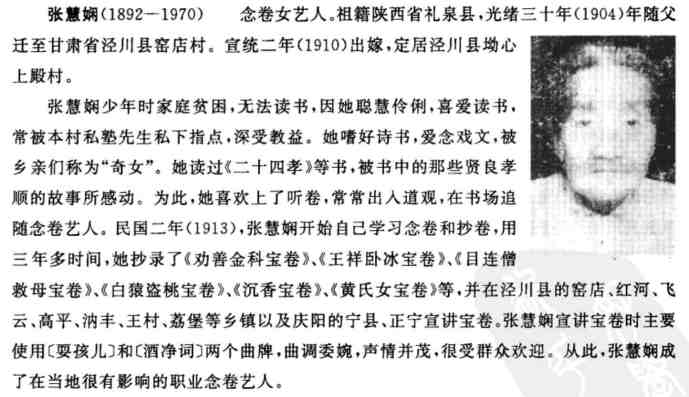
Zhang Huixian

Even the Biographies (pp.777–807) contain slim pickings. We can only imagine the tribulations of performers like Zhang Huixian (1892–1970, above), one of few female baojuan performers, based in a village in Jingchuan county (p.790).

But no-one was safe—neither poor itinerant peasant performers nor the officially-recognised representatives of the state troupes; neither obstinate traditionalists nor enthusiastic Party reformers. Wen Bingheng 文炳恒 (1913–58, p.801), organiser of folk performing groups in Heshui county, took part keenly in CCP cultural projects before and after the 1949 “Liberation”.  But during the Three Antis (sanfan) campaign of 1951, in blowing the whistle on the corruption of “a certain cadre” he was erroneously classed as a counter-revolutionary element; in 1958 he was sentenced to death.

A different kind of danger: Yang Wensheng 杨文生 (1933–58, pp.806–7), performer of xiangsheng skits with the PLA, was “martyred” in the south Gansu region during a campaign against “bandits”—presumably referring to Tibetan insurgents (among my posts on Tibet, see e.g. here) (we’re not told about Tibetans who perished under the Chinese onslaught).

Of course the biographies can only be selective, featuring just some of those whom the collectors and editors identified as leading bearers of tradition; the mass of lowly performers in the countryside remain largely unsung. Despite the vast loss of life around 1960, death dates at the time are not prominent in the biographies—though one feels almost as bad for those who survived the horrors of Maoism.

* * *

I still regard the Anthology as an essential basic source to open doors onto the depth of folk expressive culture in China. Besides the wealth of data on early history in the monographs, I suppose it’s stating the obvious to observe that for more rewarding material on the Maoist era we would have to seek out unofficial memoirs (see Ian Johnson’s excellent recent book Sparks), which are in short supply.

Alas, it’s already getting late to rectify the glaring omissions of official sources by doing fieldwork. One might decide to write a biography of one folk performer, or document one genre over a defined period; documenting the transformations of the scene since the 1980s’ reforms would make a valuable project in itself. We might even find a senior artist, perhaps born in the 1940s, to offer clear recollections of the late 1950s. Even as the Maoist era recedes, the famine and the whole political climate of the time will always be the elephant in the room.

* * *

* Related posts include China: commemorating traumaGuo Yuhua, and China: memory music, society; more broadly, cf. links under Society and soundscape.

Bosch

Bosch TV

Fast-forwarding from Raymond Chandler and The big sleep, I’ve already praised the crime novels of Michael Connelly, starring the dogged LA detective Harry Bosch. They’ve always seemed to invite representations on the Silver Screen, and now, thanks to Amazon Prime (don’t ask…), I’ve been bing-watching all seven seasons of the film adaptation Bosch (wiki, with episode guide), the first season airing in 2014.

Whether TV and film versions of novels satisfy is a matter of taste. But I found Bosch entirely gripping, with the characters most convincing—Bosch (Titus Welliver in an iconic role) and his nuanced relationships with his daughter Maddie, partner J. Edgar, sympathetic boss Lieutenant Grace Billets, and Chief of Police Irvin Irving, as well as the whole labyrinthine rigmarole of station procedurals.

With Connelly’s active involvement, the TV adaptations are creative variations on the books, combining various plots from different novels. Amply reflected in the soundtrack is Bosch’s passion for jazz, which led me to several great finds (e.g. Tomasz Stańko, Frank Morgan, Art Pepper). * Against the backdrop of a dystopian LA landscape, the jargon, and the dark humour of their exchanges, is fascinating.

My immersion in the novels was never affected by not having a firm visual image in mind; when I return to them it’ll be interesting to see how much this new input colours my reading.

Note also Michael Connelly’s website.

Other posts introduce crime fiction set in China, North Korea, and Germany, Weimar Berlin—Stasi—Russia—Hungary, Tibet, Ottoman Istanbul, and among the Navajo. You might even try Robert van Gulik‘s Judge Dee mysteries, set in Tang China… And for crime drama on screen, see under Saga and Sofia, and French slang.


* Just one more track, somewhat off-piste: the bleak finale of Season 6 plays out with Chris Botti’s 2012 cover of What a wonderful world, with Mark Knopfler. I always felt bad about not quite warming to Louis Armstrong’s 1967 original—maybe it’s just over-exposure. But this is great, both (in Bosch) as a sad commentary on the cemetery scene, and here, enhanced by the Georgian artwork:

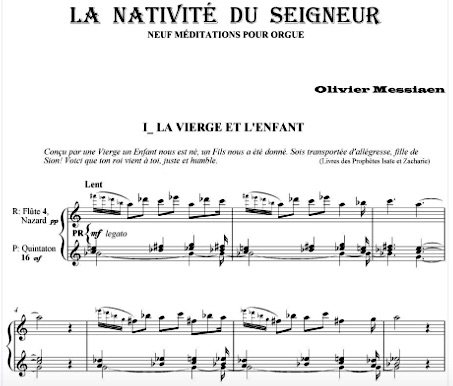
Messiaen Nativité live!!!

Nativité score

I’ve written about the nine meditations of Messiaen’s monumental organ work La nativité du Seigneur (1935), but only last week did I hear it live, played by Roger Sayer (replacing Samuel Ali) at St John’s Smith Square, * making the building resound (like the mouth-organs of the Li family Daoists in Heidelberg…). Organ recitals may not lend themselves to rapport (that of Vingt regards sur l’enfant Jésus on piano being more conducive), but after a break from Messiaen, it’s always astounding to enter his unique sound-world again.

To encourage you to bask in this amazing piece, here’s the glorious finale, Dieu parmi nous:

And don’t miss the remarkable film of Messiaen himself at the organ of Saint-Trinité (under French organ improvisation!). My Messiaen series begins with a post on the mind-blowing Turangalîla, where you can find links to more of his most cosmic masterpieces. Along with Bach, Mahler, and Ravel, Messiaen remains my deepest engagement with Western Art Music…


SJSS* St John’s Smith Square has happy memories for me, both of memorable concerts (Bach Passions…) and recording sessions (Mozart piano concertos…). In My Day the posh restaurant in the crypt made a comical contrast with the ludicrously cramped backstage facilities, never designed to accommodate an orchestra and choir—an issue I doubt if the recent revamp can have solved.

Dating from 1728, the church was gutted by fire after a bombing raid in 1941. It was eventually restored as a concert hall in 1969. Deconsecrated, it’s not quite a church, but has more atmosphere than a concert hall (see Buildings and music).


The big sleep

Big sleep

In my youth I watched The big sleep (Howard Hawks, 1946) More Times than I Had Hot Dinners—not so much in the cinema as on TV, where it was among a wealth of old movies shown in the dim and distant days before DVDs and streaming.

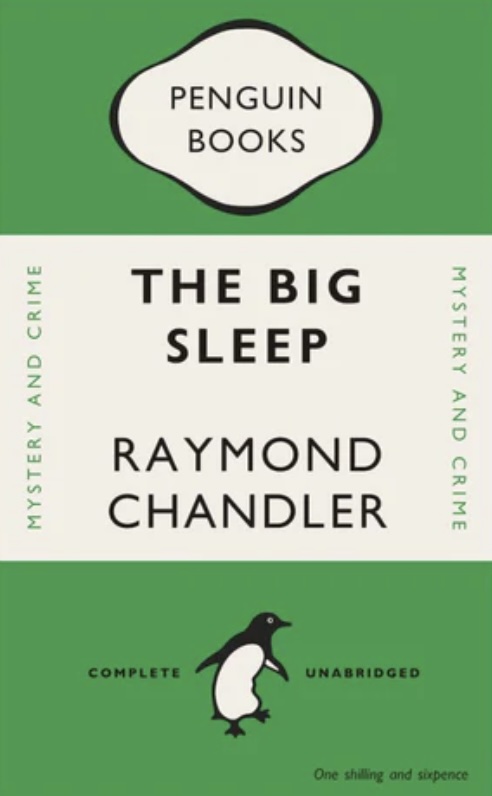
Chandler coverThe film does justice to Raymond Chandler’s brilliant prose style. Roger Ebert, always a perceptive reviewer, made some good points. He described it as

a black-and-white symphony that exactly reproduces Chandler’s ability, on the page, to find a tone of voice that keeps its distance, and yet is wry and humorous and cares.

 However often we watched the film (or read the book), the plot remained elusive. Ebert cites Sperber and Lax’s Bogart:

Hawks sent Chandler a telegram asking whether the Sternwood’s chauffeur, Owen Taylor, was murdered or a suicide. “Dammit I didn’t know either”, Chandler recalled.

But details yield to the atmosphere.

Bogart’s career was on the up with The Maltese Falcon (John Huston, 1941; trailer here)—the novels of Dashiell Hammett rivalling those of Chandler—and the iconic Casablanca (Michael Curtiz, 1942). On the Bogart–Bacall relationship, a recent book by William Mann is reviewed by David Thompson in the LRB:

The span of William Mann’s well-researched dual biography is some 115 years. But a case can be made that the “greatest love affair” promised by Mann amounted to no more than 216 minutes in the busy years of the mid-1940s. That’s the combined duration of To Have and Have Not (1944) and The Big Sleep (1946).

Their affair (she was 19, he 44), with its “thrilling ping-pong innuendo”, began while they were filming To have and have not, Bacall’s screen debut:

This led to Bogart divorcing his third wife and drinking still more heavily. Off screen he was regarded as surly and dull.

Moving on to The big sleep, here’s the opening (Chandler’s original here):

The horse-racing dialogue is “one of the most daring examples of double entendre in any movie up until that time”:

In the film, Marlowe is irresistible to a succession of women—something unfathomable to British men well into the 1970s. During wartime, women were admitted to professions from which they were otherwise barred:

Most astounding is the bookstore scene, with Dorothy Malone (and note Max Steiner’s portentous soundtrack):

And here’s the very ending:

OK, I can’t stave off old age for ever. Such films (whether 40s’ noir * from the States or modernist creations from France, Italy, or Japan) came as a kind of blessing to us on a cloistered, repressed island, and are indelibly etched into our collective memory; yet (more an observation than a lament) I doubt if they are quite so iconic to Young People Today. For other seminal influences on “my generation”, see under The conformist.

For a modern take on LA noir, see Bosch.

Irrespective of the Academy, popular culture is clearly, well, popular. Since the 60s, the Fusty Pundits of Yore have been disconcerted to find film, film music, and pop, becoming serious subjects for study; but they wield a profound influence on us all, even on those with more classical concerns… Cf. What is serious music?!, and Feminine endings: Madonna and McClary.


* I read that the term film noir was “coined by French critic Nino Frank in 1945 when a flood of dark Hollywood thrillers made during the war eventually arrived on Parisian screens after the four years of German occupation. Nearly 40 years passed before the term became current in the English-speaking world.”

Image gallery—enough already!

A bit of (non-)housekeeping…

In the sidebar, the images near the top (14 at present) show POSTS I LIKE, and I recommend them! Much further down the page is a rather vast gallery of thumbnails that you can click on as a useful window onto other early posts. It was already extensive when I updated them in 2020, but I haven’t continued to do so, and I’m unlikely to add more now—not least because it’d make the sidebar even more unwieldy. So from here on, I guess you’ll have to find other ways in, like the Search box, the monthly Archives below the images, and a series of roundups

While I’m here, I may mention a few collections:

Li images

And to complement my film and book on the Li family Daoists, as well as this roundup of related posts, this page in the top menu introduces a wealth of images.

My extensive series on Local ritual (listed here) is full of photos from our fieldwork through the 1990s and beyond, mostly in Hebei and Shanxi.

Local ritual

For “enough already”, click here.

Jazz at Ronnie’s!

Yet another post in my jazz series!

Ritenour

Since attending a couple of great gigs at the London Jazz Festival (here, here), we visited Ronnie Scott’s, still the most delightful London jazz venue of all (for its heyday, see under Ray Man: Cantonese music and jazz in Soho), to hear Lee Ritenour (b.1952—guitar) and Dave Grusin (b.1934!—keyboards), on tour with Melvin Davis on bass and Lee’s son Wesley on drums, accompanying his father sensitively since he was 13.

Delighting in constant invention, their rapport is wondrous—Ritenour and Grusin * have been making sweet music together for fifty years. Their set encompassed funk, Brazilian, and a rendition of Grusin’s song from Tootsie. Here they all are live in 2018:

And a big jazz hand for Melvin Davis’s solos—here’s one from 2013:

Jazz clubs—particularly somewhere like Ronnie’s—make such a conducive ambience for focused listening. À propos my Buildings and music, Western Art Music pays a heavy price for its move to large impersonal concert halls. Note also What is serious music?!.


* On Grusin’s wiki page, a passage like this always broadens the mind:

Grusin’s family originates from Gruzinsky princely line of the Bagrationi dynasty, the royal family that ruled the Kingdom of Georgia in the 9th-19th centuries. In Slavic languages, “Grusin” is an ethnonym for Georgians. Grusin’s father, who was a violinist, was born and raised in Riga, Latvia, then part of the Russian Empire, from where he emigrated to the United States in 1913.

Vermeer’s hat

Vermeer's hat cover

At last I’ve got round to reading

  • Timothy Brook, Vermeer’s hat: the seventeenth century and the dawn of the global world (2009).

The author, a specialist in Ming China, sets out to write a “global history of the intercultural transformations of 17th-century life”, using Vermeer’s paintings to “open doors” onto the social history of the day (cf. Music in the time of Vermeer). Such an approach has evidently become a tradition in art history—from my very limited experience, it somewhat recalls the style of Michael Baxandall and Michael Jacobs (see On visual culture), on the far broader canvas of the whole globe.

As Kathryn Hughes comments in her splendidly-titled review “Where did you get that hat?”,

while most of the figures in the paintings of the Dutch golden age look as if they have never strayed more than a day or two from Delft, the material world through which they move is stuffed with hats, pots, wine, slaves and carpets that have been gusted around the world by the twin demands of trade and war. […]

Behind the serene chinaware and glinting silver coinage that furnish Vermeer’s burnished interiors lay real-life narratives of roiling seas, summary justice, and years of involuntary exile. […]

What Brook wants us to understand is that these domains, the local and the transnational, were intimately connected centuries before anyone came up with the world wide web.

(More reviews e.g. here, here, here, here).

The 17th century was an age of “second contacts”:

First encounters were becoming sustained engagements; fortuitous exchanges were being systematised into regular trade; the language of gesture was being supplanted by pidgin dialects and genuine communication.

Things, and people, were moving around on a global scale.

Chapter 1, “View of Delft”, introduces the Dutch East India Company (VOC); the narrative soon expands from Delft and Amsterdam, with Spain and Portugal also trading in southeast Asia.

Chapter 2, “Vermeer’s hat”, sets forth from Officer and laughing girl, with a fine discourse on hats in the artist’s time, leading seamlessly to Samuel Champlain’s encounter with the Mohawks at the Great Lakes in 1609, the crucial role of the new technology of weaponry, and the beaver hat. Brook always makes connections:

I spend my summers on Christian Island, which is now an Ojibwa reserve, and I cannot walk the dappled path that angles past the place where the children are buried without thinking back to the starvation winter of 1649–50, marvelling at the vast web of history that ties this hidden spot to the vast networks of trade and conquest that came into being in the 17th century. The children are lost links in that history, forgotten victims of the desperate European desire to find a way to China and a way to pay for it, tiny actors in the drama that placed Vermeer’s hat on the officers’ head.

Vermeer 2

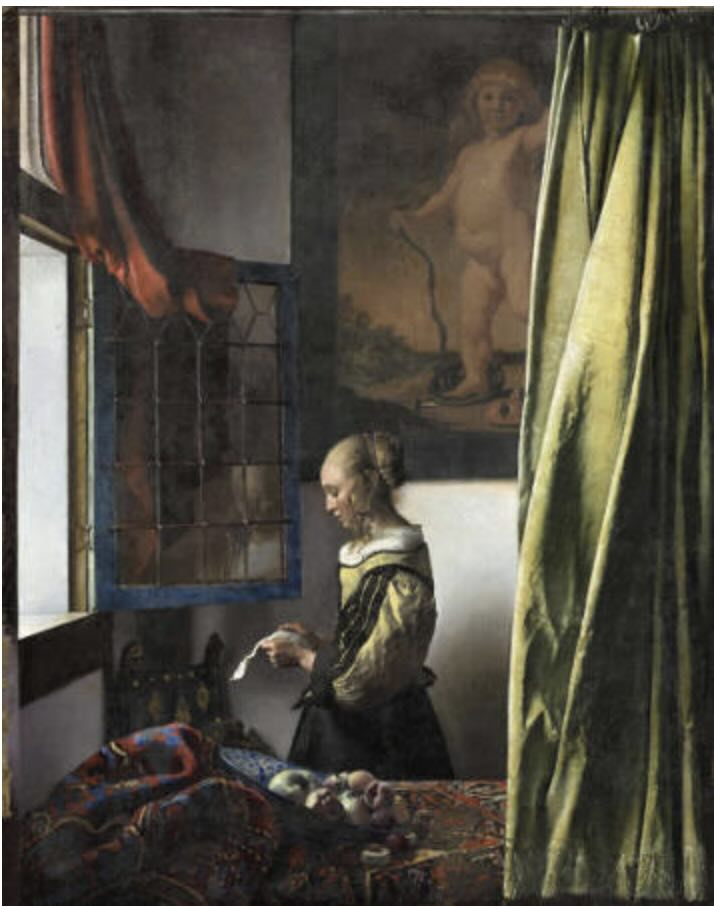
Indeed, “the lure of China’s wealth haunted the 17th-century world“—and the lure of china, theme of Chapter 3, “A dish of fruit”, based on Vermeer’s Young woman reading a letter at an open window. The British East India Company enters the fray, with their battles in St Helena. We learn of the spread of blue-and-white, in Persia, India, Mexico; exploits in the South China Sea, Macao, and Zhengzhou and Quanzhou in Fujian; and in Suzhou, Wen Zhenheng’s A treatise on superfluous things (cf. another inspired book by Craig Clunas). Brook addresses class and aesthetics. He contrasts European taste for foreign objects (“stirring no contempt or anxiety”) with Chinese mistrust of the wider world, “a source of threat, not of promise or wealth, and still less of delight or inspiration”.

In Chapter 4, “Geography lessons” based on Vermeer’s The geographer, Brook addresses the way that “the great minds of Vermeer’s generation were learning to see the world in fresh ways”. By way of the Delft draper, surveyor, and polymath Antonie van Leeuwenhoek we are taken again to the South China Sea—Manila and Macau, and coastal China, where besides Red Hairs (Dutch), Dwarf Pirates (Japanese), and Macanese Foreigners, African slaves (servants of the Portuguese) as well as Muslim merchants, were also seen. Jesuits such as Paolo Xu and Matteo Ricci play a significant role.

Chapter 5, “School for smoking”, is another fascinating exploration, covering the diffusion of the new habit around the world; “every culture learns to smoke in a slightly different way”. From images in Dutch painting and porcelain, Brook moves again to China, exploring the three routes by which tobacco entered the country. Writing in 1643, Yang Shicong noted the new taste in Beijing, whither it had spread rapidly from the southeast coast. In 1639 the Chongzhen emperor decreed that anyone caught selling tobacco in the capital would be decapitated. The colloquial term “eat smoke” (chiyan), still heard in rural China, was already in use. In the New World (documented from 1505), tobacco was used to “move between the natural and supernatural worlds and to communicate with the spirits”—a function which it still serves in Chinese ritual today. It was thought to have both spiritual and medicinal properties. Moreover,

In daily life, tobacco was an important medium of sociability that, like healing, was something that benefitted from the spirits’ kind support. Managing social relations on a personal or communal level required thoughtfulness and care, and could best be accomplished when the spirits were on one’s side. Burning or smoking tobacco was a way of propitiating the spirits if they were in an ugly mood—as they so often were—and inducing them to bless your enterprise.Sharing a smoke at a tabagie was done in the presence of the spirits, and it helped the smokers find consensus when differences arose.

In China this is another important aspect of social and ritual life that tends to get neglected in our focus on ritual texts. In 1924 Berthold Laufer praised smoking in an egregious misapprehension with grains of insight:

Of all the gifts of nature, tobacco has been the most potent social factor, the most efficient peacemaker and benefactor to mankind. It has made the whole world akin and united it into a common bond. Of all luxuries it is the most democratic and the most universal; it has contributed a large share towards democratising the world.

Brook offers perceptive asides on witchcraft in Europe, class, gender, a tobacco ballet in 1650 Turin—and slavery. And he notes how the habit of smoking morphed into opium dependency in the 19th century—another tragic story of the ravages of trade.

Chapter 6 departs from Vermeer’s Woman holding a balance to discuss the role of silver, crucial to the world economy of the day, travelling from Potosi in the Andes to Europe and Asia—with erudite discussions of coinage and morality.

Card players

Chapter 7, “Journeys”, interrogates a painting by Hendrik van Der Burch showing an African servant boy (cf. Jessie Burton’s novel The miniaturist, evoking the changing world of 17th century Amsterdam). Brook goes on to describe five journeys to distant shores: Natal, Java, a Korean island, Fujian, and Madagascar. He ponders pictorial representations of Biblical scenes (cf. Balthasar).

In the final Chapter 8, “Endings: no man is an island”, Brook ties the themes together, with discussions of translators, the role of the state, and the concept of a common humanity.

If we can see that the history of any one place links us to all places, and ultimately to the history of the whole world, then there is no part of the past—no holocaust and no achievement—that is not our collective heritage.

Yet as Brook shows throughout, all this came at vast human cost: warfare, shipwrecks, ruined lives. He appends a useful list of Recommended reading and sources.

Vermeer’s hat is a virtuosic, stimulating piece of writing.

Guest post: Alceste

Nicolas Robertson

For a general introduction to the series, click here;
for Nick’s sad demise, here.

Prelude—SJ
Having posted nine of Nick’s extraordinary anagram tales, we thought we’d give the reader [still singular, eh?—Ed.] a bit of a break, but now that he has, alas, become “late and lamented”, I find a couple more of his stories that I think I can lick into shape. They will have to stand as a posthumous tribute to his brilliant mind. Here’s the first, with Nick’s own introduction:

ALCESTE
Opera by Gluck. Staged performance in the Théâtre du Châtelet, Paris, 1999, staging by Robert Wilson, with soloists, Monteverdi Choir (offstage, in the pit) and English Baroque Soloists, directed by John Eliot Gardiner. CD recording, and TV and DVD film directed by Brian Large.

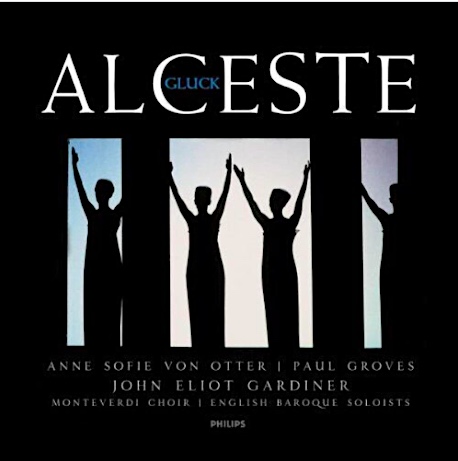
Alceste CD cover

This is the last of the “anagram stories” I compiled before the watershed year of Bach’s 250th commemoration year, 2000, and arose from a substantial residence in Paris (we also performed and recorded Orphée et Eurydice, the choir this time on stage); which accounts for the strongly French admixture in the anagrams.

I always hope that these exercises can speak for themselves, as it were. I would like to mention though that the “tsetse éclat escale” image of a clambering insect on a barred jersey was inspired by one of the most beautiful passages of prose I ever read, in Nabokov’s Bend Sinister; and that Nathan Astle, in 2002 (thus after I wrote the anagrams and the story), surprised the world, and perhaps himself, by scoring the fastest Test match double century in history, against England in Christchurch. Looking him up now, I see this is not the only prescience among the anagrams: another of Astle’s records is for the most ducks (5) in World Cup matches—it’s not said if any of them were wild. (Nabokov preferred tennis; Ibsen’s preference is unknown, to me anyway.)

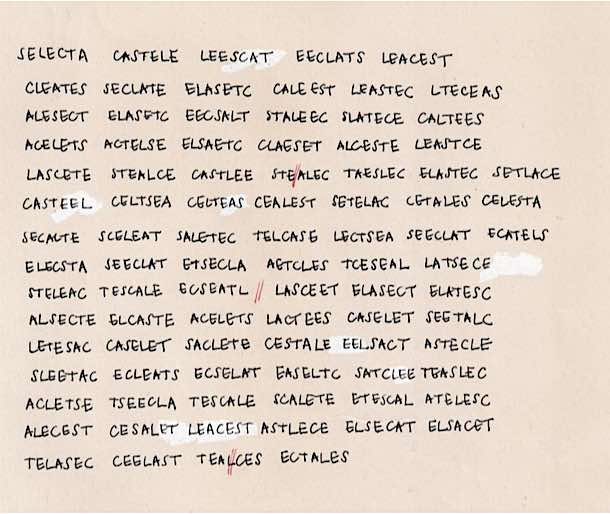
“Alceste” provided the least number of letters I’d elected to work with to date, which posed different challenges, and led me to think it could be worth including a list of the resulting anagrams, in exactly the order used. There are 91 (92 if you include the name “Alceste” itself). I must add, again, that I didn’t use, have never used, any artificial aid, such as a computer programme, in deducing the anagrams, that would be to undermine the whole idea, which is meant to be the exemplification of chance (perhaps not entirely chance) within a random (well, not quite random) set of coordinates.

Alceste anagrams

SELECT A CAST

“Lee, cas télé: Lee scat, EEC lats, le acest.”
Clea? “T’es sec late, ’élas”, etc.
“Cale? – est ‘le Astec’, L*tèce as.”
“Ale sect, ’élas” (etc.).
“EEC salt!”
“Stale EC” – slate CE.
“Cal? Tees ace.”
“Let’s act. Else Elsa, et C.. – ”
“–Claes?”
“–et‘alc’Este –”
“Least! C’è l’ascète!”
“ – steal ce castle.”

Este??
___________________________________________________________

ALEC:                    Tae slec. Elastec. Set lace, cast eel. Celt sea, celte as ce à l’est,
Sète lac, cet Alès.

CELESTA (sec):    ’Alte ! Scélé’at! Sâle ’tec! Tel cas elects ease –

     ÉCLAT

’ÉCATE [LSE] :     L’ecstase – ÉCLAT – et secla [aet. CL] est ce seal,
La’ Tse, ce stèle act.

[Escale; ecseat L.]

_____________________________________________________________________________________________________

Las, ce été, LA sect elates Cal secte, ‘el caste’, acelets lactées (case let see talc, l’été sac caselet, saclet e cesta). Le eel sac taste clé, sleet, ace cleats. Ecsel at easel, TC, sat Clee (teasle ç’a clé: tsetse éclat escale – scale ‘te’ – et escalate le scale → C).

“Est-ce Sal? et Léa? C’est Astle?”
“C’è else cat, Elsa, cette – ”
“Las! Ecce–’elastteal!”

_____________________________________________________________________________________________________

Ces EC tales.

* * *

How does one set about choosing the line-up for an international opera production? The minutes of a recent committee meeting have been passed to me, and confirm that the criteria are more mixed than might, idealistically, have been expected. Here’s an excerpt:

“I’d say we go for Lee, in case the TV recording goes ahead. He can vocalise very convincingly without the words, and has terrific torso muscles, as good as any in Europe. He’s got to be the number one choice.”
“Okay. Now, do you think I – can take on Alceste?”
“Oh, Clea, I wish I could say yes – but you’re always a fraction behind the beat.” (An example of the speciously ‘objective’ excuse.)
“I think we might try bringing in an old rock star from Velvet Underground as Charon, que tel ? He’s a bit of a Central American god here, in fact a star in Paris – ”
“But he drinks beer as if there were no tomorrow” – and other stock denigrations are brought out (see above).
“No, but he’s really the best in Europe!”
“Europe’s old hat.” And so the Church of England is written off.
“What about Cal? He sweeps the board on Tyneside.”
“It’s time for decisions. Otherwise Elsa, and the sculptor whose name I can’t pronounce, Oldenburg, thank you, he and his ‘soft harps’, as well as that Ferrara girl whose yard-arm is always well below the sun – ”
“ – Hang on! Beatrice? But she’s the most spiritual being I know! – ”
“ – will come and storm our citadel, our châtelet.”

What on earth did he mean, talking like that about Beatrice?

Beatrice
Portrait of a woman, inscribed Beatrice d’Este, c1500–10,North Italian artist (Uffizi). Source.

___________________________________________________________________

We were filming on the Breton coast. Alec had done his research, of course, so knew that this bitter moorland, with its marshy sedges which gave the technical team such trouble in achieving the mobility they needed, was supposed to hide the “Youdic”, one of the entrances to Hell. Or perhaps he only thought of this in terms of metaphor. At any rate, even during the takes he seemed to half wish we were somewhere else. That last afternoon he complained abruptly, in his raw Glasgow accent, about our work—too loose, pulling apart then coming together again too sharply. “This is being filmed through a muslin filigree, remember?Is it in place? Cal–throw the bait into the sea, so that the shadow falls on the menhir behind you. Think of Melusine, if you like, calling to you from the waves—but I don’t want a Celtic twilight, people are the same here or anywhere, this scene could be set in the blue basins of a Languedoc fishing-port, or under the ashlar of the Pont du Gard – ”

Celesta’s voice cut across the sea-washed stillness, dry and harsh: “Stop! You retch! You’re like some sort of sordid private eye! The way you lump all these together just shows how lazily you – ”

An incandescent flash split open the earth and for a moment fixed the grey sky as if in negative. The calvary poised at the intersection of the three paths above le Yeun Elez (“le marais des roseaux”, the marsh of reeds) flung its arms backwards as the setting sun caught the bones of its carved face skull-like in a spiralling cartwheel, and from where it had stood arose a creature which sucked in the elements spinning around it, and from the vortex (which reminded me of the impasse I faced in my finals exams at University) seared us with a voice unspeakably beyond our imagining,

<The bliss you seek > – another shattering burst of lightning – <is made up of centuries> (I thought stupidly, this Hecate’s face looks about 150 centuries old) <and each one bears my mark. It’s written in the Tao (in James Thurber’s version) [1] No, o ! the words are graven in stone! >

[1] I understand the reference to be to “The Wonderful O”, where the letter is banned owing to the sad fate of the principal’s mother, who became stuck in a porthole : ‘They couldn’t pull her in, so they had to push her out’. The prohibition had horrible effects, not least for Ophelia Oliver, everyone’s sweetheart hitherto. [Add to Perec’s Oulipian category of “Plagiary by anticipation”.]

The rocks at our feet suddenly tipped up, and as I sprawled amongst the armeria and sea fennel and samphire the earth gaped open to reveal a dizzying stairwell, down which Hecate plunged, disappearing south-east, in the direction of Carnac. Alec was nowhere to be seen.

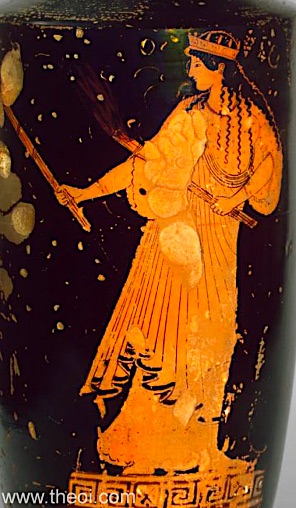
Hecate
Hecate, Attic red-figure lekythos, 5th century BCE (Hermitage Museum). Source.

____________________________________________________________________

We were tired, that last summer in California, of trying to feel different. The weight of what seemed to us to be history, or rather the end of it, the inevitable progression from the luxury of striking individual poses to the acceptance of group mores, vitiated our tentative forays into anything that could pass for independent thought. We felt obscurely guilty about this, and thus some of us, anyway, were thrilled when a new Los Angeles group seemed to offer ready-made the transcendence our own mental ambitions shied at. Unashamedly elitist (though not of their own volition: they had been “chosen”), these Hispano-Franco-Americans saw themselves, and thus us, as every one a single star in the Milky Way, powdered with a celestial shimmer we should each carry with us, in a little French pouch and a Portuguese wicker basket.

So far, so exquisite, but the angel was in the details. For, following the divinatory rituals of a Greek tribe in iron-age Thessaly, whose priest-queen Alceste, it seems (the legend has come down to us in a jumbled form), had for the first time defied the ancient rigid formalities and refused the seven-yearly sacrifice of the young king, Admète, the clan had located the essence of rejuvenescence not in the shed blood of a royal representative, but in the organs of the lamprey, a cyclostome much appreciated by gourmets and whose formidable richness in nutritional terms can see one safely through the coldest of winters as if clad in 7-league boots. (Part of their lore also included the folk-memory of how it was that Apollo, protector of Alcestis, came from Thessaly to dispossess the earth-mother/serpent cult at Delphi, replacing her with his own oracle—in short, the worship of sky-gods which accompanied the Achaean invaders from Central Europe into Greece, ousting the old chthonic deities: [2] hence the specific emphasis on summer, “l’été sac”, and celestial phenomena, “acelets lactées”. And underlying this, it struck us, the first tentative emergence of the individual, as if from the chrysalis of uniformity, realising the possibility of asserting individual choice in the face of tribal orthodoxy …)

[2] See Robert Graves, The Greek Myths.

But the members of our sect were clever enough to leaven their powerful teleology with art. The boss, known as Top Cat, was a brilliant painter and had even done a portrait of Paul Klee (TC’s spelling was all over the place, it only endeared him to us all the more, as if proof of his sincerity) in Tunisia. He used to point proudly to a burr on his Breton mariner’s top, which he said had been stuck there ever since his visit to North Africa—and this was the key to his and our undoing, for one weird day we saw the “burr” set off shakily up the staves of his striped shirt, at the same time shouldering away its tufty carapace, until with an almost audible crack the chrysalis shattered and a gleaming mature tsetse fly sidled with its smugly crossed wings into TC’s world, pricked his throat and took him down, leaving us lost, into the long sleeping sickness. I will never forget his cry, indignant at first – “Is it a bee?” – then higher pitched, “Oh, see –”. And I can never again think of a rising semitone as optimistic.

“Is that you, Sally? and Léa? is that Nathan? We need a good number 7,” murmured TC, softly, from a deep, dark maze—somehow, in extremis, reaching out to the memory of a hero from his native New Zealand cricket team.
“No, but instead we’ve got the cat who walked by herself, the lioness Elsa, born free like all the sons of Adam. There’s nothing for you to fear –”
“Alas, but look: he’s become at the end like the wild duck!” – pure symbol of freedom, brought low by stupid material ‘reality’ …

_____________________________________________________________________
[One in a series of recastings of European traditional stories: No 91]

**************************************************************************************************

Paris – London, September–October 1999
slightly revised 2015 and 2021
Nicolas Robertson
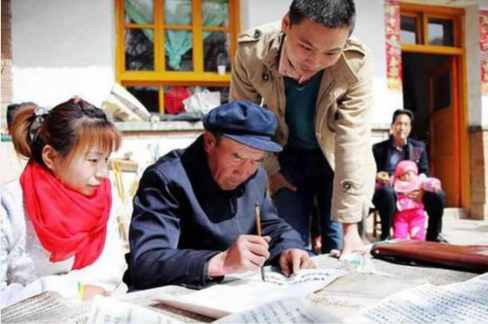
Ankou
Ankou, messenger of death, Notre-Dame de Bulat, Côtes d’Armor, Brittany.