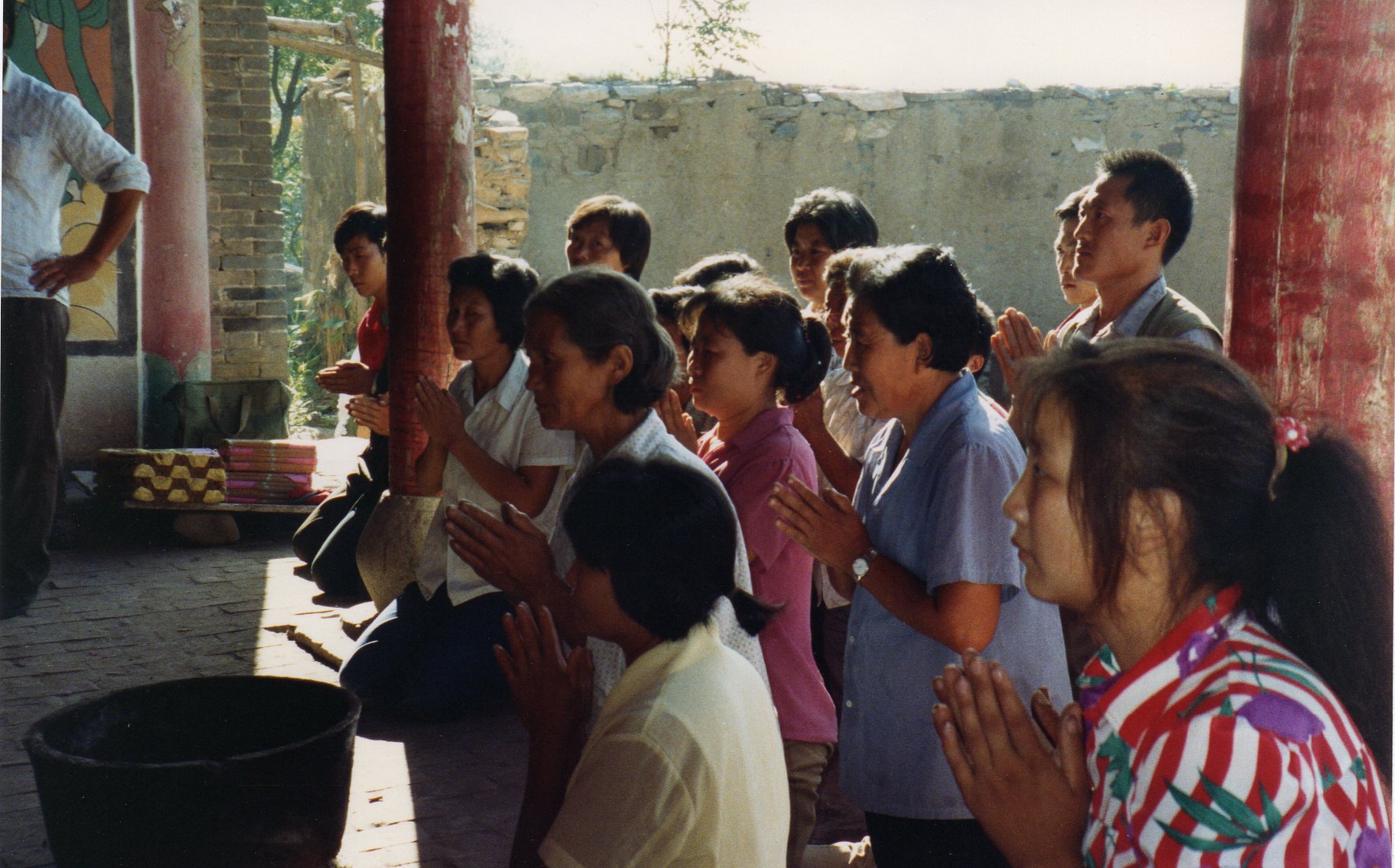
Fieldworkers, Chinese and foreign

In my post on the brief of ethnography in response to a jaded urban Chinese worker, I mentioned the tribulations under Maoism of many urbanites on being sent down to the countryside.

The memories of my splendid Chinese fieldworker friends are just as painful. Among various Beijing colleagues who have accompanied me over the years, one recalls his family starving as a young boy in Shandong around 1960; another, witnessing colleagues being crushed to death in dangerous mines in Gansu in the Cultural Revolution; yet another, being exiled to a rural “May 7th Cadre School”.

For our local assistants, the countryside may have even more direct associations: I sometimes found myself taking them back to the very villages where they had taken part in “tempering through manual labour” during the Four Cleanups campaigns of the early 1960s.

From bitter personal experience, they have no reason to idealise rural life. Thankfully, the bright new generation of Chinese fieldworkers have been spared such sufferings—though this also makes it harder for them to empathise with the life stories of our peasant masters.

So as our fieldwork in Hebei and Shanxi took off in the 1990s, my friends must have felt as if they were being dragged back into “going down to the countryside to join in the brigade” (xiaxiang chadui 下乡插队). But it wasn’t me who was dragging them—I was following them—and they too were following in the footsteps of intrepid previous generations of Chinese fieldworkers.

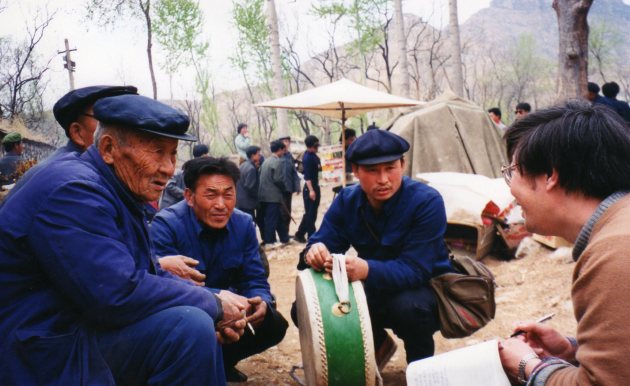
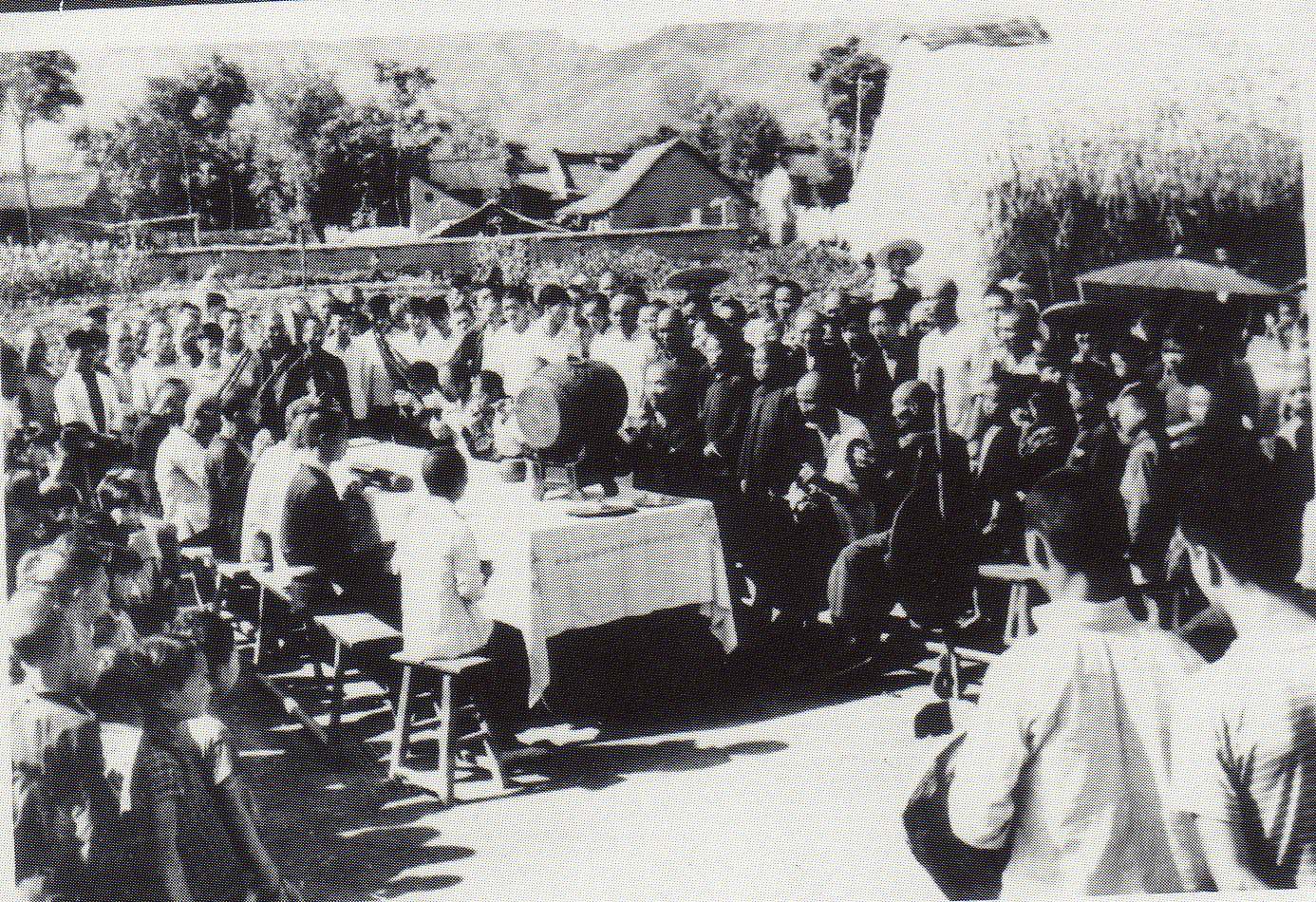
XYB Huaiyin 1992

Xue Yibing (centre) with villagers in Huaiyin, Shanxi, summer 1992.

We were all aware of the phrase attributed to Confucius, no less:

“When the rites are lost, seek throughout the countryside”
   li shi qiu zhuye 禮失求諸野

Indeed, the thoughtful and prolific Zhang Zhentao 张振涛 called an early collection of his articles “Records of seeking music in the countryside” (Zhuye qiuyue lu 诸野求乐录).

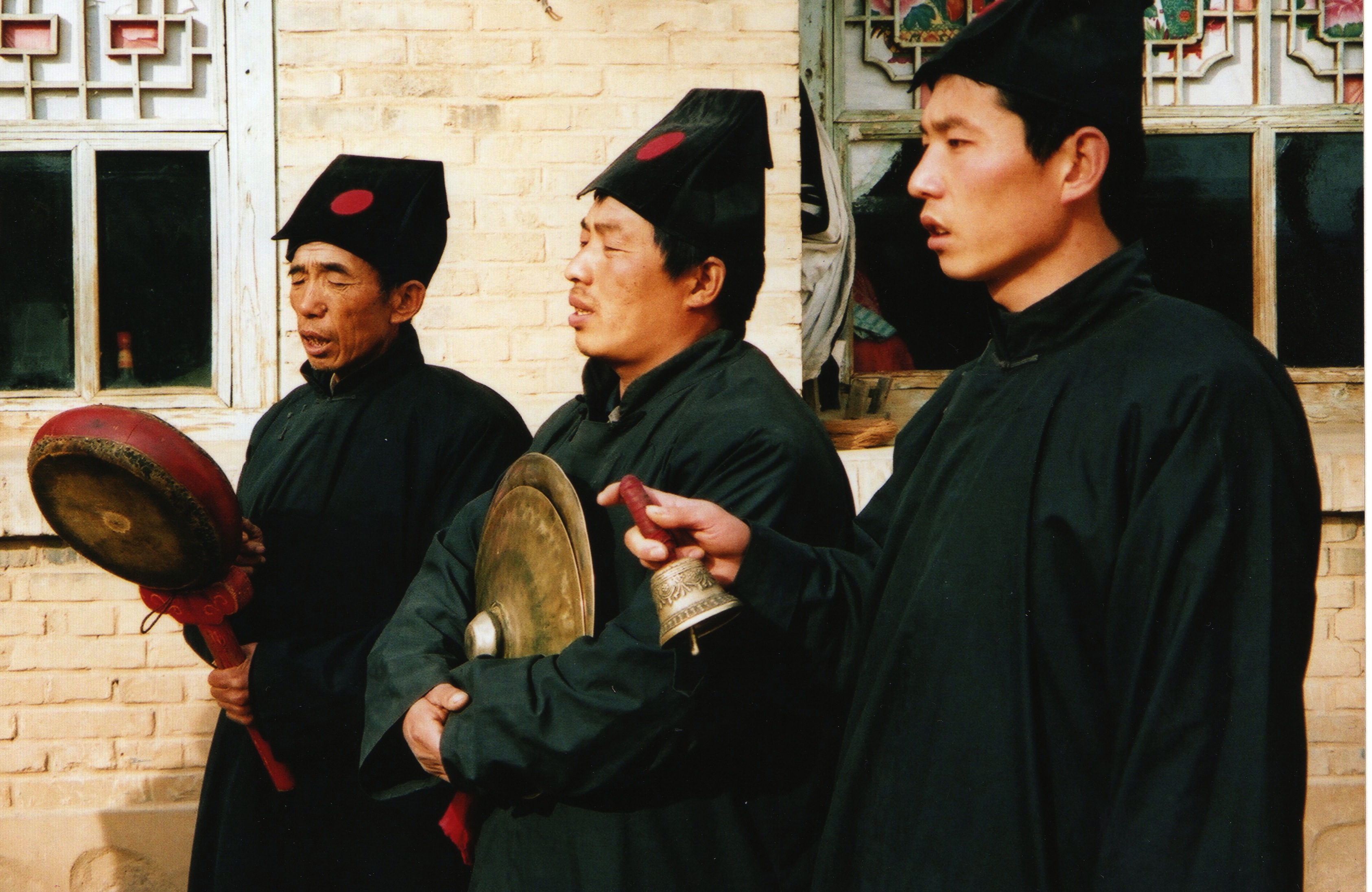
ZZT Houshan 1995

Zhang Zhentao with members of the Xiaoniu village ritual association, Houshan temple fair, Yixian 1995.

Still, occasional forays were all very well, but I began to feel the need for longer stays. For me—safely armed with my passport and return air-ticket—sleeping on the kang brick-bed of my wonderful host Cai An in Gaoluo, fetching water from the well, slurping noodles with doufu and cabbage from chipped bowls at funerals, and even visiting the latrine by the pigsty, still had a certain exotic frisson.

While my Chinese friends shared my excitement at discovering such a wealth of material on ritual life in society, their other consolation was that this new rural exile was (semi-?!) voluntary—and that there was a clear time-limit on it. In those days their living conditions in the dilapidated Music Research Institute in Beijing were far less comfortable than they were later to become, with the huge improvement in living standards and their own growing reputation. But apart from the demands on their time in Beijing, extended stays might be somewhat beyond the call of duty. Still, they entered the fray with spirit, and the fruits of their labours are outstanding.

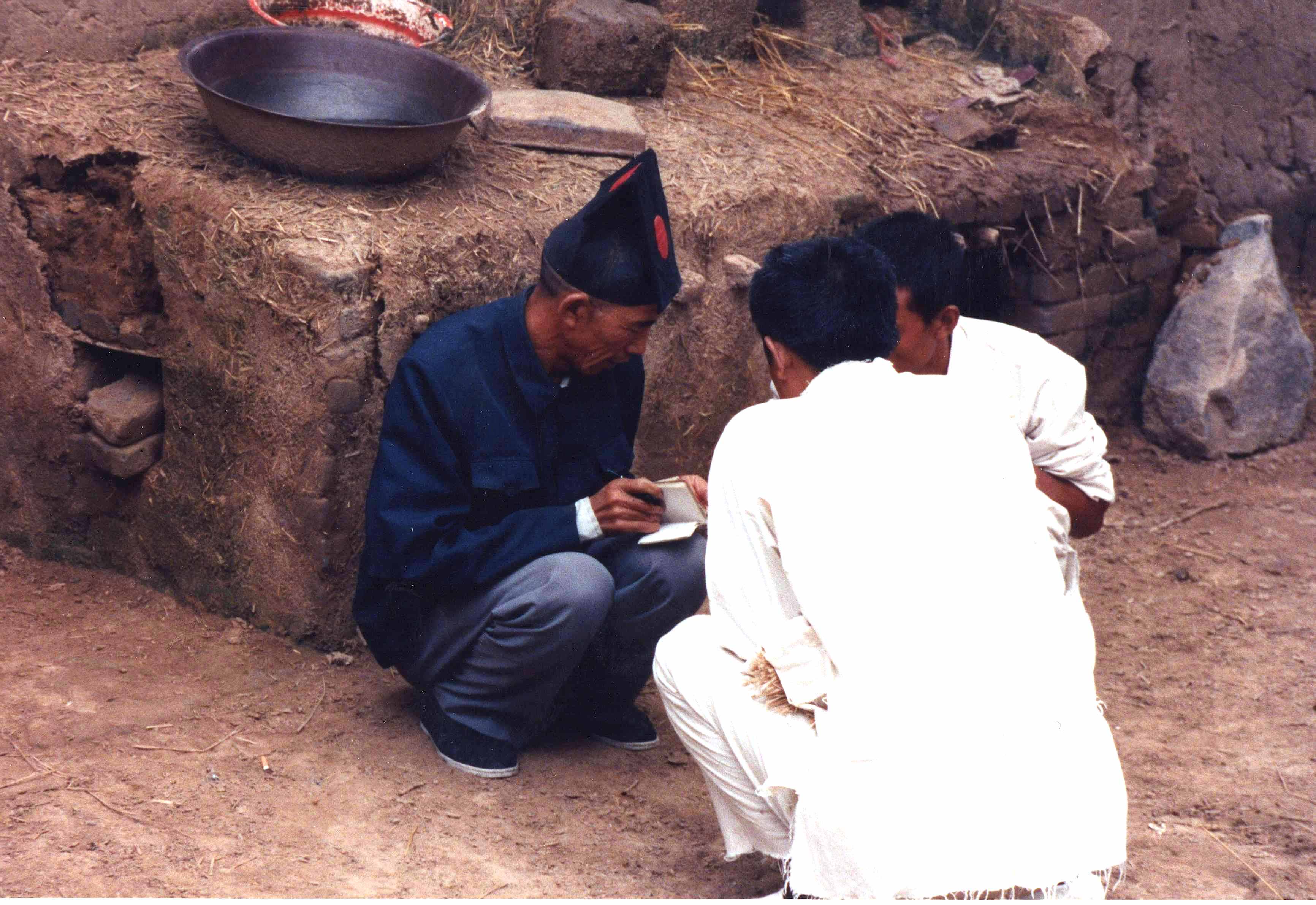
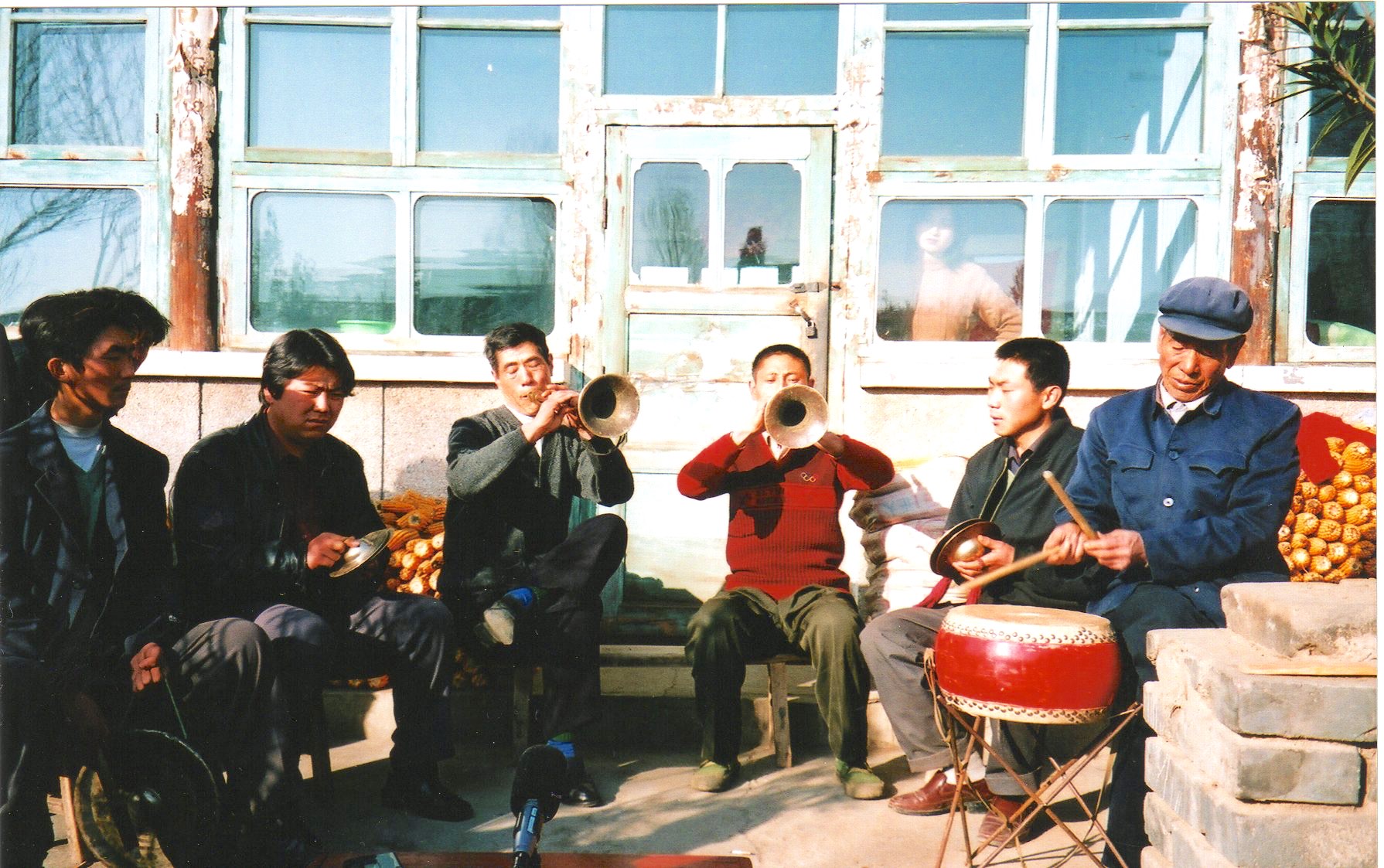
Zhuanlou 1992 caifang

Learning about shawm fingerings with the Hua family shawm band during a break at Zhuanlou village funeral, 1992. Holding shawms: Xue Yibing (left) and Jing Weigang (right).

See also my Plucking the winds, pp.234–5.

By the way, Zhang Zhentao keeps writing about how much I inspired him, but it was entirely mutual. Along with my other trusty fieldwork companion Xue Yibing, we forged our approaches in the 1990s on the anvil of the major project on Hebei ritual associations (qv). And both Zhang and I ended up writing three books on “northern” musical cultures—on Hebei:

  • Yinyuehui: Jizhong xiangcun lisuzhongde guchuiyueshe 音乐会: 冀中乡村礼俗中的鼓吹乐社 (Ji’nan: Shandong wenyi chubanshe, 2002),

Shaanbei:

  • Shengman shanmen: Shaanbei minzu yinyuezhi ‪声漫山门:陕北民族音乐志 (Beijing: Wenhua yishu cbs, 2014),

and Jinbei:

  • Chuipo pingjing: Jinbei guyuede chuantong yu bianqian 吹破平靜: 晋北鼓乐的传统与变迁 (Beijing: Wenhua yishu chubanshe, 2010).

He has also written a plethora of fine articles.

For more on our respective blind spots, see this post on Morris dancing.

On visual culture

As with my remarks on punk and so on,

You think I know Fuck Nothing—but I know FUCK ALL!

Or to adapt it to the topic in hand,

You think I know Shag Nothing, but I know CHAGALL!

More genteel would be the old “I Don’t Know Much About Art, But I Know What I Like!” (groan from Myles). So, following Myles, I write this in the spirit of The Plain People of Ireland. As often, I’m seeking clues relevant to my own areas of study, making connections that can easily get buried beneath our individual specialities. Perhaps this post might be entitled Renaissance art for Dummies in the Field of Daoist Ritual Studies—not one of their bestsellers, I suspect.

Sassetta: St Francis giving his cloak to a poor soldier.

I first came across

  • Michael Baxandall, Painting and experience in fifteenth-century Italy: a primer in the social history of pictorial style (1st edition 1972)

while browsing Rod Conway Morris’s library in Venice, along with Horatio E. Brown’s splendidly-titled Some Venetian knockers.

It’s my kind of book, full of the practical detail of materials, technical skill, and patronage, as well as exploring changing perceptions. Quite short, and eminently readable, it gains much from having grown out of a series of lectures that he gave. It addresses issues that I hardly find in discussions of Chinese ritual and music (for any period), so I’d like to explore it at a certain length.

Baxandall opens by encapsulating, in plain and elegant language,** issues that, um, scholars of Daoist ritual (of all periods) should absorb:

A 15th-century painting is the deposit of a social relationship.
On one side there was the painter who made the picture, or at least supervised its making. On the other side there was somebody else who asked him to make it, provided funds for him to make it, reckoned on using it in some way or other. Both parties worked within institutions and conventions—commercial, religious, perceptual, in the widest sense social—that were different from ours and influenced the forms of what they together made.

He observes that

The picture trade was a very different thing from that in our own late romantic condition, in which painters paint what they think best and then look round for a buyer.

Exploring the mismatch between our concepts of “public” and “private”, he notes that

Private men’s commissions often had very public roles, often in public places. A more relevant distinction is between commissions controlled by large corporate institutions like the offices of cathedral works and commissions from individual men or small groups of people: collective or communal undertaking on the one hand, personal initiatives on the other. The painter was typically, though not invariably, employed by an individual or small group. […] In this he differed from the sculptor, who often worked for large commercial enterprises. (p.5)

He meshes all this with detailed technical discussion, like the use of ultramarine:

The exotic and dangerous character of ultramarine was a means of accent that we, for whom dark blue is probably no more striking than scarlet or vermilion, are likely to miss. (p.11)

Thus in the Sassetta painting above, the gown St Francis gives away is an ultramarine gown.

The contracts point to a sophistication about blues, a capacity to discriminate between one and another, with which our own culture does not equip us.

Baxandall notes change over the course of the Quattrocento:

While precious pigments become less prominent, a demand for pictorial skill becomes more so. […] It seems that clients were becoming less anxious to flaunt sheer opulence of material.

But he goes on:

It would be futile to account for this sort of development simply within the history of art. The diminishing role of gold in paintings is part of a general movement in western Europe at this time towards a kind of selective inhibition about display, and this show itself in many other kinds of behaviour too. It was just as conspicuous in the client’s clothes, for instance, which were abandoning gilt fabrics and gaudy hues for the restrained black of Burgundy. This was a fashion with elusive moral overtones.
[…]
The general shift away from gilt splendour must have had very complex and discrete sources indeed—a frightening social mobility with its problem of dissociating itself from the flashy new rich; the acute physical shortage of gold in the fifteenth century; a classical distaste for sensuous licence now seeping out from neo-Ciceronian humanism, reinforcing the more accessible sorts of Christian asceticism; in the case of dress, obscure technical reasons for the best quality of Dutch cloth being black anyway; above all, perhaps, the sheer rhythm of fashionable reaction. (pp.14–15)

To show how skill was becoming the natural alternative to precious pigment, and might now be understood as a conspicuous index of consumption, he returns to “the money of painting”—the costing of painting-materials, and frame, as against labour and skill.

You will no longer be surprised to learn that the Quattrocento division of labour between master and disciples (pp.19–23) reminds me of Daoist ritual specialists.

Baxandall goes on to note the differences in patrons’ demands for panel paintings and frescoes. He attempts to address the issue (even for the time of creation) of public response to painting:

The difficulty is that it is at any time eccentric to set down on paper a verbal response to the complex non-verbal stimulations paintings are designed to provide: the very fact of doing so must make a man untypical. (pp.24–5)

Aesthetic terms expressed in words are contingent, varying from age to age, and anyway elusive. Even with the vocabulary of such accounts, discussing that of a Milanese agent, Baxandall notes:

the problem of virile and sweet and air having different nuances for him than for us, but there is also the difficulty that he saw the pictures differently from us.

He goes on to explore different kinds of viewers’ own exercise of skill in appreciating a painting, with their different backgrounds:

… the equipment that the fifteenth-century painter’s public brought to complex visual stimulations like pictures. One is talking not about all fifteenth-century people, but about those whose response to works of art was important to the artist—the patronizing classes, one might say. […] The peasants and the urban poor play a very small part in the Renaissance culture that most interests us now, which may be deplorable but is a fact that must be accepted. […] So a certain profession, for instance, leads a man [sic—SJ] to discriminate particularly effectively in identifiable areas. (p.39)

Whatever [the painter’s] own specialized professional skills, he is himself a member of the society he works for and shares its visual experience and habit. (p.40)

And given that “most 15th-century pictures are religious pictures”, he asks in detail,

What is the religious function of religious pictures?

His answer, in brief, is that they were used “as respectively lucid, vivid and readily accessible stimuli to meditation on the Bible and the lives of Saints.” But he goes on to enquire:

What sort of painting would the religious public for pictures have found lucid, vividly memorable, and emotionally moving?
[…]
The fifteenth-century experience of a painting was not the painting we see now so much as a marriage between the painting and the beholder’s previous visualizing activity on the same matter. (pp.40–45)

Again he makes the crucial point:

15th-century pictorial development happened within fifteenth-century classes of emotional experience.

Alongside colour, he discusses the beholders’ appreciation of gesture and groupings, adducing dance and sacred drama.

It is doubtful if we have the right predispositions to see such refined innuendo at all spontaneously. (p.76)

And apart from their basic level of piety (largely lost to us today), many of the “patronizing classes” would have assessed the work partly through their knowledge of geometry and the harmonic series.

In Part III Baxandall attempts to sketch the “cognitive style” of the time, with the reservation that

A society’s visual practices are, in the nature of things, not all or even mostly represented in verbal records. (p.109)

Finally he reverses his main argument—that “the forms and styles of painting respond to social circumstances” (and so “noting bits of social convention that may sharpen our perception of the pictures”)—by suggesting that “the forms and styles of painting may sharpen our perception of the society” (p.151).

An old painting is the record of visual activity. One has to learn to read it, just as one has to learn to read a text from a different culture, even when one knows, in a limited sense, the language; both language and pictorial representations are conventional activities. […]

In sum,

Social history and art history are continuous, each offering necessary insights into the other.

Such reflections seem more sophisticated than the “autonomous”, timeless approaches still common in both WAM and Daoist ritual. To be fair, we are quite busy trying to document ritual sequences, hereditary titles, and so on—but the Renaissance scholars have just as much nitty-gritty to deal with too.

* * *
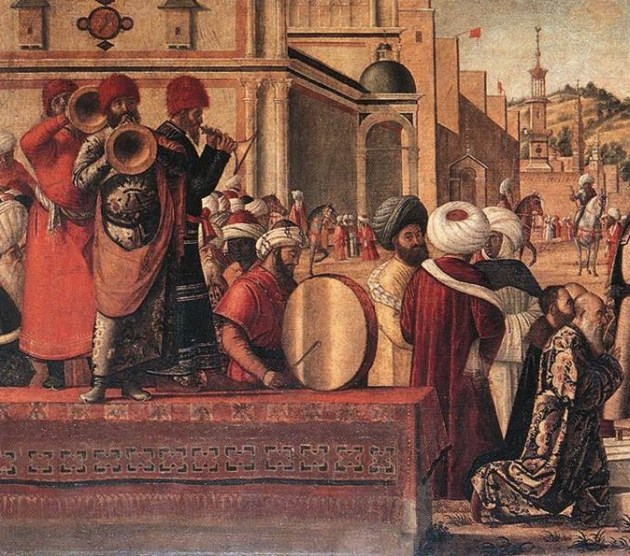
Carpaccio

Carpaccio: Baptism of the Selenites, c1504–7 (detail). San Giorgio degli Schiavoni, Venice.

(The painting features a shawm band that I’d love to hear! For Venice’s musical contacts with the East, see e.g. here).

Baxandall ends with a caveat:

One will not approach the paintings on the philistine level of the illustrated social history.

I don’t think he quite had in mind

  • Alexander Lee, The ugly renaissance: sex, greed, violence and depravity in an age of beauty (2014),

a less technical, more sociological book with a firm political agenda that some may find more appealing than others (cf. this review of Catherine Fletcher, The beauty and the terror: an alternative history of the Italian Renaissance (2020).

Poking around beneath the glamorous surface image of the Renaissance, seemingly “an age of beauty and brilliance populated by men and women of angelic perfection”, he observes:

If the Renaissance is to be understood, it is necessary to acknowledge not just the awe-inspiring idealism of its cultural artefacts but also the realities which its artists endeavoured to conceal or reconfigure.

Lee explores the brutal social universe in which artists were immersed. Like Baxandall, he explores the relationship between artist and his assistants and apprentices:

The relationship was naturally based on work, and hence could often be punctuated by squabbles, or even dismissal. Michelangelo continually had trouble with his assistants, and had to sack several for poor workmanship, laziness, or even—in one particular case—because the lad in question was “a stuck-up little turd”.

Given that patrons were as important as artists in shaping the form and direction of Renaissance art,

Rather than being seduced by the splendor of the works they commissioned, it is essential to uncover the world behind the paintings; a world that was populated not by the perfect mastery of colour and harmony that is usually associated with the Renaissance, but by ambition, greed, rape, and murder.

He shows the often dubious motives of patrons. They often valued a commission “for the contribution it could make to reshaping the image of often extremely disreputable men”. Such works “were intended more to conceal the brutality, corruption, and violence on which power and influence were based than to celebrate the culture and learning of art’s greatest consumers”.

Lee also seriously questions the image of the period as one of “discovery” of the wider world:

In their dealings with Jews, Muslims, black Africans, and the Americas, the people of the Renaissance were not only much less open towards different cultures than has commonly been supposed, but were willing to use fresh experiences and new currents of thought to justify and encourage prejudice, persecution, and exploitation at every level.

I suspect such angles may not go unchallenged, but I find it refreshing. And these unpackings again augment my comments on the “Golden Age nostalgia” of the heritage industry in China.

* * *

jue

China: jue libation vessel, Shang/Zhou dynasty.

Reception history has perhaps become a rather more established feature of visual culture (including the history of art) than for musical culture. The term “visual culture” itself reflects a more mature holistic approach, like that of “soundscape” for ritual music in China, and indeed the whole inclusive brief of ethnomusicology.

As I dip into Marcia Pointon’s History of art; a student’s handbook, she soon observes:

The meanings of the painting will be determined by where, how and by whom it is consumed.
[..]
Art historians are interested not only with objects with but with processes. […They] concern themselves with visual communication whatever its intended audiences or consumers.
[…]
Art historians investigate the origins, the connections between “high” and “low”, and the ways in which imagery such as this contributes to our understanding of a period of historical time, whether in the present or in the far distant past.

On one hand, as with music, we envy earlier viewers/audiences their familiarity with subjects/languages that we can no longer interpret easily, if at all. At the same time we have also lost the shock of the new.

We’re familiar with the idea of restoring old paintings to their original colours—negating their history?—but we can’t perform a similar operation on our eyes and minds. Doubtless there’s a vast scholarly literature on this, but one might be reluctant to remove the patina from Shang bronzes, restoring them to the condition of glossy new Italian kitchenware. For patina, see also Richard Taruskin’s comments on Gardiner’s Schumann.

Just as most people who experienced art in 15th-century “Italy” had access mainly to those works on public display in their particular city, so, long before CDs and youtube, Leipzig dwellers heard little music apart from Bach and the pieces by other composers that he selected, mostly within the Leipzig tradition. Some creators themselves might be so lucky as to travel, gaining a certain experience of other styles. And in both art forms, a majority of such work was contemporary—even the instruments that baroque musicians played were mostly modern.

To try and get to grips with what art and music meant at the time doesn’t make us able to experience it as did the “consumers” of the day—we can’t unsee Monet, TV, or skyscrapers any more than we can unhear Mahler and punk. And I hope our teeth are in a better state.

* * *

I also admire

  • Michael Jacobs, Everything is happening: journey into a painting (2015), [1]

on Velázquez’s Las Meninas (1656)—with chapters by his friend Ed Vulliamy added after Jacobs’ untimely death. As Vulliamy observes,

In this half-book, beyond a fragment, we have not only a typically Jacobs-esque narrative of his life with Velázquez—one of chance encounters, aperitifs, musings and restless autobiography—but also this manifesto for the liberation of how we look at painting. (p.146)

Jacobs does that thing that people always do in blurbs:

cutting a picaresque swathe

—and the picaro simile is fitting. Jacobs was constantly deploring the “sunless” world of academia. He documents the shift in art history that was then occurring widely in scholarship:

Many of the younger lecturers and researchers, conscious perhaps of the lingering popular image of their discipline as a precious and elitist pursuit, began adopting what rapidly became the prevailing art-historical methodology—a pseudo-Marxist one. People who might once have become connoisseurs in tweeds reinvented themselves as boiler-suited proselytisers dedicated to exposing in art revealing traces of the social conditions of a period, often resorting in the process to a hermetic prose peppered with terms I had first come across in Foucault, such as “discourses” and “the gaze”. (p.44)

Oh all right then, I’ll go for a hat-trick:

You think I know Fuck Nothing, but I know FOUCAULT!

(Note on pronunciation: whereas I can only hear “You think I know Fuck Nothing, but I know FUCK ALL!” in the caricature-Nazi accent of Karl Böhm, the above bon mot clearly belongs on the foam-specked lips of an angry young Alexei Sayle.)

By contrast with the treatments of Baxendall and Lee (themselves quite different), Jacobs’ approach is based on including “us”, the viewers, as agents in the picture—whatever his reservations, he was inspired by Foucault.

Proust, writing on Rembrandt, had spoken about paintings as being not just beautiful objects but also the thoughts they inspired in their viewers. [Svetlana] Alpers was cited as saying that “looking at a work in a museum and looking at other people looking at a work in a museum is like taking part in the life story of this work and contributing to it.”

Still, Jacobs ploughed his own furrow. As Paul Stirton recalls,

Michael always believed in the wonder of looking. Yes, there may be a profound message in a painting, but Michael didn’t want to dress it up in philosophical trappings. By all means approach a painting in a scholarly manner, but never lose the wonder. (pp.179–80)

In his book about artists’ colonies at the end of the nineteenth century, The good and simple life, he is scathing about how most painters wanting to live that life considered “the downtrodden country folk … as little more than quaint components of the rural scene. Their social conscience was as little stirred by them as by pipe-playing goatherds in the Roman Campagna.” At moments, though he is the antithesis of a “political” art critic, Michael’s writing reads like Walter Benjamin fresh from his Frankfurt School, but with a glass of Sangria in his hand. (p.182)

From both his own experience and Thomas Struth’s photos of the public response to Las Meninas over several days, Jacobs recalls

All the faces of the bored, the transfixed, the distracted, the deeply serious, the adults whose only concern was to get the perfect snap, the school children who were wondering when their ordeal would be over, the others who fooled around or diligently made notes, the few whose lives were being transformed. (pp.69–70)

So (suitably) like Monty Python’s Proust sketch, Jacobs never quite got as far as discussing the painting “itself”—not so much due to his death, as by virtue of his propensity to dwell on personal reminiscences on modern Spanish history and his own relationship with it and the painting.

He remarks wryly on the images of Spain current in his youth, reminding me of images of China, not to mention Away from it all. He recalls a train journey in the early years of Spain’s transition to democracy, when he was reading a book that

gave no hint of Spain’s repressive military regime, but instead referred to the country’s “growing agricultural and industrial prosperity” and to the “happy coexistence of the old and the new”.
The book’s role as a catalyst for my early, life-changing Spanish journeys was due entirely to its black-and-white photos, which neglected this supposedly modern and prosperous country in favour of basket-laden donkeys, adobe-walled farms, palm groves, sun-scorched white alleys and other such images that endowed Spain with a predominantly medieval and African look. Even Madrid, so regularly criticized by past travellers for its brash modernity, was made to seem more exotic and rural than any other western city I had seen. The sole street-scene was one of a large flock of sheep being herded in front of a neo-Baroque, cathedral-like post-office building popularly dubbed “Our Lady of the Post”. (p.60)

He discusses the fortunes of Las Meninas during the civil war, as well as more recent events:

… closed shops wherever you looked, restaurants offering “crisis menus”, daily protests, and graffiti and posters revealing grievances with everyone and everything, from the monarchy, to the banks, to the multinationals, to the European Community, to the politicians who made Spain the country with the the highest number of politicians per capita in Europe. (p.72)

And he describes the painting’s changing frames and settings:

The Sala Velázquez was like a shrine. […] On entering this inner sanctuary, people took off their hats, spoke in low voices, and tiptoed around so as not to destroy the atmosphere of worshipful solemnity. Every so often someone would be observed bursting into tears.
There were of course others visitors who disliked this room’s churchlike theatricality and the sentimentally nationalistic and mindless emotional reactions it inspired. (p.115)

So as it stands, Jacobs’ book is concerned more with reception history than with the society of the time of the creation of Las Meninas (though he explored this elsewhere, and doubtless had voluminous notes on the painting to supplement existing research). Background on the society of Velazquez’s day is provided mainly by Vulliamy’s fine Introduction. Evoking Lee, he notes that Seville, far from “the great Babylon of Spain, map of all nations”,

was also headquarters of the Inquisition. Indeed, the “Golden Age” which followed the unification of Spain in 1492 was accomplished, writes Michael Jacobs, “in a spirit of brutal fanaticism”, with the expulsion or enforced conversion of Andalucia’s many Moors and Jews. This dogmatism and what we would now call “ethnic cleansing” [here Vulliamy writes with traumatic personal experience in Bosnia] had a major and insidious demographic impact on the city, yet Seville remained characterized by “an architecture … of great contrasts”, wrote Michael, “for alongside the Muslim-inspired love of decorative arts richness is an inherently Spanish love of the austere”.

For a similar approach that sets forth from 17th-century Delft to go global, note Timothy Brook’s brilliant book Vermeer’s hat.

    * * *

GL Ten Kings

Yama King painting from Ten Kings series, North Gaoluo 1990.

All these books incorporate ethnography and reception history far more than the fusty old reified appreciation of “autonomous” objets d’art. For China,

  • Craig Clunas, Art in China (1st edition 1997)

makes a useful, wide-ranging, and thoughtful introduction, exploring themes like genres, techniques, functions, patrons, markets, producers, class, and gender.

For instance, discussing a wooden sculpture of the female deity Guanyin from Shanxi carved c1200 CE, he describes its original multi-coloured decoration:

All this added to the immediacy of the image for worshippers, but it was covered over at some point, probably about 300–400 years later in the Ming dynasty (1368–1644), when it was painted gold in imitation of a gilded metal sculpture. Such an aesthetic change must have gone hand in hand with some change in the understanding of what a successful image ought to look like, a change at the level of both popular belief and the attitudes of religious professionals which is as yet hardly understood. (pp.56–7)

Whereas much scholarship remains based on artefacts in museums and galleries, fieldwork reveals a vast further repository of images still used in ritual practice. One thinks of the vast hoard of religious statuettes found in rural Hunan, subject of fine research.

And apart from statues and temple murals, ritual paintings depicting the Ten Kings and the punishments of the underworld—hung out for temple fairs and funerals—suggest comparisons with Christian equivalents in medieval and Renaissance art. And they too must have changed their meanings for audiences over recent centuries. At least, illiterate rural audiences would be affected rather deeply, and modern viewers may be underwhelmed now that they are saturated with horror films and video games. But we learn rather little about this from the scholarship; Daoist culture tends to be reified. Meanwhile, household ritual specialists have continued to perform Ten Kings scriptures for funerals.

It reminds me, challenged as I am in the field of visual culture, that ritual images through the ages also need unpacking—assessing changing meanings there too, including early sources for music iconography.

This has a lot to do with reception history. Such studies of visual culture may feed into our experience of Bach and all kinds of early and folk music. If even scholars of WAM and Renaissance painting feel it germane, then studies of Chinese musical cultures, and of Daoist ritual, shouldn’t lag behind.

* * *

But I’d like to end with some more populist vignettes (“Typical!”) on the meanings of art.

Among the numerous virtues of Alan Bennett is his accessible promotion of painting, found in Untold Stories (pp.453–514) [2]notably a talk he gave for the National Gallery, with the fine title “Going to the pictures”. These essays are also a passionate plea for culture to remain accessible, a rebuke to mercenary philistine governments.

He recalls an inauspicious early lecture he gave at Oxford on Richard II:

At the conclusion of this less than exciting paper I asked if there were any questions. There was an endless silence until finally one timid undergraduate at the back put up his hand.
“Could you tell me where you bought your shoes?”

 We’ve all been there. But his remarks on painting are priceless:

Somewhere in the National Gallery I’d like there to be a notice saying, “You don’t have to like everything”. When you’re appointed a trustee, the director, Neil MacGregor, takes you round on an introductory tour. Mine was at 9am, when I find it hard to look the milkman in the eye, let alone a Titian.

We were passing through the North Wing, I remember, and Neil was about to take me into one of the rooms when I said, “Oh, I don’t like Dutch pictures”, thereby seeming to dismiss Vermeer, De Hooch and indeed Rembrandt. And I saw a look of brief alarm pass over his face as if to say. “Who is this joker we’ve appointed?”

He cites his play A question of attribution, about (Michael Jacobs’ teacher) Anthony Blunt:

“What am I supposed to feel?” asks the policeman about going into the National Gallery.
“What do you feel?” asks Blunt.
“Baffled,” says Chubb, “and also knackered” … this last remark very much from the heart.
[… Blunt] tries to explain that the history of art shouldn’t be seen as simply a progress towards accurate or realistic reprentatation.
“Do we say Giotto isn’t a patch on Michelangelo because his figures are less lifelike?”
“Michelangelo?” says Chubb. “I don’t think his figures are lifelike frankly. The women aren’t. They’re just like men with tits. And the tits look as if they’ve been put on with an ice cream scoop. Has nobody pointed that out?”
“Not quite in those terms.”

In a *** passage AB blends hilarity with insight, evoking Baxandall:

In A question of attribution the Queen is made to have some doubts about paintings of the Annunciation.
“There are quite a lot of them,” says the Queen. “When we visited Florence we were taken round the art gallery there and well … I won’t say Annunciations were two a penny but they were certainly quite thick on the ground. And not all of them very convincing. My husband remarked that one of them looked to him like the messenger arriving from Littlewoods Pools. And that the Virgin was protesting that she had put a cross for no publicity.”
This last remark, though given to the Duke of Edinburgh, was actually another flag of distress, stemming from my unsuccessful attempts to assimilate and remember an article about the various positions of the Virgin’s hand, which are an elaborate semaphore of her feelings, a semaphore instantly understandable to contemporaries but, short of elaborate exposition, lost on us today. It’s a pretty out-of-the-way corner of art history but it leads me on to another question and another worry.
Floundering through some unreadable work on art history I’ve sometimes allowed myself the philistine thought that these elaborate expositions—gestures echoing other gestures, one picture calling up another and all underpinned with classical myth—that surely contemporaries could not have had all this at their fingertips or grasped by instinct what we can only attain by painstaking study and explication, and that this is pictures being given what’s been called “over meaning”. What made me repent, though, was when I started to think about my childhood and going to a different kind of pictures, the cinema.
When I was a boy we went to the pictures at least twice a week as most families did then, regardless of the merits of the film. I must have seen Citizen Kane when it came round for the first time, but with no thought that, apart from it being more boring, this was a different order of picture from George Formby, say, or Will Hay. And going to the pictures like this, unthinkingly, taking what was on offer week in week out was, I can see now, a sort of education, and induction into the subtle and complicated and not always conventional moral scheme that prevailed in the world of the cinema then, and which persisted with very little change until the early sixties.

Unpacking the complex attributes of two stock characters, he concludes:

The 20th-century audience had only to see a stock character on the screen to know instinctively what moral luggage he or she was carrying, the past they had, the future they could expect. And this was after, if one includes the silent films, not more than thirty years of going to the pictures. In the sixteenth century the audience or congregation would have been going to the pictures for 500 years at least, so how much more instinctive and instantaneous would their responses have been, how readily and unthinkingly they would have been able to decode their pictures—just as, as a not very precocious child of eight, I could decode mine.
And while it’s not yet true that the films of the thirties and forties would need decoding for a child of the present day, nevertheless that time may come; the period of settled morality and accepted beliefs which produced such films is as much over now as is the set of beliefs and assumptions that produced an allegory as complicated and difficult, for us at any rate, as Bronzino’s Allegory of Venus and Cupid.

For a similar case, see here.

* * *

Apart from any intrinsic merit this little tour of visual culture may have, for me it also suggests several angles barely explored for Daoist ritual.

OK then, just one last aperçu—this time from Kenneth Clark (thanks, Rod). On the contrast between reified art and social reception, here’s his typically urbane formulation in Civilization:

At some time in the 9th century one could have looked down the Seine and seen the prow of a Viking ship coming up the river. Looked at today in the British Museum, it is a powerful work of art; but to the mother of a family trying to settle down in her little hut, it would have seemed less agreeable.

On behalf of the splendid Craig ClunasI accept full responsibility for any inanities in this post.
If you all play your cards right, I promise not to do this kind of thing too often. Craig and any other art historians who have managed to read this far might care to exact revenge by writing Specious Flapdoodle
[famous 19th-century Baptist pastor—Ed.] about early music or Daoist ritual… 


** Not, may I just say, the kind of moronic homespun language used by one maniacal Führer about another: “smart cookie” or “total nut-job”? Roll over Cicero.

[1] Some stimulating reviews may be found herehere, and here.
[2] Online excerpts include http://www.independent.co.uk/life-style/i-know-what-i-like-but-im-not-sure-about-art-1620866.html and https://www.lrb.co.uk/v20/n07/alan-bennett/alan-bennett-chooses-four-paintings-for-schools.

The brief of ethnography

Gaoluo 1989

Recently on Twitter, following a post on my work with the Gaoluo village ritual association, an urban Chinese worker sent me a succinct and intriguing reaction:

中国农村地方的风俗,我不喜欢!— I don’t like local Chinese rural customs!

Well, tough! 罗卜青菜各有所愛, chacun à son trou, “it’s a free country”… But actually it’s a valid point, highlighting an important issue.

Rural customs are what rural dwellers do; it’s hard to belittle the former without rejecting the latter. It’s not just a lack of tuanjie solidarity within the Labouring Masses, between the gong workers and the nong peasants; there has long been a more general alienation anyway among the urban educated. This feeling that Chinese tradition is “backward” dates back well before the 20th century, despite the efforts of Chinese folklorists since the 1920s to document the, um, heritage.

Today those older urbanites who endured banishment to impoverished villages under Maoism (like Kang Zhengguo, or the countless, and hapless, zhiqing educated youths from 1968) have good reason to feel ambivalent about rural culture (see also here).

Younger cityfolk may not have had to endure rural life like their elders. But steeped in pop music and video games, when they are dragged back to the poor countryside to attend the funeral of a grandparent, they too may find village customs irrevocably tainted by poverty and backwardness.

Moreover, apart from those duped by the media into regarding folk culture as a theme park, those younger cityfolk (not least those bravely seeking social justice) have been further alienated by rosy state cultural propaganda—quite understandably.

Of course, the arcane concerns of academia generally may not float their boat. Anyway, they’re unlikely to be excited by the links of some Daoist ritual to manuals from the Song dynasty.

But ethnographers don’t have to be misguided mouthpieces for official patriotism. It’s not about praising traditional culture—more about documenting it, complete with all the problems of rural life. Ethnography aims for the descriptive, not the prescriptive. I’ve already given some traumatic examples of participant observation in fieldwork—Germaine Tillion’s notes on her own incarceration in Ravensbrück concentration camp, and Sudir Venkatesh’s work among Chicago street gangs.

So it’s always worth documenting society, and history, without romanticizing it as some ideal “living fossil” of an illusory golden age. Along with any grandeur that pundits may impute to ritual in rural China, there belong power struggles, violence, the plight of women and blind outcast shawm players, and all kinds of tribulations under imperial, Maoist, and modern regimes. And while studying folk culture, it’s proper to note the alienation of younger urban dwellers from it, as I do. Indeed, I’m not naturally thrilled by Morris dancing—but when you get to know a little about it, you can see how it fits into the changing social culture of rural England.

However rapidly the Chinese rural population has been diminishing since the 1980s, documenting rural life is just as important as studying urbanites, of all classes—including the workers’ struggle and their expressive culture. We don’t have to “like” ♥ (grr) the songs of either those workers or household Daoists, but they all need documenting.

Descriptive ethnography doesn’t necessarily imply standing aside entirely from judgment. Now, as it happens I do indeed admire many aspects of village ritual, but that’s not the point. More adventurous fieldworkers (like De Martino) may seek to spell out some respects in which ritual is life-enhancing, offering consolation and cohesion; or, conversely, ways in which it serves to entrench delusion and conflict, or fortify irrational power. Or—quite likely—they may entertain both hypotheses at once. And both need to be tested, not assumed.

So to that underwhelmed Chinese worker on Twitter, I might say: as the great Tsinghua-university-based anthropologist Guo Yuhua can tell you, far from obstructing the quest for social justice, ethnography can be a contribution to it. Apart from urban workers, if anyone has been downtrodden, it’s the peasantry.

However much the official version may seek to reify and sanitize culture, yet factory workers, household Daoists, village cadres, spirit mediums, army recruits, sectarian groups, vagrants, and entrepreneurs are all part of the social spectrum, whose lives deserve to be documented.

All this reminds me of another gem from Nigel Barley. Arriving at his field site in rural Cameroon, he grapples with police bureaucracy (The innocent anthropologist, p.38):

The commandant turned out to be a huge Southerner of about six foot five. He summoned me into his office and inspected my documents minutely.  What was my reason for being here? […] He was clearly very unhappy as I tried to explain the essential nature of the anthropological endeavour. “But what’s it for?” he asked. Choosing between giving an impromptu version of the “Introduction to Anthropology” lecture course and something less full, I replied somewhat lamely, “It’s my job.”

Temple murals of north China

Temple ritual, Yuxian 2014. Photo: Hannibal Taubes.

Further–waay further—to my page on the Guangling DaoistsHannibal Taubes has a fine, ever-growing, website documenting his ongoing research project (worthy of further funding!) on the iconography of rural temples in north China, with wonderful photos of murals taken by him and his assistants.

One of his main sites is the Yuxian–Guangling–Yangyuan region on the border of Hebei and Shanxi. The project—reminiscent of that of Willem Grootaers in the 1940s—is another illustration of the hidden depths of ritual culture in north China, so long a poor cousin of the south.

Such work can be a valuable adjunct to fieldwork on ritual practice. I hesitate to look forward to Hannibal expanding his already vast project to ritual paintings, and incorporating temple steles too…

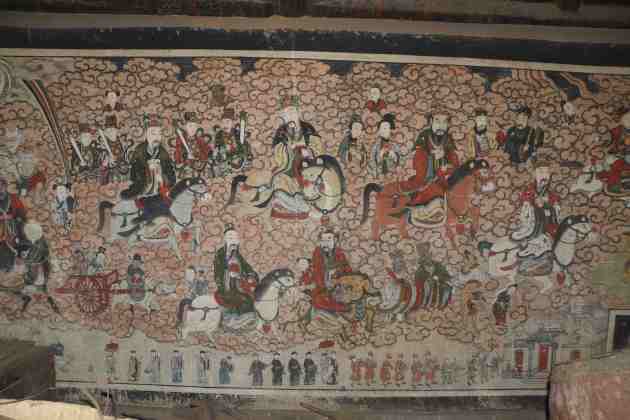
Material like this may be more fruitful for the study of deities than for actual ritual life. But just a couple of examples from the website that do suggest the latter, from village temples in Yuxian just southeast of Yanggao. This is from a Dragon King temple in Yuxian, perhaps dating from the late Qing:

full mural lowres

Photo: Hannibal Taubes, 2018.

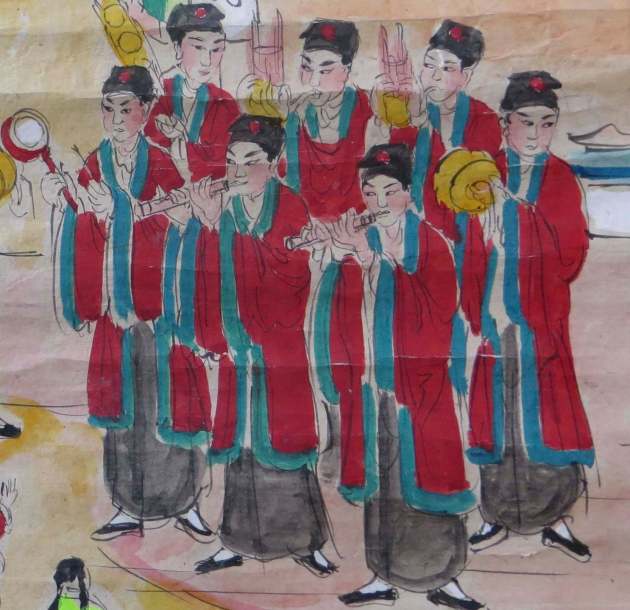
Here are two details of the procession at the foot. Leading the way, as ever, is a shawm band—in uniform, which by the 20th century was discarded:

chuishou lowres

Photo: Hannibal Taubes, 2018.

Bringing up the rear, on the left (after the temple helper bearing the ritual umbrella) it shows a Daoist band—with chief vocal liturgist, a drum master, and players of the sheng mouth-organ, yunluo frame of ten gongs (now quite rare in the area), and guanzi oboe. The outsider might easily fail to notice that the latter figure (far right) is playing the guanzi—but locals, experiencing the shengguan ensemble at their village rituals all their lives, will recognize it at once.

yinyang lowres

Photo: Hannibal Taubes, 2018.

I won’t quibble with the marching order—the drummer always leads the way, but hey.

Below we see a similar quorum from another nearby Dragon King temple, dating from 1709. Here they wear the same red costumes as household Daoists today—as do the two trumpet players leading the way, though they should be from a separate shawm band…

Daoist procession

Photo: Hannibal Taubes.

As with any such iconography (one thinks of Renaissance depictions of angel musicians), we are confronted with the issue of how “realistic”, or how generic and idealized, such depictions may be as a portrayal of local ritual life at the time. This detail from my photo of a ritual painting by Li Qing’s Daoist uncle Li Peisen undoubtedly shows an authentic view of a 1940s’ ritual band (standing) such as the one that he himself led, with a group of seven—two guanzi, two sheng, yunluo (only three gongs?!), drum, and small cymbals:

painting-detail-cropped

The dizi flute, usually a member of the full shengguan ensemble, was perhaps less often used on procession—indeed, it’s largely fallen from use in this area since the 1990s. For the public ritual in the painting, the Daoists wear their red fayi costumes over their black dashan costumes, just as today. Interpreting such details is naturally informed by knowledge of the current scene.

Apart from another ambitious collaborative project on Shanxi temple murals, Hannibal is now further presenting his vast archive in a separate website, which I introduce here.

Of course art is a valuable adjunct to our studies of ritual and religious life, but with my own stress on performance I find myself frustrated that it’s static, two-dimensional, and silent. But whatever your angle on Chinese religion, Hannibal’s sites are fantastic new material, with rich potential. For his recent article on the use of perpectival painting, click here.

Passion at the Proms

Of course the Bach Passions are a regular subject of imaginative modern re-creations (Jonathan Miller, Sellars–Rattle, ENO, and so on); but the climax of the Proms Reformation Day on Sunday, John Butt’s version of the John Passion, in a certain liturgical context, was special. Note also his book Playing with history.

Like Daoist ritual (see many posts on this blog, including my starter page on Bach!), Passions in Thuringia for Good Friday vespers varied regionally, and evolved. Of course we now attend them in “concerts”. The Albert Hall in 2017 is clearly not the Nikolaikirche in 1739—although the audience/congregation was apparently of a similar size. But having read Taruskin, and Butt’s own astute views on the HIP movement, surely we can welcome such renditions; it’s a stimulating way for us (“miserable sinners”) to experience the work anew.

Bach revised the John Passion several times; Butt recreated an “ideal” sequence based on the 1739 version (which was never actually performed!), directing with an unaffected schoolmasterly air that indeed evoked Bach the Cantor himself (cf. Robert Levin’s incarnation of Mozart).

As in Bach’s Leipzig, both parts of the Passion opened and closed with organ music and sung chorales. By contrast with the concert version (finely evoked by John Eliot Gardiner, Music in the castle of heaven, p.343), when the orchestra plunged into the anguished dissonances of the first chorus of Bach’s music, it makes you think how a congregation still unaccustomed to their new Cantor’s style, yet unprepared (though not quite—see Gardiner, pp.347–9) for the constant flow of extraordinary creativity that they were to enjoy for the next twenty-seven years, must have thought (in 18th-century Thuringian), “WTF?!” (cf. The ritual calendar).

The focal point of the Good Friday Vespers in Leipzig was actually the long sermon in between the two parts of the Passion music, which at the Albert Hall was thankfully replaced by an interval (glass of wine, ice-cream…). I wonder if a talk by someone like Malala might be a suitable further exploration—since many in the audience will experience the Passion deeply despite being less than devout religiously.

Do listen to John Butt’s remarks in the interval of the TV broadcast too (from 53.10)—and I like the analogy of Richard Coles (nay, “the Reverend Richard Coles”—clever choice of presenter, BBC!) with the mass singing at Cardiff Arms Park (more ritual and sport).

Given the rowdy behaviour of Leipzig congregations in Bach’s day, perhaps the Prom audience should have been a tad less attentive?! After we had all joined in singing the chorale O lamb of God, applause at the interval felt a bit weird, but it was entirely natural as a novel response to the life-affirming ending—after the beautiful motet Ecce quomodo moritur by Jacobus Handl (1550–91!), a blessing and response, Bach’s own organ chorale prelude Nun danket alle Gott, and a final rousing rendition of Now thank we all our God from the whole hall (a tune, suitably, that most members of the “audience” would know), accompanied by organ at exhilarating full throttle—all confirming joy at atonement.

By comparison, the great Passion performances of recent decades may seem more immaculate and micro-managed (“Chanel No.5″), but they remain deeply moving—like Gardiner’s version (also from the Proms, with the superlative Mark Padmore (note this roundup). But this performance had a Lutheran simplicity that was differently moving.

Butt also notes “the different levels of singing cultivated in the church and school environments of Bach’s time,” from basic to more advanced pupils and indeed the congregation (again, cf. Butt’s interval remarks), so that the liturgy accommodated the whole community:

What we hear in concert performance is only the tip of a much larger iceberg, a culture of singing and participation that can only be fleetingly evoked in a modern performance.

This reminds me of the different levels of accomplishment within (you guessed it) a Daoist ritual group:

This dilution of personnel is a recent change, but before 1949 too, Daoist groups might recruit some extra percussionists who would gradually pick up the basic of the vocal liturgy. The substantial group of Li Qing’s senior colleagues from the 1930s didn’t come from his own family, but they had all trained from young with his uncles, and went on to become fine Daoists. In Beijing before 1949 some Daoist and Buddhist priests specialized more in the vocal liturgy, others mainly in the melodic instruments, and some village men spent time serving the temples there mainly as instrumentalists. Thus there have long been different levels of expertise, both between groups and within a single group. In the imperial era one imagines that some groups in larger towns, serving wealthy patrons regularly, might have more abstruse knowledge than poor village bands. But even within a single group—in the courts and elite temples as well as rural household groups like the Li family—there would have been a variety of accomplishments. Both temple and household groups often included a young boy just starting out on the gong, still unfamiliar with the ritual texts. (my book, pp.324–5).

Again like a Daoist ritual, the recreated Passion also features different styles of old and new music, not such an evident feature of the usual concert version. And it reminds me rather of the Li family Daoists’ concert performances of excerpts from their lengthy funeral rituals, uprooted from their liturgical context—remember, the Li band gave wonderful performances in Leipzig in 2013.

In John Butt’s John Passion at least we get an impression, in a secular concert setting, of the power of Bach’s contribution to Good Friday Vespers.

For the 2024 Prom performance of Suzuki and BCJ, click here.

Diary of a household Daoist

LMS 1992

August 1992: In a brief break between ritual segments of a funeral led by Li Qing, his son Li Manshan consults with another family to determine the date for a future burial.

In my book (pp.18–21) I gave instances of the daily ritual schedules of household Daoists Li Manshan and his son Li Bin. They’re always so busy that Li Bin has only just found time to report back to me on what they’ve been up to recently. Apart from all the necessary research into the ancestry of ancient ritual texts, and so on, such diaries are an illuminating aspect of the ethnography of Daoist ritual practice. Apart from my film and book, Li Bin is also one of the protagonists of Ian Johnson’s The souls of China.

Li Manshan, now 72 sui, has recently been scaling down his activities a bit—mainly doing funerals in the immediate vicinity, and determinining the date. But since the band’s “triumphant return” (Kaixuan guilai 凯旋归来, on which more anon) from our mini-tour of France in May—and indeed throughout the previous months—Li Bin has hardly had a moment of free time. As he tells me,

The thing that’s the most hassle is when I get two or three concurrent funerals, having to arrange personnel and all the equipment. Each band needs suitable liturgists, wind players, percussionists, and someone to write the documents. And I have to make sure all the various sets of costumes and equipment are complete.

Until the 1950s their ritual work consisted of three types of “scriptures”: funerals, temple fairs, and (through the winter) Thanking the Earth rituals for individual families. The latter two types are now rare, so since the 1980s’ revival the vast majority of their business consists of funeral rituals and all the associated proprieties surrounding a death. But for reputable Daoists like Li Manshan and Li Bin, this alone can be a full-time occupation. In this area south of the county-town they are the most popular group performing such tasks, but there are others.

Before we look at Li Bin’s diary day by day, some more background. Funerals commonly last one and a half days. It’s very tiring work, performing from 7am to nearly midnight on the first day, with a whole series of long processions. As I say in my book,

Excuse the facile analogy with Western art music, but just the seven visits to the soul hall are like doing two motets and five cantatas over the course of the day—plus a few oratorios, and (previously, for temple fairs) six long symphonies.

For the wind players (like Li Bin) especially, accompanying the liturgy is tough physical work.

And on the following morning they make the lengthy burial procession from 8am to midday—as well as all the solo work of Li Manshan or Li Bin in exorcizing the house and checking the precise alignment of the coffin in the grave. Apart from singing the vocal liturgy, they have to double on the wind instruments and ritual percussion.

As I have also described (my book, ch.17), in addition to the two other core members Golden Noble and Wu Mei, Li Bin and Li Manshan need a pool of deps—some regular, others occasional—from the ranks of other local Daoist families and shawm bands. Using his smartphone, Li Bin has to keep a careful note of the fees he owes them; and he’s constantly driving round from village to village with his car packed with ritual equipment—ritual instruments and costumes, paper artefacts, mourning weeds for the kin, duilian and diaolian mottos to paste up at the soul hall and scripture hall, and so on.

Li Manshan prepares most of the mottos at home; he, Li Bin, or Golden Noble will also have to find moments during the funeral to write other ritual documents to be burned for particular ritual segments. At least recently they have deputed to the junior Daoists the lengthy and fiddly task of decorating (and later dismantling) the soul hall.

Usually the first day’s rituals come to a close around 11pm with Yellow Dragon Thrice Transforms Its Body (magnificent percussion coda to the Transferring Offerings ritual) and the Escorting Away the Orphan Souls segment (see my film, from 1.11.07), but sometimes the host asks them to do a lengthy Sitting through the Night sequence into the small hours (playlist, track 3—see my notes). Until quite recently the six Daoists routinely dossed down for the night in a row on the kang brick-bed of the “scripture hall” (making room for me too, a fond memory), but now with the improved road network, given the rather basic conditions of most scripture-hall hosts, they sometimes zoom off back home on their motor-bikes. If the funeral isn’t too far away, Li Bin often drives back to his home in town—not least in case he needs to bring more equipment for the burial next morning or his next stop thereafter. But each night on reaching home after a seventeen-hour day, he always remembers to light incense before the statuette of Zhang Daoling in his funeral shop.

Apart from determining the date for funerals, siting the grave and decorating coffins (also both lengthy processes), booking the band, and then performing the rituals—not to mention the daily business of running his funeral shop and making paper artefacts with his wife—Li Bin is always busy doing consultations to determine the date for weddings, construction work, journeys, and so on.

I have to field constant phone-calls every day. Sometimes I determine the date over the phone for “moving the earth” (dongtu 动土) for building work. Over the phone people can go on for ages about weddings or opening a new business—often when I’m right in the middle of some really busy arrangements. It’s a real hassle, but I can’t refuse…

Free-lance musos in London would be only too happy to have such a full diary, but it comes at a cost. As a freelancer myself, I’m glad he’s in work; he has bills to pay, but I hope he gets a bit of time off occasionally. We can well understand why Daoists don’t want their sons to continue in the family tradition.

Li Bin 2011

Li Bin (Li Manshan’s son, 9th generation) on sheng, 2011.

These notes cover the period from their flight home from Paris on 22nd May through to 8th August.

From the map below we can also see the rather typical radius of their ritual activity. Apart from the occasional funeral in Yanggao town, and a rare visit to Datong city, they work mostly in a small area in east-central Yanggao, around the Li family’s old home of Upper Liangyuan and Gucheng district just south. You can click on the place-names in the sidebar to see dates. For another map of the area (also indicating location of other Daoists groups now and before the 1950s) see here.

The Li band may cater to the mortuary needs of many of these individual villages a dozen or so times each year. And they have done so for several generations, with many trusted friends in places like Yangguantun, Pansi, Luotun, and so on.

May
22: we take 23.20 flight from CDG to Beijing;
23: landing at 15.20, 21.40 train from Beijing station.

  • 24: our train from Beijing arrives at Yanggao at 3.44am. At 4am [!] I drive down to Upper Liangyuan (dropping off Li Manshan at home) to help the Sun family prepare for funeral, then I drive back to town again to fetch equipment for them. I determine the date of the burial for 3rd June. 8am: to Shangzhuang to determine the date for a burial there (1st June).
  • 25: I decorate the coffin for Shangzhuang.
  • 26: I decorate the coffin for Upper Liangyuan, and site the grave.
  • 27–28: funeral at Upper Liangyuan for Zhao Xilin (date already determined before French tour).
  • 29: making paper artefacts, preparing for the Shangzhuang and Upper Liangyuan funerals.
  • 30–31: two concurrent funerals at South Luoyao and Pansi
  • 31–June 1: funeral at Shangzhuang.
    June
  • 1: after the Shangzhuang burial, to Houguantun to determine date for burial (12th June, a simple solo “smashing the bowl” ritual—see my book, pp.193–4).
  • 2–3: Upper Liangyuan funeral. After burial, back home to make more paper artefacts.
  • 4–5: funeral at Anzao.
  • 6: making paper artefacts.
  • 7–8: funeral at Zhaoshizhuang.
  • 9–11: three days free to make paper artefacts. Hardly any rest since we came back from France.
  • 12–13: two funerals, at Huiquanzi (in Yangyuan, Hebei) and Houguantun.
  • 15–16: funeral for Sun family in Upper Liangyuan (Li Manshan’s home village).
  • 20–21: two funerals, in Wangguantun and Yanggao county-town.
  • 22–23: funeral at Shizitun; 23 pm I determine the date in Luotun, for burial on 4th July.
  • 25–26: funeral in Lower Liangyuan.
  • 28–29: funeral at Shizitun; 29 pm I determine the date in Yangguantun, for another burial on 4th July.
    July
  • 1–2: funeral at Yousuoyao; I also determine the date in Houguantun, for burial on 8th July.
  • 3–4: funeral at Luotun. [4: burial at Yangguantun]
  • 7–8: two funerals, at Yangguantun and Houguantun. 8: after the burial at Yangguantun, another old person has died, so I go to determine the date—for 5th August.
  • 9: three families come to determine the date for their weddings.
  • 11–12: funeral in Datong
  • 14–15: concurrent funerals in Anzao and Zhanjiayao.
  • 16: coming-of-age party (yuansuo 圆锁) in town for friend’s son (cf. the scene of the party for Li Bin’s own son in my film, from 5.25).
  • 18: massive downpour in the northern hills; two killed as floods carry off a tractor [Li Manshan summoned to determine the date for a burial there].
  • 20–21: funeral at Upper Liangyuan.
  • 22–23: funeral in the county-town.
  • 27–28: funeral at Fantun (just east in Tianzhen).
    August
  • 2–3: funeral at Lower Niangcheng.
  • 4–5: funeral at Yangguantun.
  • 7–8: funeral at Sibaihu. On the afternoon of the 8th, after the burial, just northeast all around Jijiazhuang, Lanyubu, and South Xutun, extreme windstorm and hailstones destroyed cornfields; one family in Jijiazhuang lost 40 mu of peppers.

For Li Manshan’s ritual schedule for 2019, see here; and during the Coronovirus scare, here.


With thanks as ever to Li Bin and his son Li Bingchang
(also an Ariana Grande fan, I learn).

Gaoluo: a restudy, and my role

Thankfully, I am rarely the object of interview—far more often the interviewer asking fatuous questions. I mentioned one such encounter where I failed in my task of giving snappy predictable answers, as well as Jack Body’s original take on my stammer.

Far more in-depth in nature is the new PhD thesis

  • Zhang Lili 张黎黎, Lun Zhong Sidide Nan Gaoluo yinyuehui yanjiu 论钟思第的南高洛音乐会研究 [On Stephen Jones’s research on the ritual association of South Gaoluo] (Beijing: Zhongguo yishu yanjiuyuan 中国艺术研究院 2017),

on my own relationship with the ritual association of South Gaoluo village, and my whole approach. Referring to my book

she consulted me over a long period with frequent and detailed emails, and it has been most stimulating for me to reflect on my fieldwork. Her thesis (supervised by the illustrious Tian Qing) is enriched by several visits to Gaoluo—allowing her to make what is effectively a restudy, updating my history of the village and its ritual practice in the light of their later adoption into the dreaded Intangible Cultural Heritage (ICH) razzmatazz, with all the problems that it entails.

She explores the association’s memories of my visits—prompting further reflections from me here, leading to this page suggesting my challenge to the official narrative. She also discussed our work on Gaoluo, indeed our whole project on the Hebei ritual associations, with my fellow-fieldworkers Xue Yibing and Zhang Zhentao—a fruitful collaboration that stimulated us all.

MYL played

Taking part in the New Year’s rituals, 1998.

And my work in Gaoluo (from 1989 to 2001) may be seen as a blueprint for my later in-depth study with the Li family Daoists (going back to 1991, but intensive since 2011). The subject of the former was an amateur village-wide group, whereas the latter are an extended occupational family of household Daoist ritual specialists—but the principles of thick description and participant observation remain similar.

On my own “method”, at first I can’t really see what the fuss is about: isn’t this what anthropologists do?! Even in China there are many fine ethnographers, such as Wang Mingming, Guo Yuhua, Jing Jun; and in music (apart from Xue Yibing and Zhang Zhentao), Xiao Mei, Qi Kun, Wu Fan, and so on. They’re much better equipped than me for such work.

But sure, two decades ago my approach was more detailed, and personal, than was then the norm in Chinese musicology. The anthropologists whose work I was myself only beginning to digest—even those fine Chinese scholars who were later to become leading figures—were still hardly known in China. I was educating myself by reading up on both modern social-political background for China and wider ethnomusicological studies (Plucking the winds, Appendix 1). By now, such an approach is less remarkable, but then I found myself somewhat ahead of the game in ethnography—certainly within Chinese musicology, where the “living fossilsflapdoodle has remained hard to erase. Another approach that I took for granted was participant observation—a routine expectation in ethnomusicology, but still virtually unknown either in Chinese musicology or in studies of Chinese ritual.

Anyway, it will be good to see Zhang Lili’s restudy of Gaoluo, with further illustrations of the perils of the ICH.

Ritual life around Xi’an

Xi'an miaohui lowres

A new page (under Themes in Menu) introduces changing ritual life around Xi’an, setting forth from my visits since 1986 and the work of the late great Li Shigen.

It accompanies the new track 11 on the audio playlist, with comments here.

As so often for north China, all the musicological studies are very desirable, but there should be far more to it than that. It can’t be left only to musicologists—it’s just as much a topic for historians, ethnographers, and scholars of religion.

Yet more heritage flapdoodle: Hongtong

Hongtong 1
Further fodder for my distaste of the heritage shtick—thanks again to Helen Rees, my Word on the Street, I’ve been reading an interesting article by Ziying You,

  • “Shifting actors and power relations: contentious local responses to the safeguarding of Intangible Cultural Heritage in contemporary China”,
    Journal of folklore research 52.2/3 (2015).

And now she has published a book on the topic, which I look forward to reading:

Hongtong cover

Hongtong county, in south Shanxi, is always cropping up in studies of local culture in north China—notably since it was used as a huge migration transfer centre to areas further north and northeast that had been depopulated by the appalling dynastic warfare of the early Ming. Like many villages on the plain south of Beijing, Gaoluo, subject of my book Plucking the winds, is said to have been founded as a result of this migration; and Li Manshan’s lineage moved north to Yanggao just around this time. [1]

It’s a long time since we’ve featured The China Daily, so I’m delighted to cite a 2012 article here:

A step into Hongtong county in southern Shanxi province and I found myself transported into a land filled with fairy tales.

YAY! The paper hasn’t lost its old magic, then. It does provide a couple of charming pieces of folklore:

The Chinese term used today to mean “go to toilet” or jie shou is also linked to the legend.
The migrants had their hands tied behind their backs when they migrated. They were only allowed to untie their hands when they needed to relieve themselves. Jie shou, which literally means to untie the hands, gradually became the term used for “go to toilet”. The expression spread widely to the provinces where the Shanxi migrants were sent.

Another interesting tale on Hongtong involves a woman by the name of Su San in the Ming Dynasty, who became probably one of the most well-known prostitutes in Chinese history.
Su met young scholar Wang Jinglong at her brothel. The two fell in love and Wang stayed with Su for a whole year but was later chased out of the brothel because he ran out of money. Su was then sold to another man as concubine. She was framed for murdering the man, imprisoned and was sentenced to death.
Meanwhile, Wang who attempted the imperial examination, did well and was appointed governor of Shanxi. He heard about Su’s case and helped with the investigation to deliver her from death row.
The lovers eventually got married and as how all fairy tales end, they lived together happily ever after.
The story has been adapted as a Peking Opera play The Story of Su San (Yu Tang Chun) and became one of the best-known Peking Opera plays in China. Hongtong county where Su San was imprisoned became well-known through the play.
Although the original prison was severely damaged during the “cultural revolution” (1966-76), the present one restored in 1984 retains all its original features. For example, there is a cave used for dead bodies, and a well with very small mouth to prevent prisoners from jumping in to kill themselves.
Su San’s story has brought fame to the prison, making it a must-see in Hongtong. Today the site is renamed as “Su San Prison”, and her story is presented by a series of wax statues within the site.

Damn, I’m trying to write about the ICH here… Led astray by The China Daily“typical!”

Anyway, Ziying You’s article concerns Hongtong as the site of an enduring cult to the ancient sage-kings Yao and Shun, in which several villages form a she parish, with temple fairs and processions. [2] For ICH purposes it is nominated as Hongtong zouqin xisu “the custom of visiting sacred relatives in Hongtong” [3] — and yes, sure enough the term “living fossil” rears its ugly head again.
Hongtong procession
Though not currently on the UNESCO “Representative list” for the ICH, it has been inscribed on the provincial and then national lists since 2006. With typical official razzmatazz, local cultural cadres set up a “Hongtong Centre for the safeguarding of ICH”, niftily bypassing the temple committees which are the lifeblood of the whole tradition.

BTW, as at many such festivals, I see no signs here of liturgical sequences of ritual specialists—only large groups of gong-and-drum ensembles (which are also widespread in Shanxi).

By contrast with the alacrity of cadres,

For most ordinary people, ICH was a foreign term remote from their knowledge and discourse.
[…]
Those who were mobilized to assist in the ICH application expected to receive a large amount of money from the central government to do whatever they wished within their local communities.

Not only has this expectation been unfulfilled—the Yangxie temple committee spent a substantial amount in the extended process of preparing the application. Moreover, the Centre, jockeying for favour with ICH bodies higher up the chain, monopolizes as-yet elusive state funding. And while the local conflicts between the villages did not originate with the ICH application, they were exacerbated in the process. Anyway, the temple committees, true “bearers of the heritage”, have been disempowered.

The ICH project thus became a means for the local ICH centre to exploit the local population and harvest the profits from the state.

Citing Chiara de Cesari, the author comments:

UNESCO frequently ends up reinforcing the power and reach of the nation-state and its bureaucracy, which is contradictory to its own principle of involving local communities and “grassroots”.

Yet again, the ICH machinery appears not to be safeguarding local cultures so much as safeguarding itself.

My encounters over the years with groups earmarked for ICH status—such as the village ritual associations of Qujiaying and Gaoluo, as well as the Li family Daoists—only confirm such findings. But the juggernaut rolls on.

As I write, Haitink’s recent Prom is on the radio, with the Prague symphony. No Mozart balls, just boundless energy and creativity!


[1] For the migrations to Yanggao, see Jing Ziru’s article in Yanggao wenshi ziliao 阳高文史资料 2: 216–228 and 206.
[2] Note also Anning Jing, The Water God’s Temple of the Guangsheng Monastery: Cosmic Function of Art, Ritual, and Theater (Brill, 2001)—albeit more historical iconography than contemporary ritual ethnography.
[3] These photos are among many from http://photo.xinzhou.org/2010/0717/picture_1826.html

In memory of Natasha

Natasha 2

This week is the fourth anniversary of the loss of my friend Natasha at the age of 34—younger than Mozart, and just less than two years after Amy Winehouse’s death.

Unable to do anything at all for months after, I thought I’d better not cancel my planned stay with Li Manshan in September, and indeed he and the other Daoists were understanding, easing me back to life. The Li family had themselves suffered a family tragedy at just the same time. The funeral rituals they perform are always moving, but now, as the sounds of shengguan blending with the vocal liturgy soared above the kowtowing kin, I felt their grief more personally.

Natasha left barely a trace on the world apart from her wonderful kids. I dearly want to write a book on her, but since I now find I know nothing about her, this tribute will have to suffice.

Natasha smile

“Troubled genius” doesn’t do Natasha justice. She deeply touched all who met her; irresistible, she could be impossible. She was the incarnation of Elena Ferrante’s Lila.

Her wild and prodigious early life was spent in Ternopil in west Ukraine. She made her home in London aged 18. Painter and composer, with her icons and Tarot, electronica, Bach, and Arvo Pärt, earth mother and sophisticated cook, femme fatale with her look of heroin chic, chunky jewelry and slinky outfits, finally holding down a mundane job for the sake of surviving as a single mum after teaching and playing in a rock band, childlike and severe, intoxicating and intoxicated, insatiable and hallucinatory, her thirst for knowledge reflected in her multi-coloured notebooks full of sketches and musings, she was on another planet. Hearing TurangalîlaragaMozart, or Naturträne through her ears, deep in her soul, was overwhelmingly intense.

Natasha painting

Natasha’s paintings were both radiant and disturbed—her later works were yet darker. Klimt and Schiele would have lapped her up (and she them). It wasn’t easy for her inhabiting a world of Parajanov:

We were supposed to be going to Mahler 5 at the Proms when she had her first heart attack. This is a perfect version of her song, with Magdalena Kožená and Claudio Abbado:


Thriving on impermanence, that I get. But Natasha, you have to keep living…

Dissolving boundaries

I’ve just added a page (under “Themes” in Menu) on

Folk and art music in China: qin and shawm music

Hua band 2001 edited

Far away from the pop music and cutesy erhu solos that dominate the Chinese media, I’d like to compare two melodies with the common theme of “Geese landing”: the intimate meditative solo Pingsha luoyan 平沙落雁 for the elite qin zither, and the searing folk suite Da Yanluo 大雁落 for two shawms and percussion.

Such utterly contrasting styles may seem to make an absurd comparison, and we shouldn’t suppose that any two pieces with a similar title will have anything in common. In this case it’s more of a convenient pretext to reflect on disparate genres.

One tradition is highly literate, the other non-literate. Yet the incongruous juxtaposition, however polemical, turns out to be illuminating—querying the widely-held myth that qin music, as “art music”, will be more sophisticated and complex than “folk” shawm pieces.

*** Both pieces are illustrated by recordings of master musicians!***

Rethinking Zhengyi and Quanzhen: an update

I’ve just added to my page on Rethinking Zhengyi and Quanzhen, but it’s worth highlighting my new reflections here.

I began exploring the false dichotomy between Orthodox Unity (Zhengyi)  and Complete Perfection (Quanzhen) branches in my book In search of the folk Daoists of north China (note especially pp.17–18). Now that we have more instances, let’s revisit the scene.

In areas of north China for which I have information (see In search of the folk Daoists of north China), household Daoists may nominally belong to either Orthodox Unity or Complete Perfection branches. But such simplistic pigeonholing may distract us from the details of their ritual practice.

In their rituals and ritual manuals I can discern no significant distinction. When the Complete Perfection branch evolved in the 12th century, its priests (both temple and household) took over Orthodox Unity ritual practice: as John Lagerwey once observed to me, “that was the only show in town”. And while a distinct Complete Perfection literature did evolve (see my book, pp.203–207), their ritual practice never developed into a separate corpus of Complete Perfection ritual texts.

That explains why such an august Complete Perfection temple priest as Min Zhiting (see above) was constantly citing Orthodox Unity ritual manuals from the Daoist Canon; and why the best mainstream source for the manuals of the Orthodox Unity Li family household priests in Yanggao is the repertoire of modern “Complete Perfection” temple practice like the Xuanmen risong.

On the evidence to hand, household Complete Perfection Daoists seem rather more likely to recall their place in their particular lineage poem. They may have a clearer family tradition of earlier ancestors having spent time as temple priests. But household Orthodox Unity priests may also possess both these features. Of course the histories of such groups need documenting, but when we come to performance (which, after all, is the heart of ritual) it may be less germane.

And in some places now—since around 2000—the picture is further confused by a certain “centripetal” tendency. With wider access (such as the internet), some groups that have always been Orthodox Unity may be exploring ways of “legitimizing” themselves by seeking manuals from prestigious central sites like the White Cloud Temple in Beijing, and having costumes and hats made which make them appear to be Complete Perfection Daoists. They may even reform their “local” ritual practice by adopting elements from the “national” White Cloud Temple.

The scene is further obfuscated by a tendency among some scholars (both local and central) to assume that if a group is household-based, then they must be Orthodox Unity—a problem I have already queried. We really must debunk this assumption. In my recent posts, the Changwu Daoists turn out to belong to the Huashan branch of Complete Perfection, and the Guangling Daoists appear to come from a Longmen tradition. Actually, this is not so clear-cut—even non-Quanzhen priests might adopt Longmen titles (note sources by Vincent Goossaert cited in my In search of the folk Daoists of north China, p.18 n.34).

So while the ritual texts and ritual sequences of the two notional branches are rather similar, what always makes local traditions distinctive is the way in which the texts are performed.

vocal trio 2001

Vocal trio, 2001: Li Manshan, Golden Noble, Li Bin.

Even here there’s another erroneous cliché that needs debunking. Generations of scholars of Daoist music have parroted the notion that in style the “music” of Orthodox Unity (conceived narrowly as “household” or folk) Daoists is more popular and lively, whereas that of Complete Perfection (again, conceived narrowly as austere monastic) Daoists is solemn, slow and restrained. It derives entirely from an unfounded theory about household and temple practice. We only need to watch my film about the Li family band to realize this simply won’t do. Orthodox Unity Daoists, their basic style (exemplified by the zantan hymns that permeate all their rituals) is extremely slow and solemn—but as you can hear, it is indeed punctuated by exhilarating moments. The style of (household!) Complete Perfection Daoists is certainly no more “solemn”. Both branches may use melodic shengguan instrumental ensemble—and if anything, that of the Orthodox Unity groups tends to be more slow and solemn.

Indeed, when I showed Li Manshan my videos of funeral segments by the Complete Perfection Daoists in Shuozhou, he found their performance “chaotic” (luan). Orthodox Unity groups in Yanggao like that of Li Manshan pride themselves on the “order” (guiju) of their performance.

My only ongoing note on this is that several household Complete Perfection groups (such as in Shuozhou and Guangling) may have preserved the element of fast tutti a cappella recitation of the jing scriptures better than in some Orthodox Unity traditions like those of Yanggao. But that doesn’t bear on the false stylistic dichotomy. Like Life, It’s Complicated… We always need to expand our database and use our critical faculties.

Daoists of Guangling, Shanxi

*For main page, click here*

Following my articles on the household Daoists of Shuozhou and Changwu, I’ve now added another page to the “Themes” menu, on a group in Guangling, north Shanxi.

Guangling kaiguang

Apart from my work on the Li family Daoists of Yanggao, Chen Yu 陈瑜 led me towards other Daoist ritual groups in north Shanxi. We had leads to most other counties in the region, but Guangling was a blank area on our map of Daoist ritual activity. So Chen Yu’s visit there in May 2015 made a valuable addition to our surveys.

Calendrical rituals

Further to my thoughts on festivals, today is the focus of the round of Bach Passion performances, now a kind of secular pilgrimage very different from the original liturgical context—not just of Good Friday but of the whole calendar (note John Eliot Gardiner, Music in the castle of heaven, ch.9, “Cycles and seasons“). Different too are our ears, bodies, world-views, experiences, sanitation

Mark Padmore, incomparable Evangelist in the Passions, makes some thoughtful points here (cf. this article). Do watch his Matthew Passion as staged by Peter Sellars. And here he is in the John Passion (cf. Passion at the Proms)—how he sings und ging heraus und weinete bitterlich (from 33.48), and how Bach composed it, is miraculous:

Also in the John Passion is one of Bach’s most moving arias is Zerfließe, mein Herze:

Zerfließe, mein Herze, in Fluten der Zähren        Dissolve, my heart, in floods of tears
Dem Höchsten zu Ehren!                                         to honour the Almighty!
Erzähle der Welt und dem Himmel die Not:        Tell the world and heaven your distress:
Dein Jesus ist tot!                                                     your Jesus is dead!

More performative tears (see links here)—like north Chinese Daoist ritual, the aria is also accompanied by anguished wind ensemble, almost evoking (for modern ears) French film music.

While Protestants do their thing, let’s not forget Holy Week in Spain, with solemn hooded processions, soaring trumpets, and saeta devotional songs for the images of Christ and the Virgin (for more saeta, along with other moving cante jondo songs, see here):

Indeed, for me one of the benefits of being a touring muso was being able to combine both Bach Passions and flamenco. In southern Spain flamenco only tends to get going in the small hours, but concerts also begin at 10pm or later. So by the time we had played the final chorus of the Matthew Passion in Seville, there was plenty of time to stroll over the bridge to the wonderful Anselmas bar in Triana, downing a few G&Ts before the flamenco began to get in the groove.

Note also the liturgy of Castelsardo in Sardinia.

* * *

Meanwhile it’s a busy period in the Chinese ritual year calendar too. [1] On the Hebei plain, apart from everyone taking part in the lineage observances for the Qingming festival, Catholics are busy holding Masses and making pilgrimages—not least evading police road-blocks (see here, and for the Gaoluo Catholics, here). It is also the time of the 3rd-moon festival for the goddess Empress Houtu, when many villagers go on pilgrimage to the Houshan mountain temples to revere her.

Houshan disciples

The Houshan pilgrimage, which under the commune system had been observed only by a tenacious minority through the 1960s and 70s, began reviving in the 1980s; by the 1990s it was attracting around 100,000 pilgrims for its 3rd-moon temple fair. We met several village ritual associations on the mountain for the festival in 1995, though Gaoluo village no longer organizes a group; in recent years “people’s hearts are in discord”, as association leader He Qing lamented. In some places the Houtu festival has been revived within the village: for the 3rd-moon festival in 1996, for instance, we visited Shenshizhuang, south of Yixian county-town, whose four ritual associations all celebrate the Houtu festival in their separate ritual buildings in the village.

SSZ xihui 1996

Altar to Houtu, Shenshizhuang West association 1996.

Many villagers make the pilgrimage in small groups on their own initiative. Their vows are pledged to Houtu. One can climb to the Houshan temples to offer incense and pledge a vow, or just make it at home; the vow often used to include a promise to “look after a banquet” for the ritual association.

So the red flag which one often sees adorning truckloads of villagers in the 3rd moon now heralds a group of pilgrims rather than any political campaign—another sign of the changing times. But despite the lengthy impoverishment of ritual and faith, the power of Houtu is still strong: even in 1997 Gaoluo friends reminded me “Here we believe in the Empress Houtu, so a lot of people offer incense”.

* * *

For the dispassionate (sic) observer, some photos may distinctly suggest a stress on masochism in Easter observances around the world. Meanwhile on a visit to the Saudis, celebrated defenders of religious values, our Prime Minister gets herself embroiled in a futile dispute about Easter eggs with the notoriously subversive National Trust. Indeed, this “We’re not even allowed to celebrate our own culture any more” fatuity is itself becoming an annual ritual. Hey-ho.

For thoughts on our approaches to Morris dancing and local Chinese rituals, see here. See also The Annunciation in art and music.


[1] These notes are revised from my Plucking the winds.

Singing from a different hymn-sheet

vocal trio 2001

Vocal trio, 2001: Li Manshan, Golden Noble, Li Bin.

That’s the zippy title of Part One of my book In search of the folk Daoists of north China.

There I observe that nationally, Daoist ritual is far from standardised. Our picture (still misleadingly reinforced in encyclopaedias and media coverage) has previously been based on southeastern Orthodox Unity Daoists performing jiao Offering rituals, using manuals from the Daoist Canon; to be sure, scholars note a wide variety of practice even in south China, both within a region like Fujian and between regions like Jiangxi, Sichuan, or Jiangsu.

But to include in our picture the vast area of north China—always wrongly assumed to have no household Daoists at all, merely celibate temple-dwelling Complete Perfection priests—suggests a still more complex taxonomy. Household ritual specialists may be either Orthodox Unity or Complete Perfection; and at least until the 1940s,  temple-dwelling priests too might belong to either branch. Moreover, the very distinction doesn’t explain nearly as much as has been assumed: rituals, and ritual texts, of the two branches overlap to a great extent.

“Singing from a different hymn-sheet” also seems a suitable metaphor to challenge the reified conformity of many reports by both scholars of Daoist ritual and Chinese musicologists—their dry, silent, timeless lists often relegating thick ethnographic description and accounts of society and lives in change (my book, pp.364–6).

So just as ritual is itself diverse, I’m seeking a more varied spectrum of our areas of enquiry.

En passant, I note that Daoists rarely sing from hymn-sheets at all! They may possess ritual manuals, but in performance they are seldom needed (my book, pp.203–14). Oral transmission is a major element in both training and ritual practice. Often the only manuals they place before them on the table are the jing scriptures—lengthy discursive texts, chanted very fast, isorhythmically. Anyway, the efficacy of a ritual lies more in its performance than in its written text: ritual is conveyed by means of sound.

The life of the household Daoist

vocal trio 2001

Vocal trio, 2001: Li Manshan, Golden Noble, Li Bin.

Not so much

Don’t put your daughter on the stage, Mrs Worthington

as

Don’t put your son on the Daoist ritual arena, Mr Li.

Patrice Fava’s film Han Xin’s revenge, about the rituals of a group of household Daoists in rural Hunan, is very fine. The voiceover contains an intriguing line:

“Many young people choose to become Daoists.”

Whether in Hunan or elsewhere, today or when the film was made, I find this hard to believe—it seems a romantic notion.

As I observe in my book, Li Bin (b.1977) is the ninth generation of Daoists in the Li family, and could well be the last. Moving with his family to the county-town in 2007 was initially a stepping-stone for his son to get a better education—seeing it as a route towards betterment, just as his forebears had done under successive regimes.

Even if new recruits can now skimp on the training, Daoist fathers no longer want their sons to continue the tradition; there are now easier ways to make a better living, and people like pop music anyway. Fees are low, and the lifestyle, working long days and nights traipsing around backward demoralized villages, is tough and none too comfortable (see e.g. recent diaries of Li Bin and Li Manshan). Potential young recruits go away to seek urban laboring work or get a good education leading to a secure job in town, providing an escape from the countryside towards urban registration and higher wages. And this is what their parents (including Daoists) want for them.

In The souls of China (p.48) Ian Johnson puts it well (in a passage about Li Manshan’s “determining the date” activities):

… Their relief was palpable, but so was Old Mr Li’s exhaustion. It was a tiring life, always on call, staying in people’s homes, burying their dead, eating their banquets. The questions never stopped—an avalanche of new challenges and problems that were overwhelming these old villages.

So whereas Daoist ritual somehow managed to survive after Liberation in 1949, and to revive after the liberalizations from 1979, today, in a world turned competitive, where the villages themselves are depleted, working as a household Daoist offers no route to advancement. As the Daoists realize, official initiatives like the Intangible Cultural Heritage project are quite unable to solve these issues.

If there are indeed areas of China where recruits do still emerge to perform a more complex repertoire of rituals, it would be interesting to discern reasons for such variation.

All this is explored in my film too. After screenings I like to ask the audience,
“Would you let your sons take this up as a livelihood?”

This doesn’t amount to hand-wringing, however. Daoist ritual has adapted under all kinds of vicissitudes over the last century, as it always has done.