The Houshan Daoists

*Click here to read page!*

So far, most of my pages on local ritual have described traditions in Shanxi. The province of Hebei, surrounding Beijing, may seem “too close to home”, lacking the romantic image of either the ethnic minorities or the barren northwest, but it is a remarkably fruitful site for fieldwork.

While the topic belongs with my pages on Gaoluo (under Other publications), I’ve put it under Local ritual, since it sets forth from the lives of Daoist priests.

You can find background on the Hebei plain south of Beijing by consulting the many sources in my introduction here, but one major site in our fieldwork on ritual life there was Houshan 后山, in Yixian county, centre of the cult to the female deity Houtu 后土, whose temple fair I’ve already outlined.

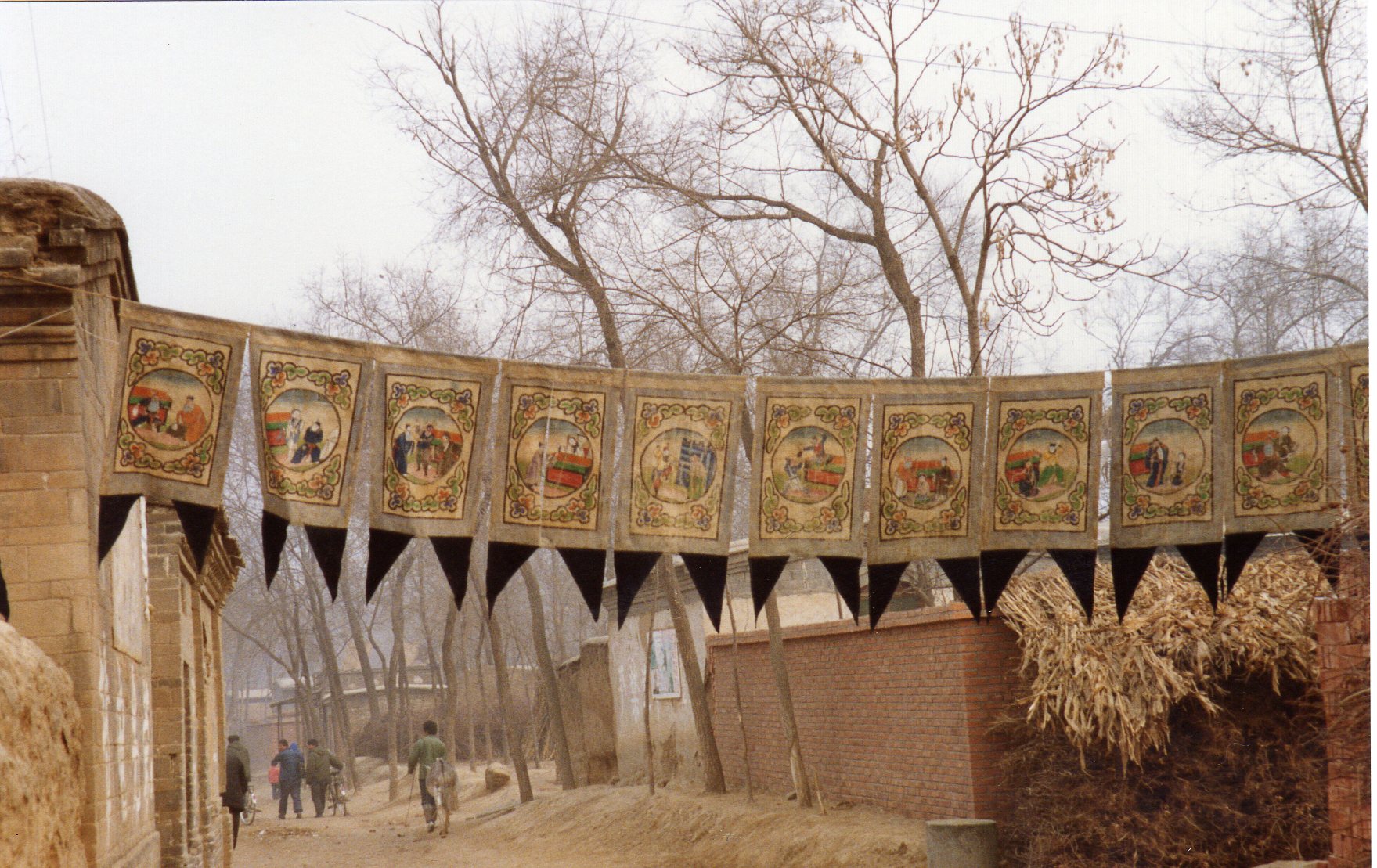
This sketch of the Complete Perfection Daoist priests of the temple there on the eve of the 1949 Liberation again illustrates their close connection with the ritual life of local villagers. In a (lavishly illustrated!) article I introduce the Houshan priests; the village ritual associations and sects nearby which continued their ritual tradition; the rich trove of “precious scrolls” in the region; and nearby temples to Houtu.

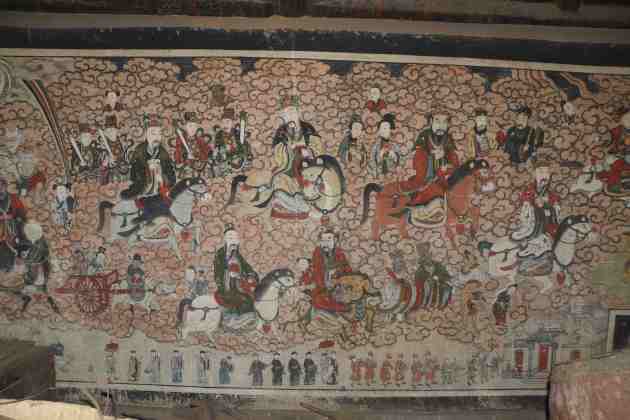
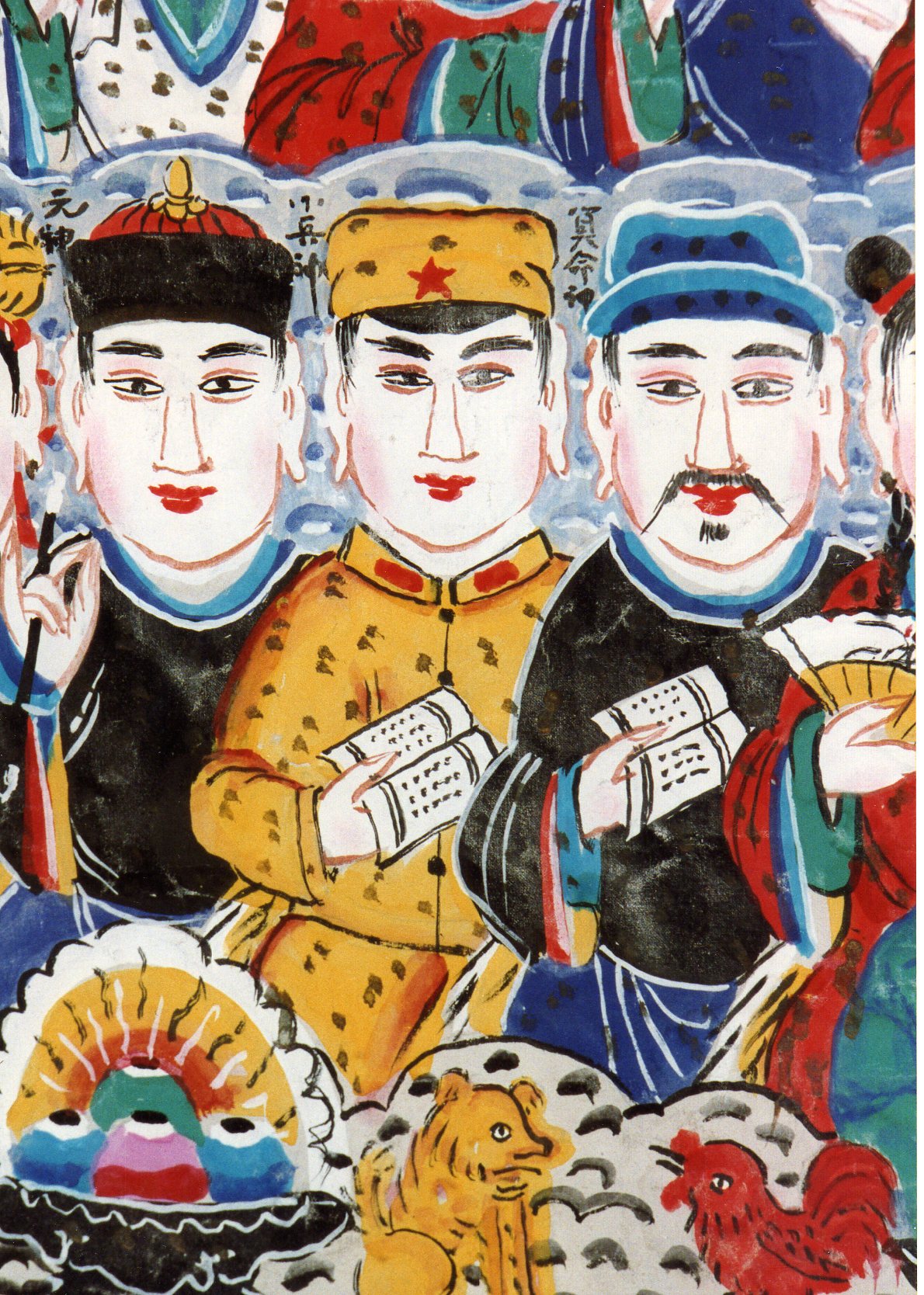
Pantheon, Liujing 1995

Wind, ethnicity, gender

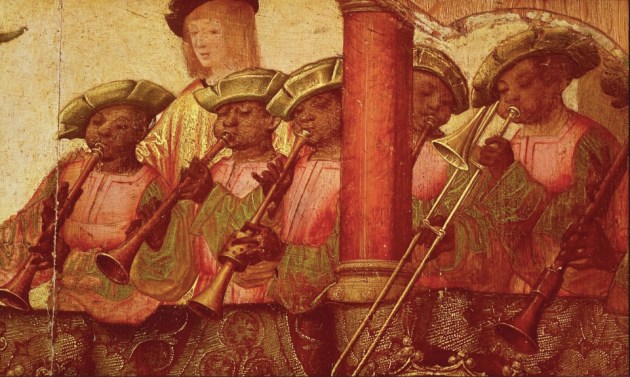
My time with Chinese shawm bands (most ubiquitous of performers for rural ceremonial) leads me to dabble mildly in studies of early European wind bands. So I’m struck by this detail of a 1520 Portuguese painting:

trombone

The Engagement of Saint Ursula and Prince Etherius,

It makes an alluring image for reviews of Miranda Kaufmann’s new book Black Tudors: the untold story, though it’s familiar to musicologists on the period—leading me to a glimpse of some of the fine work that scholars do for early European organology. See these images—Keith McGowan’s groundbreaking work on wind bands (which we await, um, breathlessly) encompasses social aspects of early European players of ethnic minority backgrounds—who, as in China, were generally low in status. And the painting is included in a survey by Will Kimball on early sackbut grips (and I thought my work was niche…)

That image comes from Portugal, but Kaufmann opens her book with a vivid account of John Blanke, trumpeter at the Tudor court.

John Blanke (rear, centre), from Westminster tournament roll, 1511.

Note the John Blanke Project—here’s an instructive film (see also this Twitter thread):

As Kaufmann notes, African musicians (mostly wind players) had been playing for European monarchs and nobility since the 12th century. More commonly represented in painting are Middle-Eastern shawm bands, as in Carpaccio’s Baptism of the Selenites.

So if the 1520 Portuguese painting is the earliest surviving representation of a black trombonist, then when was the next, eh? Before the 20th century?

Moving laterally (like a trombone slide), here’s Melba Liston:

While we’re about it, any excuse to cite Some like it hot:

And Vermeer’s The art of painting attracts as much interpretation as Las meninas:

* * *

Now, much as I admire Chinese music historians and the many fine collections of early iconography of Chinese instruments, I wonder if the Confucian habit of merely citing early written sources without discussing them applies in that field too: beyond merely displaying images, we need to interpret them.

While I’m on the subject, citations of early texts by Chinese scholars seem to assume we all know what they mean; they feel no need to translate them into modern Chinese. Yet when I query how to translate such passages, even the best scholars aren’t necessarily clear—and the uncertainty is precisely why we need to discuss them.

* * *

On a topical note, I caught a glimpse on the news recently of a shawm band playing for a demo in troubled Catalonia. Among the amazing regional variety of folk culture in Spain (e.g. Valencia and Rioja, not to mention flamenco), folk Catalan double-reed instruments include grallatarota, tible, and tenora.

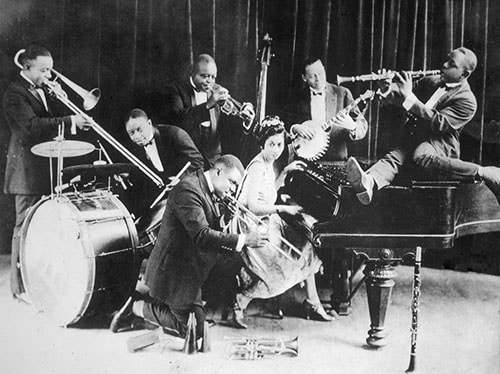
For links to posts on shawms around the world, click here; for a handy list of posts on trumpets, wind and brass bands, here (see also trumpet tag). In a related ball-park, note Black and white.

Officials without culture

*UPDATED!*

Strange—not to say fatuous—goings-on in Pingyi county in Shandong.

I generally give Short Shrift to horror stories in the Western media about new clampdowns on “superstitious practices” in China, finding that they rarely have any perceptible long-term effect at local level. Indeed, I have it on good authority that this latest instance of interference from local government is only a blip, going against the current tide in these more laissez-faire times—but it’s still rather interesting.

A fine article “The endangered sound of suona” by Fu Danni, on the Sixth Tone website, reports on the recent ban on shawm bands at funerals in Pingyi county. But the official directive looks far more disturbing than that—it’s just one aspect of a far more ambitious attempt to limit the length of life-cycle ceremonies and extravagant spending therein. The Pingyi measures even castigate the zacai decorations at the funeral altar as a “corrupt feudal practice”. Similar leftist campaigns, effectively seeking to deprive villagers of their traditional funerary observances, have occasionally been touted ever since traditional life-cycle events revived in the 1980s—a related article makes an ominous comparison with the “Destroy the Four Olds” campaign that accompanied the Cultural Revolution.

But there’s both more and less to this story than meets the eye. Campaigns aimed at enforcing frugality at life-cycle ceremonies have a long and mostly futile history, long before funeral strippers became a routine and salacious media topic (as a quick Google search will reveal). So it’s good to see twenty-one noted Chinese academics protesting at the fatuous recent official directive in a detailed open letter (Chinese text here). Note how adroitly it adopts the language of both Confucian and current CCP values—reminiscent of the recent online rebuffs to the Chinese FA over their attempt to ban Daoist ritual at a football match. The open letter has stimulated much online discussion, in which voices in support of the restrictions are largely drowned out.

Still, however isolated and fleeting such instances of local implementation may be, it’s remarkable that even in 2017 the Pingyi county government announced that it would confiscate musical instruments played at funerals. Sure, this kind of thing has happened occasionally since the 1980s’ revival; generally, as here, the musicians manage to get them back after a while.

Wang Ruiyong’s shawm band in Pingyi, suffering from the recent directive. From Sixth Tone article.

It may be that in Pingyi the shawm bands have unfairly taken the blame; some scholars too have reservations about “other, more vulgar, funeral practices” (like stripping, perhaps), though it’s unclear how a criterion for vulgarity might be policed, short of inculcating norms of public decency—for which cadres are not renowned.

Xingyuan 2011

Burning paper ritual money for the deceased before the coffin—village funeral, Yanggao 2011. My photo.

The article on the Pingyi nonsense observes the flagrant irony of the simultaneous [albeit formalistic and superficial, I should add!] brief of the cultural authorities to document such bands as part of the Intangible Cultural Heritage project—whose agenda has anyway never been exactly ethnographic. But by contrast with the project’s kitsch nostalgic dreams, shawm bands all over China are far from a bastion of tradition. They’re always innovative: for several decades, they have themselves been spontaneously adapting to the times by replacing their traditional repertoire with popular melodies and supplementing their instrumentation with trumpet, electronic keyboard, and drum-kit. You can read all about shawm bands in my post Walking Shrill, and in my books on Yanggao and Shaanbei (both with DVDs); there I documented the rapid substitution of the majestic old suite repertoires with pop music before my very eyes and ears. There are tracks on the playlist too, with notes here.

Were I just a tad cynical [surely not—Ed.], I might say that the Chinese are perfectly capable of diluting their own local traditions without government assistance. This cultural shift has been taking place ever since the early 1980s, as a result not of state interference but of changing popular tastes. And when the article comments that “most suona players have started to take on other jobs”, such as in factories and construction, this too is part of a much wider and longer trend, not some sudden response to the directive—as I noted for the Li family Daoists, the choice to abandon a hereditary tradition is complex.

Though the Sixth Tone article uses the nationally standard term suona for the shawm, it’s good to see the local term wulawa—one of many such names by which this most ubiquitous instrument is known (hence my adoption of the English term shawm, avoiding official vocabulary). And I was glad to see a reminder of the technique of blowing through a hollow reed into a basin of water—standard device for teaching circular breathing to young students.

The article doesn’t mention liturgical performance (such as household Daoists) at funerals, which generally alternates with that of the “secular” shawm bands, but it’s quite possible that there aren’t any ritual groups in this area. Anyway, hiring such bands is only a minor item in the total budget for the funeral family.

Keep calm and carry on

Meixian funeral
Back in 1990 I attended an impressive funeral in Meixian county-town in Guangdong province, with accomplished young xianghua household Buddhist ritual specialists presiding. Above the road outside (where they performed many of their rituals) was draped a slogan advertising a campaign against spirit mediums (cf. my unpublished article “Striking a happy medium”). Of course mediums and liturgical specialists (not to mention shawm bands) provide very different services, but one might suppose that there’s a risk that blanket directives may throw out the baby with the bathwater.slogan Meixian 1990So while there are complex issues at work here, the recent directive illustrates a common befuddled knee-jerk response from local government. If they’re so keen on harking back to Maoist values, they might instead consider a re-education campaign for cadres—it is they who now lead the way in “vulgarity” and “lack of culture”.

Still, I can’t quite join in the general moral outrage over the Pingyi campaign. While it is quite right for scholars (both Chinese and foreign) to protest, at the same time we shouldn’t overestimate the long-term effect of such fatuous official measures. Observers have been lamenting “cultural impoverishment” in China for many decades—indeed, further afield, nay worldwide, the call to “rescue endangered traditions” went out a nanosecond after the birth of anthropology. But change is a constant. As is clear from my recent film and book, since the 1980s’ revival—in both ritual and music—any dilution takes place not so much as a direct result of sporadic leftist campaigns, but under more pervasive socio-economic pressures (to be sure, related to wider political currents) such as urban migration, modern secular education, and the changing tastes of rural patrons as they aspire to the modernity of pop and media culture. Since these are trends with which few seekers of hallowed Chinese traditions tend to engage, the state may seem to make an easier scapegoat.

For a prequel to this story, see here.

Update
Local relations have only deteriorated following the interference of the radical cadres of Pingyi in funeral customs. An article on Chinese Twitter (no longer available) told how irate musicians have ceremoniously burned their instruments in protest. The only good news is that public criticism of the directive forbidding “extravagant” funeral observances is ever-more widespread, both from local villagers and from higher-ranking officials and pundits further afield—again adroitly (indeed convincingly) adducing “cultural heritage” and the good old Confucian values touted by Uncle Xi.

One old musician observed that neither the Allied forces suppressing the Boxers, nor the Japanese invaders, nor even the Four Cleanups campaign had ever managed to silence such bands:

“自打西太后还活着那会儿,咱家就吹;八国联军来了怎么样?照样没碍着,那帮蓝眼珠子都觉得咱这牛逼;后来小日本来了,在他们枪口底下,挺直了腰杆吹,也没人禁过;破四旧那会儿,打和尚烧庙,也都没碰过咱这喇叭。”

From London, or even Beijing, it’s hard to judge what’s going on. The focus on shawm bands still seems something of a red herring. As locals observe, “extravagance is something for people with money—what have the common people got to waste?” The shawm bands are not only inexpensive but utterly “secular”—and again, we’re not being told about the wider restrictions on funeral observances.

This still seems to me like an isolated blip—has anyone heard of serious instances anywhere else recently? It’s all the more curious when funeral customs continue to be observed grandly throughout China—see this recent report on a six-day Daoist funeral in Hunan.

The radical stance of the Pingyi cadres seems deranged. Usually such campaigns blow over (an apt metaphor), or at worst cadres adopt the age-old practice of “one eye open, one eye closed”, or “there’s a policy, but it isn’t implemented”; but here they haven’t backed down, and the musicians’ astute demonstration has gained widespread publicity.

burning shawms

For more background, see here; and for a related debate, here.

Further update
I can’t keep up with all such cases, but this one caught my eye.

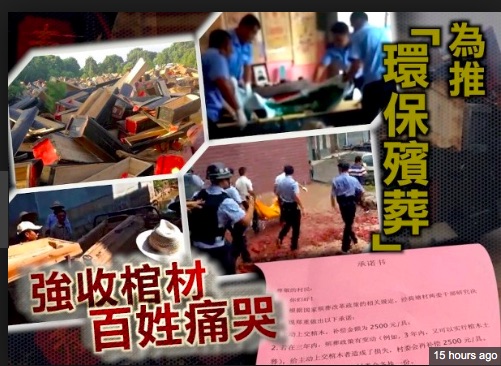
Chinese media (in English, see e.g. here, and this article with further background) are in uproar over a draconian policy in 2018 to destroy coffins in rural Jiangxi province—which one might suppose less vulnerable to radical directives. It’s a misguided attempt both to save land and to discourage extravagant burial rituals.

Jiangxi

Again, campaigns to enforce cremation have a long history, but have been largely ineffective outside the towns.

In this case the protest doesn’t even need righteous netizens—it’s led by the state-run media:

Chinese state media editorials on Monday slammed the policy as “barbaric and unpopular”. Articles in both People’s Daily and Guangming Daily urged the Jiangxi government to rethink its funeral reform.

“Is there any reason to carry out such a rough and even barbaric move?” the editorial in People’s Daily, the mouthpiece of China’s Communist Party, said. “Even if the funeral reforms are effectively carried out, the hearts of the people are hurt and [the administration’s] credibility is lost … [and] built-up resentment triggers instability.”

Even Jiangxi’s department of civil affairs issued a notice saying a number of county-level officials had taken “simplistic and extreme” actions that had “hurt the feelings” of local residents.

Again, it looks like a conflict between particular trigger-happy extremist local governments, with central authorities on the side of the local population.

None of these stories is so simple as blanket state repression: conflicting forces operate. For an even more recent update for Shanxi, see here.

Daoists of Tianzhen, Shanxi

***Link to this page!***

Click above for the latest in my surveys of household Daoist groups in north Shanxi, including Shuozhou and Guangling (not to mention Yanggao, main subject of this blog), as well as Changwu in Shaanxi. They’re now grouped in a sub-menu “Local ritual” under the “Themes” menu.

Here I outline the history and ritual practices of three families of Complete Perfection Daoists in Tianzhen county—a tradition derived from the Nanmen si temple in Huai’an just northeast.

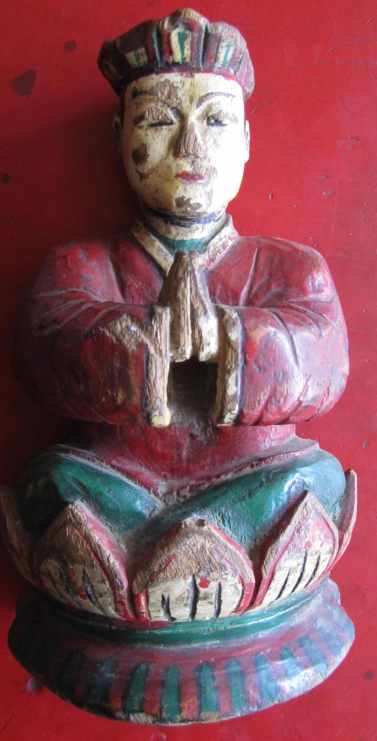
Ning statuette


On visual culture

As with my remarks on punk and so on,

You think I know Fuck Nothing—but I know FUCK ALL!

Or to adapt it to the topic in hand,

You think I know Shag Nothing, but I know CHAGALL!

More genteel would be the old “I Don’t Know Much About Art, But I Know What I Like!” (groan from Myles). So, following Myles, I write this in the spirit of The Plain People of Ireland. As often, I’m seeking clues relevant to my own areas of study, making connections that can easily get buried beneath our individual specialities. Perhaps this post might be entitled Renaissance art for Dummies in the Field of Daoist Ritual Studies—not one of their bestsellers, I suspect.

Sassetta: St Francis giving his cloak to a poor soldier.

I first came across

  • Michael Baxandall, Painting and experience in fifteenth-century Italy: a primer in the social history of pictorial style (1st edition 1972)

while browsing Rod Conway Morris’s library in Venice, along with Horatio E. Brown’s splendidly-titled Some Venetian knockers.

It’s my kind of book, full of the practical detail of materials, technical skill, and patronage, as well as exploring changing perceptions. Quite short, and eminently readable, it gains much from having grown out of a series of lectures that he gave. It addresses issues that I hardly find in discussions of Chinese ritual and music (for any period), so I’d like to explore it at a certain length.

Baxandall opens by encapsulating, in plain and elegant language,** issues that, um, scholars of Daoist ritual (of all periods) should absorb:

A 15th-century painting is the deposit of a social relationship.
On one side there was the painter who made the picture, or at least supervised its making. On the other side there was somebody else who asked him to make it, provided funds for him to make it, reckoned on using it in some way or other. Both parties worked within institutions and conventions—commercial, religious, perceptual, in the widest sense social—that were different from ours and influenced the forms of what they together made.

He observes that

The picture trade was a very different thing from that in our own late romantic condition, in which painters paint what they think best and then look round for a buyer.

Exploring the mismatch between our concepts of “public” and “private”, he notes that

Private men’s commissions often had very public roles, often in public places. A more relevant distinction is between commissions controlled by large corporate institutions like the offices of cathedral works and commissions from individual men or small groups of people: collective or communal undertaking on the one hand, personal initiatives on the other. The painter was typically, though not invariably, employed by an individual or small group. […] In this he differed from the sculptor, who often worked for large commercial enterprises. (p.5)

He meshes all this with detailed technical discussion, like the use of ultramarine:

The exotic and dangerous character of ultramarine was a means of accent that we, for whom dark blue is probably no more striking than scarlet or vermilion, are likely to miss. (p.11)

Thus in the Sassetta painting above, the gown St Francis gives away is an ultramarine gown.

The contracts point to a sophistication about blues, a capacity to discriminate between one and another, with which our own culture does not equip us.

Baxandall notes change over the course of the Quattrocento:

While precious pigments become less prominent, a demand for pictorial skill becomes more so. […] It seems that clients were becoming less anxious to flaunt sheer opulence of material.

But he goes on:

It would be futile to account for this sort of development simply within the history of art. The diminishing role of gold in paintings is part of a general movement in western Europe at this time towards a kind of selective inhibition about display, and this show itself in many other kinds of behaviour too. It was just as conspicuous in the client’s clothes, for instance, which were abandoning gilt fabrics and gaudy hues for the restrained black of Burgundy. This was a fashion with elusive moral overtones.
[…]
The general shift away from gilt splendour must have had very complex and discrete sources indeed—a frightening social mobility with its problem of dissociating itself from the flashy new rich; the acute physical shortage of gold in the fifteenth century; a classical distaste for sensuous licence now seeping out from neo-Ciceronian humanism, reinforcing the more accessible sorts of Christian asceticism; in the case of dress, obscure technical reasons for the best quality of Dutch cloth being black anyway; above all, perhaps, the sheer rhythm of fashionable reaction. (pp.14–15)

To show how skill was becoming the natural alternative to precious pigment, and might now be understood as a conspicuous index of consumption, he returns to “the money of painting”—the costing of painting-materials, and frame, as against labour and skill.

You will no longer be surprised to learn that the Quattrocento division of labour between master and disciples (pp.19–23) reminds me of Daoist ritual specialists.

Baxandall goes on to note the differences in patrons’ demands for panel paintings and frescoes. He attempts to address the issue (even for the time of creation) of public response to painting:

The difficulty is that it is at any time eccentric to set down on paper a verbal response to the complex non-verbal stimulations paintings are designed to provide: the very fact of doing so must make a man untypical. (pp.24–5)

Aesthetic terms expressed in words are contingent, varying from age to age, and anyway elusive. Even with the vocabulary of such accounts, discussing that of a Milanese agent, Baxandall notes:

the problem of virile and sweet and air having different nuances for him than for us, but there is also the difficulty that he saw the pictures differently from us.

He goes on to explore different kinds of viewers’ own exercise of skill in appreciating a painting, with their different backgrounds:

… the equipment that the fifteenth-century painter’s public brought to complex visual stimulations like pictures. One is talking not about all fifteenth-century people, but about those whose response to works of art was important to the artist—the patronizing classes, one might say. […] The peasants and the urban poor play a very small part in the Renaissance culture that most interests us now, which may be deplorable but is a fact that must be accepted. […] So a certain profession, for instance, leads a man [sic—SJ] to discriminate particularly effectively in identifiable areas. (p.39)

Whatever [the painter’s] own specialized professional skills, he is himself a member of the society he works for and shares its visual experience and habit. (p.40)

And given that “most 15th-century pictures are religious pictures”, he asks in detail,

What is the religious function of religious pictures?

His answer, in brief, is that they were used “as respectively lucid, vivid and readily accessible stimuli to meditation on the Bible and the lives of Saints.” But he goes on to enquire:

What sort of painting would the religious public for pictures have found lucid, vividly memorable, and emotionally moving?
[…]
The fifteenth-century experience of a painting was not the painting we see now so much as a marriage between the painting and the beholder’s previous visualizing activity on the same matter. (pp.40–45)

Again he makes the crucial point:

15th-century pictorial development happened within fifteenth-century classes of emotional experience.

Alongside colour, he discusses the beholders’ appreciation of gesture and groupings, adducing dance and sacred drama.

It is doubtful if we have the right predispositions to see such refined innuendo at all spontaneously. (p.76)

And apart from their basic level of piety (largely lost to us today), many of the “patronizing classes” would have assessed the work partly through their knowledge of geometry and the harmonic series.

In Part III Baxandall attempts to sketch the “cognitive style” of the time, with the reservation that

A society’s visual practices are, in the nature of things, not all or even mostly represented in verbal records. (p.109)

Finally he reverses his main argument—that “the forms and styles of painting respond to social circumstances” (and so “noting bits of social convention that may sharpen our perception of the pictures”)—by suggesting that “the forms and styles of painting may sharpen our perception of the society” (p.151).

An old painting is the record of visual activity. One has to learn to read it, just as one has to learn to read a text from a different culture, even when one knows, in a limited sense, the language; both language and pictorial representations are conventional activities. […]

In sum,

Social history and art history are continuous, each offering necessary insights into the other.

Such reflections seem more sophisticated than the “autonomous”, timeless approaches still common in both WAM and Daoist ritual. To be fair, we are quite busy trying to document ritual sequences, hereditary titles, and so on—but the Renaissance scholars have just as much nitty-gritty to deal with too.

* * *
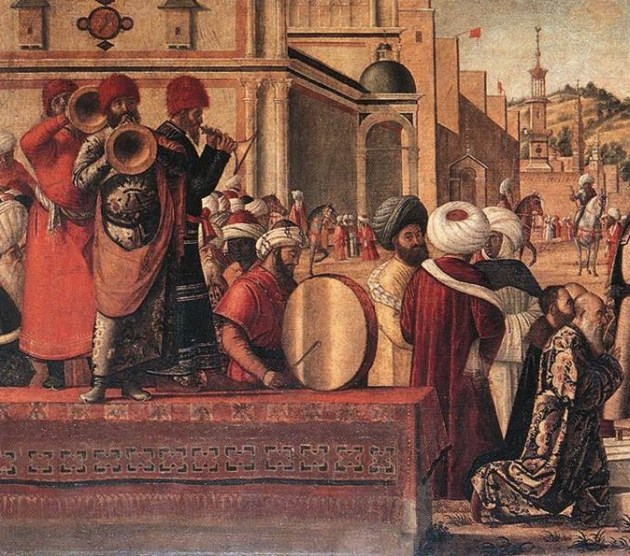
Carpaccio

Carpaccio: Baptism of the Selenites, c1504–7 (detail). San Giorgio degli Schiavoni, Venice.

(The painting features a shawm band that I’d love to hear! For Venice’s musical contacts with the East, see e.g. here).

Baxandall ends with a caveat:

One will not approach the paintings on the philistine level of the illustrated social history.

I don’t think he quite had in mind

  • Alexander Lee, The ugly renaissance: sex, greed, violence and depravity in an age of beauty (2014),

a less technical, more sociological book with a firm political agenda that some may find more appealing than others (cf. this review of Catherine Fletcher, The beauty and the terror: an alternative history of the Italian Renaissance (2020).

Poking around beneath the glamorous surface image of the Renaissance, seemingly “an age of beauty and brilliance populated by men and women of angelic perfection”, he observes:

If the Renaissance is to be understood, it is necessary to acknowledge not just the awe-inspiring idealism of its cultural artefacts but also the realities which its artists endeavoured to conceal or reconfigure.

Lee explores the brutal social universe in which artists were immersed. Like Baxandall, he explores the relationship between artist and his assistants and apprentices:

The relationship was naturally based on work, and hence could often be punctuated by squabbles, or even dismissal. Michelangelo continually had trouble with his assistants, and had to sack several for poor workmanship, laziness, or even—in one particular case—because the lad in question was “a stuck-up little turd”.

Given that patrons were as important as artists in shaping the form and direction of Renaissance art,

Rather than being seduced by the splendor of the works they commissioned, it is essential to uncover the world behind the paintings; a world that was populated not by the perfect mastery of colour and harmony that is usually associated with the Renaissance, but by ambition, greed, rape, and murder.

He shows the often dubious motives of patrons. They often valued a commission “for the contribution it could make to reshaping the image of often extremely disreputable men”. Such works “were intended more to conceal the brutality, corruption, and violence on which power and influence were based than to celebrate the culture and learning of art’s greatest consumers”.

Lee also seriously questions the image of the period as one of “discovery” of the wider world:

In their dealings with Jews, Muslims, black Africans, and the Americas, the people of the Renaissance were not only much less open towards different cultures than has commonly been supposed, but were willing to use fresh experiences and new currents of thought to justify and encourage prejudice, persecution, and exploitation at every level.

I suspect such angles may not go unchallenged, but I find it refreshing. And these unpackings again augment my comments on the “Golden Age nostalgia” of the heritage industry in China.

* * *

jue

China: jue libation vessel, Shang/Zhou dynasty.

Reception history has perhaps become a rather more established feature of visual culture (including the history of art) than for musical culture. The term “visual culture” itself reflects a more mature holistic approach, like that of “soundscape” for ritual music in China, and indeed the whole inclusive brief of ethnomusicology.

As I dip into Marcia Pointon’s History of art; a student’s handbook, she soon observes:

The meanings of the painting will be determined by where, how and by whom it is consumed.
[..]
Art historians are interested not only with objects with but with processes. […They] concern themselves with visual communication whatever its intended audiences or consumers.
[…]
Art historians investigate the origins, the connections between “high” and “low”, and the ways in which imagery such as this contributes to our understanding of a period of historical time, whether in the present or in the far distant past.

On one hand, as with music, we envy earlier viewers/audiences their familiarity with subjects/languages that we can no longer interpret easily, if at all. At the same time we have also lost the shock of the new.

We’re familiar with the idea of restoring old paintings to their original colours—negating their history?—but we can’t perform a similar operation on our eyes and minds. Doubtless there’s a vast scholarly literature on this, but one might be reluctant to remove the patina from Shang bronzes, restoring them to the condition of glossy new Italian kitchenware. For patina, see also Richard Taruskin’s comments on Gardiner’s Schumann.

Just as most people who experienced art in 15th-century “Italy” had access mainly to those works on public display in their particular city, so, long before CDs and youtube, Leipzig dwellers heard little music apart from Bach and the pieces by other composers that he selected, mostly within the Leipzig tradition. Some creators themselves might be so lucky as to travel, gaining a certain experience of other styles. And in both art forms, a majority of such work was contemporary—even the instruments that baroque musicians played were mostly modern.

To try and get to grips with what art and music meant at the time doesn’t make us able to experience it as did the “consumers” of the day—we can’t unsee Monet, TV, or skyscrapers any more than we can unhear Mahler and punk. And I hope our teeth are in a better state.

* * *

I also admire

  • Michael Jacobs, Everything is happening: journey into a painting (2015), [1]

on Velázquez’s Las Meninas (1656)—with chapters by his friend Ed Vulliamy added after Jacobs’ untimely death. As Vulliamy observes,

In this half-book, beyond a fragment, we have not only a typically Jacobs-esque narrative of his life with Velázquez—one of chance encounters, aperitifs, musings and restless autobiography—but also this manifesto for the liberation of how we look at painting. (p.146)

Jacobs does that thing that people always do in blurbs:

cutting a picaresque swathe

—and the picaro simile is fitting. Jacobs was constantly deploring the “sunless” world of academia. He documents the shift in art history that was then occurring widely in scholarship:

Many of the younger lecturers and researchers, conscious perhaps of the lingering popular image of their discipline as a precious and elitist pursuit, began adopting what rapidly became the prevailing art-historical methodology—a pseudo-Marxist one. People who might once have become connoisseurs in tweeds reinvented themselves as boiler-suited proselytisers dedicated to exposing in art revealing traces of the social conditions of a period, often resorting in the process to a hermetic prose peppered with terms I had first come across in Foucault, such as “discourses” and “the gaze”. (p.44)

Oh all right then, I’ll go for a hat-trick:

You think I know Fuck Nothing, but I know FOUCAULT!

(Note on pronunciation: whereas I can only hear “You think I know Fuck Nothing, but I know FUCK ALL!” in the caricature-Nazi accent of Karl Böhm, the above bon mot clearly belongs on the foam-specked lips of an angry young Alexei Sayle.)

By contrast with the treatments of Baxendall and Lee (themselves quite different), Jacobs’ approach is based on including “us”, the viewers, as agents in the picture—whatever his reservations, he was inspired by Foucault.

Proust, writing on Rembrandt, had spoken about paintings as being not just beautiful objects but also the thoughts they inspired in their viewers. [Svetlana] Alpers was cited as saying that “looking at a work in a museum and looking at other people looking at a work in a museum is like taking part in the life story of this work and contributing to it.”

Still, Jacobs ploughed his own furrow. As Paul Stirton recalls,

Michael always believed in the wonder of looking. Yes, there may be a profound message in a painting, but Michael didn’t want to dress it up in philosophical trappings. By all means approach a painting in a scholarly manner, but never lose the wonder. (pp.179–80)

In his book about artists’ colonies at the end of the nineteenth century, The good and simple life, he is scathing about how most painters wanting to live that life considered “the downtrodden country folk … as little more than quaint components of the rural scene. Their social conscience was as little stirred by them as by pipe-playing goatherds in the Roman Campagna.” At moments, though he is the antithesis of a “political” art critic, Michael’s writing reads like Walter Benjamin fresh from his Frankfurt School, but with a glass of Sangria in his hand. (p.182)

From both his own experience and Thomas Struth’s photos of the public response to Las Meninas over several days, Jacobs recalls

All the faces of the bored, the transfixed, the distracted, the deeply serious, the adults whose only concern was to get the perfect snap, the school children who were wondering when their ordeal would be over, the others who fooled around or diligently made notes, the few whose lives were being transformed. (pp.69–70)

So (suitably) like Monty Python’s Proust sketch, Jacobs never quite got as far as discussing the painting “itself”—not so much due to his death, as by virtue of his propensity to dwell on personal reminiscences on modern Spanish history and his own relationship with it and the painting.

He remarks wryly on the images of Spain current in his youth, reminding me of images of China, not to mention Away from it all. He recalls a train journey in the early years of Spain’s transition to democracy, when he was reading a book that

gave no hint of Spain’s repressive military regime, but instead referred to the country’s “growing agricultural and industrial prosperity” and to the “happy coexistence of the old and the new”.
The book’s role as a catalyst for my early, life-changing Spanish journeys was due entirely to its black-and-white photos, which neglected this supposedly modern and prosperous country in favour of basket-laden donkeys, adobe-walled farms, palm groves, sun-scorched white alleys and other such images that endowed Spain with a predominantly medieval and African look. Even Madrid, so regularly criticized by past travellers for its brash modernity, was made to seem more exotic and rural than any other western city I had seen. The sole street-scene was one of a large flock of sheep being herded in front of a neo-Baroque, cathedral-like post-office building popularly dubbed “Our Lady of the Post”. (p.60)

He discusses the fortunes of Las Meninas during the civil war, as well as more recent events:

… closed shops wherever you looked, restaurants offering “crisis menus”, daily protests, and graffiti and posters revealing grievances with everyone and everything, from the monarchy, to the banks, to the multinationals, to the European Community, to the politicians who made Spain the country with the the highest number of politicians per capita in Europe. (p.72)

And he describes the painting’s changing frames and settings:

The Sala Velázquez was like a shrine. […] On entering this inner sanctuary, people took off their hats, spoke in low voices, and tiptoed around so as not to destroy the atmosphere of worshipful solemnity. Every so often someone would be observed bursting into tears.
There were of course others visitors who disliked this room’s churchlike theatricality and the sentimentally nationalistic and mindless emotional reactions it inspired. (p.115)

So as it stands, Jacobs’ book is concerned more with reception history than with the society of the time of the creation of Las Meninas (though he explored this elsewhere, and doubtless had voluminous notes on the painting to supplement existing research). Background on the society of Velazquez’s day is provided mainly by Vulliamy’s fine Introduction. Evoking Lee, he notes that Seville, far from “the great Babylon of Spain, map of all nations”,

was also headquarters of the Inquisition. Indeed, the “Golden Age” which followed the unification of Spain in 1492 was accomplished, writes Michael Jacobs, “in a spirit of brutal fanaticism”, with the expulsion or enforced conversion of Andalucia’s many Moors and Jews. This dogmatism and what we would now call “ethnic cleansing” [here Vulliamy writes with traumatic personal experience in Bosnia] had a major and insidious demographic impact on the city, yet Seville remained characterized by “an architecture … of great contrasts”, wrote Michael, “for alongside the Muslim-inspired love of decorative arts richness is an inherently Spanish love of the austere”.

For a similar approach that sets forth from 17th-century Delft to go global, note Timothy Brook’s brilliant book Vermeer’s hat.

    * * *

GL Ten Kings

Yama King painting from Ten Kings series, North Gaoluo 1990.

All these books incorporate ethnography and reception history far more than the fusty old reified appreciation of “autonomous” objets d’art. For China,

  • Craig Clunas, Art in China (1st edition 1997)

makes a useful, wide-ranging, and thoughtful introduction, exploring themes like genres, techniques, functions, patrons, markets, producers, class, and gender.

For instance, discussing a wooden sculpture of the female deity Guanyin from Shanxi carved c1200 CE, he describes its original multi-coloured decoration:

All this added to the immediacy of the image for worshippers, but it was covered over at some point, probably about 300–400 years later in the Ming dynasty (1368–1644), when it was painted gold in imitation of a gilded metal sculpture. Such an aesthetic change must have gone hand in hand with some change in the understanding of what a successful image ought to look like, a change at the level of both popular belief and the attitudes of religious professionals which is as yet hardly understood. (pp.56–7)

Whereas much scholarship remains based on artefacts in museums and galleries, fieldwork reveals a vast further repository of images still used in ritual practice. One thinks of the vast hoard of religious statuettes found in rural Hunan, subject of fine research.

And apart from statues and temple murals, ritual paintings depicting the Ten Kings and the punishments of the underworld—hung out for temple fairs and funerals—suggest comparisons with Christian equivalents in medieval and Renaissance art. And they too must have changed their meanings for audiences over recent centuries. At least, illiterate rural audiences would be affected rather deeply, and modern viewers may be underwhelmed now that they are saturated with horror films and video games. But we learn rather little about this from the scholarship; Daoist culture tends to be reified. Meanwhile, household ritual specialists have continued to perform Ten Kings scriptures for funerals.

It reminds me, challenged as I am in the field of visual culture, that ritual images through the ages also need unpacking—assessing changing meanings there too, including early sources for music iconography.

This has a lot to do with reception history. Such studies of visual culture may feed into our experience of Bach and all kinds of early and folk music. If even scholars of WAM and Renaissance painting feel it germane, then studies of Chinese musical cultures, and of Daoist ritual, shouldn’t lag behind.

* * *

But I’d like to end with some more populist vignettes (“Typical!”) on the meanings of art.

Among the numerous virtues of Alan Bennett is his accessible promotion of painting, found in Untold Stories (pp.453–514) [2]notably a talk he gave for the National Gallery, with the fine title “Going to the pictures”. These essays are also a passionate plea for culture to remain accessible, a rebuke to mercenary philistine governments.

He recalls an inauspicious early lecture he gave at Oxford on Richard II:

At the conclusion of this less than exciting paper I asked if there were any questions. There was an endless silence until finally one timid undergraduate at the back put up his hand.
“Could you tell me where you bought your shoes?”

 We’ve all been there. But his remarks on painting are priceless:

Somewhere in the National Gallery I’d like there to be a notice saying, “You don’t have to like everything”. When you’re appointed a trustee, the director, Neil MacGregor, takes you round on an introductory tour. Mine was at 9am, when I find it hard to look the milkman in the eye, let alone a Titian.

We were passing through the North Wing, I remember, and Neil was about to take me into one of the rooms when I said, “Oh, I don’t like Dutch pictures”, thereby seeming to dismiss Vermeer, De Hooch and indeed Rembrandt. And I saw a look of brief alarm pass over his face as if to say. “Who is this joker we’ve appointed?”

He cites his play A question of attribution, about (Michael Jacobs’ teacher) Anthony Blunt:

“What am I supposed to feel?” asks the policeman about going into the National Gallery.
“What do you feel?” asks Blunt.
“Baffled,” says Chubb, “and also knackered” … this last remark very much from the heart.
[… Blunt] tries to explain that the history of art shouldn’t be seen as simply a progress towards accurate or realistic reprentatation.
“Do we say Giotto isn’t a patch on Michelangelo because his figures are less lifelike?”
“Michelangelo?” says Chubb. “I don’t think his figures are lifelike frankly. The women aren’t. They’re just like men with tits. And the tits look as if they’ve been put on with an ice cream scoop. Has nobody pointed that out?”
“Not quite in those terms.”

In a *** passage AB blends hilarity with insight, evoking Baxandall:

In A question of attribution the Queen is made to have some doubts about paintings of the Annunciation.
“There are quite a lot of them,” says the Queen. “When we visited Florence we were taken round the art gallery there and well … I won’t say Annunciations were two a penny but they were certainly quite thick on the ground. And not all of them very convincing. My husband remarked that one of them looked to him like the messenger arriving from Littlewoods Pools. And that the Virgin was protesting that she had put a cross for no publicity.”
This last remark, though given to the Duke of Edinburgh, was actually another flag of distress, stemming from my unsuccessful attempts to assimilate and remember an article about the various positions of the Virgin’s hand, which are an elaborate semaphore of her feelings, a semaphore instantly understandable to contemporaries but, short of elaborate exposition, lost on us today. It’s a pretty out-of-the-way corner of art history but it leads me on to another question and another worry.
Floundering through some unreadable work on art history I’ve sometimes allowed myself the philistine thought that these elaborate expositions—gestures echoing other gestures, one picture calling up another and all underpinned with classical myth—that surely contemporaries could not have had all this at their fingertips or grasped by instinct what we can only attain by painstaking study and explication, and that this is pictures being given what’s been called “over meaning”. What made me repent, though, was when I started to think about my childhood and going to a different kind of pictures, the cinema.
When I was a boy we went to the pictures at least twice a week as most families did then, regardless of the merits of the film. I must have seen Citizen Kane when it came round for the first time, but with no thought that, apart from it being more boring, this was a different order of picture from George Formby, say, or Will Hay. And going to the pictures like this, unthinkingly, taking what was on offer week in week out was, I can see now, a sort of education, and induction into the subtle and complicated and not always conventional moral scheme that prevailed in the world of the cinema then, and which persisted with very little change until the early sixties.

Unpacking the complex attributes of two stock characters, he concludes:

The 20th-century audience had only to see a stock character on the screen to know instinctively what moral luggage he or she was carrying, the past they had, the future they could expect. And this was after, if one includes the silent films, not more than thirty years of going to the pictures. In the sixteenth century the audience or congregation would have been going to the pictures for 500 years at least, so how much more instinctive and instantaneous would their responses have been, how readily and unthinkingly they would have been able to decode their pictures—just as, as a not very precocious child of eight, I could decode mine.
And while it’s not yet true that the films of the thirties and forties would need decoding for a child of the present day, nevertheless that time may come; the period of settled morality and accepted beliefs which produced such films is as much over now as is the set of beliefs and assumptions that produced an allegory as complicated and difficult, for us at any rate, as Bronzino’s Allegory of Venus and Cupid.

For a similar case, see here.

* * *

Apart from any intrinsic merit this little tour of visual culture may have, for me it also suggests several angles barely explored for Daoist ritual.

OK then, just one last aperçu—this time from Kenneth Clark (thanks, Rod). On the contrast between reified art and social reception, here’s his typically urbane formulation in Civilization:

At some time in the 9th century one could have looked down the Seine and seen the prow of a Viking ship coming up the river. Looked at today in the British Museum, it is a powerful work of art; but to the mother of a family trying to settle down in her little hut, it would have seemed less agreeable.

On behalf of the splendid Craig ClunasI accept full responsibility for any inanities in this post.
If you all play your cards right, I promise not to do this kind of thing too often. Craig and any other art historians who have managed to read this far might care to exact revenge by writing Specious Flapdoodle
[famous 19th-century Baptist pastor—Ed.] about early music or Daoist ritual… 


** Not, may I just say, the kind of moronic homespun language used by one maniacal Führer about another: “smart cookie” or “total nut-job”? Roll over Cicero.

[1] Some stimulating reviews may be found herehere, and here.
[2] Online excerpts include http://www.independent.co.uk/life-style/i-know-what-i-like-but-im-not-sure-about-art-1620866.html and https://www.lrb.co.uk/v20/n07/alan-bennett/alan-bennett-chooses-four-paintings-for-schools.

Temple murals of north China

Temple ritual, Yuxian 2014. Photo: Hannibal Taubes.

Further–waay further—to my page on the Guangling DaoistsHannibal Taubes has a fine, ever-growing, website documenting his ongoing research project (worthy of further funding!) on the iconography of rural temples in north China, with wonderful photos of murals taken by him and his assistants.

One of his main sites is the Yuxian–Guangling–Yangyuan region on the border of Hebei and Shanxi. The project—reminiscent of that of Willem Grootaers in the 1940s—is another illustration of the hidden depths of ritual culture in north China, so long a poor cousin of the south.

Such work can be a valuable adjunct to fieldwork on ritual practice. I hesitate to look forward to Hannibal expanding his already vast project to ritual paintings, and incorporating temple steles too…

Material like this may be more fruitful for the study of deities than for actual ritual life. But just a couple of examples from the website that do suggest the latter, from village temples in Yuxian just southeast of Yanggao. This is from a Dragon King temple in Yuxian, perhaps dating from the late Qing:

full mural lowres

Photo: Hannibal Taubes, 2018.

Here are two details of the procession at the foot. Leading the way, as ever, is a shawm band—in uniform, which by the 20th century was discarded:

chuishou lowres

Photo: Hannibal Taubes, 2018.

Bringing up the rear, on the left (after the temple helper bearing the ritual umbrella) it shows a Daoist band—with chief vocal liturgist, a drum master, and players of the sheng mouth-organ, yunluo frame of ten gongs (now quite rare in the area), and guanzi oboe. The outsider might easily fail to notice that the latter figure (far right) is playing the guanzi—but locals, experiencing the shengguan ensemble at their village rituals all their lives, will recognize it at once.

yinyang lowres

Photo: Hannibal Taubes, 2018.

I won’t quibble with the marching order—the drummer always leads the way, but hey.

Below we see a similar quorum from another nearby Dragon King temple, dating from 1709. Here they wear the same red costumes as household Daoists today—as do the two trumpet players leading the way, though they should be from a separate shawm band…

Daoist procession

Photo: Hannibal Taubes.

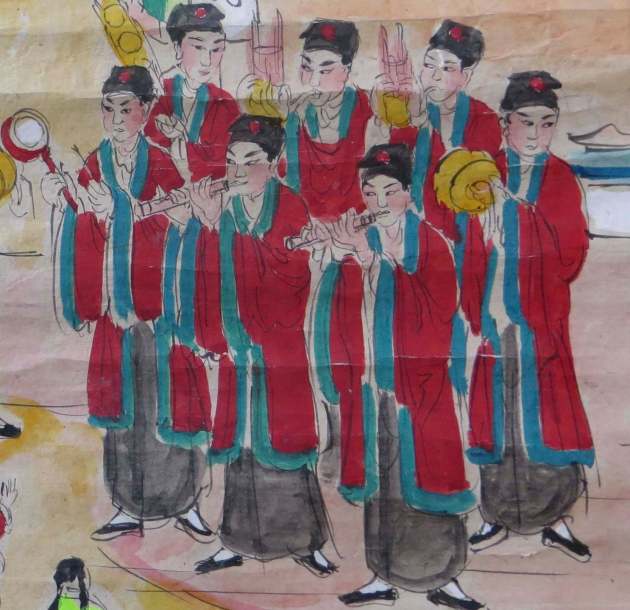
As with any such iconography (one thinks of Renaissance depictions of angel musicians), we are confronted with the issue of how “realistic”, or how generic and idealized, such depictions may be as a portrayal of local ritual life at the time. This detail from my photo of a ritual painting by Li Qing’s Daoist uncle Li Peisen undoubtedly shows an authentic view of a 1940s’ ritual band (standing) such as the one that he himself led, with a group of seven—two guanzi, two sheng, yunluo (only three gongs?!), drum, and small cymbals:

painting-detail-cropped

The dizi flute, usually a member of the full shengguan ensemble, was perhaps less often used on procession—indeed, it’s largely fallen from use in this area since the 1990s. For the public ritual in the painting, the Daoists wear their red fayi costumes over their black dashan costumes, just as today. Interpreting such details is naturally informed by knowledge of the current scene.

Apart from another ambitious collaborative project on Shanxi temple murals, Hannibal is now further presenting his vast archive in a separate website, which I introduce here.

Of course art is a valuable adjunct to our studies of ritual and religious life, but with my own stress on performance I find myself frustrated that it’s static, two-dimensional, and silent. But whatever your angle on Chinese religion, Hannibal’s sites are fantastic new material, with rich potential. For his recent article on the use of perpectival painting, click here.

In memory of Natasha

Natasha 2

This week is the fourth anniversary of the loss of my friend Natasha at the age of 34—younger than Mozart, and just less than two years after Amy Winehouse’s death.

Unable to do anything at all for months after, I thought I’d better not cancel my planned stay with Li Manshan in September, and indeed he and the other Daoists were understanding, easing me back to life. The Li family had themselves suffered a family tragedy at just the same time. The funeral rituals they perform are always moving, but now, as the sounds of shengguan blending with the vocal liturgy soared above the kowtowing kin, I felt their grief more personally.

Natasha left barely a trace on the world apart from her wonderful kids. I dearly want to write a book on her, but since I now find I know nothing about her, this tribute will have to suffice.

Natasha smile

“Troubled genius” doesn’t do Natasha justice. She deeply touched all who met her; irresistible, she could be impossible. She was the incarnation of Elena Ferrante’s Lila.

Her wild and prodigious early life was spent in Ternopil in west Ukraine. She made her home in London aged 18. Painter and composer, with her icons and Tarot, electronica, Bach, and Arvo Pärt, earth mother and sophisticated cook, femme fatale with her look of heroin chic, chunky jewelry and slinky outfits, finally holding down a mundane job for the sake of surviving as a single mum after teaching and playing in a rock band, childlike and severe, intoxicating and intoxicated, insatiable and hallucinatory, her thirst for knowledge reflected in her multi-coloured notebooks full of sketches and musings, she was on another planet. Hearing TurangalîlaragaMozart, or Naturträne through her ears, deep in her soul, was overwhelmingly intense.

Natasha painting

Natasha’s paintings were both radiant and disturbed—her later works were yet darker. Klimt and Schiele would have lapped her up (and she them). It wasn’t easy for her inhabiting a world of Parajanov:

We were supposed to be going to Mahler 5 at the Proms when she had her first heart attack. This is a perfect version of her song, with Magdalena Kožená and Claudio Abbado:

Thriving on impermanence, that I get. But Natasha, you have to keep living…

Trauma: music, art, objects

Norman Lebrecht has long laid bare the links of celebrated senior conductors (as well as Karajan…) to Nazism: it’s one subtext of his fine book The maestro myth.

I just read his review of Fritz Trümpi, The political orchestra: the Vienna and Berlin Philharmonics during the Third Reich.

The book actually takes the story through to our own times. As Lebrecht observes, neither orchestra emerges with any credit—indeed, it’s a shocking account.

For me, as a teenager in the National Youth Orchestra (of GB), another inspiring conductor (apart from Boulez) was Rudolf Schwarz (1905–94). Member of the Vienna Philharmonic in his youth, later inmate of Auschwitz and Belsen, after the liberation of the camps he eventually ended up in Bournemouth, remoulding the orchestra there. His Bruckner 7 with the NYO was wonderful—all the more intense with his laboured conducting style, partly the legacy of a broken shoulder-blade in Auschwitz. Never a superstar in the Karajan mould (which was why musicians appreciated him), he was a formative influence on the young Simon Rattle, my contemporary in the NYO.

Bruckner 7 is in the incandescent key of E major, just like the basic scale of the Li family Daoistsshengguan ensemble—I often think of it while I listen to the shengguan piercing the bright blue sky of rural north China (e.g. playlist, #4, with commentary here).

Meanwhile, as Rudi was being dragged through the camps, here’s Wilhelm Furtwängler conducting the Adagio with the Berlin Philharmonic in 1942. Like Philippe Sands’ choice of Bruno Walter conducting Mahler 9 in 1938— and just as with Daoist ritual—we have to personalise such seemingly disembodied works, and place them in time.

You can find a newly remastered version here. For Celibidache’s Bruckner 7, see here.

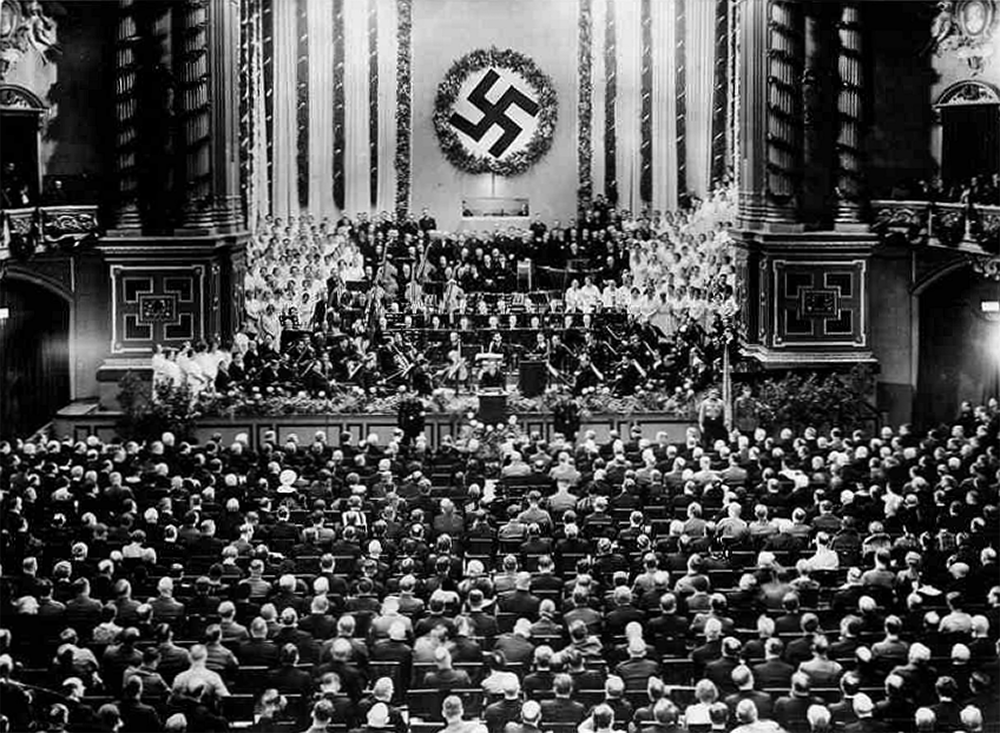
Furtwängler’s relationship with Nazism has been much debated. Generally reluctant to collaborate, he did what he could, even helping some Jews escape, and with close ties to the resistance. Yet inevitably people baulk at his participation in events like this Beethoven 9 for Hitler’s birthday, also in 1942:

Lebrecht sums up his legacy (The maestro myth, p.93):

In Furtwängler the Nazis retained an interpreter who performed German music with undiminished conviction while genocide was committed in his name. By opting to remain, he endowed the Nazis with cultural respectability at a  crucial moment in their ascent, and in wartime gave moral sustenance to their cause. In his confrontations with tyranny, Furtwängler proved a feeble adversary who was all too easily manoeuvred into outright collusion. The humanity he expressed in music was traduced and travestied by his paymasters. His legacy as a performer may well be among the most significant in the annals of conducting, but his conduct under political pressure compromised the very profession on which he wielded so formative an influence. [for Lebrecht’s more recent exposé, see here.]

Still, it’s easy for us to say that. Reflecting on the Nazi era from the perspective of our blessed safety from invasion and  agonising choices, Neil MacGregor poses the disturbing question “What would we have done?”. In his brilliant 2014 book Germany: memories of a nation (and no less enchanting are his podcasts—the perfect Radio 4 voice!), using both works of art and everyday material objects, he ponders how we can fit the great humanistic traditions of Germany into the same picture with Nazi barbarism. And having suffered throughout this whole period, people of Central and Eastern Europe would still have to continue making appalling moral choices for decades to come.

Apart from MacGregor’s astute discussions of earlier historical artefacts, one can’t help being drawn into those from more recent history—like the slogan (“to each what they are due”) above the camp gates of Buchenwald—just a few miles outside the Weimar of Goethe and Bach:

Bwald

MacGregor observes the noble lineage of words that had once signified an ideal of justice—the very words that Bach used as the title of a cantata in 1715 Weimar. Indeed, as a prelude to John Eliot Gardiner’s epoch-making Bach Cantata Pilgrimage all through 2000, I played a modest role in the Christmas oratorio at the Herderkirche in Weimar—here’s Part One. Next day we all visited Buchenwald.

I’m not sure we can derive any encouragement from MacGregor’s idea that the stylish lettering of those words above the gate (designed by an inmate, Communist and former Bauhaus student Franz Ehrlich) might be read by fellow inmates as a subtly subversive message that the SS would eventually get their just deserts. By the way, Ehrlich survived, also disturbingly, to become a Stasi informant under the GDR.

MacGregor gives a fine diachronic survey of Käthe Kollwitz’s work,

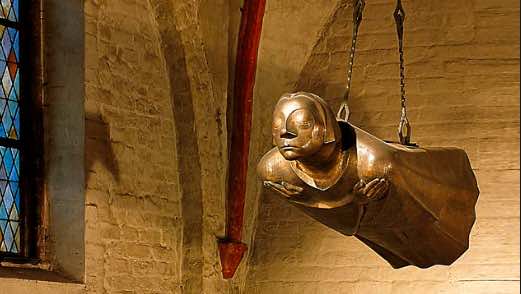
as well as the incarnations and migrations of Ernst Barlach’s Hovering angel (1926, cf. the 1966 GDR film The lost angel),

angel

along with reflections on Remembrance ceremonies.

But he also discusses movingly the “rubble women” (Trümmerfrauen) who rebuilt shattered Germany after the war, and objects such as a little hand-cart pulled by refugees from Eastern Pomerania in late 1945—now reminding us tellingly of the refugee crises of our own day.

The wonderful Forum of Contemporary History in Leipzig has a similar exhibit.

But to return to Trümpi’s book, this tale of two orchestras brings us, shamefully, right up to the lives of my generation and later. It was not until 2013 that the Vienna Philharmonic revoked the Ring of Honour it had bestowed on three leading figures in the Nazi genocide—including Richard Strauss’s patron Baldur von Schirach, who (also in 1942) described the deportation he oversaw of 65,000 Viennese Jews to the death camps as a “contribution to European culture”. Indeed, our feelings about those celebrated Viennese New Year’s concerts can’t help being stained by learning that it was Schirach who instigated them.

As an aside, these orchestras haven’t exactly been at the forefront of gender equality either. Competing hotly in the misogyny stakes with “Rear Admiral” Foley, Karl Böhm (a Great Maestro far more flawed than Furtwängler) is quoted as saying that “the Nazis aren’t that bad—they want to eliminate women from politics.” Digging himself into a deeper hole, he went on, “Of course, not all women are worthless—Rainer Maria Rilke [sic] wrote some good poems.”

And now there are new causes for anxiety, threatening all the liberal values that have been achieved so painfully over several centuries.

NB also posts on Ravensbrück, SachsenhausenMetamorphosen, A Nazi legacy, The Ratline, and Gitta Sereny; as well as posts on Maoism in China, starting here; see also under Life behind the Iron Curtain, as well as Aleppo: music and trauma.

Shanxi, summer 1992

Partly to remind myself that I don’t only do jokes, here are some more fieldnotes.

I’ve already noted the differences between our early fieldwork in the 1990s and conditions more recently. So I thought I’d give you a flavour of one of those earlier fieldtrips.

Over the hot summer of 1992, following hot on the heels of the Wutaishan Buddhist group’s visit to England, Xue Yibing and I made a three-week trek from Taiyuan northwards through Wutai, Xinzhou, Daixian, and Hunyuan, finding ritual activity all along the way, en route for another rendezvous with the great Li Qing in Yanggao. Our last stop was nearby Yangyuan county, just in Hebei.

Since our fruitful initial survey of ritual associations in Hebei over New Year in 1989, this was my fourth fieldtrip with Xue Yibing. Before we could return to the Hebei plain, and before I began to focus on particular villages and families, this was still only a partial survey of central and north Shanxi—for what became Chapter 12 of my book Folk music of China.

We had a van and a driver from the MRI at our disposal, and for parts of the trip we were accompanied by Shanxi scholars Jing Weigang and Wang Bin, whose local knowledge was valuable. We were mostly unencumbered by the need to “kowtow to the Gods of the Soil”, except when we knew there was a knowledgeable scholar—like the senior Liu Jianchang in Taiyuan, who was studying the Buddhist ritual music of the Wutaishan mountains through the 1950s whenever political conditions allowed. All along the way we found local traditions, differing significantly from each other. [1] Power cuts were frequent. And before motorways, our progress was often far from smooth; even on the main roads we generally found ourselves crawling along behind long lines of coal lorries.

stuck-in-mud

Dongye township
In central Shanxi, I had already visited central Wutaishan, so I was interested to explore the outlying areas. While we found many shawm bands (here called gufang 鼓房), our main interest was in ritual shengguan bands (here called xiangda 响打). Though they were rarely ritual specialists with vocal liturgy, some bands performed a fine repertoire of long suites related to the temples of Wutaishan and Beijing—the kind of groups found by the great Yang Yinliu in 1953, in whose steps we were now following.

dongye-chubin

Funeral procession, South Daxing, Dongye.

We spent time with one such band, led by Xu Yousheng in Dongye.

It soon became clear that this whole area was also a hotbed for female spirit mediums, including Xu Yousheng’s wife. These mediums did exorcistic rituals as a group, singing ritual songs a cappella. In this photo, at Xu Yousheng’s house near Dongye, his wife and her fellow medium pose before ritual paintings commissioned by him.

mediums

This page from Xue Yibing’s precious notebook lists the gods on the pantheon to the right in the photo.

xu-pantheon-xyb

In this detail, the “young soldier god” features because a medium had divined that he once saved the life of Xu’s son while he was in the army:

painting-detail

For more on such pantheons, see the remarkable website of Hannibal Taubes.

The Xinzhou region
In this large and mountainous region we found more household Daoists (this time of the Complete Perfection branch!), as well as a thriving community of Catholics who also used shengguan music to accompany their rituals.

christians-1992

The Ekou Buddhists
After digging our van out of the mud yet again, we reached Ekou township in Daixian county, in the northern foothills of Wutaishan. I was hoping to see Chengde, lovely former Buddhist monk whom I had hosted in England a few weeks earlier. But he was doing a temple fair some distance away—so we had a chat with his older brother, who provided us with useful detail on local ritual life there. This was one of rather few occupational household Buddhist groups that we found.

ekou-painting-1

Old pantheon at Chengde’s house.

Hunyuan
Arriving hot and sweaty in the (then) cosy little hill town of Hunyuan (at the foot of Hengshan, the northern marchmont of Daoism), we checked into a modest hostel. On the guest registration form, under “Level of Culture” (wenhua chengdu 文化程度) I wrote “None” (wu 无), as is my wont.

After a long drive and many days in scorching temperatures without running water, we were delighted to find that not only did our room have a bath, but that hot water was promised (typically “after 8pm”, which often means either “never” or “from 3.30 to 3.35 am”).

The bathroom wasn’t exactly hygienic, but hey, we weren’t fussy—ruxiang suisu, “when in Rome…”. Xue Yibing rashly took the plunge first, and he was just sinking into the water in ecstasy when the ceiling (exhausted by unprecedented strains on the plumbing above) promptly caved in, covering him in rusty debris (or is that the name of a Country singer?). Adopting what Nigel Barley calls “fieldwork mode”, we both burst out laughing. He came out a lot dirtier than he went in.

Next day we found no ritual activity at the Hengshan mountain temples, but in town we found yet another great family of household Daoists.

hunyuan-ritual

hunyuan-manual

Page from ritual manual: end of Fetching Water ritual and opening of Dispensing Food.

This group belonged to a lengthy Orthodox Unity lineage. By the time I went back to see them in 2011 with the wonderful Li Jin, significant changes had taken place in their practice (see fieldnotes here).

The north
After a brief visit to more Orthodox Unity household Daoists in Datong county, we reached Yanggao, where I was delighted to find Li Qing again, performing a funeral with his ritual band. He also managed a long session with us, providing detailed accounts of ritual sequences, augmenting my notes from the previous year.

After a brief and rather unedifying stop-off in Yangyuan county, we made our way back to Beijing. Upon my return, I once again (as usual) sought out former monks, before we set off once more for Liaoning in the northeast, finding majestic shawm bands there too…

* * *

Such early fieldtrips with Xue Yibing were an important training for us both, before we launched into more in-depth study of the Hebei ritual associations. I always treasure his notes, but however brief our visits on that Shanxi trip, the three hand-written volumes he copied out for me are full of wonderful ethnographic detail on folk religion.

Since 2011, having profited from collaborative fieldwork for twenty-five years, I have largely engaged with the Li family Daoists on my own, regaining a certain self-esteem—except for the occasional mishap


[1] For more detail on most of these sites, see my In search of the folk Daoists, pp.65–81; Chen Yu, Jinbei minjian Daojiao keyi yinyue yanjiu, pp.65–90 and passim. For a richly-illustrated overview of folk customs throughout Shanxi, see Wen Xing 文幸 and Xue Maixi 薛麦喜 (eds.), Shanxi minsu 山西民俗 (Taiyuan: Shanxi renmin cbs, 1991).

Two local cultural workers

These notes are partly stimulated by Zhang Lili, currently writing her PhD in Beijing on my relationship with the village of South Gaoluo, subject of my book Plucking the Winds.

A useful idiomatic term evoking the whole spectrum, whether of guanxi contacts or the range of funeral services, is yitiaolong “the whole dragon” (indeed, this blog may itself be considered “the whole dragon”, making links between seemingly diverse topics).

Li Bin’s first funeral shop in town.

Li Bin’s funeral shop in Yanggao county-town, Shanxi.

So having praised Yang Yinliu, shining pinnacle of Chinese musicology, I want to pay tribute to two admirable local cultural workers at the opposite end of the dragon (cf. An unsung local hero) whose work has inspired us since 1989:

Liu Fu 刘阜 and Wang Zhanlong 王占.

Their only qualification was that they were local, and came to take pride in documenting their local traditions under the stimulus of the new directive from the Anthology of folk music of the Chinese peoples, the vast project that got under way from 1979 as China began to liberalize after the collapse of Maoism.

Let me adapt a passage from my article

  • “Reading between the lines: reflections on the massive Anthology of folk music of the Chinese peoples”, Ethnomusicology 47.3 (2003), pp.287–337 (for reading between the lines of a Chinese article on 1950s’ Tibet, see here).

Antoinet Schimmelpenninck described the process of collecting folk-song in Jiangsu in the early 1990s.

The collecting of folk-songs is one task, but by no means the only or primary task of the bureaus of culture. They carry out political propaganda, make posters about family planning or about the punishment of local criminals, organize dance parties, stage plays and children’s games for local entertainment, run libraries, and execute various administrative tasks which help the provincial government. […]
It is not, at present, one of the specific tasks of the Cultural Bureaus of the Wu area to collect folk-songs. I visited one wenhua zhan (village cultural post) which was mainly engaged in printing labels for jam jars and other consumer goods.

Censorship may operate throughout the process: first, self-censorship of performers (e.g. what kind of songs singers see fit to sing for fieldworkers), and then editorial adaptation of the material collected. In Baoding, one single region of Hebei province, where ritual associations have important traditions, such fieldwork as was done on “instrumental music” took place mainly from 1983 to 1985, but in only two or three of a dozen counties we have visited did we find knowledgable cadres who had done such work.

One of the most diligent of these was Liu Fu, of the Hall of Culture in Laishui county. He acted early on the Anthology directive, printing a mimeograph (4 pp. introduction, map, list of contents, 128 pp. transcriptions, 22 pp. field report, 8 pp. diagrams of instruments) on the county’s instrumental music as early as 1983, which was an important inspiration for my own work on ritual associations there. I don’t know if the regional editors ever forwarded Liu Fu’s work, but it was entirely omitted from the final provincial publication. The following passages of his “Field report” show some of the problems faced by local collectors, here partly relating to the sensitive and secret nature of ritual music:

The work of collecting folk instrumental music is not always smooth: we have met considerable difficulties. For instance, some elderly folk musicians had been struggled against during past campaigns for this [their music/ritual], and had been labelled as “black cliques” and “ox demons and snake spirits”, so they are still anxious. When they heard that we wanted to collect pieces of music, they suspected that it was once again “luring the snake out of its hole”, and so they refused to play for us.

Some associations are very conservative in their thinking, and are concerned that their distinctive pieces will be taken off and learnt by others—in their own words “something we begged for on our knees, we can’t just throw it out now we’re on our feet”, and so they make excuses not to play for us. Some associations take the opportunity to make economic demands. Some brigade [village] cadres think this work is meaningless, and are afraid it might have side-effects, and so are unwilling to co-operate with us. And so on.
Since these are ritual associations, by “side-effects” he apparently means that the collection may be seen as encouraging feudal superstition. Liu Fu continues:

To tackle this situation, every time we arrive in a place, we explain the document “On the collection and documenting of the Chinese folk musical heritage” from the Ministry of Culture and the Musicians’ Association, and the spirit of the directive from the relevant organs of the province and regions, and we discuss the great academic value of the repertory of the ritual associations in our county, and the great significance of the work of collecting, to make the cadres and musicians have a correct understanding; we then show them that they can play whatever they have to play, they must not leave it to later musicians, but do their best to make their own page in the Anthology of instrumental music.

Poor equipment for sound recording, copying, and photography was the norm. Liu Fu goes on to discuss the problems of recording:

Although there are said to be instructions and directives from the central, provincial, and local authorities for the work of collecting instrumental pieces, no-one has given us a scrap of money, and the expenses of the county Bureau of Culture are reduced year by year. Under present conditions, where they can only guarantee annual salaries, they can’t supply any more money to support the work apart from producing a minimal sum for buying necessary goods like tape and paper. Thus, all the associations have to perform for free. This requires us to record as much as possible in a short time.

I might add that any tapes were poorly annotated if at all, and haphazardly stored. One keen cadre I know in the same area had to use a single tape over and over, transcribing a piece in one village one evening and then re-recording music in another village the next day on top of the old recording. But at least he did some work! Of course there was a lot more that local scholars could have done, given time and money—like copying gongche scores and ritual manuals, filming rituals, documenting the histories of the associations, and giving detailed descriptions of ritual sequences, as we later aspired to do in our project around several nearby counties. But Chinese fieldworkers have now overtaken us.

Central funds barely reached down to grass-roots level, and cultural cadres did what they could. On one hand, they were indigenous to the musics they were documenting, but they were rarely able to afford the time or resources, even if they had the training, to make systematic reports. Still, some of the results are impressive.

Anyway, we knew that we might learn from local cultural officials how to find ritual groups. Besides, in those early days, when the memory of the commune system was still fresh, it was a necessary first stage to go through the chain of local officialdom. Sometimes, when our preliminary research in Beijing failed to suggest any knowledgeable local officials, we simply bypassed them. A couple of times we got our fingers burnt, but the most fruitful leads to ritual groups often came just by stopping to chat to any old melon-seller by the roadside—he would generally tell us where the grand rituals were held, and which villages were worth visiting.

There were actually two types of cultural officials: those inclined towards “cultural work”, and jobsworths. The latter, once we began visiting the villages regularly, realized that we didn’t constitute an excuse to hold another vast banquet; I was clearly not an eminent foreign professor but an ill-dressed and impecunious young researcher, so they soon left us to our own devices.

Times have changed, though: now the local Bureaus of Culture are staffed by administrators, not necessarily even local, with their smartphones and spreadsheets.

Liu Fu and Gaoluo
Further to A slender but magical clue, I’ve been recalling how we found the village of Gaoluo.

Liu Fu himself came from a Laishui village, East Mingyi, with its own tradition of vocal liturgy (including baojuan “precious scrolls”) and shengguan ensemble. After the 1986 “discovery” of the Qujiaying ritual association in nearby Gu’an county, he had already approached officials in Beijing to tell them that there were plenty of similar groups in his county alone, giving them a copy of his fine 1983 mimeograph and a tinny tape he had somehow made of a few of their shengguan pieces.

In Beijing Liu Fu also met my mentor Qiao Jianzhong, Yang Yinliu‘s successor as head of the Music Research Institute, who then made an exploratory trip to two other Laishui villages in 1988. It was this that prompted me and my friend Xue Yibing  (a bright musicologist from the distinguished Music Research Institute in Beijing) to visit Liu Fu in his bare dingy office in Laishui county-town as part of our first fieldwork survey in New Year in 1989.

After giving us an outline of the various ritual groups in the county, Liu Fu recommended Gaoluo, so we all sallied forth. Here I adapt from the Prelude of Plucking the Winds:

I first arrived in the village of South Gaoluo on a cold but bright winter’s afternoon, on the 14th day of the 1st moon in 1989, in the middle of the great New Year’s rituals then taking place in every village in China. This was one of many villages just south of Beijing where I was working with Xue Yibing in doing exploratory fieldwork on amateur ritual groups.

Escorted on that first visit by a well-meaning ganbu (“cadre”, as state officials are known in China) from the cultural bureau of the county-town, we made slow progress by jeep along the bumpy track to the village; though it is only nine kilometres from the dingy county-town of Laishui, the journey took over half an hour.

cart

An encounter on the way to Gaoluo, 1989.

First we went to the house of the then village chief Cai Ran, himself a vocal liturgist in the village ritual association, and had to spend over an hour in heated debate before we could cajole him into allowing us to trudge through the alleys to the ritual building a few hundred yards away, where the association was then performing before the god paintings at the altar (photo here).

cai-ran

Cai Ran, 1989.

diaogua

Diaogua hangings for the New Year’s rituals, 1989.

gl-beiwen

Donor’s list (1930) of the South Gaoluo association, New Year 1989.

At the time Cai Ran’s caution seemed to me excessive, since we were all clearly sympathetic, and the county cadre was taking responsibility, but in retrospect I felt rather embarrassed: maybe we should have respected his reluctance. Later, when I learned of the 1951 imprisonment of the Italian missionary Bishop Martina, apparently the last foreigner to visit the village, and as I experienced more often the sensitivity of “superstitious” practices in China, I understood his anxieties better. But later Cai Ran recalled that his hostility that day was not related to the revealing of secret rituals to foreigners, nor to fear of criticism from county cadres, but rather to the possible appropriation of his village’s ritual music by the cadre, whom he already suspected of handing on some pieces to the association in his own home village. After this strange introduction, we soon came to enjoy our sessions with Cai Ran: he has a wonderful informality, a great sense of humour, and is full of insight.

Later I liked to share with the villagers another amusing memory of that first afternoon. After finally persuading Cai Ran to escort us to the ritual building, and having gained the musicians’ approval to record and take photos (alas, I didn’t yet have a camcorder!), I had just set up my recording equipment when in walked a severe-looking policeman in uniform. Knowing the sensitivity of what the musicians were doing, and of what I was doing in watching them doing it, my heart sank: feeling irrationally as if I’d been caught in the act (fan cuowu “made a mistake”, as the eloquent Chinese expression goes), I prepared for further lengthy negotations. But the policeman, the splendid Shan Rongqing, back in the village for the New Year holiday, immediately picked up the large ritual cymbals and joined in with feeling. He later took part keenly in our studies of the village traditions; we often admired his musicianship on the ritual percussion, and later too on the “old fellow”, the bowed fiddle on which he accompanied the local opera.

srq

Shan Rongqing, 1989.

That day we felt lucky enough to have been allowed—eventually—to witness the association’s afternoon ritual, and since we had business in the county-town that night, we agreed to return the next day to talk with the members. That next day they were friendly, as always with such amateur associations; we recorded them “singing the score” of some of their shengguan pieces for us (cf. sidebar playlist, #9), and learned the bare bones of the New Year’s rituals and the history of the association—material which later, in view of all that we would gradually learn, came to look ludicrously sparse. And again we took our leave—the time still had not come for in-depth work, since we were only making a general survey.

Somehow, that first visit to South Gaoluo left us with a deep impression: the village seemed isolated (a view we later corrected) and its ritual life intense, with all the beautiful hangings decorating the temporary temple and the alleys outside. But it was not until the summer of 1993 that we were able to go back there. By now we were engaged on a four-year project to document village ritual associations throughout the area; but while we continued to collect basic data on other villages, we naturally felt the need to dig beneath the surface, not just to “gaze at flowers from horseback”. Gaoluo became a magnet for us, and over the following years we made many stays there, having a fantastic time as we learn more about the turbulent experiences of the village and its ritual performers throughout the 20th century.

Wang Zhanlong
The very next day after those first visits to South Gaoluo at New Year 1989, in the adjacent county of Yixian, home of the Western tombs of the Qing emperors, we visited the office of the Bureau of Culture to seek clues to local ritual associations. There we found the splendid and unassuming Wang Zhanlong. Like Liu Fu, he too relished the task of collecting material, riding his bicycle through poor villages with a crummy little tape recorder and a notebook. Wang promptly took us to Liujing village, also in the midst of their New Year’s rituals.

liujing

Xue Yibing documents pantheon, Liujing, New Year 1989.

This was the start of our studies of the Houshan pilgrimage and the cult of the goddess Houtu.

wzl-xyb

Wang Zhanlong and Xue Yibing, Houshan 7th-moon temple fair, 1993.

Houshan is just one of those numerous local mountain sites attended several times each year by vast throngs of pilgrims, ritual groups, spirit mediums, and beggars, yet (unlike Miaofengshan to the northwest of Beijing) it had never attracted the attention of outsiders.

houshan

Houshan temple fair, 7th moon 1993. Matou village ritual association (left) accompanies a spirit medium (front centre) and disciples (whom she has healed) for boat-burning ritual as they pray.

Right through the 1990s Wang Zhanlong made a wonderful sincere companion on our regular visits to Houshan and the ritual groups of Yixian county, always in sympathy with our project. Here we are in 1995 with erudite ritual specialist Li Yongshu in Baoquan village near Houshan, learning the details of the complex performance practice of the “precious scrolls” to Houtu, the Ten Kings, and so on.

Li Yongshu, Baoquan 1995

liujing-pantheon-1995

Pantheon, Liujing, hung out for rituals on the 1st day of the 3rd moon, 1995. Right: envelope with petition, to be burned in supplication to the goddess Houtu.

For an intrepid fieldworker in Liaoning, see here. See also surveys based on the Anthology for Fujian and Tianjin.

Art and architecture

Palin cover

From Michael Palin’s 1995 diaries:

Another Irishman is helping Mr Brown paint his house: “You wouldn’t think he’d painted the Sistine Chapel, now, would you?” says Mr Brown to Helen. The other man, young, thick-set, dark hair, florid face, protests from the top of the ladder: “Paint it? I built it.”