Narrative-singing in Chinese society: a roundup

ZJYT beggars
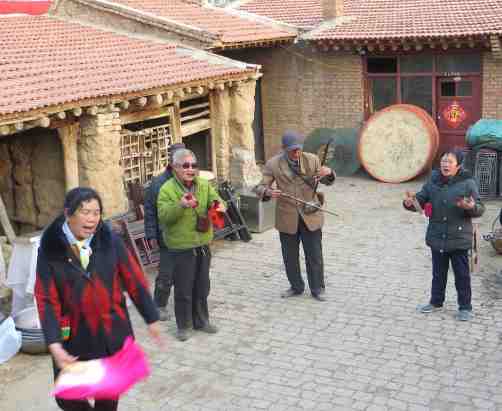
Itinerant beggars performing for funeral, north Shanxi 2018. My photo.

In vocal traditions of Chinese expressive culture (as I keep harping, or drumming, on), the neat pigeon-holes of folk-song, narrative-singing, and opera disguise a continuum from solo singing though to fully-staged genres with larger forces, all oscillating between a range of points along the ceremonial–entertainment continuum—see my

  • “Reading between the lines: reflections on the massive Anthology of folk music of the Chinese peoples”, Ethnomusicology 47.3 (2003), pp.287–337, e.g. §4.4.

Within the Anthology, one often needs to consult all three rubrics: folk-song, narrative-singing, and opera—and indeed dance. Along with my focus on ritual traditions and instrumental ensembles, narrative-singing (aka “story-telling”) is often relevant to my studies. So I’ve recently added a tag in the sidebar for shuoshu 说书 (aka shuochang 说唱, or in official parlance quyi 曲艺)—I’ll try and keep updating this roundup.

Another issue of taxonomy in the Anthology: whereas “religious music” is largely consigned to the instrumental music volumes, some ritual groups accompanying their vocal liturgy only with percussion are found within the narrative-singing volumes, such as the household Daoists of Changwu in Shaanxi. Also classified somewhat uncomfortably under “narrative-singing” is the substantial theme of

  • “precious scrolls” (baojuan)—surveyed here, with links to Hebei, Gansu, and south Jiangsu.

baojuan Berezkin

From Rostislav Berezkin, “Scripture-telling (jiangjing) in the Zhangjiagang area
and the history of Chinese storytelling”
 (2011).

Of course, rather than being constrained by narrow categories, we need to place the variety of expressive cultures in social context. Studies of “narrative-singing” often highlight the refined urban entertainment of urban stages and teahouses, with a largely sinological, literary approach to late imperial history—itself a worthy topic—tending to reify performances that are in fact animated by a strong element of improvisation. And as with folk-singing, opera, and indeed instrumental music, this may distract us somewhat from the ethnography of changing modern society. In rural China, ritual contexts are strong; much story-telling takes place in the context of temple fairs and domestic blessings. The rural perspective is significant across all genres, but I find it particularly salient in coverage of narrative-singing. It may also remind us of the importance of povertyItinerant blind performers are prominent.

Salutary instances include these two posts on Shanxi:

  • Xu Tong: subaltern lives, featuring the documentary Cut out the eyes.
  • Here I introduce Liu Hongqing’s harrowing exposé of the lives of poor peasant families in the Taihangshan mountains, based on a blindmens’ “propaganda troupe”.

Other regions featured on this site, in more or less depth, include

Shaanbei:

and under Chinese film classics of the early reform era, Old well and Life on a string.

Gansu:

Beijing and Tianjin:

Henan:

Moving further south,

Hunan:

South Fujian and Taiwan:

Hong Kong and the Pearl River Delta:

Note also

and under Chinoperl. CHIME 21 (2019) is a collection of article on narrative-singing.

* * *

Further afield, see e.g.

Navigational tools coming in handy, I’ve added this post to my Roundup of roundups!

Rugby balls and violin strings

rugby ball
Source.

Glued to the Six Nations rugby, I’m wondering if negotiating the shape of the ball, * with its unpredictable bounce, might be compared to going on stage with a violin whose strings never stay in tune—like playing baroque violin in an overheated concert hall (he said with feeling—see The Mary Celeste).

On the plus side, concerts are less muddy, with fewer injuries, and you don’t get sent off so often. As to referees (Confucius), musos’ attitude to conductors is more like that of footballers than rugby players.

Dali
Salvador Dali, The persistence of memory (1931).

Such a degree of unpredictability is rarely built into the design of the game—as if tennis rackets were crafted from blancmange. Nor did elliptical balls catch on with other sports, like snooker. To cast the net wider, it’s like a steering wheel that offers few clues to the direction of the car, or a novel whose pages the publisher prints in a random order.

This is part of mini-series on rugby under A sporting medley: ritual and gender, featuring the haka and some arcane rules. For more on the perils of tuning in Western Art Music, see under Hugh Maguire, and Muso speak: excuses and bravado (“It was in tune when I bought it”). More unlikely inventions here.


* Apart from unseemly anatomical explanations involving the shape of the pig’s bladder, and posh public-school twats, some suggest that it’s harder to dribble with the feet as in football, and that the oval ball is easier to carry with one arm, leaving the other arm free to push adversaries away—reminding me of the shakuhachi flute as potential weapon (komusō monks rebuked for “meddling in earthly affairs and not the emptiness of being”).

Tibetan resistance to Heritage fever

In several of my posts on Tibet I’ve featured the insightful research of Isabelle Henrion-Dourcy (e.g. The enchanting world of Tibetan opera, Women in Tibetan expressive culture, Expressive cultures of the Himalayas). Now she has written an outstanding article on Tibetans’ reluctance to climb aboard the Intangible Cultural Heritage (ICH) bandwagon as espoused by UNESCO and China:

Based on a 2019 presentation made for Tibetan artists and bureaucrats in Dharamsala for the 60th anniversary of the Tibetan Institute of Performing Arts (TIPA) there, the article deserves a wide readership: many of Isabelle’s findings are applicable to genres both among the Han Chinese and elsewhere around the world, making a valuable addition to the extensive literature on “Heritage” (for a roundup of posts on this site, click here—with my own first rant on the topic here).

She discusses in detail the evolving debate around the system worldwide, as well as the Tibetan notion of “culture”. As she explains, the ICH terminology has been ubiquitously used in the cultural policies of the PRC since 2006—towards Han Chinese communities, but most critically among the so-called “ethnic minorities” (including the Tibetan regions of TAR, Amdo, and Kham), and it has given rise to “a massive output of lavishly funded state programmes, festivals, museums, academic conferences, books, DVDs and commercial by-products for tourism”—a veritable “heritage fever”. 

The article sums up the genealogy, aims, language, and logic of UNESCO’s categorisations of culture, contextualising the UNESCO heritage nominations in a comparative worldwide survey. It then explores the political, linguistic and cultural reasons explaining the relative blind spot for the ICH among Tibetan communities, before moving to the specific challenges faced by ICH-nominated traditions and artists in Tibet. Unpacking the notions of “heritage” versus “cultural heritage”, Isabelle notes:

The very idea of “heritage” in the West came up as a sort of nostalgic look at the past, when it was already “too late”, that is, when the cultures supporting these objects were in a great part defunct. Moreover, this nostalgia is imbued with a nationalistic flavour, in the sense that these traditions on the verge of being lost are deemed essential in the shaping of a national bond and belonging. It may be the case that Tibetans feel that their traditions are lively enough that they do not need an objectifying label such as “heritage”. But the very idea of the creation of (what would later be called) the Tibetan Institute of Performing Arts in 1959 draws exactly from that same double logic of nostalgia and nationalism.

While ICH policies are “aimed at preserving songs, dances, dramas and cultural practices—not unlike what TIPA has been attempting to do for six decades”,

this politicised “catalogue” view of culture is also remote from how anthropologists understand culture: as ever adaptive and organically articulated in the multiple layers of the lives of people.

Thus “the recurrent effect of ICH proclamations is that they, in effect, isolate the practice from its context, and lead to its further endangerment”.

Yet

The phrase ICH remains obscure for nearly all Tibetans in exile—actually, as we will see, for most Tibetans in Tibet as well […] The idiom remains obstinately abstract for the great majority of Tibetans, even for those who are involved in ICH… and sometimes even for the local Chinese administrators in charge of the programmes. *

Isabelle goes on:

Cultural reluctance to the concept of ICH can be seen in two ways. On one hand, despite strong assaults on Tibetan culture that some authors have termed “cultural genocide” or “assimilation”, aspects of Tibetan of culture are still felt by Tibetans as being very strong and alive. Tibetans do not easily identify with a nostalgic contemplation of “culture” in terms of the ways in which it is embedded in ICH and UNESCO objectified conceptions. For most Tibetans, culture is not (yet) something distant, staged, or at least it is not only that. On the other hand, another cultural reluctance may concern the very notion of “culture”. ICH presupposes a democratic, or rather a “people’s view” of culture, where “culture” is that everyday life content which is shared by most people. This differs from an elevated and exclusive conception of “culture” (rig gnas) by Tibetans, that carries connotations of virtuous knowledge transmitted by role models. The idea of honouring “simple” singers, dancers or ache lhamo performers as cultural heroes of the community seems odd to most conservative Tibetans. Prestigious seats at official functions are meant for “cultural heroes” that inspire devotion and respect, such as lamas, politicians, and more recently (in exile) resistance fighters who bravely confronted the enemy. In a deeply religious and perhaps exclusive diasporic society, where the very survival of the community rests upon keeping the culture homogenised and extolling role models, the idea to give money, titles, and public acknowledgement to “simple” TIPA artists (if we consider Tibetan exiles) seems at best out of place, if not outright unacceptable. Finally, the third possible reluctance I see of Tibetans with the ICH concept is political. For those who are informed, they know that UNESCO is a cenacle of recognised independent States, and that Tibetans, not having this legitimacy, do not stand much of a chance to be heard, so why bother?

So I might consider this “blind spot” of the Tibetans not so much “unfortunate” as wise, suggesting a reluctance to play the Chinese game or pander to commodification.

Calling ICH “yet another tool to milk the government”, observers have voiced that ICH boils down to a competition between bureaucrats for their personal benefit, rather than a meaningful way to safeguard traditions for the benefit of the local people.

Still, along with other scholars of ICH, Isabelle recognises that “astute stakeholders” are sometimes able to use the ICH for “manoeuvring and promoting Tibetan culture”—a ploy also adopted among the Han Chinese and communities further afield.

Most rural performers, who are generally not educated (in formal schools), do not understand the underpinnings of the concept of “intangible cultural heritages but retain a rather positive attitude towards ICH, which they construe as bringing them material benefits (money, costumes, equipment, occasions to perform, status and value in the eyes of the State, etc.). They also recognize that ICH garners more visibility of Tibetan traditions that are disappearing fast from rapidly modernising rural areas, after decades of marginalisation and hardships. The ICH program has indeed allowed the revitalisation of derelict traditions in remote parts of the countryside and has brought more awareness about “tradition” among the youth. 

On one hand “ICH does enhance visibility, give opportunities to perform (for example at State-run festivals) and sustain, to some degree, the continuous practice of art traditions”. However,

troupes are often limited to performing a short vignette of their style (20 minutes or less). When preparing their troupes for such snippets, troupe directors confess a frustration at not being able to pass down a full tradition to the next generation. A majority of these rarefied translocal art traditions require an immersion into a whole system of knowledge and cultural references to be understood and appreciated, but only a series of “postcard-like” excerpts are allowed to be “displayed” for public consumption and entertainment (and approval).

As she notes, “ICH programmes came about in a situation where performing arts traditions had already been heavily reworked through State-run programmes during the previous six decades.”

Local community traditions versus reified state propaganda:
left: Ngagmo female ritual group, Rebkong (Amdo);
right: TAR song-and-dance ensemble. Source.

Within the borders of China, for traditions nominated for the ICH, three were promoted simultaneously in 2009: the Gesar epic, Tibetan opera (ache lhamo), and what UNESCO dubs “Regong arts” (a thangka painting tradition in Rebgong, Qinghai). The article goes on to list the later profusion of ICH inscriptions at national, regional, and county levels.

It’s always important to unpack state agendas in promoting culture; I admire much scholarship on ICH, but while the programme has cast an ever larger shadow over local traditions, it seems sad that such authors have to invest so much energy in bureaucratic theory and practice which they might otherwise be able to spend on studying the changing communities themselves.

In her fine Conclusion, Isabelle sums up:

On the global stage, ICH is an exercise in public relations. International identity politics are now done through “spectacle”, and the representation of one’s nation through simplistic reified images. The crucial aspect of UNESCO’s conception of culture is that these cultural expressions are a “property”, an entity that is owned and managed by a State presenting itself as the legitimate custodian of that heritage.

At the level of the PRC, ICH is a crucial notion in understanding the current predicament of Tibetan culture. While definitely allowing for more visibility of folk traditions in the public and media spaces, generating more income, and offering some possibilities to safeguard and sustain cultural traditions, its actual implementation is typically fraught with complications. ICH programmes have reinforced both ancient and new hierarchies of knowledge, power and money and fostered an ever-pervasive State interventionism into the management of folk culture. The staggering budget poured into traditional culture brings about radical transformations in the name of preservation, and economic marginalisation in the name of empowering local communities. But many artists and observers in the performing arts try to stake their claim to these choreographed cultural forms and, at the same time, manoeuvre within the system to try and salvage their traditions in between the dotted lines defined by their duties. I will leave the last word to one of these Tibetan cultural custodians, who perceptively remarked:

The government wears the clothes of “culture” to do politics.
We Tibetans wear the clothes of “politics” (obedience, loyalty) to do culture.


* Echoing Musapir‘s findings for Uyghur traditions—on which, note also the work of Rachel Harris, exposing the Chinese state’s sinister agenda in co-opting culture as part of its war on the Uyghur heritage—recently, this article.

Kali Malone

Kali Malone

Another reason to rejoice in the pipe organ, besides Bach and Messiaen (see also French organ improvisation!), is Kali Malone (website; wiki; YouTube topic; interview).

Raised in Denver, since 2012 she’s been based in Stockholm, fertile soil for her experiments. The extreme austerity of her ouevre, using electronic technology to the full, somehow gains rave reviews far beyond the organ cabal; I find it a weird and wonderful cause for celebration that there are tribes for this kind of thing. As with much minimalism, my need to listen to all her work may be partly because I keep wondering if something is ever going to happen, or if I will notice it happening while still semi-conscious—or perhaps rather it’s that I want to rise to the challenge of internalising her time-frame. This music makes Noh drama (links here) seem positively action-packed.

Organ dirges 2016–2017:

Cast of mind (2018), with wind and brass (as playlist):

On organ, The sacrificial code (2019) (as playlist):

Living torch album (2022), which one might hardly notice is “an organ-free zone”:

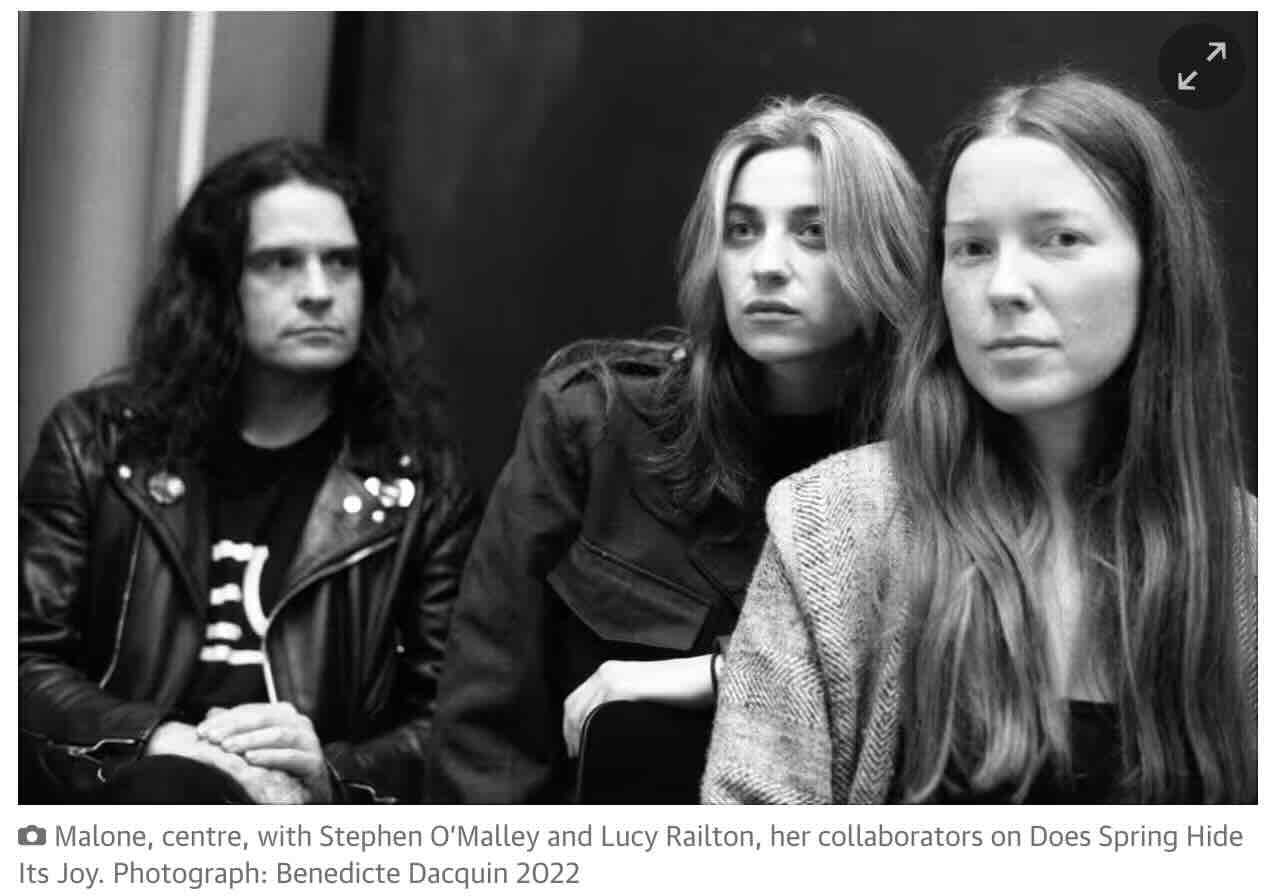
On Does spring hide its joy * (2020/2023), Malone plays sine-wave oscillators, with Stephen O’Malley on guitar and Lucy Railton on cello—another album that has achieved remarkable popularity in this age of fragmented attention:

The three variations span over 300 minutes—still more compelling, With All Due Respect, than the interminable ramblings of George Gurdjieff on harmonium.

Malone Spring

Her latest album is All life long (2024), again incorporating hieratic vocals and brass (playlist):

In his review, Alex Petridis splendidly describes Malone’s interviews as

very much the place to go if you’re interested in the cultural contexts of 15th-century meantone organ tuning…

Her partner Stephen O’Malley plays guitar in SUNN O))) (listen e.g. here), a band that blends doom metal, drone, black metal, dark ambient, and noise rock (more taxonomy!), their style “characterised by slow tempos, distorted guitars, lack of rhythm and melody, and alternative tunings” (YAY).

In the best possible way, this music “really messiaens with your head”—you might need to take an occasional break… I think we can safely discount rumours (again in my head) of a collaboration with Katherine Jenkins for a Christmas album of catchy hits from the shows.

For earlier, and more eventful, avant-garde soundscapes, see e.g. Meredith Monk. See also The right kind of spirituality?.


* I wonder if this a kind of rhetorical non-question, perhaps to be completed by HELLO.

Music–ritual cultures of Taiwan

Music is not a thing at all but an activity, something that people do

Christopher Small, Musicking

Through the Maoist decades after the 1949 Communist takeover, while the society of mainland China was constantly beset by a succession of iconoclastic traumas, the Republic of China on the island of Taiwan was considered a bastion for the maintenance of traditional Chinese culture.

What I suspect hasn’t always been clarified is that Taiwan cannot embody that culture as a whole: naturally, its heritage largely reflects the traditions of the particular regions from which they were descended on the southeastern mainland—and it was that, until the 1980s, which was the only peep-hole through which we could view the enormity of Chinese culture. *

But then, as “reform and opening” swept the PRC, ritual and other folk performance activity—that outsiders could only assume to have been extinguished there after the Communist takeover of 1949—began reviving on a vast scale, along with an array of central and regional scholars keen to resume fieldwork and research. And at the forefront of discoveries was the region of south Fujian, just across the strait from Taiwan (see e.g. C.K. Wang, Kristofer Schipper, Ken Dean, John Lagerwey). As fieldwork expanded to other parts of the southeast (see Daoist ritual in south China), it soon became clear that there was a vast repository of local traditions of ritual and expressive culture to document all over China (see The resilience of tradition)—if not eclipsing the reputation of Taiwan’s heritage, then at least putting it into perspective. The research of Taiwanese scholars was now able to inspire fieldwork on the mainland.

Still, the main genres of Taiwan have rather little bearing on the kind of ritual traditions that were coming to light in the north Chinese countryside, or even in east-central China; indeed, they only represent a small selection from the diverse range of genres around Fujian, as becomes clear by consulting the volumes of the monumental Anthology (for now, see here, with a further post to follow).

I also think of the transformation of Tibetan studies. After 1950, exile communities (led by TIPA in Dharamsala—see e.g. Zlos-gar, 1986) had been considered as the sole heirs to the culture of Tibet; but by the 1990s scholars began shifting towards the mature ethnographic assessment of its vicissitudes under the Chinese yoke (under Recent posts on Tibet, see e.g. Labrang 1). In her wise article “Easier in exile?, Isabelle Henrion-Dourcy ponders the different challenges of doing fieldwork among Tibetans in Lhasa and Dharamsala (see The enchanting world of Tibetan opera).

* * *

Taiwan
Besides the small minority of aboriginal groups (c2%), the main populations of Taiwan are Hoklo (Holo, c70%), Hokkien speakers originating from the Quanzhou and Zhangzhou regions of south Fujian; and Hakka (c15%), descended from the mainland regions of east Guangdong and west Fujian (click here and here for the expressive cultures of both groups). Refugees from elsewhere in China fleeing to Taiwan in the 1940s also brought some staged vocal genres with them.

With Taiwanese society subject to far fewer traumatic social upheavals than on the mainland, cultural forms were certainly better maintained there. But as in any modern society, there are no “living fossils”: besides the island’s complex colonial legacy, performers and patrons have to negotiate the incursions of modernity and popular media (see Society and soundscape, notably the work of Bruno Nettl).

Since the clampdown in the PRC under Xi Jinping, perspectives regarding the mainland and Taiwan are modifying (see The Queen Mother of the West); having myself been busy studying the maintenance of local ritual cultures in the PRC, it’s high time for me to re-assess my approach. So as sometimes happens on this blog (e.g. Precious scrolls, and even A jazz medley), this basic overview of music–ritual traditions is as much for my benefit as yours…

Surveys
In English, starting points include articles in The New Grove Dictionary of music and musicians, The Garland encyclopedia of world music (Wang Ying-fen pp.423–9, Hsu Tsang-houei pp.523–9), Wang Ying-fen in The Rough Guide to world music, Europe, Asia & Pacific (3rd edition, 2009), and even wiki.

At the forefront of studies of traditional music in Taiwan was Hsu Tsang-houei 許常惠 (1929–2001), who gravitated from WAM-style composition to fieldwork on folk traditions. ** Among his surveys are Taiwan yinyue shi chugao 台灣音樂史初稿 (1991, I think) and (with Cheng Shui-cheng) Musique de Taiwan (1992). See also Lü Ch’ui-k’uan 呂錘寬, Taiwan chuantong yinyue gailun 台灣傳統音樂概論 (2005, 2007), in two volumes on vocal and instrumental music.

Genres
Among the most popular topics are nanguan and Daoist ritual—both, since the 1980s, informed by fieldwork on either side of the strait. Amateur nanguan 南管 music societies, performing exquisite chamber ballads for calendrical and life-cycle ceremonies, have long been deeply embedded in community life (see this post). Nanguan is the subject of much research, both in Fujian and Taiwan. Wang Ying-fen has published extensively on the Taiwan scene in both Chinese and English—I particularly admire her articles on the risks inherent in state promotion of nanguan (such as this), worthy contributions to studies of the thorny issue of heritage.

Temple fairs, with vibrant processions, remain a major part of life in Taiwan. Regional traditions of Daoist ritual (for the north, click here) are the focus of generations of Taiwanese and foreign scholars. For the former, alongside many distinguished scholars, Lü Ch’ui-k’uan 呂錘寬 has paid notable attention to ritual soundscape (e.g. Daojiao yishi yu yinyue 道教儀式與音樂, 1994). Another major theme in ritual studies is the worship of the female deity Mazu, widespread both in Taiwan and around the southeastern coast of the mainland.

The composite genre of beiguan 北管 (good wiki page here, with links) is again performed mainly for calendrical and life-cycle ceremonies, largely by occupational groups; while closely related to vocal drama, it’s best known for its loud outdoor shawm-and-percussion bands. Here’s a short documentary about the master Qiu Huorong 邱火榮 (b.1937):

Most flexible of popular operatic forms is gua-a-hi (gezai xi 歌仔戲). And more popular in Taiwan than shadow puppets and marionettes, glove-puppetry (budai xi 布袋戲) has adapted to changing times; the former tradition was transmitted by masters such as Li Tianlu 李天祿 (1910–98), whose early life is evoked in Hou Hsiao-hsien’s 1993 film The puppetmaster.

Narrative-singing is best known through Chen Da 陳達 (1905–81) on the Hengchun peninsula. He was “discovered” in 1967 by Hsu Tsang-houei and Shih Wei-liang 史惟亮 as part of their fieldwork for the Folk-song Collection movement, forerunner of several state-sponsored organs in Taiwan. Here’s Shih Wei-liang’s recording from 1971:

In the north of the island, the blind female singer Yang Xiuqing 楊秀卿 (b.1934) is also renowned.

(As in the PRC, please excuse me if I fall into the old Songlines trap of giving undue attention to “star performers”—whereas in-depth ethnography soon uncovers the myriad unsung bearers of tradition, such as Vincent Goossaert’s “ordinary Daoists”, or rank-and-file members of festive groups.)

Like beiguan, the Hakka bayin 八音 ensemble is dominated by shawms and percussion. Here’s the CD Taiwan: mountain songs and bayin instrumental music (Inedit, 2006; as playlist):

As in mainland China, the vocal polyphony of minority peoples (notably Amis, Bunun, Tsou, Paiwan, Rukai—around 2% of Taiwan’s population) has attracted much attention, with many recordings issued of aboriginal singing, such as Polyphonies vocales des Aborigènes de Taiwan (Inedit, 1989):

and Taiwan: music of the Aboriginal tribes (Jecklin, 1991) (playlist):

As in mainland China, while such traditions struggle to remain relevant in a modernising society, national cultural bodies have adopted particular genres as symbols of identity. Expressive culture has made a major component in the rapprochement between the PRC and overseas Chinese communities. Wind Records in Taipei issued a succession of CDs of mainland genres in conjunction with the Music Research Institute in Beijing, notably an important series of archive recordings (folk-song, narrative-singing, opera, and instrumental music, as well as minority polyphony), and of the qin zither. The journal Minsu quyi, with its detailed studies (mostly in Chinese) on ritual, theatre, and folklore, also expanded its scope from Taiwan to the mainland.

* * *

Growing political tensions encourage us to pay renewed attention to Taiwan, and to support beleaguered democracy. While it’s fruitful to study the genres introduced above on both sides of the strait, the island remains a conducive environment for both performance and research. Now I’m keen to see someone with fieldwork experience in both societies, such as C.K. Wang, Wang Ying-fen, Ken Dean, or Adam Yuet Chau, expounding the different trajectories of the diverse traditions there, and the challenges that they face.


* Now, none of these comparisons quite work, but…
While it’d be far too parochial to imagine the Isle of Wight as a refuge from a radical government in mainland UK, perhaps we might visualise Cuba becoming a liberal sanctuary from a Gilead-style fundamentalist north America (see The handmaid’s tale)—or even Sicily as the sole isolated outpost for tradition while mainland Europe languishes in the grip of authoritarian regimes.

In chapter 10 of In search of the folk Daoists of north China I made a similarly rash comparison, seeking to incorporate north China into our overview of Daoist ritual (cf. this post, again):

It is rather as if our knowledge of Christianity in the whole of Europe were based almost entirely on Sicily and Puglia, with the odd footnote on the Vatican and Westminster Abbey. We may like what we find in those places, perhaps considering it more exalted, mystical, and ancient—but that is another issue.

Without at all playing into the greasy hands of PRC propaganda, one might consider Taiwan (culturally, not politically, since it is clearly an independent nation! Cf. China has always been part of…) as just one among over thirty provinces of China, all of whose forms of expressive culture are dominated by long-established local folk traditions while also featuring some “national” genres and styles from other regions.

** If Yang Yinliu wasn’t the Chinese Bartók, then Hsu Tsang-houei wasn’t the Taiwanese Yang Yinliu (whereas Bill Evans was the Bill Evans of jazz).

Words

Real Group early
The Real Group, 1984. Source.

I’m always enchanted by the a cappella singing of the Real Group—their rapt intoning of the Swedish psalm Härlig Är Jorden is one of the most exquisite pieces I know (click here, with a bonus of Bill Evans).

Another gorgeous song of theirs is Words, by Anders Edenroth, tenor in the group—here’s a 2005 performance in Stockholm, soon after he composed it:

Words
A letter and a letter on a string
Will hold forever humanity spellbound
Words
Possession of the beggar and the king
Everybody, everyday
You and I, we all can say
Words
Regarded as a complicated tool
Created by man, implicated by mankind
Words
Obsession of the genius and the fool
Everybody, everyday,
Everywhere and everyway

Words!
Find them, you can use them
Say them, you can hear them
Write them, you can read them
Love them, fear them

Words
Transmitted as we’re fitted from the start
Received by all and we’re sentenced to a life with
Words
Impression of the stupid and the smart
Everybody, everyday
You and I, we all can say
Words
Inside your head can come alive as they’re said
Softly, loudly, modestly or proudly
Words
Expression by the living and the dead
Everybody, everyday
Everywhere and everyway

Words!
Find them, you can use them
Say them, you can hear them
Write them, you can read them
Love them, fear them

Screenshot

Source: Musescore.

Complementing the, um, words is the finely-crafted music (score matched to audio here, with link to harmonic analysis—and Spanish captions to boot!). The narrow, hieratic pitch range of the verses (with plentiful appogiaturas, gradually venturing beyond a minor third!), adroit rhythmic variation alternating between syncopations and regular quavers, as well as subtle chromaticisms (cf. this post), the melody eventually branching out for the chorus (“Find them…”),

Screenshot

with motifs recombined and elaborated from 1.39…

Here it might be unseemly to note that words aren’t always useful—see e.g. Adam Chau’s caveats about focusing on the discursive/scriptural modality in religious studies, as opposed to “red-hot sociality”. Just saying, like (with words)—cf. Laozi (here and here), as well as “Writing about music is like dancing about architecture“.

Click here for more a cappella singing around the world. Cf. The art of the miniature, and my introduction to Dream a little dream.

In memory of Seiji Ozawa

The great Seiji Ozawa died last week (tributes; obituaries e.g. NYT; see also nippon.com). *

Born in 1935 to parents based in Mukden (Shenyang) during the Japanese occupation of Manchuria, he returned with his family to Japan in 1941. His rise to conducting stardom was meteoric. A pupil of Hideo Saito (1902–74), in 1959 he won a conducting competition in Besançon. This led to an invitation to study with Charles Munch and Pierre Monteux in Boston, where he soon won the Koussevitzky Prize; this began his close association with the Tanglewood Festival. Gaining a scholarship to study with Herbert von Karajan in West Berlin, he was spotted by Leonard Bernstein, who made him assistant conductor of the New York Phil in 1961. Here Bernstein introduces Ozawa conducting the overture to The marriage of Figaro in 1962:

Ozawa remained the only conductor to have studied under both Karajan and Bernstein (cf. Unlikely bedfellows).

Messiaen Ozawa 1962
Meeting Messiaen and Yvonne Loriod on their honeymoon in Japan, July 1962.

In 1963, still little-known in the USA, Ozawa appeared on What’s my line (cf. Anna Mahler on You bet your life, 1952!). By the late 60s, in contrast to the staid, ageing Teutonic maestros to whom concert-goers were accustomed, he exuded a rock-star vibe that no-one has since been able to emulate (NYT: “with his mop of black hair, his boyish demeanor and his seemingly boundless energy, he captured the popular imagination early on”; Peter Gelb: “a symbol of male beauty on the podium that I don’t think the world had seen before.”) As Norman Lebrecht commented (The maestro myth, pp.137–41):

Ozawa sported a Beatle fringe, flowery shirts and cowboy boots, and wore a roll-necked sweater instad of a dress-shirt at concerts. His appointment was clearly aimed at rejuvenating the Symphony Hall subscription list. Oriental mysticism was all the rage among the East Coast college kids who escaped conscription to Vietnam; and Ozawa was, they said, something else.

Ozawa 1973

In the early 70s I too basked in his charisma at London concerts, hearing him conduct an exhilarating Symphonie fantastique, as well as November stepsTakemitsu’s music becoming known partly thanks to Ozawa’s advocacy.

Ozawa LennyBaseball with Lenny, Japan 1970.

Here Ozawa directs Maki Ishii’s Sō-Gū II for Gagaku and Orchestra (1971):

Ozawa acted as music director of the Boston Symphony from 1973 to 2002, a tenure that “many thought too long for anyone’s good: his own, the orchestra’s or the subscribers’ “.

Screenshot

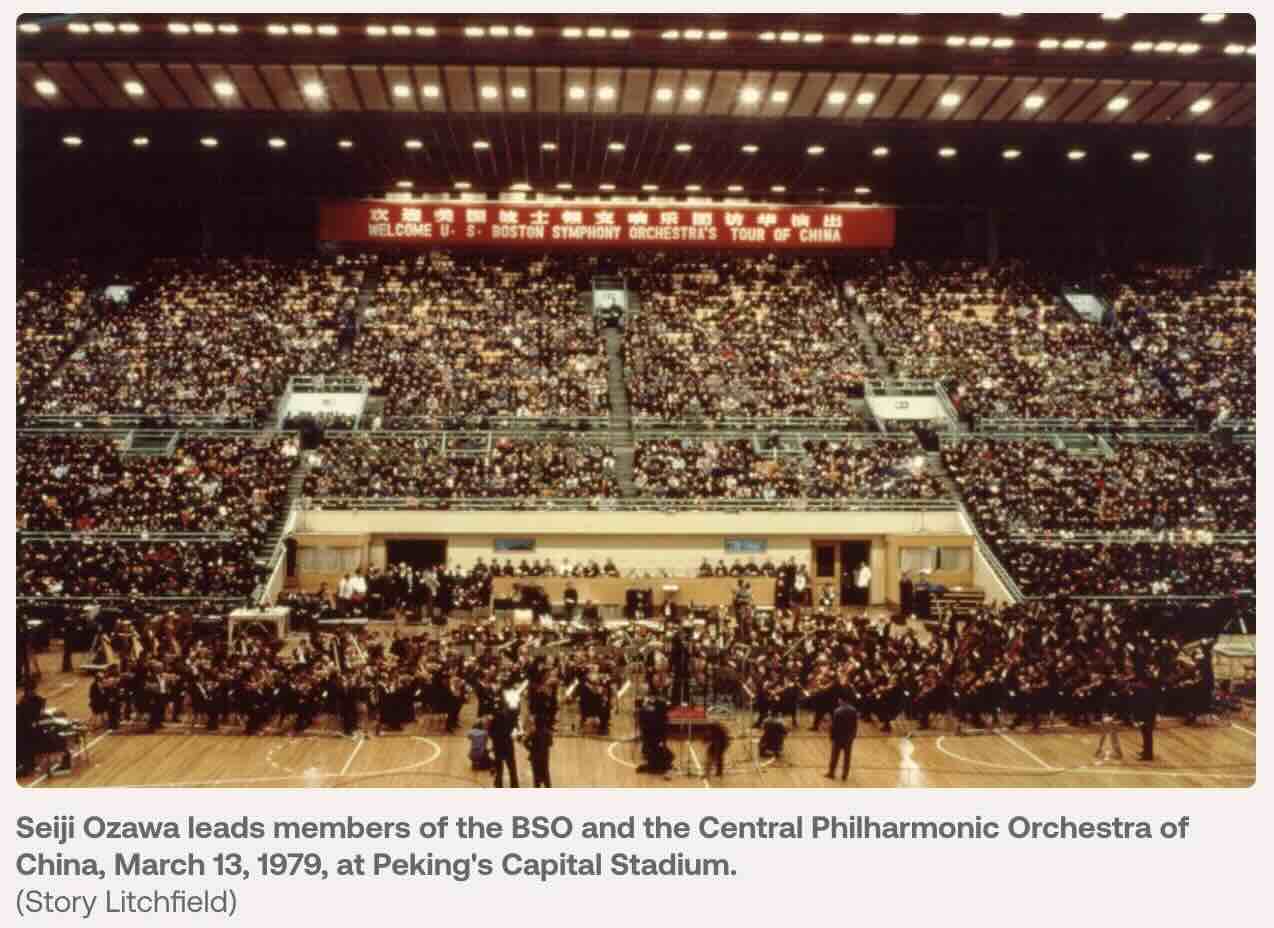
According to the NYT, he played a role in easing tensions between China and the USA in 1979, when the Boston Symphony toured China, still emerging from the Cultural Revolution (cf. the 1973 visits of the Philadelphia and London Philharmonic). Peter Gelb, then the orchestra’s publicity director, said that Ozawa had been crucial in making the tour happen, Chinese officials feeling “a connection with him since he had spent part of his childhood in China” (hmm, I wonder how that worked…).

Noting Ozawa’s fine ear for timbre and nuance, some magical selections:

Ravelthis playlist, with the Saito Kinen orchestra that he nurtured, contains his 2015 recordings of both L’enfant et les sortilèges and Shéhérazade (cf. my main Ravel page, and links). Here’s Pavane pour une infante défunte, from a concert in 2007:

Ozawa’s 1968 recording of Messian’s glorious Turangalîla, with Jeanne and Yvonne Loriod (on 2 LPs, with November steps), is on this playlist—here’s the fifth movement Joie du sang des étoiles (Gramophone: “turbo-thrusted to the point of kinky delirium”):

and the sixth, Jardin du sommeil d’amour (“an early window into Ozawa’s ear for obsessive detail and softer-than-soft textures”):

Ozawa also conducted the 1983 premiere of Messiaen’s monumental opera Saint François d’Assise.

All this can only be matched by Mahler 2, live in 1995 for a Nagasaki peace concert:

In 2016 Ozawa’s conversations with Haruki Murakami were published as Absolutely on music (introduced here and here). See also this Gramophone roundup from 2014, and the magazine’s review of his complete DG recordings. For more maestros, see The art of conducting: a roundup.


* As I write, the regular Guardian is strangely devoid of an obituary—a gap filled by the East London and West Essex Guardian, whose readers seem rather less likely to be avid tofu-eaters. Update: Guardian notice here.

Tibet: ritual singing in an Amdo community

*Part of my education in the travails of modern Tibet*

Shepa cover

  • Bendi Tso, Marnyi Gyatso, Naljor Tsering, Mark Turin, and members of the Choné Tibetan community, Shépa: The Tibetan oral tradition in Choné (2023)
    (free access here).

Shépa (bshad pa) * is an encyclopaedic repertoire of antiphonal songs performed by ritual specialists and prestigious elders of the Choné people (Co ne pa), a Tibetan subgroup in the Luchu river valley of Kenlho (Kan lho; in Chinese, Gannan 甘南) Tibetan Autonomous Prefecture of Gansu province in northwest China. The region straddles both the Tibetan regions of Amdo and Kham and the Chinese provinces of Sichuan and Gansu, bordering territory managed by the great monastery of Labrang (cf. this post, including further readings on Amdo, and sequel).

Shépa “encapsulates the evolution of Tibetan civilisation through time and serves as a repository of the cultural, religious, and historical knowledge of the Choné people”. As the authors explain, Choné history is profoundly shaped both by intricate interactions with close neighbours (Han, Hui, and Monguor) and by distant political and religious centres. From creation myths to Bon and Buddhist cosmologies and wedding songs, shépa engages with and draws on elements of religious traditions, historical legacies, and deep-seated cultural memories.

“A collaboration with and between members of the local community, including narrators, monks, and scholars”, with its trilingual format (in English, Tibetan, and Chinese) the book’s 778 pages become less daunting.

Bendi Tso’s preface opens with a promising vignette, in what has become a classic juxtaposition (for Chinese instances, see e.g. my film Li Manshan, from 30.32 and 1.07.34):

Leaning against the living room window the night before Sangye Men’s wedding, I felt as if I was straddling two worlds, separated by a thin pane of glass. In the yard, Sangye Men’s friends formed a circle and took it in turns to sing and dance, accompanied by a giant stereo speaker and a rotating rainbow globe light. Their playlist ranged from Tibetan ballads to Chinese songs, and from the traditional Tibetan lute (sgra snyan) to nightclub music. When Arabian Night started, a popular dance song appreciated by younger generations, the guests turned up the volume as high as it would go, swaying their bodies to the music and showing their enjoyment.

Right across the window and inside a living room, four elders were sitting on tsatap (tsha thab / rdza rdo), a raised clay platform where people eat and sleep, drinking Tibetan spirits (bod rag). The flickering rays of the rainbow globe danced on their faces. Occasionally looking out of the window, the elders continued intermittent conversations while singing Shépa. I wondered whether they were able to catch each other’s words on account of the loud noise emanating from the speaker next door.

The co-authored Introduction (pp.1–64 in the English version) gives a nuanced definition of shépa, which has been considered as “poetic recitals”, “speeches”, “oral literature” or “oral tradition”—a combination of verse and prose in recitation and song. In their broad understanding, it is “an umbrella category including all local oral performances that have survived to the present”, on a spectrum from religious to secular. They discuss the relation of shépa to other oral traditions both in Choné and in the wider Tibetan and Himalayan cultural spheres.

The authors introduce ritual specialists (cf. Tibet: some folk ritual performers):

Almost every Choné village had an anyé bonpo (a myes bon po) household belonging to a lay Bon priest or an anyé gompa (a myes sgom pa) household of a lay Nyingma practitioner, who would be in charge of performing rituals for individuals and community before the 1950s. Nowadays, ever fewer villages have these priests.

As they surely know, this leap in time begs some basic questions. Again:

Leu (le’u / lhe’u), who appear in Shépa, are a type of anyé bonpo. In Choné, Leu are crucial figures who conduct the protection ritual (srung) during the marriage ceremony. Over the past decades, ever fewer households of anyé bonpo have been in a position to transmit their heritage and duties to the next generation. Based on our current research, there remain only a handful of anyé bonpo, and no leu, in Choné.

The emblem of the anyé bonpo’s ritual expertise is the anyé zhidak (a myes gzhi bdag), “a built-in wooden cabinet designed for storing arrows (mda’) that represent lineage, fortune, and fertility, located beside the main pillar in the living room”.

Among the main performance contexts are wedding ceremonies, as well as horse racing and arrow shooting over New Year (cf. Bhutan). Weddings have “changed significantly over recent decades”, but we are not offered details on the process. Other material on change also begs questions:

These days, almost all of the critical moments in the lives of Choné people now involve Geluk monks and lamas, from naming newborn children to blessing newlyweds to performing funeral rituals. Since the 18th century, the majority of Choné people have become Geluk followers. Major festivals, fairs, and pilgrimage dates in the local calendar are arranged according to the religious schedule of Choné Monastery and its branches. In recent years, with village ritual specialists ageing and passing away, villagers offer their non-Buddhist ritual texts to Geluk monks and ask them to perform rituals that were once conducted solely by anyé bonpo and anyé gompa. Monks usually conduct these rituals with some Buddhist modifications.

I applaud the intent of this study. Salvage projects can be valuable to document a kind of maximum repertoire, and the authors’ diligence in recording the community elders is commendable. But after that promising opening vignette, we are never told if shépa has taken on a new life, perhaps modified in new popular forms, beyond the reified stagings of the Intangible Cultural Heritage—whose many problems they recognise:

In recent years, “traditional” ways to learn and perform Shépa have undergone rapid transformation in the Choné Tibetan community. The transmission of Shépa is increasingly privatised and its performance is becoming standardised in response to the inscription of this oral tradition into the Kenlho Prefectural-level register of the Intangible Cultural Heritage in 2016. The performative setting and standards for what constitutes a “good” performer are fast changing, and this process has also been accompanied by a reconceptualisation of what Shépa was, is, and will be.

The remaining seven sections of the Introduction document texts—myths, ** and wedding songs—without any further social-political analysis of changes in wedding customs and New Year’s observances over the previous decades. The book has no index.

* * *

Outside the PRC, the field of Tibetan studies has made immense progress in recognising the legacy of the Maoist era, and the ongoing consequences of Chinese occupation—with research both from Tibetans based abroad (such as Tsering Shakya, and the High Peaks Pure Earth team) and from Western scholars (under my roundup of posts on Tibet, see e.g. Conflicting memories, When the iron bird flies). Among fine ethnographers in the field of customary life and expressive culture (note this bibliography) are Charlene Makley, Isabelle Henrion-Dourcy, Katia Buffetrille, Gerald Roche, Anna Morcom, and Timothy Thurston (see also Keila Diehl’s Echoes of Dharamsala); the monographs of the Asian Highland Perspectives series were compiled by trained local fieldworkers.

Such research hardly features among the Shépa authors’ references. The book provides useful material on early history (migration, the Choné kings, Bon, Buddhist sects, warfare), but is entirely silent about social and political change since the 1950 Chinese occupation. So this is the last episode in their historical overview:

From the mid-19th century, the Luchu valley suffered several regional wars. The Choné people were at that point the largest Tibetan group ruled by the Choné kings. Time and again, they were either conscripted into the king’s militia to suppress insurgents for the Qing and the Republic of China (1912–49) or slaughtered by insurgents. Throughout this period, the Choné people suffered serious depopulation. Most Tibetan villages on the northern bank of the Luchu River were destroyed in warfare. To collect tax and recruit militiamen, the kings leased destroyed, bankrupted or empty [sic] households to Chinese migrants who had narrowly escaped with their lives from social unrest and natural catastrophes in neighbouring areas. This resulted in a steady inflow of Chinese migrants into Choné. By 1949, the Choné people had already become a minority within an ever-growing Chinese population.

The authors state their goal:

We hope that this book may serve as an entry point for the Choné Tibetan community in support of their goal of Shépa revitalisation and at the same time uplift their linguistic heritage and cultural dignity.

This is laudable, yet while they are well aware of “the socio-cultural dilemma facing all Choné people over the past several decades”, political constraints hamper their analysis. Cultural impoverishment in communities like these is not simply a function of some generalised modernisation; it is also indivisible from political history since the 1950s.

Of course we always have to read between the lines of PRC publications (see e.g. under Cultural Revolutions, and my two recent posts on opera and narrative-singing among Han Chinese communities in Gansu during the famine). The book’s four named authors are all based outside the PRC, and (like Amdo dwellers) doubtless have insights on the radical changes in society following the Chinese invasion in 1950, the devastation of communities as political campaigns escalated from 1956, and the new transformations since the 1980s. Even within the PRC, perspectives on the traumatic history of Tibetans (indeed, particularly Amdowa) under Maoism—and since—have not always been entirely off-limits.

But the period since 2015, when the authors were carrying out their own fieldwork, has been marked by intensified state surveillance amidst a severe deterioration in Tibetan–Chinese relations, with serious conflicts which they also pass over in silence, such as the 2008 unrest (e.g. here, under 15th June) and 2015 self-immolations (cf. Eat the Buddha). Their reluctance to broach such issues doubtless follows in part from their noble decision to involve as co-authors “the members of the Choné Tibetan community”; and the authors themselves, even while based outside the PRC, may not feel secure enough to avoid self-censorship. So my caveats are critical not of them, but of the extent of the climate of fear beyond the PRC.

Given that the book’s whole subject is cultural transmission, for which the era of Maoist extremism was a crucial period, I find it disturbing that discretion has obliged the authors to exclude all but the vaguest of allusions to it. Other topics left unexplored include migration, state education, and the vast influence of pop and mass media. Thus their account of “history” comes to an abrupt halt in 1950. While one must respect their decision, it limits the book’s value. I still wonder if there might be a way of giving some tactful clues to the painful maintenance of shépa; otherwise there’s a glaring lacuna, risking the kind of reified, timeless, rosy portrayals that are de rigueur in the Intangible Cultural Heritage mission.

Since the authors quite rightly esteem the elders of the community such as Grandfathers Meng Tusktor and Zhang Gyatso, * one wants to know more about the vicissitudes of their lives—through the late 1950s’ uprisings, the famine, the Cultural Revolution; did they manage to continue singing shépa in the early 1950s, the late 50s, even the 60s? Were any of them recruited to the new song-and-dance troupes funded by the Chinese state—and what was happening to the traditional contexts for shépa in local communities? Have performers and audiences expressed any opinions about all this?

And of course, apart from silent, immobile texts, we also need accessible audio/video recordings (see e.g. Amdo rituals: early and recent films)—something eminently realisable with online publishing.

Despite such lacunae, there is substantial material here for historians of (pre-1950) Amdo; with its trilingual format, it is designed to serve the Choné community, under the conditions in which they find themselves.


* On the minefield of Tibetan and Amdo transliteration, see Robbie Barnett’s introduction to Conflicting Memories.

** Including the bird-like deity Khyung, and Rübel (Cosmic Tortoise, a name just begging to be taken up by a Choné rock band—cf. the Croatian metal combo Teddy Bear Autopsy).

Pibroch

Rona

Rona LIghtfoot (b.1936), inspiration for new generations.

I rarely dip my toes into the folk cultures of these isles (So we’re not good enough for ye, that it? Off cavorting with all them non-nationalsThe Plain People of Ireland). I’ve made so bold as to delve a little into Irish music (series here); in an obscure connection with Chinese yangge (Typical!), I learned a little about Morris dancing, and I’ve only recently made a bit of an effort to catch up on English folk-singing. Songlines is good on the changing scene, and I really should listen more to Late junction on BBC Radio 3. I had a passing acquaintance with Irish piping through the sterling work of Séamus Ennis, so now for some Scottish Gaelic piping.
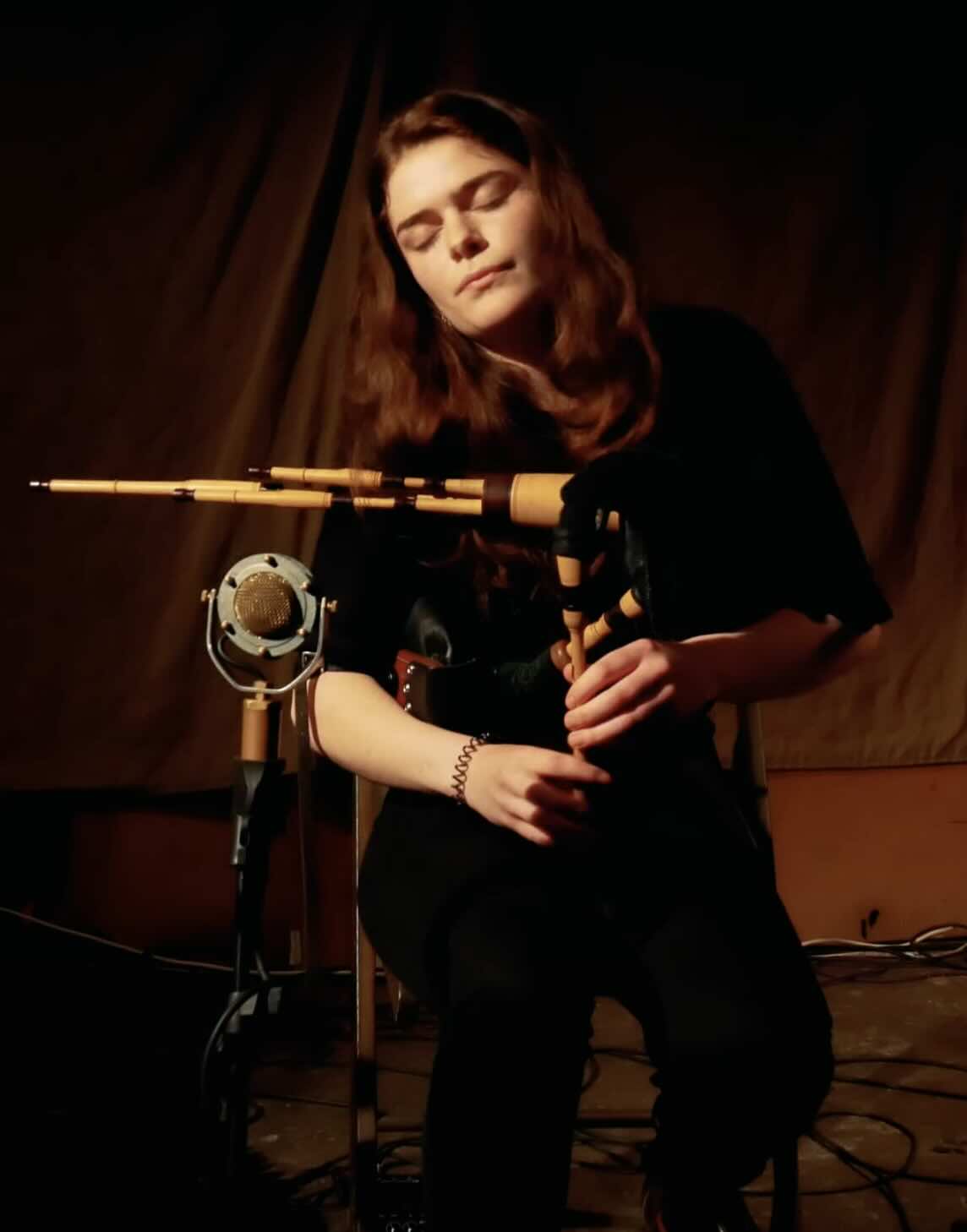
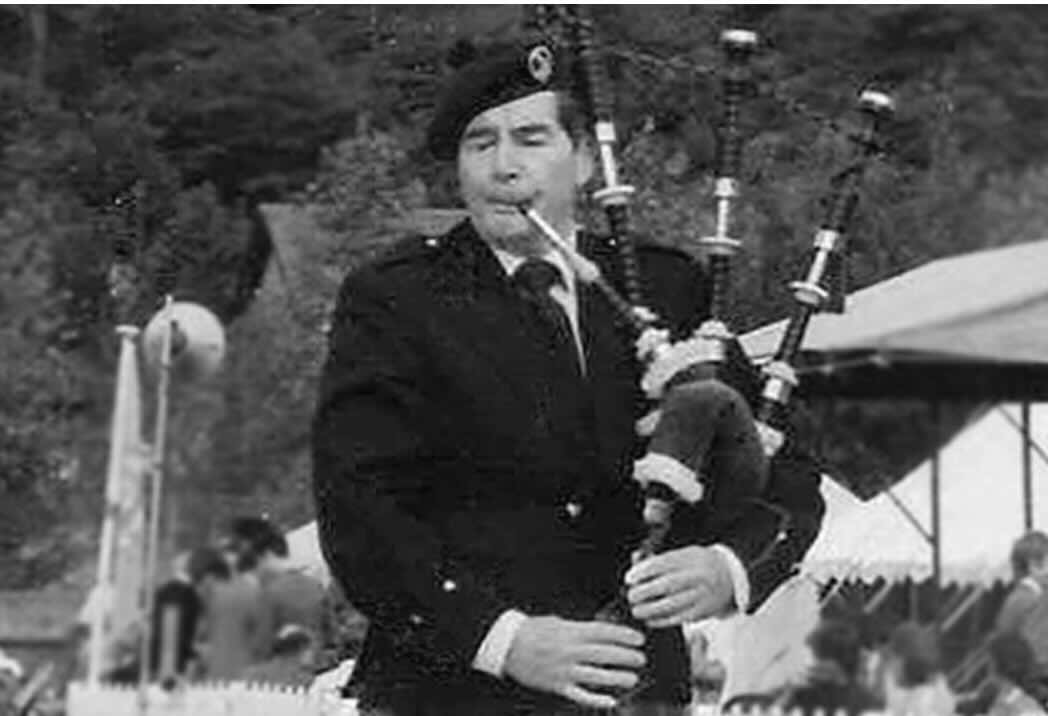
Chaimbeul

I was reminded to listen up to the Scottish Highland smallpipes by an interview with Brìghde Chaimbeul. While grounded in the Skye tradition, she is pleasantly resistant to the “tartan and shortbread” image—as I am to kilts. From her YouTube channel, here’s her 2019 album The reeling (playlist):

Both the current scene and recordings are dominated by “the great Highland bagpipe” (GHP), but the mellower sound of smallpipes also creates an enchanting timbre. Historical evidence for the smallpipes is just as early: “used for dancing and entertainment in court and castle, later they became popular amongst burgh pipers, and town minstrels [,] until the early 19th century, when the demise of the town pipers led to their disappearing from the record.” But always suited to chamber ensemble playing, the smallpipes have enjoyed a revival since the 1980s.

While I don’t at all propound “the other classical traditions” (cf. What is serious music?!, and Joining the elite musical club), pibroch Is considered as “art music” (ceòl mòr “great music”), as opposed to ceòl beag ”small music” (more popular genres such as dances, reels, marches, and strathspeys). It appears to have been commonly played on the bagpipes since the 16th century. As aristocratic patronage and musical tastes shifted, pibroch migrated over time from the clàrsach harp and the fiddle, which have also taken part in cycles of revival—partly based on early manuscripts notated from canntaireachd oral mnemonics. The pibroch repertoire is common to both the GHP and smallpipes.

Niall Mòr MacMhuirich (c1550–1630), poet to the MacDonalds of Clanranald, didn’t mince his words:

John MacArthur’s screeching bagpipes, is like a diseased heron, full of spittle, long limbed and noisy, with an infected chest like that of a grey curlew. Of the world’s music Donald’s pipe, is a broken down outfit, offensive to a multitude, sending forth its slaver through its rotten bag, it was a most disgusting filthy deluge…

This contrasts aptly with a poem by Alasdair mac Mhaighstir Alasdair (c1695 –1770) in praise of the pipes:

Thy chanter’s shout gives pleasure, Sighing thy bold variations. Through every lively measure; The war note intent on rending, White fingers deft are pounding, To hack both marrow and muscles, You shamed the harp, Like untuned fiddle’s tone, Dull strains for maids, And men grown old and done: Better thy shrill blast, From gamut brave and gay, Rousing up men to the destructive fray…

Looks like we need an edition of the Lexicon of musical invective for folk music…

The simple distinction between large and small pieces, doubtless found in many cultures, reminds me of Chinese instrumental suites—as does the structure of large pieces:

Pibroch is a theme with variations. The theme is usually a very simple melody, though few if any pibroch contain the theme in its simplest form. The theme is first stated in a slow movement called the ground or in Gaelic the ùrlar. This is usually a fairly stylised version of the theme, and usually includes numerous added embellishments and connecting notes.

In both style and structure, I’m also reminded of Chinese shawm bands. And I’m always attracted to free-tempo music.

This passage from the wiki article strikes a chord:

While the conventional accounts of the origins of pibroch are largely characterised by an aggrandising romanticism common to antiquarian appropriations of remnant historical traditions in the late 18th century and early 19th century, there are substantial surviving authentic musical documents that concur with a living tradition of performed repertoire, providing a grounding for any debate over authoritative accounts of the tradition.

MacPherson
Donald MacPherson. Source.

While the soundscape of the pipes is beguiling, until we immerse ourselves in the style—monophony with drone, only not recalling Indian raga much at all!—a little goes a long way. Laments, salutes, and gatherings feature prominently in the pibroch repertoire. Among rich documentation for the GHP, a useful starting point is the website of the School of Scottish Studies Archives (introduction, specifically here). On YouTube, here’s a playlist of 209 early recordings:

Among the leading lineages of modern times are Cameron and MacPherson. For the former, here’s an early recording of Robert Reid (1895–1965):

And the YouTube topic for Donald MacPherson (1922–2012) has several albums.

But in chamber settings, some modern ears may find the more mellifluous timbre of the smallpipes more appealing.

Here’s some latter-day pibroch on fiddle:

* * *

Among bagpipe traditions elsewhere are those of south Italy (e.g. here and here), Iberia (see under Festive soundscapes of the Rioja), Ukraine, and around east Europe. See also two articles on the Essential Vermeer site (introduced here).

Pibroch seems to have influenced unaccompanied Gaelic Presbyterian psalm singing, now mainly to be heard in the Hebrides (cf. A cappella singing). Its practice of “lining out” resembling that of Old Regular Baptist churches in Appalachia (see America over the water).

Other major genres in world music with extensive, complex repertoires include north Indian raga, flamenco, the maqam family—and the suites of the north Chinese paraliturgical wind ensemble

More musical chinoiserie

Bantock 1
Source.

The going was tough for the members of the BBC Symphony Orchestra in the years following the regime of William Glock. A rigorous, ear-scouring diet of avant-garde music was leavened only occasionally by returns to the core symphonic repertoire, as well as dutiful lip service to the “cowpat” school of early-20th-century English composers—although I recall being impressed by Arnold Bax’s Tintagel.

Following Berlioz’s distaste for the music of the not-so-mystic East, I’ve touched on musical chinoiserie in posts such as Mahler and the mouth-organ. Among other composers whose work Angela Kang discusses in her 2011 thesis are Purcell, Gluck, Roussel, Puccini, Debussy, and Stravinsky—see also Ravel, and this article on the American composer Charles Griffes (more here). Cf. Lili Boulanger’s Vielle prière bouddhique, and Kreisler’s Tambourin chinois.

Granville Bantock (1868–1946) was one of the English composers whose work we must have played, somewhat casually, in the BBC SO. I’ve only recently clocked his 32 Chinese songs, a substantial series that he wrote from 1918 to 1920, inspired by the exotic East—Arabia, Japan, Egypt, India, and Persia (note also his vast suite Omar Khayyám) (see also here).

Bantock Persia
Great designs, eh? Well done, Breitkopf & Härtel…

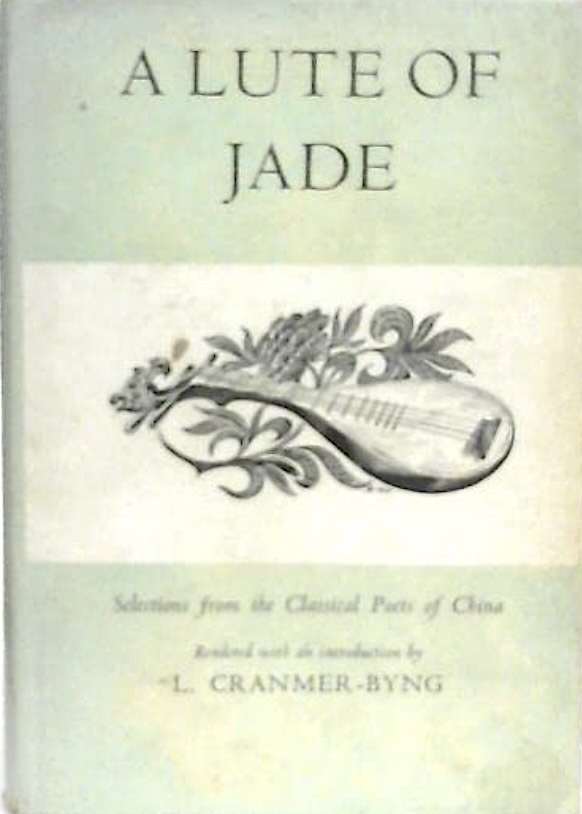
Lute of jadeThe first cycle of Five songs from the Chinese poets (score) set English texts by Bantock’s friend the euphoniously-named Launcelot Cranmer Byng, after Tang poems by Zhang Zhihe, Du Fu, Li Bai, Tong Hanqing, and Sikong Tu. All but one appear in A lute of jade (1909)—one of the first collections of Chinese poetry that I bought (probably from Watkins) while still at school. The cycle was arranged for string quartet in 1933 as In a Chinese mirror. According to this post, some of the lyrics of Songs of China were written by Bantock’s wife Helen.

From the second set (score), here’s John McCormack singing a version of a text by the Tang poet Cen Shen in 1927:

* * *

Bantock also composed Chinese-inspired works on a larger canvas. Besides Choral suite from the Chinese (1914, again to texts by Cranmer Byng), I note the orchestral Four Chinese landscapes (1936)—the latter mostly directed by Walter Collins in 1946:

To the modern ear, such sketches are no more enticing than the works of Chinese composers trained in the WAM idiom such as Xian Xinghai, Nie Er and He Luting (a focus for much ideological wrangling in China over the following decades). But “it is what it is“: Bantock and others were part of a lasting European fascination with the Mystic East (see e.g. More East–West gurus), as yet largely uninformed by later fieldwork in the folk cultures of a vast region.

For later Eastern-inspired works, see e.g. Messiaen, and the ambivalent reaction of Toru Takemitsu to Japanese tradition. For the great Bruno Nettl‘s taxonomy of responses to the growing hegemony of Western musics in developing societies, click here. For Tang poetry, see under A Tang mélange.