Mahler, Brahms, Schoenberg

Prom MahlerSource: review.

Just days after the Zemlinsky and Schoenberg Prom, I went back to the Albert Hall for another course of late Romanticism, with the talented Ryan Wigglesworth conducting the BBC Scottish Symphony Orchestra (listen on BBC Sounds).

I don’t think I ever played Brahms 3 (make what you will of that uncertainty…). Well-received at the time, but now perhaps the least popular of his symphonies (I can’t miss any opportunity to remind you of Kleiber‘s Brahms 2!), it always deserves a re-hearing. l’ve been getting to know it better by listening to some classic recordings—

Bruno Walter and the Vienna Phil, 1936:

Furtwängler with the Berlin Phil, 1949:

Abbado fifty years later, again with the Berlin Phil (still largely a woman-free zone):

Then we heard Schoenberg’s tone-poem Verklaerte Nacht (1899) (wiki, and here), in the string orchestra version that he later arranged from his string sextet. The latter was premiered by the augmented Rosé quartet—here are members of the Ensemble Intercontemporain with Boulez, c1985:

And this is Mitropoulos with the strings of the Vienna Phil in 1958:

The Prom ended with Mahler’s Kindertotenlieder (1904, to texts by Rückert), movingly sung by Alice Coote. Here’s her recording from 2017 (along with the Rückert Lieder):

And here’s Janet Baker’s classic recording with Barbirolli, 1969 (cf. their Nuits d’été):

* * *

Back at the Prom, a more conventional sequence might have opened with Verklaerte nacht followed by the Mahler songs, with the Brahms symphony as a traditional second half; but the chronological order made a lot of sense, intensifying Mahler’s prophetic, tragic vision. All three pieces end quietly. I still don’t quite get a sense of coherence from Brahms 3, but it’s growing on me—Wigglesworth conducted it without the score, bringing out its chamber music elements. Despite its portentous opening, and hints that the finale might become grandiose, it’s largely elegiac, its middle movements unassuming yet affecting.

The second half was full-on in its intensity. Verklaerte nacht is a major work, long predating Strauss’s Metamorphosen; “filled with crepuscular angst” (as the BBC website has it), the writing especially favours the violas (always good to hear). BTW, and FWIW, the ever-stimulating Richard Taruskin (The danger of music, pp.325–6) doesn’t buy Schoenberg’s resort to extolling “pure” music in his attempt to deflect the misogyny of Richard Dehmel’s poem (“an immanently sinful modern Eve forgiven and redeemed by a godlike magnanimous man”). Finally, Alice Coote’s dramatised grief was perfect for the Kindertotenlieder (for her Mahler 3 with Michael Tilson Thomas earlier this year, click here). For me, the brief coda to the final song doesn’t suddenly sweep aside the anguish of the cycle—it seems more spooky than serene.

Ryan Wigglesworth’s serious, sincere musicking seems to convey a feeling of trust, free of the dubious trend for the flashy wizzkids who have replaced the dour, autocratic maestros of Yore. The composer-conductor combo doesn’t always yield results, but when it does it’s deeply satisfying, as with Salonen, Boulez—and clearly Mahler. But now that I observe the WAM scene as a mere outsider, I’m no longer privy to the more salient assessments of the musicians themselves.

For all my immersion in “world music” and its diverse social contexts, having been Promming since the 1960s, I always find it a blessing that concerts like this generate such attention and enthusiasm—nightly over nearly two months.

Football in Stalinist Albania

with asides on religion and the alliance with China

Hermit kingdom cover

In a curious spinoff from Euro 24,  I came across the intriguing

  • Phil Harrison, Inside the hermit kingdom: football stories from Stalinist Albania (2024) (extract here).

I trust you understand why I just had to read it. The modern history of Albania holds a grim fascination for outsiders. For a book clearly aimed at a popular market, Harrison’s obsession with football through the period seems to me on a par with that of scholars who document early Daoist ritual—or does his dogged optimism resemble mine in supposing I can make the modern travails of household Daoists palatable?!

Inside the hermit kingdom was “written by accident”, with major input from Irvin, an Albanian expat whose own story remains opaque. * While Harrison is aware of the dangers of portraits of Albania that “instil a sense of Western, capitalist superiority”, he inevitably paints a bleak picture, sometimes reminiscent of the spoof travel guide Molvania. The account is punctuated with “Iconic games” and vignettes on the careers of some of the major stars. There may not be such a thing as a casual reader here, but fair-weather fans may find it somewhat excessive to plough through some of the detailed reports of the most obscure matches ever

The book opens in 1905 with the arrival of Christian missionaries in the “tribal backwaters” of mountainous Shkodër, beset by banditry, a Maltese priest founding the first club in 1912. The craze soon spread (cf. Futbol in Turkey, then and now).

Harrison soon plunges us into the vernacular of Albanian football terminology: positions on the pitch, organisations, and slang (humbje hapësire “a waste of space”).

He describes early internationals and the Zog-Mussolini axis. In April 1939 Mussolini’s forces invaded Albania, forcing King Zog into exile. We learn the stoies of two outstanding players among the Albanians recruited to Serie A, and of the Balkan Cup, held from 1946.

Dinamo

Clubs were now controlled by the army and police. Dinamo Tirana was founded in 1950—its stadium (above, via Fussball Geekz) built in 1956 by political prisoners supervised by armed militia, with many of the conscripts dying from exhaustion and injuries. In 1958 Partizani took part in the Spartakiad tournament in the GDR between army-affiliated clubs from the communist countries of the world.
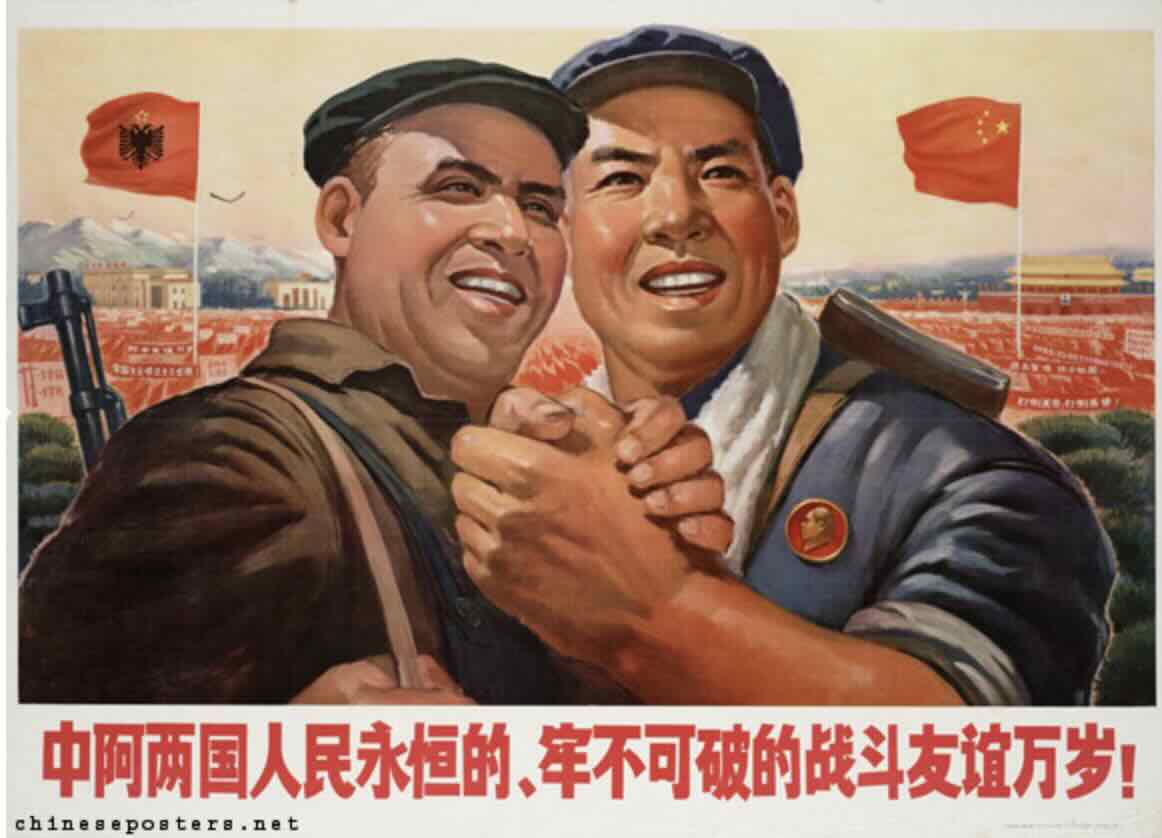
Albania China poster

“Long live the eternal and unbreakable friendship in battle between
the peoples of China and Albania!” Source.

After the death of Stalin in 1953 Enver Hoxha’s relationship with the Soviet Union eroded, deteriorating further in 1956, until the rupture of 1961 which led to Albania’s solitary alliance with Maoist China. In 1957, the wave of Albanianization was evident in the political renaming of many football clubs. Harrison shows how the “golden goal” dates back to 1961 Albania.

North Xinzhuang 1959

Quite the most remarkable image I know:
former Buddhist monk with village disciples, suburban Beijing 1959.

With religion suppressed under Hoxha, it was replaced by the ritual and passion of Sunday-afternoon football, a “communal protest against oppression and servility”. Asking “How did football make Albanians feel?”, Harrison describes wages, bicycles, cigarettes (with an aside on their manufacture), alcohol, transistor radios, and racing pigeons. In Tirana from the 1960s, Gimi’s tiny kiosk was a hub of activity, not only selling newspapers and magazines but serving as ticket office for the Albanian Football Federation. At the stadium one stand, the Tribuna, was reserved for army, police, and Party members. The only refreshments available were fara grilled sunflower seeds, wrapped in paper cones sold from tezga usherette trays. For away matches, with train links rudimentary, diehard supporters would undertake a three- or four-hour bike ride, or hitch a lift on an army truck. Attempting access to foreign matches via satellite TV was fraught with danger.

Political anxieties were pervasive, with society surveilled by the Sigurimi secret police (eight of whose nine directors were themselves imprisoned and executed between 1943 and 1991), and the spectre of labour camps. In 1967 star player Skënder Halili was caught selling two wristwatches and sentenced to hard labour in the mines of Bulqiza, eventually cause of his death in 1982—attendance at his funeral marking a small-scale protest against the regime.

“Truth over religion”, screenshots.

In 1966–67, just as the Summer of Love was under way in the West, Hoxha, emulating Mao’s Cultural Revolution, clamped down still more harshly on religion and Western influence. He sponsored the making of the 1967 propaganda film E vërteta mbi fenë [Truth over religion] (do watch here). Among the casualties were Catholic priests, imams, and leaders of the Bektashi order (cf. Turkey; for another niche topic, see Shamans in the two Koreas). This was among several waves of violent religious persecution throughout the Soviet bloc since the 1920s. I’m keen to learn more of the underground maintenance of religious traditions, one of my main themes for China; in Skopje, for instance, just northeast from Albania, a remarkable 1951 film shows self-mortification rituals of the Rufai order.
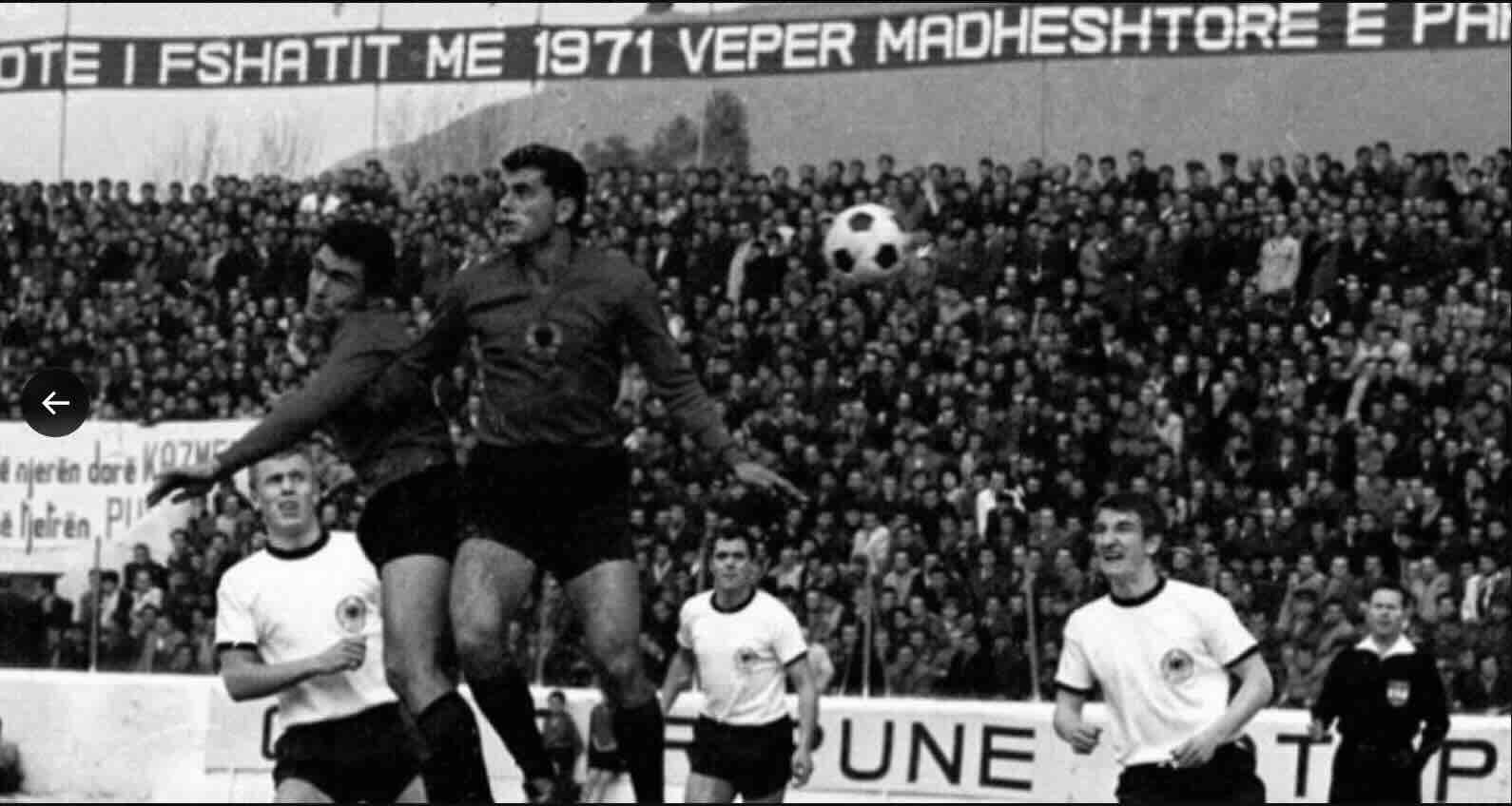
1967 Albania match
Source.

Back with the football, the 1966–67 “Championship of Coals” was subject to murky political interference. And in typical detail, Harrison describes the plucky goalless draw with West Germany in 1967 (above), watched from the Tribuna by Party stalwarts and Chinese dignitaries. I wonder about the lives of those visiting diplomats, who had somehow survived the Anti-Rightist purge, the Great Leap Backward and famine—now to find themselves exchanging cautious platitudes at a football match in a remote third-world country just as chaotic violence was being unleashed back home at the outbreak of the Cultural Revolution.
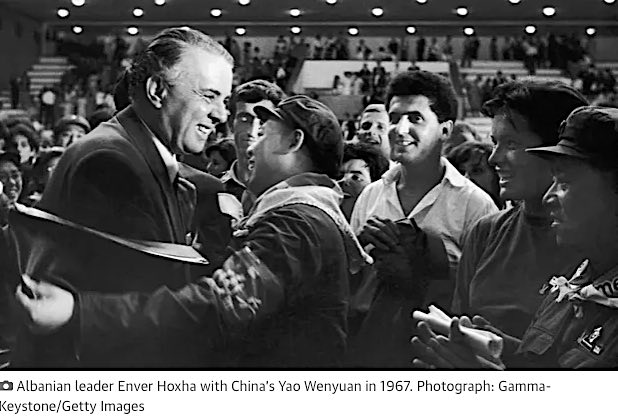
Enver

As purges continued, Albania became even more isolated. Harrison now devotes a substantial chapter to Fatmir Shima (with the catchy subtitle “the man from Xhomlliku”), father of his guide Irvin, who played in a lower division from 1969 to 1975 (cf. ordinary tennis players, Daoists, musicians, and so on), a temporary diversion from his career in agronomy. The chapter ends with another iconic game, between Tirona and Ajax, with predictable cultural clashes. Meanwhile Italian clubs were still scouting for Albanian players.

Under Hoxha the Gheg city of Shkodër was penalised, but its Vllaznia team rose to win the Kampionati Kombetar league in 1971–72, first of several successes over the following years—as the culture of Tirana at last no longer seemed so impregnable, people began to sense new possibilities.

Harrison continues to excel in arcane nerdiness with his account of the Dinamo club, which enjoyed success through the 1950s but then languished until the 1970s. Again he ends with an iconic game, between Partizani and Celtic for the 1979 European Cup—hair once again making a potential flashpoint. The game was “a sell-out, with ticket prices ranging from 7p to 21p”.

One of the great ironies of the piece is that Celtic’s players—upon their visit to Tirana during the dire, ramshackle days of the late 1970s—were privy to observing a failing city that was grim, penurious, and devoid of hope; a place of limited prospects.

In an act verging on satire, Vata—the first Albanian footballer to ever play in Scotland—made the reverse journey to his Celt predecessors 13 years later, keen to see what the world outside of Albanian borders had to offer. He now continues, by choice, to live in Hamilton.

By the 1970s, the Sino-Albanian collaboration suffered from Hoxha’s disillusion with China’s new rapprochement with the USA. Entirely isolated from 1978 once Chinese funding was discontinued, Albania was in an even more desperate plight. As audiences for the major games declined, people turned to futboll lagjesh “neighbourhood football”, a version of Italian calcetto. Harrison praises the creative improvisation of this five-a-side street style, “an inclusive, democratic idea set against an autocratic backdrop; an arcane act of defiance hiding within plain sight”, with vivid vignettes of the architecture of suburban east Tirana. But “with increased popularity came increased scrutiny”. “Enacting a class war”, a team from privileged Blloku ended up playing a rancorous game against a local Roma team, ending in a brawl and the sending of the Roma to labour camp.

By the early 80s, the regime was on its knees. As Hoxha lay dying, links were being forged with Italy, Greece, and Turkey. Within Albania, funding for football dwindled further. But apart from the long dominance of Tirana and Shkodër, KS Labinoti (in Elbasan county in central Albania) emerged as a contender. And the national team was making progress, at first through Shyqyri Rreli’s leadership of the under-21 team, and then in the 1984 World Cup qualifiers—with another blow-by-blow account of Albania’s magnificent 2-0 win over Belgium in Tirana. Albania narrowly failed to qualify for the Mexico 1986 World Cup, but the seed had been sown.

No nation has endured a more ill-tempered relationship with Europe’s footballing community than Albania. […] The Party remained unswervingly peevish in its interactions with the outside world, and this innate narrow-mindedness transposed itself on to sport.

Harrison documents the troubled domestic league, and encounters between Albanian and foreign clubs, over the whole period from the death throes of the regime from the late 1980s to the final collapse in 1992—whereupon Albania entered a period of anarchy and crushed dreams, prompting a mass exodus. 

But somehow in football, clubs “trundled on”. The final chapter, “The other side of the abyss”, describes how clubs reverted to pre-Hoxha names, resentment emerged in on-pitch petulance and crowd violence, corporate sponsorship gave rise to a new kind of corruption, and criminal gangs flourished. While the domestic game has suffered, since 2014 the national side has been reborn—with the great majority of the squad playing outside Albania.

The new, great Albanian players ply their trade elsewhere and are rewarded with huge remuneration and lavish lifestyles, connected to their native people only by ethnicity, not locality or reality.

Memory remains strong:

The only thing people who lived through Albanian Stalinism still celebrate, or seem to agree on, is  the football [… —] a football that unified fans and provided a balm during fifty years of horrific suffering.

One has to applaud Harrison’s boundless enthusiasm for such a niche project. Of course, football was not the only source of communal celebration; musical gatherings were an important part of social life at the domestic level (see under Musical cultures of east Europe, and Bernard Lortat-Jacob at 80). For other Albanian icons, see the unlikely bedfellows of Norman Wisdom and Mother Teresa. Note also posts under Life behind the Iron Curtain; more on football under A sporting medley: ritual and gender.


* With more detail on football than on social history, Harrison’s scant citations include Margo Rejmer’s collection Mud sweeter than honey: voices of Communist Albania, the memoir Erla Marinaku, “A social history of Socialist Albania, 1975-1991”, and the title Albania—who cares? is suggestive. He would doubtless like to add Lea Ypi’s perceptive 2021 memoir Free: coming of age at the end of history, which I reviewed here

Proms: Zemlinsky and Schoenberg

Zemlinsky concert 1905

For my first Prom this season, I went to hear Ryan Bancroft directing the BBC National Orchestra of Wales in Zemlinsky’s Die Seejungfrau and Schoenberg’s Pelléas und Melisande, premiered at the same concert in 1905. Having already written about both works, I was glad to hear them live.

In my youth, besides Ravel‘s Daphnis and Chloé, Schoenberg’s Pelléas left a deep impression on me, attending rehearsals and concerts in the fluid hands of Boulez; with his choices there was always a sense of discovery. At this week’s Prom I could only summon up fleeting glimpses of that magic, but (within the niche of ominous late-Romantic angst) Pelléas is perhaps rather more accessible, so it probably made sense to open the concert with it, building the audience’s attention for Die Seejungfrau after the interval. But either order could work. Ryan Bancroft, brought up in LA, directed fluently—like Boulez, conveying the music with his hands rather than a baton.

Prom BancroftSource.

You can hear the concert on BBC Sounds for the next two months. A sumptuous fin-de-siècle opening to the season, then—the previous evening Mark Elder conducted Mahler 5 in his Proms farewell to the Hallé after 25 years with them (available on BBC iPlayer). Even if Mahler towers over just about everyone (do consult my series!), it’s always rewarding to explore the work of his contemporaries and disciples, and to immerse ourselves in the whole culture of early-20th-century Vienna. Though the hall was less than packed, how wonderful that Prom-goers devote such attention and enthusiasm to the less familiar aspects of the symphonic repertoire.

Just a few days later came another fine late-Romantic Prom.

Some German tongue-twisters

Wartke

Whereas the mind-boggling “tapeworm words” in my post on Some German mouthfuls are of a practical nature, the realm of fantasy opens up whole new linguistic vistas. In a stimulating article, Deborah Cole introduces the work of the Berlin-based cabaret performer, playwright, and pianist Bodo Wartke.

She begins with some drôle political context:

Annegret Kramp-Karrenbauer, a former defence minister with a dastardly difficult name to say, was long seen as a likely successor to the relatively pronounceable ex-chancellor, Angela Merkel. Kramp-Karrenbauer’s resignation as the conservatives’ party chief came as a relief to news presenters the world over, clearing the way for the tight three-syllabic Olaf Scholz. Sabine Leutheusser-Schnarrenberger, once a federal justice minister and the ultimate double-barrelled tongue-tripper, was not invited to join his cabinet.

Now Bodo Wartke and his musical partner Marti Fischer have gone viral with their rap-tinged Zungenbrecher (“tongue-breakers”)—notably  “Barbaras Rhabarberbar” (recorded in 144 takes!), the story of a bar owner named Barbara who enchants all who try her rhubarb cake, including a group of bushy-bearded, beer-swilling barbarians who bring their barber back to try a bite:

This was followed by a charming sequel:

All this is entertaining for Germans and “reliably hilarious to foreigners”. With further links, Cole’s article makes good points about the history and appeal of German tongue-twisters. In English, this video is delightful too.

In Chinese, see A tongue-twister for the household Daoist. The apotheosis of word play, not to be missed, is Nicolas Roberton’s series of Anagram tales. See also under Language learning: a roundup.

Empireland

Empireland

Thoughtful analysis of the legacy of empire is part of a productive academic trend—one which is being vehemently resisted in the corridors of entrenched power, fulminating against the “Guardian-reading, tofu-eating wokerati” (links e.g. here; cf. Fatima Manji, Hidden heritage, and sources there).

  • Sathnam Sanghera, Empireland: how imperialism has shaped modern Britain (2021)

makes an engaging, accessible summary of research (among reviews, Guardian; LSE; and on the sequel Empireworld, LRB).

In the opening chapter Sanghera imagines a revival of Empire Day that would be more educational. As he notes,

It’s all very well highlighting empire awareness by talking about how our honours list still hands out Orders of the British Empire, how many of our common garden plants were originally imported into Britain by imperialists, or how Worcestershire sauce might originally have been an Indian recipe, reportedly brought back to Britain by an ex-governor of Bengal. But our imperial past has had a much more profound effect on modern Britain.

Empire explains why we have a diaspora of millions of Britons spread around the world. Empire explains the global pretensions of our Foreign and Defence secretaries. Empire explains the feeling that we are exceptional and can go it alone when it comes to dealing with everything from Brexit to dealing with global pandemics. Empire helped to establish the position of the City of London as one of the world’s major financial centres, and also ensures that the interests of finance trump the interests of so many other groups in the 21st century. Empire explains how some of our richest families and institutions became wealthy. Empire explains our particular brand of racism, it explains our distrust of cleverness, our propensity for jingoism. Let’s face it, imperialism is not something that can be erased with a few statues being torn down or a few institutions facing up to their dark pasts or a few accomplished individuals declining an OBE; it exists as a legacy in my very being and, more widely, explains nothing less than who we are as a nation.

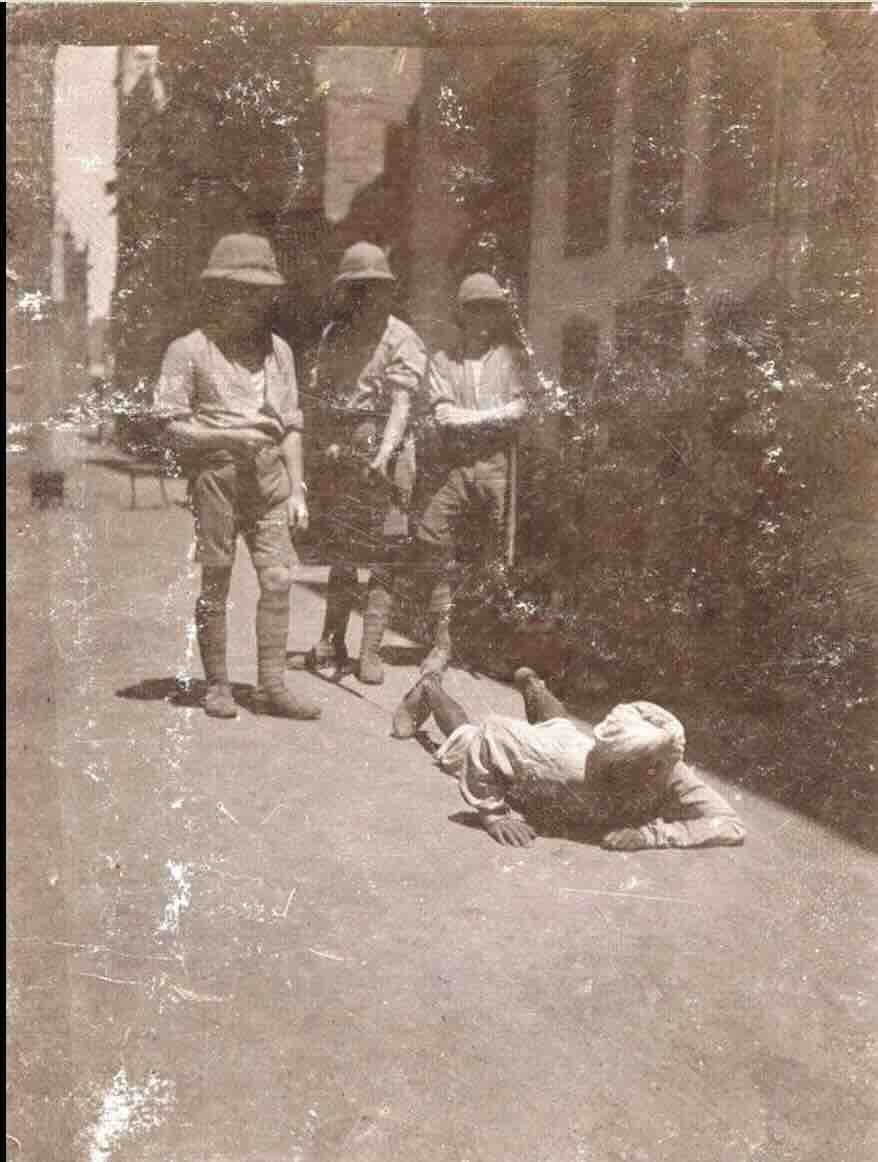
Amritsar 1919Prelude to the Jallianwala Bagh massacre (Amritsar):
“All native men were forced to crawl the Kucha Kurrichhan on their hands and knees
as punishment, 1919″. Source: wiki.

He frankly explores his Punjabi Sikh background, and demolishes the “futile and misleading” balance sheet of “was the Empire good or bad?”. Chapter 4, “Emotional loot” gives an instructive take on the 1903 British invasion of Tibet (“the Younghusband expedition”), leading him to consider the massive stock of looted artefacts that adorns our museums and stately homes, and the bitter debate over restitution. Chapter 5, “We are here because you were there”, opens in Brighton with the story of Dean Mahomed (1759–1851) (also explored by Fatima Manji), leading to an outline of the early presence of black and brown people in Britain.

Sanghera reflects on nostalgia for the Raj, the persistent self-isolation of expat communities around the world, and their taste for British food and education; on the irony of the British search for adventure (“There is no shortage on Instagram of people who confuse travelling with having a personality”); on the lure of sexual opportunity, and prudery; and on the vanity of our claim to be “world-beating”. An intriguing insight on empire’s fetish for manliness:

It was not uncommon to find men with a stammer working in administrative roles in the Indian Civil Service—to have a position in empire instantly gave a man kudos, and a speech impediment might be overlooked for “empire served as proof for masculinity”.

Empireland is full of such instructive byways, such as the history of gin and tonic, “the cornerstone of the British Empire” (Spanish fly 1976):

Gin to fight the boredom of exile and quinine to fight malaria. How else do you think we could have carried the cross of responsibility for the life of millions without the friendly fortitude of gin and tonic?

Sanghera cites a Tweet by Helen Zaltzman:

Britain is hostile to people arriving in boats because Britain knows what happened when Britain arrived in other countries in boats.

Chapter 8, “Dirty money” continues to unearth the foundations of British wealth, while carefully identifying the complex issues. Just as balanced is Chapter 9, “The origins of our racism”:

To say Britain has a dark history of racism which influences contemporary psychology and culture […] does not preclude, for me, the fact that it simultaneously, if inadvertently, inspired anti-racism.

Farage PowellSource.

In Chapter 10, “Empire state of mind”, Sanghera returns to his own experience, pondering the public school system, analysing the warped psychology of Boris Johnson and Jacob Rees-Mogg along with other recent Tory fatuities—but finding inspiration in the work of Edward Said. Chapter 11, “Selective amnesia”, pinpoints a major theme of troubled national histories around the world (see e.g. Memory, music, society), with a trenchant vignette on Britain’s obsession for India’s railways—citing Katherine Schofield’s hashtags #OccasionalMassacre and #ButTheRailways. He introduces James Walvin’s The trader, the owner, the slave as the single best book he has read on slavery—elsewhere he imagines putting Robert Winder, Bloody foreigners on the national curriculum.

Chapter 12, “Working off the past”, continues to explore the right-wing backlash against the convincing arguments of historians, but in conclusion he details several reasons to be optimistic. In 2023 he issued a children’s book, Stolen history: the truth about the British Empire and how it shaped us

Just as reasonable and constructive is his two-part documentary Empire state of mind for Channel 4 (2021). Perhaps you can also find his 2019 film The massacre that shook the Empire. Do consult his useful website.

I remain fond of this definition of patriotism from a Yugoslavian child in the 1990s, cited by Kapka Kassabova:

I love my country. Because it is small and I feel sorry for it.

* * *

Empireland makes a convenient survey of the major topics in imperialism explored by academics—and relieves bigots of the burden of reading them, allowing them to focus their fulminations on Sanghera. Despite his impartial considerations of the evidence, a counter-movement of denial soon surfaced—which he explores thoughtfully (see also here).

For what it’s worth, I am actually grateful for a great deal. […] For having had a free education at one of the best grammar schools in the country; for having attended (for free) one of the best colleges at one of the most successful universities in the world; for an NHS that cares for the people I love the most; for a welfare state that has saved my family from the most crushing consequences of poverty; for the chance to live in the greatest city on earth and work on two of the greatest newspapers in the world; for British pop music; for the glorious British countryside; for Pizza Express. But I resent being instructed to demonstrate my gratitude whenever I analyse any aspect of British life, when my white colleagues don’t get the same treatment. Yes, I have had a better life than I would probably have had in India, but I was born here, not India. I am British. I am as entitled to comment on my home nation as the next man and the endless insistence that I demonstrate my gratitude is rooted in racism. Racism which is, in itself, rooted in the fact that the children of imperial immigrants born here are not always seen as fully British.

Given that many white authors have reached precisely the same conclusions, the backlash against Sanghera and David Olusoga suggests just the kind of racism that this approach exposes, as William Dalrymple observes:

“Despite writing very similar stuff to Sathnam, I have never received a single letter like that. It is a direct result of his ethnicity and skin colour,” says Dalrymple, whose latest book The anarchy tackles the “relentless” rise of the East India Company. “You can’t really draw any distinction between what Sathnam’s writing and what I’ve written. And my books have got a free pass. There is a very serious distinction to be drawn between what he’s gone through writing what he has on empire, and me as a Caucasian writing the same thing.”

BTW, Sanghera,  Olusoga, and Dalrymple are just the kind of scholars I would love to see elaborating on my speculations about the early-19th-century reversal of the black and white keys on fortepianos in the context of slavery and empire.

A film on the qin zither

JT film poster

Lest anyone despair that my Chinese theme has recently been submerged
beneath football and tennis

Having studied the qin zither obsessively for my first few years after coming to China in 1986, I then defected—feeling not exactly unworthy but just too immersed in the utterly different world of folk ritual life in the poor countryside (see Taking it on the qin). So my posts on this elite solo tradition (see qin tag) are partly an attempt to atone for jumping ship. The qin being a genuine ivory tower, we might try and see the wood for the trees (make up your own metaphors—though “Swirls before pine” is unbeatable!).

John Thompson has never wavered in his devotion to the qin. The documentary

  • Music beyond sound: an American’s world of guqin (Lau Shing-hon, 2019)
    (watch here; introduction here, with links)

makes a useful introduction to his lifelong work. Interspersed with lengthy sequences in which he plays his reconstructions of Ming pieces at scenic spots in Hong Kong and Hangzhou (in the mode of the literati of Yore), he reflects on his early life, his later path, and the state of the qin (biography here). Subtitles are in both English and Chinese. It’s something of an illustrated lecture, with testimonials.

From a background in Western Art Music (WAM), John was drawn to early music, as well as popular music and jazz. After graduating in 1967 he was confronted with the draft, serving in Military Intelligence in Vietnam (cf. Bosch) for eighteen months and making trips around East Asia. Already educating himself on Chinese culture, he returned to the USA to attend graduate school in Asian Studies, studying Chinese language and discovering “world music” through ethnomusicology, learning the Japanese shamisen. In those early days before the vast revival of traditional Chinese culture around 1980, he was understandably underwhelmed by the bland diet of conservatoire dizi and erhu solos. Instead, through reading the seminal work of Robert van Gulik, The lore of the Chinese lute, he became fascinated with the highly literate, prescribed microcosm of the qin. *

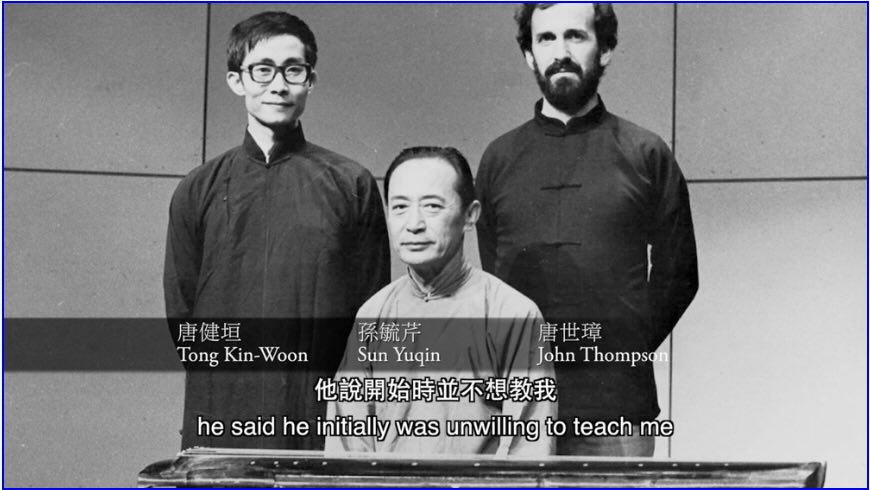
JT with Sun Yuqin

For this his best option was Taiwan, where from 1974 to 1976 he studied with Sun Yu-ch’in (1915–90); he then studied with Sun’s accomplished pupil Tong Kin-woon and the veteran Tsar Deh-yun (1905–2007) ** in Hong Kong, where he made his home. While learning from the qin renaissance in mainland China before and after the Cultural Revolution, he has forged his own path performing and researching early tablatures; setting forth from reconstructing the 64 pieces in the 1425 Shenqi mipu (6-CD compendium with 72-page booklet, 2000), he avidly sought out other early tablatures (CD Music beyond sound, 1998).

This may seem like a niche within a niche, and it’s an even more solitary pursuit, but the search for early pieces vastly expands the small repertoire handed down from master to pupil. All this work gave rise to his remarkable website.

In the PRC since the 1960s the traditional silk strings of the qin were largely replaced by metal, though they persisted in Taiwan and Hong Kong, and there are some advocates on the mainland. In keeping with his taste for historical recreation, John is a fervent advocate of silk strings (see this typically exhaustive essay).

In Hong Kong he also served as Programme Adviser for the Festival of Asian Arts from 1980 to 1998. In 2001 he married Suzanne Smith and they moved to New Jersey. Alongside his ongoing research he continues to engage with the qin scene in mainland China, where his work is respected. In 2010 he was among fourteen masters invited to take part in a festival at the Zhejiang Museum to play qin zithers from the Tang dynasty (!!!) (click here; for a 2019 festival, here). Like other wise qin players, confronted by the performance ethos of the conservatoire and the Intangible Cultural Heritage, he valiantly proclaims the literati aesthetic of self-cultivation.

* * *

While silkqin.com contains a vast range of material, John remains devoted to recreating Ming tablatures (still, I find it refreshing to hear him explaining that in such an oral tradition, there was no need for tablature!). The site contains ample material on the changing modern practice of the qin, but the social context before, during, and since Maoism (suggested in my series on the qin zither under Maoism) is not his main theme. Clearly the quietism the film evokes (cf. the spiritual quest of Bill Porter) is remote from the “red and fiery” atmosphere of the folk festivities that I frequent, but the social bond of PRC qin gatherings is also largely absent.

In the Chinese media the dominance of elite imperial culture is stark; online there is a wealth of information on the qin, whereas material for far more common traditions (such as the rituals of spirit mediums) is elusive. While John’s comments on the differences between early WAM and “Chinese music” are thoughtful, the vast variety of the latter cannot be represented by the qin; his dedicated study of one aspect of an elite tradition hardly allows room to absorb the wider context.

Bruno Nettl has wise words on “you [foreigners] will never understand our music” (The study of ethnomusicology: thirty-three discussions, ch.11). Conversely, I’m tired of the old clichés “Why should a foreigner study Chinese culture?” and “The monk from outside knows how to recite the scriptures“. Within China there are plenty of “monks to recite the scriptures”; no-one there would ever suggest that the qin is only understood by foreigners. John is indeed exceptional in his long-term in-depth study, but further afield this kind of thing is common—as is clear from the careers of other foreign scholar-performers such as Ric Emmert for Japanese noh drama, Veronica Doubleday for Afghan singing, or Nicolas Magriel for the sarangi in India. ***

In the sinosphere, whereas scholars rarely engage in participant observation for folk music, for the qin performing and scholarship tend to go hand in hand. So alongside the majority of qin players who have been content to transmit the repertoire that they learned from their teachers are some distinguished masters who unearth and recreate early historical sources—such as Zha Fuxi, Yao Bingyan, Tong Kin-woon, Bell Yung, Dai XIaolian, and Lin Chen. John’s work as performer and scholar is a particularly intense instance of this historical focus, a niche in the wider movement of Historically Informed Performance (HIP: see e.g. Richard Taruskin, John Butt).

Qin fraternities are now thriving in mainland China, Taiwan, Hong Kong, and around the world. Senior figures on the Hong Kong scene include Tsar Teh-yun, Tong Kin-woon, Lau Chor-wah, and Bell Yung. Note also the work of Georges Goormaghtigh. The qin has long been a popular choice for foreign students to study in the PRC.

My usual point: given its tiny coterie of players, the qin is vastly over-represented in studies of Chinese music! But however niche, the qin is an essential aspect of literati culture through the imperial era, along with poetry, painting and calligraphy; and John Thompson’s work is an essential resource.


* For my own Long March to Chinese music around this time, see Revolution and laowai, and under Ray Man.

** See Bell Yung, The Last of China’s literati (2008), and the 2-CD set The art of qin music (ROI 2000 / AIMP 2014).

*** Note the contrasts between these four cultures, and approaches to them: Emmert working within the “isolated preservation” (Nettl) of noh, Doubleday as participant observer of an Afghan folk tradition soon to be decimated by warfare and fundamentalism, Magriel immersed in the changing social context of sarangi, and Thompson focusing on his own historical recreations of qin music.

Folk cultures of Europe

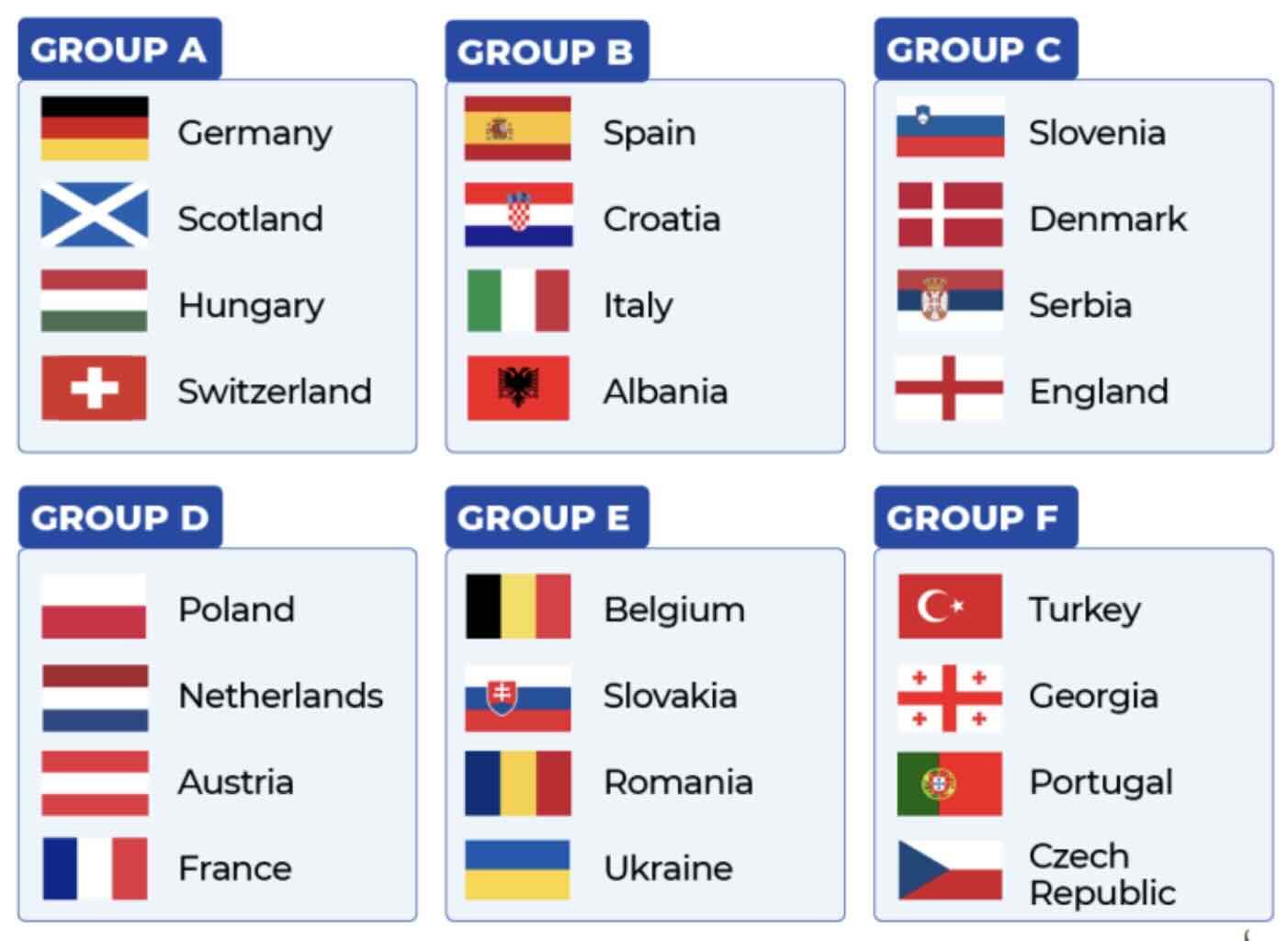
Euro teams

A major theme of this site is the rich variety of regional folk expressive cultures, in China and around the world. Quite by chance, the compelling drama of Euro 24 has provided me with a wacky perspective to celebrate the wonders of folk cultures around Europe—at a time when all seems lost amidst supermarkets and ring roads, Brexit and the dangerous idiocies of far-right politicians.

And as Barney Ronay notes,

Saka is a player you just love to see have these moments, to smile, to remind you […] that this is still at bottom a matter of play, joy, fun, and invention.

My three recent posts, all with wonderful playlists:

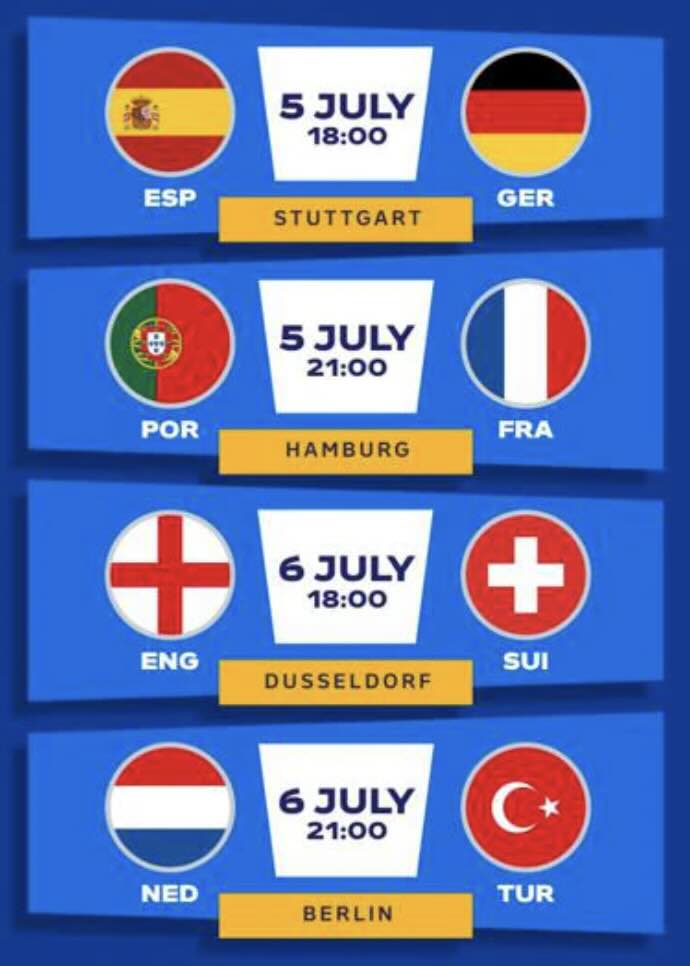
So we might regard Sunday’s final as a contest between the passion of flamenco and, um, Morris dancing—like so:

Southgate devises a novel wall to defend a free-kick from a youthful Spanish team.

These posts complement regional surveys such as Musical cultures of east Europe, Italy: folk musicking, Portugal: folk traditions, flamenco, fado (here and here), Irish folk, and so on. See also Bernard Lortat-Jacob at 80.

Meanwhile, A sporting medley: ritual and gender has links to other posts on football, as well as snooker, tennis (including a wonderful playlist for Emma and Leylah!), and rugby—for Morris dancing as a suitable response to the All-Black haka, click here.

Curse of the Ninth

*Latest in my Mahler series!*

Curse

Ever since the very first episode in 2014, the BBC TV comic-noir series Inside No.9 (website; wiki) has been consistently brilliant. Written by and starring Steve Pemberton and Reece Sheersmith, it features cameos from a succession of fine actors. The plot twists are ingenious, the mood sinister and enigmatic.

The penultimate episode of the ninth (and final!) series (watch here) takes its title from the Curse of the Ninth, attributed to Mahler’s fruitless efforts to trick fate. Typically macabre, it’s “an Edwardian chiller in which a talented piano-tuner is forced to confront the power of a centuries-old curse by the owners and servants of a large country house.” As the drama unfolds, we hear well-chosen excerpts from the 1st movement of Mahler 9.

Curse 2

The wiki article on the curse gives instances of composers unable to complete their 10th symphony—but also lists counterexamples of others who did manage to do so. So there.

* * *

No.9

A random selection of (nine!) other stimulating episodes from Inside No.9:

The very final episode Plodding on is ingenious…

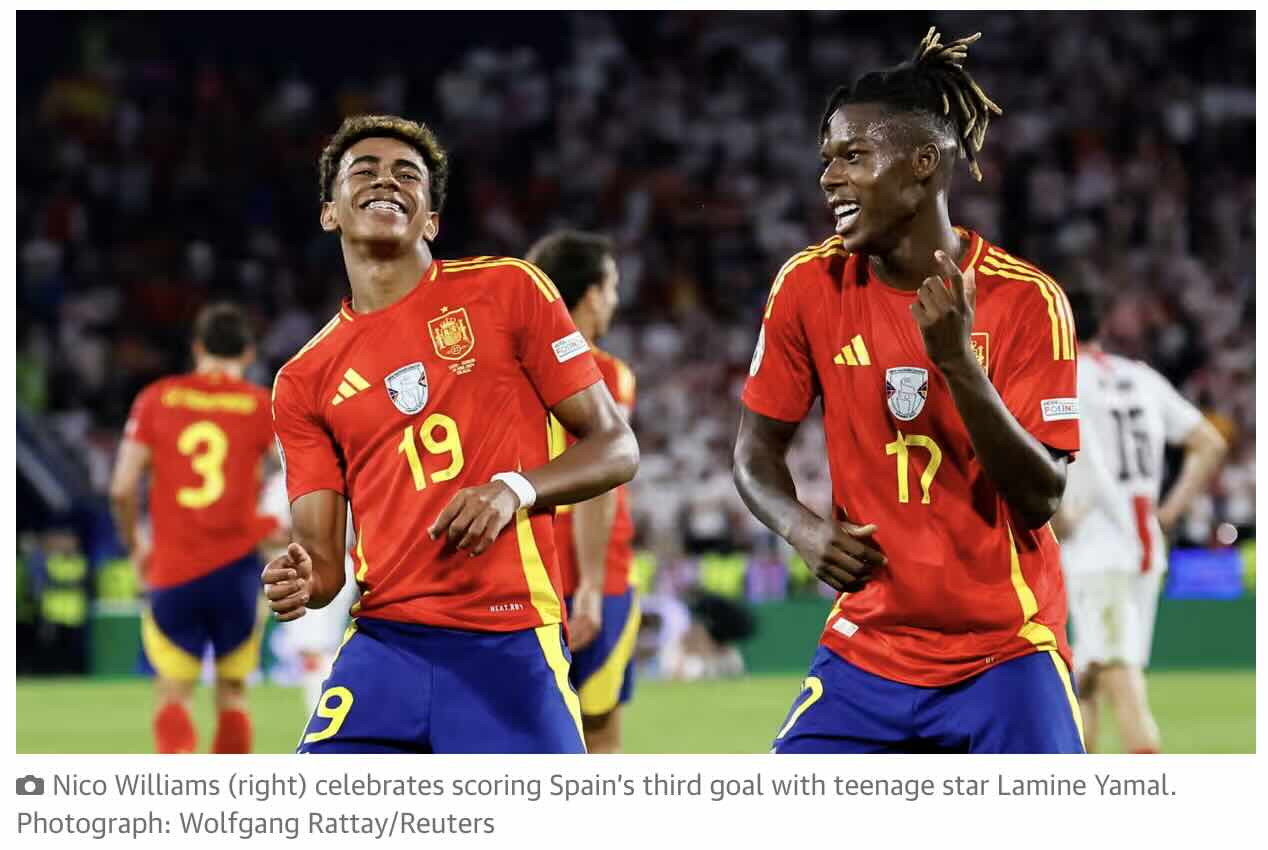
Euro 24, the semi-finals: yet another playlist!

In celebration of folk cultures around Europe

Compiled without regard to expense or the feelings of the public

Flann O’Brien

On a roll after my Euro 24 folk playlists for the 24 teams and then for the quarter-finals, here’s another niche selection of funky tracks for the semi-finals! Having covered some bagpipe traditions, I might have gone on to highlight shawms (suitably loud, and widespread), but this playlist (partly derived from previous posts, with some new material) is based on singing and fiddling.

Whatever your feelings about football, just in case you suppose this exercise is a frivolous diversion from weightier matters, it makes an instructive and inspiring reminder of the diversity of European cultures!

* * *

Screenshot

For Spain, for all its wealth of regional styles (e.g. Songs of Valencia and Festive soundscapes of the Rioja), one can never have enough flamenco (and the documentary series Rito y geografïa del cante is not to be missed!)—here are a few classics from my series.

* * *

PraviAs to France, even I might hesitate to try out Boulez or Messiaen on a football crowd; Un homme et une femme and Comment te dire adieu are tempting, but here I suggest

If it’s folk traditions you’re after (Yeah right—Ed.), then how about

  • the world of fiddlers around the Dauphiné in the southeastern Hautes-Alpes, accomoanying the rigodon dance—here’s the CD France “Rigodon sauvage”—Alpes du Sud: Dauphiné (Ocora, 1995): *

* * *

England penalties

England: more singing with fiddles (from this post on the doyens of the English folk scene)—

  • here’s Eliza Carthy and the Ratcatchers, with John Boden and John Spiers of Bellowhead:

Barney Ronay:

Saka is a player you just love to see have these moments, to smile, to remind you […] that this is still at bottom a matter of play, joy, fun, and invention.

* * *

Turkey fans

Now don’t get me wrong, I love the Dutch; I should really make an effort with their folk cultures, although recordings (mainly from Friesland) such as Jaap Kunst‘s 1956 LP seem less than enthralling (playlist here, or this clip from a 1963 disc, with images). I’m all for doorstep anthropology, but one can imagine Kunst finding Indonesia a more stimulating fieldsite, and I can see why Antoinet Schimmelpennick set off for China. Still, personal taste isn’t really the brief of the ethnographer.

All the same, in my self-appointed capacity as referee I’m going to overrule the Netherlands’ second-half goals and pretend Turkey won—because they have been the stars of the tournament, and it feels like they’ve been playing at home. So first,

Another reason for me to bend the rules is because Turkey has some amazing music. Whereas modern France is multicultural, my other choice for Turkey reflects a multicultural past:

Well I guess that’s about it for tonght folks! Now read on for those Alpine fiddlers…


* Archive recordings are heard on the 1978 LP Violoneux et chanteurs traditionnels du Dauphiné—cf. Le violon traditionel en France (Silex, 1994, with notes by Patrick Mazellier).

Violon traditionel CD cover

The tracks from 1939, on the eve of war, were recorded by Roger Dévigne (1885–1965):

The 26th—telegram from the Vice-Chancellor: “Come back immediately”. Mr Jouan Nicola arrived at the same time as the telegram: “I’m here to help you dismantle your recording equipment” he told me. From outside came the continuous rumble of coaches leaving packed with soldiers called up. Off to the station. Long queues of soldiers called up from the mountains, each with his cardboard suitcase…

Additional items were recorded from 1975 to 1977, featuring the veteran fiddlers Emile “Milou” Escalle (1900–1987), Augustin Istier (1906–89), and Camille Roussin-Bouchard (1909–90).

The more fanatical football supporter may wish to delve into the fine site violoneux.fr

violon map

Detail of map showing distribution of fiddle traditions in France!

For a less voluminous introduction to regional styles, click here—citing an 1821 decree:

It is forbidden to all fiddlers or other instruments forming any gathering around [feasts], they could become responsible for the evil that would result and need to be arrested by order of the Mayor.

Such sources reflect on the long decline of the traditional context of social dance.

Rigodon 1908Not so much an impromptu pre-match party as

a rigodon at Saint-Pierre-de-Méarotz, Isère, July 1908. Source
(cf. the excellent title Le rigodon n’est pas un fromage!).

The purgatory of the tennis circuit

tennisConor Niland after losing to Adrian Mannarino at Wimbledon 2011.
Ben Stansall/AFP/Getty Images.

The life of the concert soloist may seem glamorous, though the routine of airports, hotels, concert halls, and receptions must wear thin. Still, it contrasts with that of rank-and-file orchestral musos (cf. Mozart in the jungle, and Ecstasy and drudge). Apart from The Money, I note the irony of the soloist being condemned to churning out the same three or four concertos all their lives while the orchestral musos are constantly playing a variety of wonderful music (Mahler—you know that’s who I meant).

LMS

By the same token, following Vincent Goossaert’s search for “ordinary Daoists” (theme of his The Taoists of Peking, 1800-1949: a social history of urban clerics), it’s not all about the Du Guangtings and Chen Rongshengs, or about the elite mystical sages of yore. Hence my own search for household Daoist groups like the Li family.

Nor is tennis all about the superstars, the Federers and Świąteks, with their ritzy entourages. An interesting Guardian Long Read by Connor Niland, “I’m good, I promise: the loneliness of the low-ranking tennis player”, describes life at the bottom of the top. Formerly No.1 Irish player, he tells a sad story.

He outlines the three tiers of men’s professional tennis: the ATP Tour for the top 100 male tennis players in the world, the Challenger Tour, mainly by players ranked between 100 and 300—and the Futures tour, “tennis’s vast netherworld of more than 2,000 true prospects and hopeless dreamers”, which

sometimes felt like a circle of hell, but in practical terms it’s better understood as purgatory: a liminal space that exists only to be got out of as quickly as possible.

As he explains,

Surviving on the Futures and Challenger tournaments isn’t just about being good at tennis. It’s about being able to cope with the strange bedfellows of regular boredom and constant uncertainty. Not many succeed.

He felt trapped:

I phoned Mum from the airport in Geneva, telling her I was tired and would skip Edinburgh and fly home instead. She wasn’t having that. “This is your job now, Conor,” she said. “You can’t just not turn up because you’re tired.” I remembered my friend and one-time tennis partner Pat Briaud’s words: “Your parents don’t mess around.” I turned up and made the semi-final, losing a feisty two-and-a-half-hour match to Britain’s Jamie Baker. It was my 24th match in five weeks. Exhausted, I collected my prize money: $480, before 20% tax.

By contrast with the constant media exposure the stars have to endure, loneliness and isolation are the fate of the rank-and-file.

I made virtually no lasting friendships on tour through my seven years, despite coming across hundreds of players my own age living the same life as my own.

And he describes the difficulty of finding a practice partner. At least the life of orchestral musos is leavened by an embattled camaraderie—and they share a bond in maestro-baiting and deviant behaviour.

I almost never went sightseeing on a day off. That was partly to conserve energy, partly because I had nobody to go with. And in many of the one-horse towns that hosted Futures events, there weren’t any sights to see. […]

I would return to Ireland from three-week trips to these exotic places with no notable stories or experiences. “How was Morocco?” I would be asked. “Fine,” I would say, with nothing else to add. […]

The true unfortunates, though, were the ones who were talented enough to rationally hope to advance. These were people who grew up as the best tennis players in their country, but were stuck between 300 and 600 in the world, not quite contending for the Challenger Tour nor the qualifiers at grand slams, but winning just often enough to keep their tennis dream faintly alive. A Futures tournament referee in the US became infamous for his straight-talking to 28-year-old players: “C’mon man, what are you still doing here?” He was straying out of his lane, but his intentions were good. And he was usually right.

Niland ends with a depressing account of a fruitless Challenger event in Uzbekistan. It all sounds a bit like doing a Messiah in Scunthorpe for a jolly good tea. Whether in music, religion, or sport, ethnographic perspectives like this are always valuable.

Under Sporting medley: ritual and gender I list several posts on tennis.

Euro 24: the last eight bagpipes standing

Another playlist in a series that football fans didn’t know they needed

Euro 24 list

Now that the twenty-four teams of Euro 24 have been reduced to eight, I hear you clamouring for a more focused playlist of bagpipe music to represent them (Yes, I am getting my hearing tested).

Among many sources on the history and distribution of bagpipes, the Essential Vermeer website has instructive material (here and here); and I set forth again from this list. As shown in my previous post, the distribution of instruments rarely aligns with either current or past national boundaries.

SpainGrooving to the gaita. *Coimbra gaita

Starting with

how about gaita from Coimbra (the image by Armando Leça shows an old handmade bagpipe from Coimbra, late 1930s—who knows if such a player inspired Portugal in their 1930 victory over France?!)

—and Galicia:

Guler“Just dig that funky tulum

For a related “tapeworm word”, see under Some German mouthfuls!

Around north Europe, with online clips dominated by medieval revivals, living folk traditions are harder to find.

England goal

  • England—here’s Kathryn Tickell on Northumbrian smallpipes:
  • FranceBreton pipers:

As to

  • Switzerland (not Italy—whence I await more “Caporetto” headlines, to follow those for the 2002 and 2018 World Cup defeats). **
  • Germany
  • The Netherlands (though Romania might have been more fruitful),

referring back to the Essential Vermeer site, there’s some fine material on peasant bagpipes as depicted by Peter Brueghel the Elder and Jan Steen; and we can seek further for modern vestiges under Dudelsack, SackpfeifeDoedelzak, and so on.

Brueghel bagpipes

There—just what you need to warm up for the quarter-finals eh…

More football posts under A sporting medley: ritual and gender.


* Sorry to go on, but this comment in the Guardian live-feed reminded me of my own football dream:

The first time Lamine Yamal joined the Spain squad, they left his boots behind. His and everyone else’s too. When the selección touched down in Tbilisi to face Georgia in September 2023, the trunk carrying part of their kit was still sitting at Barajas, forcing them to complete the evening session at the Boris Paichadze stadium in trainers, unable to strike the ball. The following night, they scored seven. On his debut, the Barcelona winger got the last of them, aged 16 years and 57 days, and the national team got a new beginning.

JRM** Before England’s Great Escape from Slovakia, I was composing our own version of Caporetto, inspired by that popular classic from the Minister for the 18th Century:

“the greatest vassalage since King John paid homage to Phillip II at Le Goulet in 1200”

Magnificently 🍾🍾🍾 , the Haunted Pencil is now Toast, or Ashes—as the sun came up, he crumbled into dust…

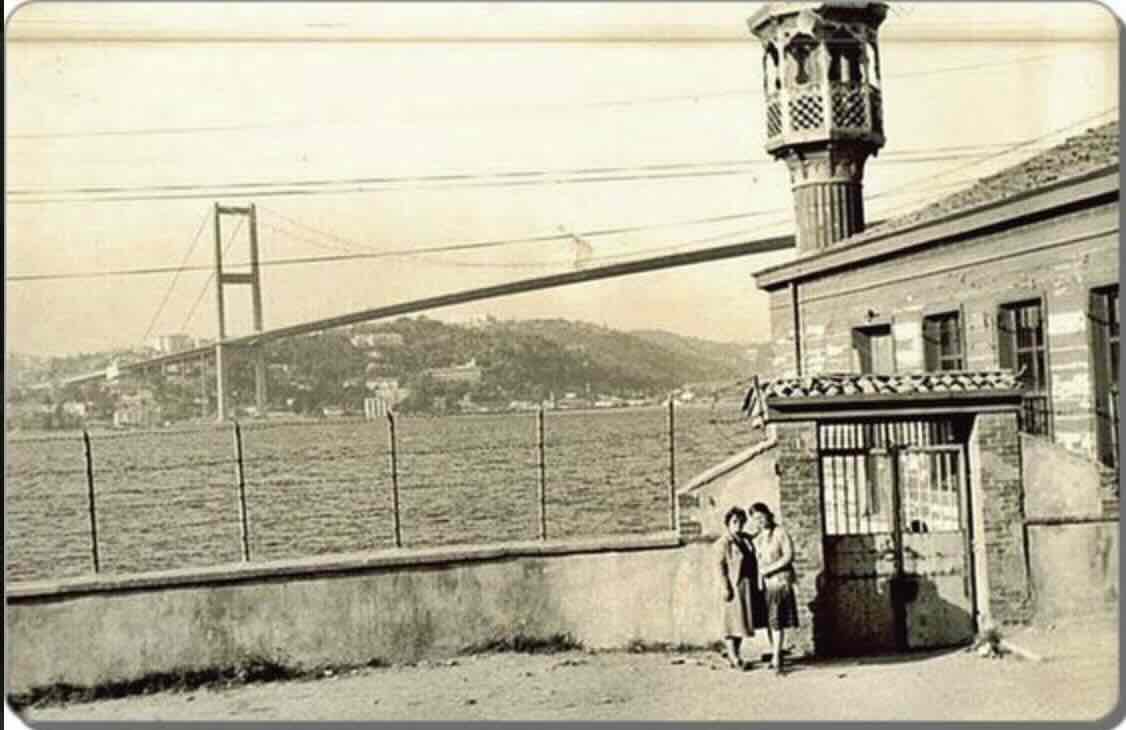
A bijou mosque in Kuzguncuk

I’ve written several posts on the picturesque Istanbul mahalle of Kuzguncuk on the Asian shore of the Bosphorus—notably on Nostalgia for cosmopolitanism, Epiphany, Greek liturgy, The 1955 riots, The kiosk in Turkey and Europe, Köçek in Kuzguncuk, and Blindman Ali.

Since at least the 19th century Kuzguncuk was mainly populated by Armenians, Jews, and Greeks. By 1933, sources suggest that the population was still 90% non-Muslim. As Amy Mills notes, the present mosque, opposite the iskele ferry and next to the 1835 Armenian church, was only built in 1952, “the first moment in the neighbourhood’s long history when there were enough Muslim Kuzguncuklus to necessitate a local, regular, community gathering space.” It is now blessed with the splendid imam Aydin Hoca (see under The call to prayer).

MinaretIt’s taken me all this time to visit the bijou rectangular wooden mosque further up the coast towards the bridge—just below the mansion of Sultan Abdülhamid’s cultured confidant Cemil Molla (1864–1941), who sometimes served as imam there, and just past the yalı waterside residence of Sare Hanım (1914–2000), aunt of left-wing poet Nâzım Hikmet (see here).

Built in 1860 by Üryanizade Ahmet Esat Efendi, the mosque was allegedly completed in forty days (see e.g. here). It has a wooden pulpit and preaching platform, and a modest wooden minaret with a single balcony; it has its own boathouse.

Left, 1946; right, 1973—among old and recent images here.

After restoration work started in 2013, the mosque was re-opened for worship in 2017, making a place of great tranquillity, and a reminder of a time when Muslims were a small minority in Kuzguncuk.

mosque nd

Undated.

Further up the coast in Kanlıca, in the square by the ferry, is the İskender Pasha Mosque, where we heard the noon ezan from a riverside café on my first visit in 2021. Not quite so miniature, but still on a human scale, it was built in 1559–60, designed by the great architect (and former Janissary) Mimar Sinan.

Kanlica

All this by way of reflecting on the art of the miniature—by contrast with the grandiose projects of the Ottoman sultans that I churlishly avoid. In rather the same way, in China I’ve never visited the Great Wall, but in the countryside humble little “public buildings” are decked out to become the heart of the ritual life of the community.

SSZ xihui 1996
3rd-moon festival for female deity Houtu, Shenshizhuang, 1996.

See also under West/Central Asia: a roundup.

Voice of Baceprot

Despite Delighting in All Manifestations of the Terpsichorean muse, I need hardly tell you that Glastonbury is a mystery to me. But to follow We are Lady Parts, I learn of Voice of Baceprot (VoB). An Indonesian all-female metal trio from rural Garut, West Java, they sing in English, Sundanese, and Indonesian (website; wiki; useful survey).

VoB

Making headlines since 2017, their 2018 single School revolution (lyrics) was remixed on EP in 2022. From VoB’s YouTube channel, their 2023 album Retas (Guardian interview) includes tracks like What’s the Holy (Nobel) today?, God, allow me (please) to play music, and [NOT] PUBLIC PROPERTY. Here’s the playlist:

Warming up for Glastonbury (where they are understandably concerned about the weather and the food…), VoB played in London at Downstairs at the Dome—but it was sold out, so I wasn’t distracted from Euro 24—indeed, I would have felt like a tarantula on a slice of angel food cake, in Raymond Chandler‘s fine simile.

This makes quite a change from Éva Gauthier‘s genteel promotion of gamelan. Note also my roundups on punk (including Croatia, Spain, Iran, Beijing, and the GDR), gender, and West/Central Asia—Like I’d Know…