Social survey

China’s prostitutes were better-trusted than its politicians and scientists, according to a 2009 online survey published by Insight China magazine. The survey found that 7.9% of respondents considered sex workers to be trustworthy, placing them third behind farmers and religious workers. “A list like this is at the same time surprising and embarrassing,” said an editorial in the state-run China Daily.

Politicians were far down the list, closer to scientists and teachers. Insight China polled 3,376 Chinese citizens in June and July this year. “The sex workers’ unexpected prominence on this list of honour… is indeed unusual,” said the China Daily editorial. “At least [the scientists and officials] have not slid into the least credible category which consists of real estate developers, secretaries, agents, entertainers and directors”, the editorial said. Soldiers came in fourth place.

For an elaborate story linking the Sex-Workers’ Association and the Journalists’ Association, see here.

Watching the English

Fox

If it’s pop armchair ethnography you want (and why not, sometimes?), then

  • Kate Fox, Watching the English: the hidden rules of English behaviour

is brilliant.

To be impeccably English, […] one must appear self-conscious, ill-at-ease, stiff, awkward, and above all, embarrassed. Hesitation, dithering and ineptness are, surprising as it may seem, correct behaviour. (41)

And her insights into the “Typical!” rule (pp.199–200, 303–305) and funerals (pp.374–8)… Her final list of English traits (pp.400–414) includes Social dis-ease and Reflexes such as Humour, Moderation, Hypocrisy, Eeyorishness, Fair play, and Modesty.  I’ve also cited her remarks on headline punning. Click here for her comments on funerals.

And say what you like about Bill Bryson, but he too has some fine insights into the British (Notes from a small island, pp.68–9):

It has long seemed to me unfortunate—and I’m taking the global view here—that such an important experiment in social organization was left to the Russians when the British would have done it so much better. All those things that are necessary to the successful implementation of a rigorous socialist system are, after all, second nature to the British. For a start, they like going without. They are great at pulling together, particularly in the face of adversity, for a perceived common good. They will queue patiently for indefinite periods and accept with rare fortitude the impositioning of rationing, bland diets and sudden inconvenient shortages of staple goods, as anyone who has ever looked for bread at a supermarket on a Saturday afternoon will know. They are comfortable with faceless bureaucracies and, as Mrs Thatcher proved, tolerant of dictatorships. They will wait uncomplainingly for years for an operation or the delivery of a household appliance. They have a natural gift for making excellent jokes about authority without seriously challenging it, and they derive universal satisfaction from the sight of the rich and powerful brought low. Most of those over the age of twenty-five already dress like East Germans. The conditions, in a word, are right.

On a related tack (pp.98–9):

And the British are so easy to please. It is the most extraordinary thing. They actually like their pleasures small. […] They are the only people in the world who think of jam and currants as thrilling constituents of a pudding or cake. Offer them something genuinely tempting—a slice of gâteau or a choice of chocolates from a box—and they will nearly always hesitate and begin to worry that it’s unwarranted and excessive, as if any pleasure beyond a very modest threshold is vaguely unseemly.

“Oh, I shouldn’t really,” they say.

“Oh, go on,” you prod encouragingly.

“Well, just a small one then,” they say and dartingly take a small one, and then get a look as if they have just done something terribly devilish. All this is completely alien to the American mind. To an American the whole purpose of living, the one constant confirmation of continued existence, is to cram as much sensual pleasure into one’s mouth more or less continuously. Gratification, instant and lavish, is a birthright.

And on puddings:

It’s a funny thing about English diners. They’ll let you dazzle them with piddly duxelles of this and fussy little noisettes of that, but don’t fuck with their puddings, which is my thinking exactly.

For further comments on being English, see this roundup. Such observation should be part of fieldwork in more far-flung societies too.

In the past

From my book (pp.33–4):

We have to learn to latch onto troublesome terms like “in the past” (guoqu) or “originally” (yuanxian). I’m getting better at leaping in and asking, “You mean in the 1980s? Or before the Cultural Revolution?” or even more precisely, “Before the 1964 Four Cleanups, or before Li Qing went to Datong in 1958? Or before Liberation?” Even the seemingly mechanical task of eliciting dates requires imagination. Though not necessarily clear on dates, they may recall how old they were the last time they performed such and such a ritual, or we may ask questions like “Was Li Peisen still alive?” or “Before your first son was born?”

One day, admiring the trendy outfit that Li Manshan’s second daughter Li Min has bought for her young son, I observe, “Funny, in the past one never had to worry about fashion for kids’ clothing, either in China or England!” She has an astute come-back:
“How do you mean, ‘in the past’?!”
Me: “Ha—that’s what I’m always asking your dad!”
Hoist on my own petard.

Like her dad, she is perceptive and humorous—for more, see here.

Speaking from the heart

Further notes on fieldwork
A tribute to Antoinet Schimmelpenninck (1962–2012)

 revised version of a talk I gave at the CHIME conference in Leiden, 2012
ant

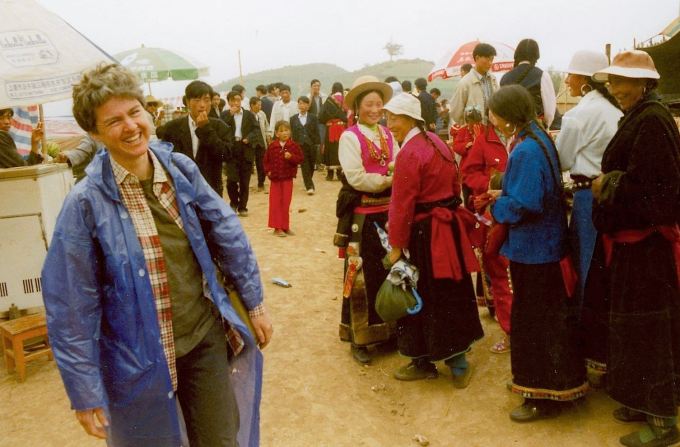
Amdo-Tibetan area, south Gansu, 2001 (photo: Frank Kouwenhoven).

I never did any fieldwork with Antoinet, but I admired and envied her natural engagement with musicians and with people altogether.

I won’t portray her as some kind of Lei Feng, so this can also be a kind of homage to, and reflection on, fieldwork itself. And I will discuss her alone, whereas of course she and her partner Frank Kouwenhoven, dynamic leaders of CHIME in Leiden, made an indivisible team.

Almost anything can be fieldwork, such as talking to your mum, or your kids, or going clubbing—although we’re perhaps unlikely to undertake all three at the same time. But I refer here to spending time with Chinese musicians in the countryside, which requires a rather different set of skills from hanging out with rock musicians in Beijing, for instance.

Fieldwork by the Chinese on their local musical traditions, in a sense that we can recognize, goes back to at least the 1920s. But when we laowai began to join in in the 1980s, it was exciting to get some glimpses of local folk traditions. We can see that sense of discovering a “well-kept secret” right from Antoinet’s articles in early issues of CHIME[1]

All these years later, I suspect local traditions are still largely a well-kept secret, and that may not be an entirely bad thing. But fieldwork by the Chinese has also thrived since the 1980s; plenty of Chinese are doing great work. In those early days, Chinese fieldwork was rather mechanical: the main object was to collect material in the form of musical pieces, conceived of as rather fixed and somewhat detached from changing social context. Antoinet was at the forefront of broadening the subject; the title of her book, Chinese folk songs and folk singers, is significant. This inclusion of the performers in the frame has borne fruit in Chinese and foreign work.

as-book-cover

Among general skills, we might list

  • preparation (finding available material, maps, preparing questions, etc.)
  • linguistic competence (how I envied her ability to communicate, and latch onto regional dialect)
  • musicality (and “participant observation”; routine for us, rare among Chinese scholars)
  • back home: analysis/reflection; sinology and ethnomusicogical/anthropological theory

In addition to my citings of Bruce Jackson and Nigel Barley (Fieldwork, under Themes), further reflections include:

  • Helen Myers in Ethnomusicology: historical and regional studies (New Grove Handbooks on Music)
  • Barz and Cooley, Shadows in the field
  • Lortat-Jacob, Sardinian Chronicles
  • Don Kulick and Margaret Willson (eds.), Taboo: sex, identity and erotic subjectivity in anthropological fieldwork.

As to what is ponderously known as “participant observation”, musicians tend to react well to other musicians—it shows a willingness to engage, and also helps us think up useful questions.

As to what we do after fieldwork: Antoinet was well grounded in ethnomusicological readings, but she was never controlled by theory, she used it critically to illuminate points, as one should. Scholarship is not always like that! Her book really is an amazing achievement. She not only broadened the subject, she made it more profound.

Rapport
A lot has been written about personal interaction in fieldwork. I like Bruce Jackson’s book very much. We all have different personalities; some of us may seem more outgoing than others. It’s an unfair accident of birth, upbringing, and all that. Musicians will be more forthcoming with people they feel comfortable with—like Antoinet. Of course fieldwork manuals talk about good guanxi, but it’s more. We respect people that we talk to, but we also aspire to some sort of equality; we hope to be neither obsequious nor superior. On the agenda here are sociability, informality, amateurism, humanity/fun/enthusiasm/empathy, and humour—all without naivety or romanticism!

We do naturally adapt our behaviour to different situations. I’m much more sociable in China than in England. Antoinet, it seems to me, never needed to adapt, she was just always naturally gregarious and sparkling.

Age is an interesting factor: I guess it’s good to be old or experienced enough to be taken seriously, but intelligence and sincerity are appreciated, and it’s also good to be young enough, at least at heart, not to seem too important! Antoinet was always self-effacing, companiable.

I do bear in mind Nigel Barley’s warning (The innocent anthropologist, p.56):

Much nonsense has been written, by people who should know better, about the anthropologist being “accepted”. It is sometimes suggested that an alien people will somehow come to view the visitor of distinct race and culture as in every way similar to the locals. This is, alas, unlikely. The best one can probably hope for is to be viewed as a harmless idiot who brings certain advantages to this village.

By the way, I’m not a harmless idiot, I often feel like a harmful idiot: I hope it’s a coincidence that everywhere I go, the local traditions go down the drain…

Our ways of repaying all this hospitality are variable, depending on our means and inclinations. One may send photos and videos, and organise tours; Chinese colleagues have gone so far as to install running water, or find urban jobs for relatives.

I note some some handy Maoist clichés linking fieldwork and Communist ideals:

  • chiku 吃苦 “eating bitterness”
  • santong 三同 “the three togethers” (eating, living, and labouring together. Hah!)
  • dundian 蹲点 (“squat”; more generously defined in my dictionary as “stay at a selected grass-roots unit to help improve its work and gain firsthand experience for guiding overall work”. How long is this dictionary?!)
  • gen qunzhong dacheng yipian 跟群众打成一片 “becoming at one with the masses”
  • bu na qunzhong yizhenyixian 不拿群众一针一线 “not taking a single needle or thread from the masses”

My point here is to get over the empty formalism of such slogans and see through to the sincere humanity that once inspired them.

These thoughts on empathy aren’t something we can do much about, but it’s interesting to reflect on the topic. Obviously enthusiasm isn’t enough; on its own it can be quite irritating!

I guess we all use teamwork to some extent, and Antoinet was good at finding, and supporting, good regional and local scholars to work with. I have always relied heavily on my Beijing colleagues to make notes, at least until circumstance and greater familiarity lend me the confidence to spend time with musicians on my own.

Group fieldwork is good up to a point. It depends partly on one’s means, but the group perhaps shouldn’t be too large. I like the informality and flexibility of working alone, but it is a bit much to take photos and videos and make notes and distribute fags all at once.

 Of course Antoinet was interested in all kinds of music-making, but she was among few laowai who did much work outside the main urban areas. Her two main fieldwork areas were very different: in south Jiangsu she found herself mainly doing a salvage project, but in Gansu she found a ritual scene that is very much alive.

As to time-frame, she and Frank mainly made repeated visits over time, and as I did for Plucking the Winds or my work with the Li family. Talking of Plucking the Winds, I’ve never had such a perceptive meticulous and patient editor as Antoinet.

Obviously, a brief interview with a stranger is likely to yield less interesting or reliable results than long-term acquaintance. But I do take on board the notion of stranger value. On one hand (Jackson, Fieldwork, pp.69–70, after Goldstein),

The collector who comes from afar and will disappear again will be able to collect materials and information which might not be divulged to one who has a long-term residence in the same area.

On the other hand, there’s the whole “You will never understand this music” thing (Nettl, The study of ethnomusicology, ch.11, brilliant as ever).

And then, who is an insider? What of urban Chinese? How might an urban-educated male Fujianese get along with female spirit mediums in rural Shanxi, and so on?! There are several complex subjects for discussion here.

Talking of etic questioning, here’s another vignette from the Li band’s 2012 tour of Italy (my book p.336):

Third Tiger is as curious as ever, always asking weird “etic” questions like “Why are Italian number-plates smaller at the front than at the back?” Bemused, I later ask several Italian friends, who have never noticed either. It strikes me that this is probably just the kind of abstruse question that we fieldworkers ask all the time, and I’m sure my enquiries in Yanggao sound just as fatuous. I must cite Nigel Barley (The innocent anthropologist, p.82)—and note the car link:

They missed out the essential piece of information that made things comprehensible. No one told me that the village was where the Master of the Earth, the man who controlled the fertility of all plants, lived, and that consequently various parts of the ceremony would be different from elsewhere. This was fair enough; some things are too obvious to mention. If we were explaining to a Dowayo how to drive a car, we should tell him all sorts of things about gears and road signs before mentioning that one tried not to hit other cars.

By the way, I was the victim of a flawed fieldwork interview some years ago. A Korean student, whom I knew fairly well, was doing an MA on ethnomusicology in London, and had to do an interview. She knew I was both a violinist and did fieldwork on Chinese music, so she came over to my place with a list of questions all prepared. Her English wasn’t great—like, even worse than my Chinese. OK, her project demanded quite a short interview.

She began with “Who is your favorite composer?” and I went, “Well, music is more about context, mood, not compositions, and anyway I don’t listen to so much WAM these days, and most music in the world we don’t really know of a “composer”… OK, if you insist, then Bach.” She went, “Thankyou. What was the best concert you ever done?” so I observed that we don’t do so many memorable concerts over a year, and that great music-making doesn’t only happen in concerts. “Being an orchestral musician can be frustrating, one’s teenage idealism tends to get beaten down, getting a plane, then five minutes in the hotel before a long rehearsal with a boring conductor, no time to eat properly… You could ask me, what was the most wonderful musical experience I have had—it wouldn’t necessarily be playing with an orchestra…” In response to this cri de coeur, she went on, “Thankyou. What is the difference between the Western violin and the Chinese violin?” Aargh. I mean, anyone would want to follow up on all that I had just said, right? But her rigid questionnaire was in control.

So is that what I have been doing in China all these years—misunderstanding, ignoring leads, and following up with my own stupid blinkered questions?!

One hopes to find questions that will get people talking at length (so avoid questions that invite simple Yes/No answers!); but there was I blabbering on, and all she wanted was short snappy answers!

I’m still very attached to the detailed notes of my Chinese colleagues. One can’t record everything on audio or video, and even if we could, it would leave unclear how many characters should be written. I used to use video mainly to film ritual—I only began to record informal situations later. Antoinet was great at bypassing formality.

They recorded all kinds of things as well as formal singing sessions, and sure they had the means to do that, as well as recruiting helpers and so on.

A questionnaire is essential, [2] but it must always be flexible, following their flow, always thinking of new questions, how to express them suitably, and listening. All of which Antoinet was brilliant at.

For me fieldwork is a constant discovery of how inaccurate and superficial my previous notes were. Antoinet and Frank’s enquiring spirit can be seen in these reflections that Frank later sent me:

We had no such thing as a “method”—in general we did tend to visit singers more than one time, preferably many times, in order to ask them the same questions repeatedly, and to let them sing the same songs more than once, with intervals of days, weeks, months or even years in-between. That was only possible with individual songs, of course, not with spontaneous dialogue songs, which we got acquainted with mainly in Gansu.

I think we learned most from what people told us spontaneously, about their own lives, in personal conversations, which were not strictly private conversations. People are nearly always in a space together with others. But group interviews (group chats, rather) were good, people felt at ease, they were not “attacked” by us, they were simply chatting…

Basically, in our fieldwork, we were always out to discover what we were not aware of yet. That is a hard task. And I think we kept discovering that we had not yet asked the right questions, had not investigated the right topics yet… Even now do I realize that I should go back… Maybe this is only the natural, classic, condition for fieldworkers: you return home with an idea of how things might be, you end up with an hypothesis, you suddenly stumble upon a new hypothesis which sheds new light on the situation, but then you have to go back again to test it, and the work starts all over again… A never-ending process, also because the questions you ask are nearly always bigger than the time and resources you have, and you need to address your problems piecemeal… We often wished we were five hundred people!


By the way, do watch their beautiful film Chinese shadows: the amazing world of shadow puppetry in rural northwest China (Pan, 2007).

In short, fieldwork may be an unending amount of work, but it’s endless inspiration too: and one works better when inspired. So I hope we can keep Antoinet’s spirit alive by emulating her humanity, enthusiasm, and critical intelligence.

For a recent volume on doing fieldwork in China, see here. And note the folk-song research of Qiao Jianzhong.


[1] Or for Daoist ritual, see e.g. the early fieldwork of Kenneth Dean.

[2] For her sample questionnaire for southern Jiangsu, see Chinese folk songs and folk singers, pp.395–6. Cf. McAllester’s questionnaire for the Navajo.


Li Manshan film: new version

Michele has just uploaded a new version of the film, with only tiny imperceptible changes. Spot the difference…

The main change is removing the out-take at the Temple of the God Palace (8’24” ff.).

We walked over there just after sunrise to go and record, when there wouldn’t be too much background noise. As it turned out, the cooing of birds was deafening—delightful as it was on my headphones, Michele managed to keep it under control when editing later. Li Manshan was going to do a little spoken intro recalling the temple, and since we were joined by a nice villager who also recalled the temple fondly, I thought it’d be nice to get him to stand just out of view of my camcorder so Li Manshan could have an interlocutor. It worked out fine, but their opening exchange made us all burst out laughing:

Li Manshan [confidently explaining the setup to his mate]: So we’re gonna have a natter!
[begins spiel]: In the past this Temple of the God Palace…
[Mate interrupts]: If it hadn’t been demolished, it’d be a tourist spot now!
[Li Manshan has drôle thought]:  … What, you mean you demolished it?!

We tried including this exchange in the film, with a suitable pause while we composed ourselves for Take 2, but it doesn’t quite work unless you were there…

The meaninglessness of ritual

Staal

The work of Frits Staal on Indian ritual contains much from which scholars of Daoist ritual (not least I) might benefit, confronting issues that I encounter in working with Li Manshan. Staal’s ideas about orthopraxy seem to go beyond the discussions following those of James Watson for China. There’s a lot more to Staal’s work than that, but this is a start.

In “The meaninglessness of ritual”[1] Staal eschewed “the dewy-eyed romanticism that is pernicious to any serious study of cultures and people.”

A widespread but erroneous assumption about ritual is that it consists in symbolic activities which refer to something else. It is characteristic of a ritual performance, however, that it is self-contained and self-absorbed. The performers are totally immersed in the proper execution of their complex tasks. Isolated in their sacred enclosure, they concentrate on correctness of act, recitation and chant. Their primary concern, if not obsession, is with rules. There are no symbolic meanings going through their minds when they are engaged in performing ritual.
Such absorption, by itself, does not show that ritual cannot have a symbolic meaning. However, also when we ask a brahmin explicitly why the rituals are performed, we never receive an answer which refers to symbolic activity. There are numerous different answers, such as: we do it because our ancestors did it; because we are eligible to do it; because it is good for society; because it is good; because it is our duty; because it is said to lead to immortality; because it leads to immortality. A visitor will furthermore observe that a person who has performed a Vedic ritual acquires social and religious status, which involves other benefits, some of them economic. Beyond such generalities one gets involved in individual case histories. Some boys have never been given much of a choice, and have been taught recitations and rites as a matter of fact; by the time they have mastered these, there is little else they are competent or motivated to do. Others are inspired by a spirit of competition. The majority would not be able to come up with an adequate answer to the question why they engage in ritual. But neither would I, if someone were to ask me why I am writing about it.
[…]
Most questions concerning ritual detail involve numerous complex rules, and no participant could provide an answer or elucidation with which he would himself be satisfied. Outsiders and bystanders may volunteer their ideas about religion and philosophy generally—without reference to any specific question. In most cases such people are Hindus who do not know anything about Vedic ritual. There is only one answer which the best and most reliable among the ritualists themselves give consistently and with more than average frequency: we act according to the rules because this is our tradition (parampara). The effective part of the answer seems to be: look and listen, these are our activities! To performing ritualists, rituals are to a large extent like dance, of which Isadora Duncan said: “If I could tell you what it meant there would be no point in dancing it.”
Ritual, then, is primarily activity. It is an activity governed by explicit rules. The important thing is what you do, not what you think, believe or say.

This echoes Catherine Bell’s comment that I cited in my post on Bach and Daoist ritual—for her masterly surveys of ritual studies, click here.

Here’s a trailer for Staal’s 1975 film on the Vedic fire ritual:

Poul Andersen offers caveats to Staal in a review of volumes on Shanghai Daoist ritual (Daniel Overmyer, Ethnography in China today, pp.263–83). He highlights the interpretations of the participants (including the liturgists themselves), which “in many ways influence the actual performance. They are relevant for the way in which performances take shape, develop, and are modified over time.” Such interpretations, while important, rarely offer a detailed critique, so such a view refines rather than refutes Staal’s point.

I pursue the theme under Navajo culture.


[1] Numen 26.1 (1979): 2–22. See also Ritual and mantras: rules without meaning (Motilal Banarsidass, 1996), and (source of my quote here) S.N.Balagangadhara, “Review of Staal’s Rules without meaning”, Cultural dynamics 4.1 (1991), pp.98–106.

Ask my father

*Part of my series on Irish music!*

Ennis

Peter Kennedy (fiddle), Marie Slocombe, and Séamus Ennis (Uillean pipes).

Another passage from Last Night’s fun that reminds me of Chinese music is Carson’s brilliant discussion (pp.7–13) of the naming of tunes, what the Chinese call qupai 曲牌 “melodic labels”:

A: What do you call that?
B: Ask my father.
A: “Ask my father”?

I can only hope we haven’t made such a mistake in documenting folk qupai. Indeed, I could well have asked Li Manshan’s son that very question (cf. the joke at the end of our film)…

Here’s the great Séamus Ennis playing Ask my father:

This story of his bears on the subject too:

For Scottish pibroch, click here.

Another Czech mate

Hasek last photo

Further to my Czech mentor Paul Kratochvil:

Along with Flann O’Brien, high on the guest list for my fantasy dinner-party would be Jaroslav Hašek—”humorist, satirist, journalist, anarchist, hoaxer, truant, rebel, vagabond, play-actor, practical joker, bohemian (and Bohemian), alcoholic, traitor to the Czech legion, Bolshevik, and bigamist”.

Hašek’s The Good Soldier Švejk has long been popular in China. Cecil Parrott, its English translator, also wrote a biography of Hašek’s “bottle-strewn life”, The bad Bohemian. Former British Ambassador in Prague, Parrott effortlessly avoids betraying any sympathy with Hašek’s reprobate behaviour (see also Hašek’s adventures in Soviet Tatarstan). As he explans in the introduction to his translation:

His next escapade was to found a new political party called The Party of Moderate and Peaceful Progress within the Limits of the Law […] publicly debunking the monarchy, its institutions and its social and political system. Of course it was only another hoax, designed partly to satisfy Hašek’s innate thirst for exhibitionism and partly to bolster the finances of the pub where the election meetings were held.

Among his many japes, his short-lived editorship of the journal The Animal World was curtailed after he published articles about imaginary animals.

Dangerous herds of wild Scottish collies have recently become the terror of the population in Patagonia

Thoroughbred werewolves for sale

Newly discovered fossil of an antediluvian flea

And his hobbies combined:

Everyone who votes for us will receive as a gift a small pocket aquarium.

Svejk Chinese

Gratifyingly, The Good Soldier Švejk clearly appeals to Chinese sensibilities; it was translated, and the 1956–1957 Czech films were dubbed into Chinese:

Alexei Sayle wonders if the Czech regime knew what they were doing promoting Švejk, since its message hardly supports the ideals of socialist conformity. Though it became popular in many languages, I suspect there’s something about it that appeals in particular to Chinese people—an antidote to compulsory patriotism? The Chinese translator dutifully portrays it as a tirade against imperialism, but it surely spoke to The Common Man (Flann O’Brien’sThe Plain People of Ireland”) oppressed by the destructive irrationalities of a newer system…

The Chinese version of Švejk’s name (Shuaike 帅克) is perfect. It drives me to a little fantasy.

Voices and instruments

In my book (p.261) I glibly compared the Li band’s hymns to the arias in the Bach Passions, “where action and drama are suspended while we contemplate the deep meaning of a scene.” In most elite Daoist and Buddhist temples, liturgy is accompanied only by percussion, not melodic instrumental music. Many of the Li band’s hymns are sung thus, a cappella—including those used to Open Scriptures in the morning and afternoon.

Whereas Chinese studies of northern Daoist and Buddhist “music” often focus almost entirely on shengguan melodic instrumental music, in my book (ch.16) I try to put it within the ritual context. But does the shengguan accompaniment (notably the constant variations of the guanzi) express what the vocal text is unable to embody?

As usual, this is not a close parallel, but one thinks of Erbarme Dich:

“Language is not essential to this moment, or even adequate to it. A verbal penitence is expressed by the alto voice, but the violin expresses a more universal distress.” (Gardiner p. 422, citing Naomi Cumming).

But remember, I find nothing akin to word-painting in the Li band’s vocal repertoire (my book p.277):

I can find no matching of melody to textual content. There is nothing akin to word-painting, no illumination of the meaning of the text through music. Vocal liturgy is capable of arousing emotion, as for instance it should do in the Song of the Skeleton (see Yesterday…), but this is achieved through the general style of delivery rather than the specific text-setting. In musical style the Song of the Skeleton is no different from other hymns, and even its desolate text is not comprehensible when sung.

So expression is conveyed mainly through timbre. The more I listen to Li Manshan and Golden Noble, the more impressive I find the mournful nasal quality of their voices; I can sing some hymns, but can’t emulate this. They have utterly absorbed the meaning of the texts into their voices. And when the shengguan accompanies, Wu Mei complements them perfectly on guanzi, managing to combine a deeply mournful tone with an almost playful way of weaving in and out of the melodic line, ducking and diving, sometimes soaring. The singers recognize that a good guanzi player is a great help to them in rendering the text.

Anyway, both the decorations of a Daoist on guanzi and Bach’s oboe lines are spellbinding—an intrinsic part of the realization of the text. So I both demote and stress the shengguan accompaniment.

Beyond the transition of the Passions from liturgical to concert performances, the staged versions of recent years can also be compelling (for us):

And we’re already in tears (along with Peter) from the recitative of the Evangelist that introduces it. The shuowen introits of the Daoist also introduce arias…

Those of a sensitive disposition may wish to avoid reading my Textual scholarship, OMG.

Living in the past

Past

In the mid-1980s a story did the rounds at the Central Conservatoire in Beijing, about a group of students sent to do fieldwork in a remote part of southwest China. In one village the peasants seemed not to have heard of Chairman Mao, and when asked “So who’s in charge, then?”, they hesitantly replied “Um… is it called Great Ming dynasty?” They hadn’t even heard of the Qing.

Of course this sounds apocryphal, a kind of Shangri-La story. Generally, however backward the conditions of places we visit, the scars of Maoism are evident. But I’m not sure we can dismiss it entirely…

It was formative fieldtrips like this, evoked in Liu Sola‘s 1985 novella In search of the king of singers 寻找歌王, that inspired the new generation of avant-garde composers like Qu Xiaosong, Tan Dun, and Guo Wenjing.

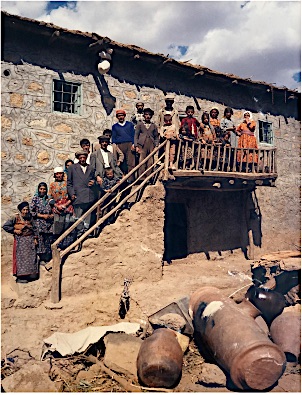
Reading Avedis Hadjian’s amazing book Hidden nation, I find a similar case:

Living in tne past Armenians

The residents of an Armenian village in Sasun, in a photo taken by the photographer Shiraz during a pioneering journey in 1973. Such was their isolation that they asked Shiraz to advise “the Armenian king that there are still Armenians in Sasun.” However, the last Armenian monarch, Levon V of the Kingdom of Cilicia, had been dethroned in 1375 by Mamluk invaders.

Such stories are extreme instances of the Chinese proverb “The mountains are high, the emperor is distant“.

Yesterday…

I have outlined the importance of the Song of the Skeleton in the rituals of both north and south China (In Search of the folk Daoists pp.233–4). It’s a common theme throughout the north—mainly as part of the yankou, both Daoist and Buddhist.

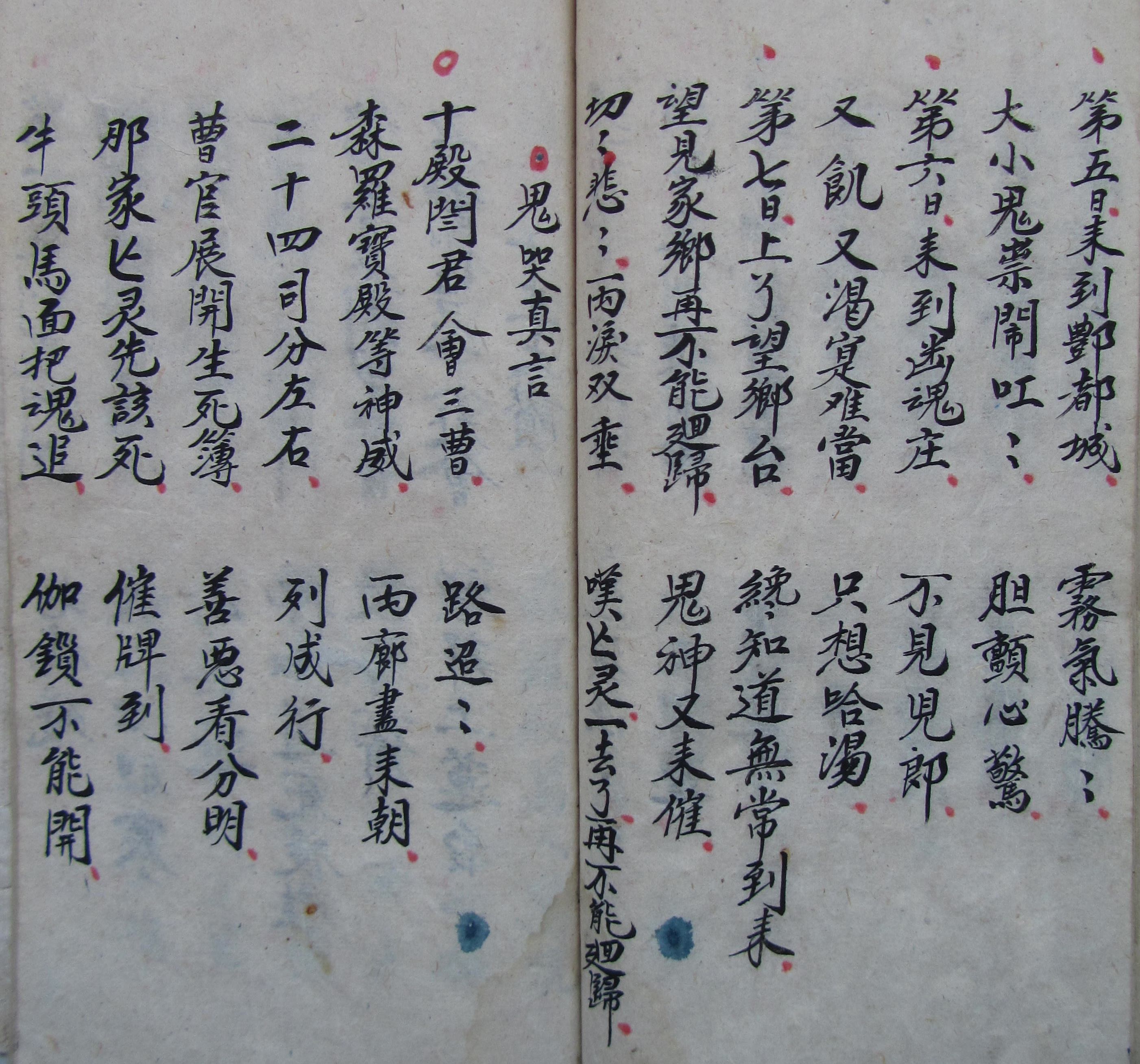
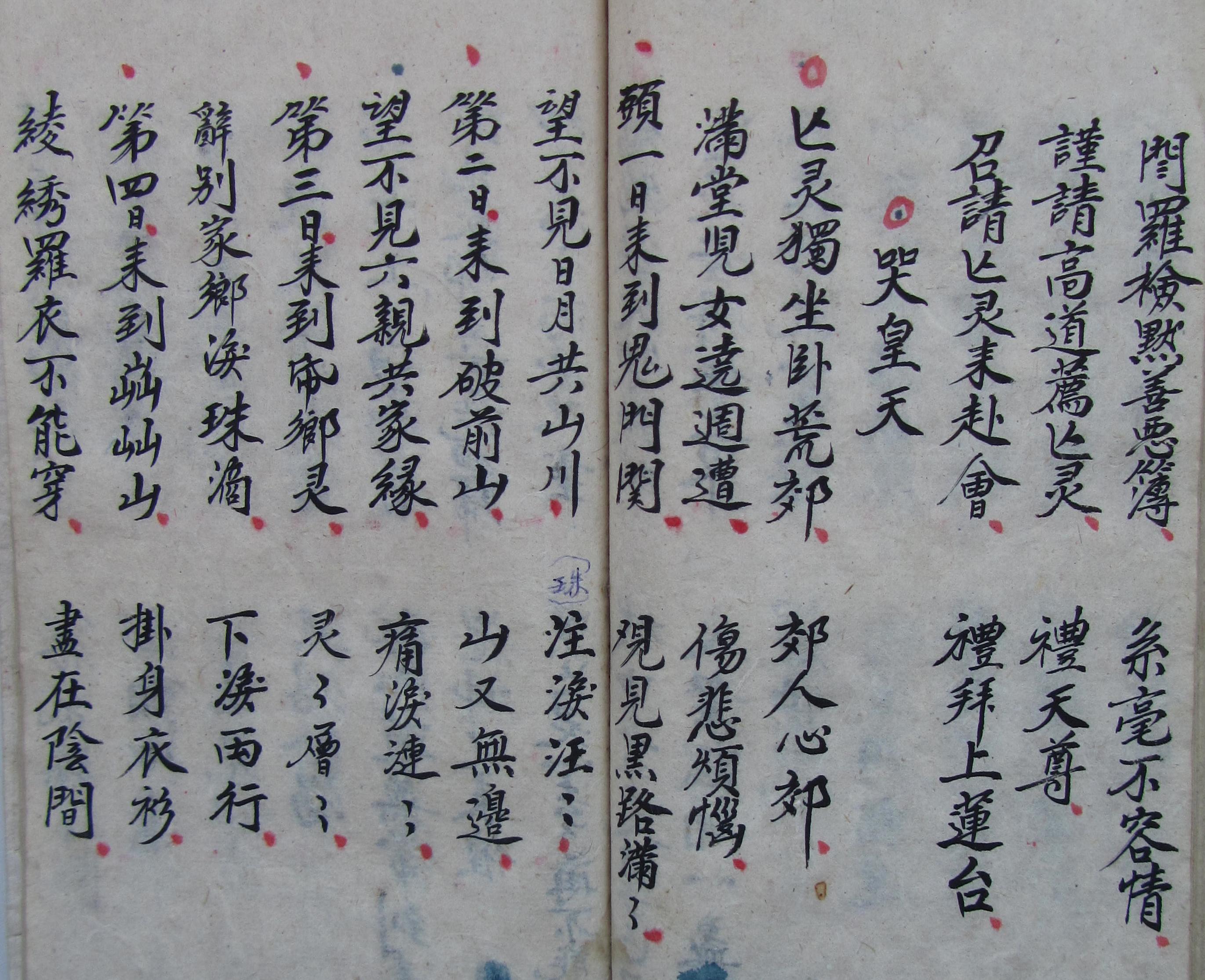
In Yanggao Daoist ritual (Daoist Priests of the Li family, pp.274–5), several hymns are related. The Mantra of the Skeleton (Kulou zhenyan 骷髏真言, more commonly known here by the melodic label Wailing to Sovereign Heaven, Ku huangtian 哭皇天) is prescribed, a cappella, for Opening Scriptures on the first afternoon of a funeral.

It’s a kind of catalogue aria, with seven long verses for the visits to the stations of purgatory over seven days. Its melodic material overlaps substantially with that of other hymns, beginning with the opening of the Diverse and Nameless melody (Daoist priests pp.267–8). The melismatic “Ah, Skeleton” (Kulou) refrain, and the coda in pseudo-Sanskrit (also in common with Diverse and Nameless), are not written here in the manual. My film (from 56’08”) shows the sixth verse:

Ah Skeleton! Skeleton!
On the sixth day he reaches Netherworld Souls Village
His sons not to be seen
Starving and parched, at his wits’ end,
Desperate to sup broth.

kulou-2kulou-1
From Li Qing’s hymn volume, 1980. The final folio on the left has the opening of Mantra to the Wailing Ghosts—my book p.266, also featured in the film, from 1.03.56).

* * *

For most such hymns one hardly expects an “emotional” response from audiences—in Yanggao, after all, it shares both melodic material and style with many others in the repertoire. But in his brilliant ethnographic studies of ritual practice in old Beijing, Chang Renchun notes how the renditions of two celebrated Buddhist monks moved their audiences to tears. Performative tears feature in many posts on this blog—links here.

Some common versions open:

昨日去荒郊玩游        Yesterday, seeking diversion roaming in the barren outskirts…

So talking of “Yesterday”, Paul McCartney heard his own version in a dream, like Aboriginal singers.

Yesterday

Though secular, it’s deeply moving. Here’s an early solo rendition, live (and Paul’s unaffected style is a major element of the song’s impact—no cover versions come close):

Here’s the remastered version from 2009:

As I observe in the introduction to my series on the great Beatles albums, analysis, while optional, can supplement our response; again it’s instructive to read Wilfred Mellers and Alan W. Pollack. Dating from the same period as A hard day’s night, Mellers considers Yesterday a “small miracle”:

Although the opening words tell us that yesterday his troubles seemed far away, the music in the second bar immediately enacts these troubles with a disquieting modulation from tonic, by way of the sharpened sixth, to the relative. The first bar, with its gentle sigh, seems separated, stranded, by the abrupt modulation; and although the troubles “return to stay” with a descent to the tonic, the anticipated modulation sharpwards is counteracted when the B♮is flattened to make an irresolute plagal cadence. […]

The immediate nostalgia of the song is without suspicion of sentimentality, and the corny accompaniment of string quartet can be employed, with validity, to reinforce the music’s frail bewilderment.

Yesterday quartet

George Martin’s manuscript for Yesterday, on display at Abbey road studios.

Pollack’s analysis is also insightful. And as he notes (also in my roundup), the opening uses a device here that Paul was to use regularly in some of his great songs: a declarative word, followed by a pause, and then rhythmically active ascent.

I can be quite confident about our own emotional responses to this song; less so about the responses of various types of Chinese mourners to the Skeleton, over time.

More social commentary

This is another ever-popular story in our fieldwork joke manual:

Taking his donkey with him, a peasant goes into the county-town to do some business in the county government headquarters. Leaving the donkey in the compound courtyard, he goes in.

When he emerges he finds that the donkey has eaten up all the plants in the courtyard, so he storms up to it and bursts out,

“So you think you’re some kind of national apparatchik, eh—cadging a meal wherever you go?!”

In the original Chinese that last phrase is typically blunt and effective:
走到哪儿吃到哪儿。

Hebei: new discoveries

In the recent, ongoing, fieldwork project continuing our work on the Hebei ritual associations, led by the energetic Qi Yi 齐易, most welcome for me so far is new material on Hubenyi 虎贲驿 village (see e.g. here).

htj-2htj-1

In Plucking the Winds (pp.90–92) I told how the beautiful surviving copy of the Houtu scroll of Gaoluo village was copied by Ma Xiantu, a cultured teacher and sectarian from Hubenyi village just further northeast. Then teaching in Beijing, he first borrowed the old copy of the scroll from South Gaoluo “to supplement the deficiency of my village’s Hongyang Holy Association”. His brother-in-law, South Gaoluo villager Shan Hongfu, was also staying in Beijing, and watched Ma Xiantu copying the scroll; he then bought more paper and asked Ma to make another copy for South Gaoluo. So Ma Xiantu copied it every day after school. He started copying the scroll in the 6th moon of 1942, and completed it in the 1st moon of 1943, finally adding the punctuation in red while he visited South Gaoluo to hand it over formally to the Association for the New Year’s rituals.

The 2015 fieldwork at Hubenyi, though not mentioning Ma Xiantu or the Houtu scroll, revealed further Hongyang scriptures, including an old copy of the Hunyuanjiao Hongyang zhonghua baojing 混元教弘陽中華寶經. Qi Yi and Song Yingtao 荣英涛 have collected basic data, so with bated breath I await a study from scholars of folk sectarian religion, for whom this whole area should be such a rich field… And who will supplement our work on the foshihui 佛事會 ritual associations around Yixian county?

For Hunyuan and Hongyang sects in the region, see my In Search of the folk Daoists of north China, Part Three.

Ecstasy and drudge

Leeds
Source.

Alan Bennett (him again) recalls his early music education attending concerts at Leeds Town Hall—making an ethnographic point that is as valid for Daoist ritual as for WAM (Untold Stories p.412):

So it is not just music that I learn, sitting on those harsh benches, Saturday by Saturday. Music in the concert hall is also a moral education, and watching the musicians at close quarters, I realize that it is not just ecstasy and inspiration but that there is drudge to it too. Sometimes, the players would be on the same tram coming home, and I see that they are just like everybody else—shabby, in dirty raincoats and sometimes with tab ends in their mouths, ordinary people who, half an hour ago, were artists and agents of the sublime.

See also Mozart in the jungle, The Commitments, and cf. The purgatory of the tennis circuit.

Recitation

In 1980, when Li Qing began recopying the family ritual manuals as Daoist activity gradually revived, the very first manual that he copied was the hymn volume of funerary texts.

Within this volume, Li Manshan loves, and identifies with, the beautiful long meditation on impermanence titled Kangxi yun—actually attributed to Kangxi’s father the Shunzhi emperor (1638–61), and Buddhist in language. The standard version is known by names such as as Poem on returning to the mountains (Guishan shi 歸山詩), Poem on entering the clergy (Chujia shi 出家詩), or Gātha in praise of the sangha (Zanseng jie 贊僧偈).

The Li family’s ritual manuals are largely superfluous to their ritual practice today: those rituals that are still required they perform from memory. The Kangxi yun is one of many texts in the manuals that are no longer performed; and the Daoists never read the manuals as silent literature. But as I began to go through them with Li Manshan, I found that he was most taken by the poem. It shows how drawn he is to the retreat from worldly cares; household Daoists don’t necessarily evince this, and you might not notice this contemplative aspect of his character.

Li Manshan says parts of it were formerly performed as a shuowen 說文 solo introit within particular ritual segments. He has a distant memory of hearing the Daoists reciting it for a temple ritual when he was 8 or 9 sui, around 1953–54, but he only began taking note of it when he came across it in his father’s hymn volume in the 1980s.

Indeed, it is among several rather long texts grouped together in the hymn volume that could be used thus; but there are no longer any suitable ritual segments in which to recite them. The shorter solo introits still used, like those for Presenting Offerings, are now mostly recited by Golden Noble.

shanggong

From my film: a shuowen introit from the shanggong ritual.

I’ve long wondered how, and when, this long poem found its way into the ritual manuals and ritual practice of the Yanggao Daoists. We discussed this further during my stay with Li Manshan in 2018 (under “Pacing the Void”).

* * *

For readers less than fluent in classical Chinese (of whom I hope there are many!), below I offer a very rough translation (for the challenges of translating the Li family texts, see here). I can’t find an English rendition of Shunzhi’s standard text (anyone?), but here I use the variant in the Li family manuals, only resorting to the original where sense requires. But often Li Qing’s variants seem no less elegant than the original, and sometimes I even find them preferable.

When we have a more widely-distributed “classical” source with which to compare the ritual texts of household Daoists (as is often the case), one often finds minor discrepancies. Many manuals (including most of those of the Li family) were recopied from memory in the 1980s, so a certain amount of variation was likely. However, while sometimes the Daoists might remember how to recite or sing a phrase or character but not how to write it, in general Li Qing’s manuals are remarkably accurate. Moreover, it’s also likely that variants had entered into the ritual manuals of household Daoists long before that. So it’s hard to tell when and how the variant of this poem arose.

The poem is not just about the emptiness of worldy cares, but refers to Shunzhi’s own struggle between his responsibilities as emperor and his personal inclination to Buddhist transcendence:

The forest of temples throughout the empire offers sustenance like a mountain
Everywhere the monastic bowl depends on the lord to provide.
There is no value in yellow gold and white jade
Only to don [1] the monastic cassock is difficult.
I, as great lord of the land of mountains and rivers
Am concerned for the nation and the people, serving to deflect their troubles.
One hundred years, thirty-six thousand days [2]
For a monk, don’t amount to [3] half a day’s rest.
Confusion on arrival, bewilderment on departure [4]
Travelling in vain for a while among men.
Better not to arrive and not to depart
With neither pleasure nor pain.
Before I was born, who was I?
Who was I at the hour of birth?
I only became an adult after I grew up
And once eyes are closed in the void, then who am I?
In this world the only good is to enter the clergy
With pure heart and peaceful mind, who is to know?
The mouth having taken its fill of eating harmonious flavours
One can always wear restitched robes from cast-offs.
The five lakes and four seas make a superior guest
Roaming free in the God Palace, lodging at will.
Do not call it easy to attain the dharma by becoming a monk
Let us talk only of the various bodhi of bygone ages.
I, as great lord of the land of mountains and rivers [5]
Seek the body of Crop Founder descended to earth.
Bright as is the cassock of the Western Quarter
Why has it descended upon the imperial family?
Just because at first my recitation was deficient
I had to exchange my purple cassock for a humble new robe.
For eighteen years I have been dreaming—
When can I rest from the great task of mountains and rivers?
Today, clapping my hands, I return to the mountains
How can I be expected to control the thousand, myriad autumns?

I’ve largely refrained from adding the Teutonic scholarly footnotes that the text suggests, but:

[1] Using the original 披肩.
[2] Chinese poetry has a lot of lines like this, and they read better in Chinese!
[3] Using the original不及.
[4] Referring to life and death, of course—but please feel free to provide your own joke about the airline of your choice.
[5] Here Li Qing repeats the earlier phrase, whereas the original couplet has “Even without being a true luohan, one also dons the triple vestments of Sakyamuni.” The following couplets of Li Qing’s version depart further from the original, and my translation is even more approximate.

The Three Wise Men

congshu

Fieldwork reports on local Daoist ritual continue to amass. Note the growing series Daojiao yishi congshu 道教儀式叢書.

In my book I described the main instigators of this impressive movement—C.K. Wang, John Lagerwey, and Lü Pengzhi—as a “holy trinity”. Then I thought maybe that should be the Three Pure Ones (Sanqing 三清)—but actually (since they are not so much objects of veneration as witnesses to marvels), a better metaphor might be the Three Wise Men:

“…Creeping around a cow shed at two o’clock in the morning? Doesn’t sound very wise to me…”
“We were led by a star!”
“Led by a bottle, more like!”

(Sorry, can’t help it…)

Now I’m wondering if they had a list, perhaps from Fortnum and Mason—how embarrassing if they’d all brought myrrh. “Sorry, your choice is already taken, please choose gold”.

For related irreverence, see Jesus jokes.

Laozi

Household Daoists tend to know about performance, not doctrine. I focus on practical knowledge—right down to which cymbal patterns to use as interludes for which hymns, and when to use them, or not. What the Li family don’t know, or do, is things like secret cosmic visualizations.

They don’t necessarily know how to write the texts, or if they do so (for me) they may write some characters a bit approximately because they already know how to recite them.

They know nothing of Laozi’s Daode jing, so central to Western images of Daoism. When I quote the pithy, nay gnomic, opening two lines to Li Manshan and his son Li Bin:

道可道非常道    The way you can follow is not the eternal way;
名可名非常名    The name you can name is not the eternal name.

they don’t quite get it, and I have to translate it into colloquial Chinese for them! Hmm…

We have a bit of fun playing with feichang, which in modern Chinese is “very”, rather than the classical “not eternal”. Actually, in their local dialect they don’t use feichang at all, though of course they know it. In Yanggao the usual way of saying “very” is just ke 可, pronounced ka—thus “dao kedao feichang dao” might seem to be “The way is soooo waylike, I mean it’s just amazingly waylike”…

Still, Daoists like Li Manshan will have picked up a broad understanding of the texts they sing every day, even if they have never been taught their “meaning”. They know Laozi not as the author of the Daode jing but as a god.

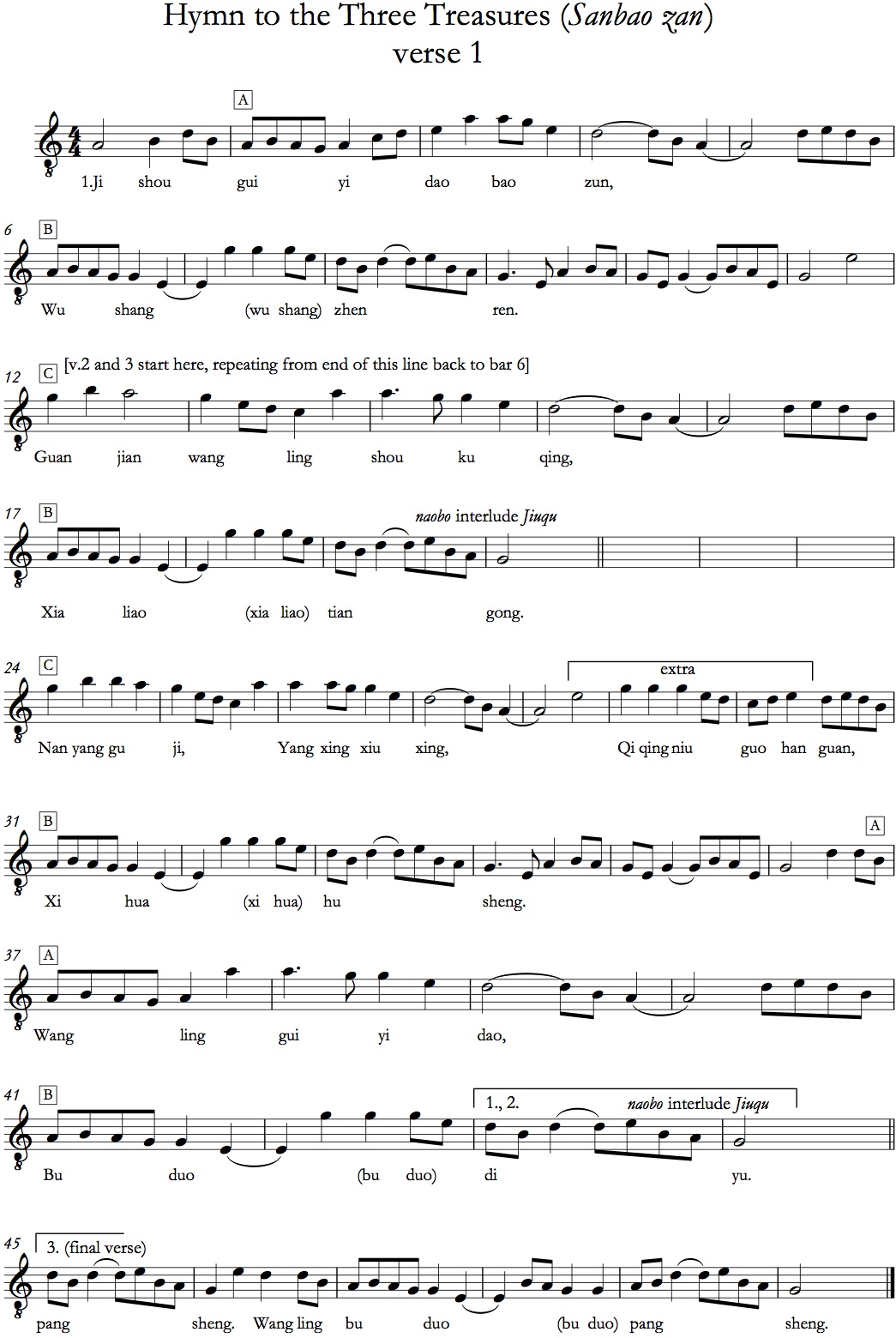
As I wrestled with translating the Hymn to the Three Treasures (Sanbao zan), used for Opening Scriptures in the morning (Daoist priests of the Li family, pp.262–3, and film from 22.01), Li Manshan explained it to me.

sanbao-zan-2-in-1-cropped

Hymn to the Three Treasures, from Li Qing’s hymn volume, 1980.

sanbao-zan-best

The subject of the first verse to the dao, “We bow in homage to the worthy of the dao treasure, Perfected One without Superior” (Jishou guiyi daobaozun, Wushang zhenren) is Laozi himself, so it is he who is the subject of the remainder of the verse: “He descended from the heavenly palace” (xialiao tiangong) refers to Laozi descending from the heavenly palace after beholding the sufferings of the deceased spirit (guanjian wangling shou kuqing)—it’s all about Laozi! So you see, Li Manshan does get the texts…

As for any ritual tradition, where does the “meaning” reside, when texts are unintelligible to their audience? When we translate and explain ritual texts, we are radically altering them as experienced by their audience. True, the performers, the priests, certainly “understand” them, to various degrees, if not in the same way as scholars translating them. I don’t suggest limiting ourselves to the consideration of how people experience rituals, but that should surely be a major part of our studies. Experience lies beyond textual exegesis, consisting largely in sound and vision.

I am reminded of Byron Rogers on an American version of the New Testament (Me: the authorized biography, p.268):

Pilate: “You the King of the Jews?”
“You said it.” said Christ.

There’s another one for the Matthew Passion (cf. Textual scholarship, OMG). “What is truth?”, indeed…

Mercifully, there is no movement to translate the ancient texts of Daoist ritual into colloquial modern Chinese. Of course, for northern Daoist ritual a modern translation wouldn’t make the texts any more intelligible anyway, given the slow tempo and melisma.

Laozi does appear in one of our favourite couplets for the scripture hall (see Recopying ritual manuals, under “The couplet volume”; cf. my book pp.194–5—not easily translated!):

穩如太山盤腿座     Seated in lotus posture firm as Mount Tai,
貫定乾坤李老君     Old Lord Li thoroughly resolves male and female aspects.

For a basic roundup of posts on the Li family Daoists, see here.

Muzak

Ethnomusicologists, aspiring to some pseudo-scientific objectivity, tend to put their tastes on hold—for like John Cleese in the cheeseshop sketch, we “delight in all manifestations of the Terpsichorean muse”.

The live version is also very fine:

Football songs, Bulgarian wedding laments, ice-cream-van jingles, Demis Roussos, world accordion conventions, even Beethoven, all are grist to our mill.

My esteemed colleague Helen Rees, in a fine outline of the Chinese soundscape, wrote:

Doorbells play Muzak when pressed.

I like that—I play Muzak when pressed too. For more on the doorbell, press here.

And here‘s a sequel on ice-cream vans and garbage trucks!

Confession

I truly believe that one day there will be a telephone in every town in America—Alexander Graham Bell

phone

The date of the first landline phone in Li Manshan’s village is another of our standing jokes.

This is really embarrassing to admit, but when I asked him about it in 2011, I heard his reply as ‘sisannian’, so I unquestioningly wrote ‘1943’ in my notebook, I mean how mindless was that of me… Only later, writing up my notes back home, did I smell a rat, and it finally dawned on me that he must have said shisannian (qian), ‘thirteen years ago’! (The difficulty of distinguishing shi and si was only part of my howler; and actually, he would never say sisannian for 1943—even if he knew such a date he could only say “32nd year of the Republican era”, cf.my book pp.37-8). So the first landline was only installed in 1998, just a few years before mobile phones swept the board.

Now, whenever we misunderstand each other, we just say “sisannian” and fall about laughing. For more on our relationship, see here; and for a classic joke, here. For early linguistic escapades in Hebei, see here.

The percussion prelude

In my book (p.280) I observed a subtlety of Yanggao Daoist ritual that may elude us:

Novices soon pick up the short pattern in rhythmic unison on drum, small cymbals and yunluo that opens and closes every item of liturgy, an accelerando followed by three beats ending with a damped sound. This is known as luopu (“cadential pattern”) and it turns out that the number of beats is fixed, 7 plus 4—unless the guanzi player needs a bit more time to prepare his reed!

See also Tambourin chinois, and Drum patterns of Yanggao ritual .

Much less impressive is Beethoven’s take on this, the four soft quarter-note beats that open his violin concerto (less creative than the EastEnders Doof Doof). The quote from my book is itself just a prelude to the popular story of a famous conductor rehearsing his orchestra in the concerto. Though he was notorious for nit-picking, one might suppose that at least here the band would get up a bit of a head of steam before he started correcting them. But no, sure enough he brings them to a halt even before the oboe can come in.

Turning to the bemused timpanist, he says,

“Can you play that with a little more… magic?”

The timpanist looks back at him sullenly, beats out the four notes again, and goes,

“Abra-ca-fucking-dabra”.

* * *

In Daoist ritual there’s nothing quite akin to “rehearsal”, but during a ritual Li Manshan maintains standards by the subtlest of facial gestures, with a little glare if the ensemble is less than perfect. As I learn, I benefit from such hints.

A meeting with Teacher Wang

lms-and-me-in-hk

With Li Manshan in Hong Kong, 2011

Chinese peasants tend to “eat” cigarettes (chiyan) rather than the standard “take a drag on” them (chouyan)—yet another instance of the practical blunt charm of their language.

Timothy Mo alludes to this locution in Sour Sweet:

“Eat things, eat things,” he said aloud, gesturing to the smoking plates in front of everyone but only lighting a cigarette for himself.
“You don’t eat things yourself, Grandpa?” This was Mui.
“I eat smoke,” he quipped, laughing immoderately at his own wit.

Indeed, the expression survives from 17th-century usage, as shown by Timothy Brook in Vermeer’s hat.

At a conference in Hong Kong (my book pp.333–4) I was delighted to introduce Li Manshan to the illustrious Taiwanese scholar C.K. Wang. Apart from his indefatigable energy in opening up the vast field of ritual studies in mainland China, he has a remarkable gift for finding a place for a surreptitious smoke (cf. the first poem in Homage to Tang poetry). In Hong Kong, where smoking laws are draconian, he would regularly lead us through labyrinthine corridors to some corner of an underground car park for a furtive fag.

This soon became part of my secret language with Li Manshan. Back in Yanggao, he was careful not to smoke in the presence of his baby grandson—so sometimes when I felt he needed a fag-break, I would suggest to him, “Shall we go and hold a meeting with Teacher Wang?”

For Li Manshan and Andy Capp, click here.

Funeral music

Invitation, Beijing concert

Beijing concert, 2013.

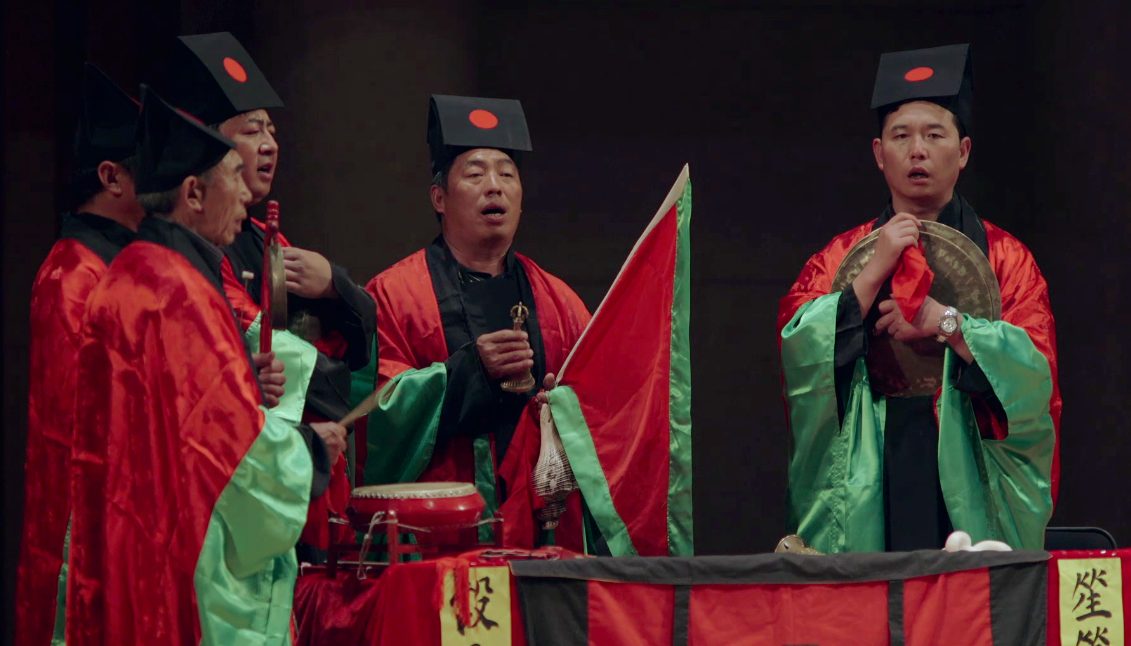
On the Li family Daoists’ 2013 tour of Germany I suggested an extra item in our evolving concert programme, an a cappella sequence based on the Invitation ritual performed at the edge of the village (my book p.339; film, from 58.14; playlist #1, with commentary here).

At first they were reluctant: while they have no qualms about performing ritual items on stage, they worried that performing an item so explicitly funerary might be unsuitable. I pointed out that some of the greatest music in the concert tradition of Western Art Music is for the dead.

Apart from various requiems (Mozart, Brahms…), one of the pieces I used to reassure them that funeral music was quite familiar to Western audiences  was Buxtehude’s Klaglied. Though a recording by the wondrous Michael Chance has just disappeared from YouTube (BRING IT BACK AT ONCE!!!), Andreas Scholl’s version is also great:

Not that the Daoists were remotely impressed by it—by contrast with Steven Feld’s influential experiments in finding which kinds of alien musics might strike a chord among the Kaluli (Sound and sentiment). They enjoyed our trip to the Bach museum in Leipzig not so much for the music as to get a glimpse of the life of a European ritual specialist; and when I showed them the EBS video of the Christmas oratorio they were mainly amused to see me in tails. I can’t even turn them on to jazz.

Occasionally some well-meaning urbanites have rashly suggested I bring my violin to play along with the Daoists, or even arrange their music for orchestra—but to their credit, the Li band have the taste never to do so.

Anyway, the Invitation has turned out to be a great success in our touring programme, a moving tranquil interlude between the uproar of “catching the tiger” and the wild percussion of Yellow Dragon Thrice Transforms its body. As an encore for our French tour in 2017 we even sang the Mantra to the Three Generations (playlist #2 and #3), which follows the Invitation at the gateway after the return to the soul hall.

For adaptations of ritual to the concert stage, see also here, under “The reform era”.

Fieldwork and textual exegesis

Bo Dudley

Academic interpretation gets its comeuppance:

Fieldworkers beware…

The longer audio version (on Derek and Clive live, 1973) has some pleasing further vignettes, like:

And then we hear the words “Right on baby!”…
Seems a little puzzling, “Write on baby”…
Well, let me explain: the father of the house has just walked into the wigwam, and he says “Write on baby” to the mother, meaning “write the shopping list on the baby for tomorrow morning”. […] Paper was scarce…
And then we have the line, “Get down baby!”—the baby realises that once again it’s going to be written on, and has climbed the wall. This is one of those distinctive, um, boogie, Harlem instincts…

Cf. Got my mojo working.

For more and less successful enterprises, see the fieldwork category in the sidebar. And for more from Dud, see Dud’n’Pete tag, not least the psalm, and his Britten spoof in Stella Gibbons’s brilliant Em creeps in with a pie. See also Alan Bennett’s sermon, and  Replies from the Complaints Department.

Silly questions

Barley

One prominent badge of fieldworkers, distinguishing them from the natives, restless or not, is their asking stupid questions. Nigel Barley, as ever, has a good illustration (The innocent anthropologist, p.41):

“What happens to a man’s powers/soul/spirit after he dies?” I tried querulously, like a vicar hoping to get a current affairs discussion going at a youth club. They ignored me. Then one young man turned round and snapped, “How should I know? Am I God?”

Among many posts on fieldwork exchanges, note Bruce Jackson’s fine exposition, and Speaking from the heart. See also Chinese folk religion: “belief”.

Mind your language

I can’t resist citing a charming story from a Chinese anthropologist documenting a village in Shaanxi province: [1]

One sunny afternoon in February 1992, I went to the main village by myself. Since it was not long after the Chinese New Year’s day, everyone in the village was still in new dresses. When I was walking around, trying to talk to people, I met an old woman who carried her little grandson whose age was no more than three or four. The little boy was dressed up in a new green suit designed like the People’s Liberation Army uniform, and he was wearing a brand new green hat with a red star in the middle. He looked so pretty that I bent over to say “hello” to him. To my surprise, the little prince quietly said to me, “Fuck your mother”. I was so embarrassed that I did not know if I had done anything improper. The old woman slapped her grandson and told him, “No, you little fucking bastard! Don’t say that to Teacher Liu. He is a fucking nice person.”


[1] Liu Xin, Zhao villagers: everyday practices in a post-reform Chinese village, PhD (Dept of Anthropology and Sociology, SOAS, 1995), p.183—cruelly censored from the published version In one’s own shadow (2000)!

It’s the only language they understand

In the early 1990s, arriving with my long-suffering friend and colleague Xue Yibing in a typically bare and grimy office of the Bureau of Culture in a county south of Beijing, we settle down to courtesies with the Bureau Chief, to clear our way to go down to the villages. I launch into my routine again—delighted to be in this fine county, heard so much about your wonderful music, blah-blah, most grateful for your support, international cultural exchange blah-blah.

The Bureau Chief is looking even more nonplussed by all these pathetic clichés than one would expect, and eventually, as I flounder around searching for yet more sonorous bullshit with which to impress him, Xue Yibing interjects,

“Do you understand what he’s saying, Bureau Chief?”

He replies earnestly,

“Well, if Mr Jones could speak Chinese, I might understand a bit!”

OK, my accent may not be perfect, but really! Xue diplomatically explains,

“Mr Jones doesn’t speak Chinese so well…”, which prompts me to joke with him,

“My Chinese is a lot better than your bloody English, mate—wodya mean, motherfucker?”

Needless to say, these choice expressions come out in perfect Chinese readily understood by all. The assembled cronies are bemused.

This story soon became part of our Fieldworkers’ joke manual (cf. Writing English: the etic view), and has even been immortalised, if somewhat modified, in a little article I published in a Chinese conference volume. [1]

* * *

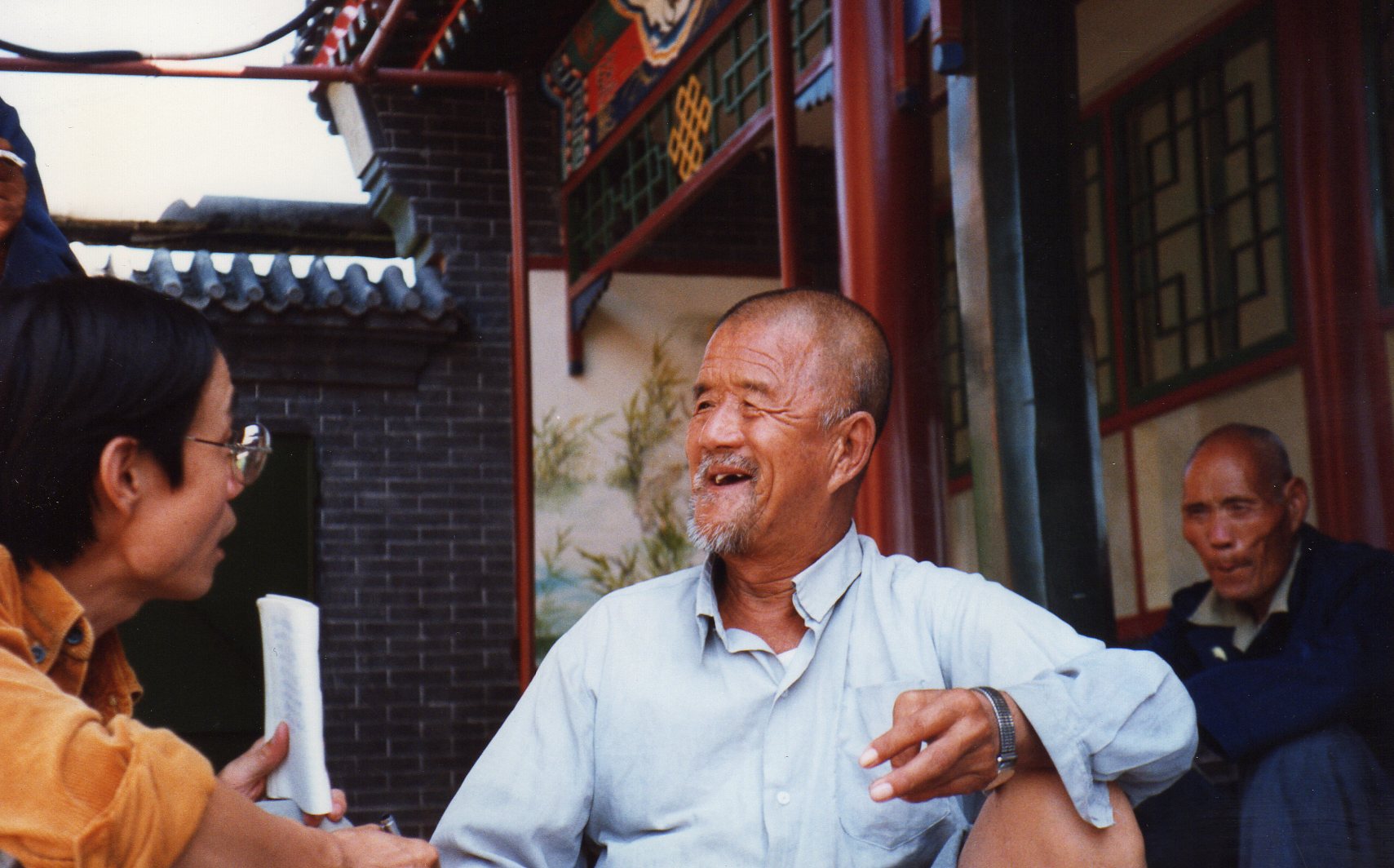
Gao Liwang 1993

My confidence was restored soon after, when we visited an old-people’s home where we were told a fine former Daoist priest was living. We find him, and are soon chatting in the sunny courtyard with a crowd of lovely old geezers assembled. They haven’t had such fun since the Red Star Chairman Mao Thought Propaganda Troupe arrived to perform classic hits like We are little screws in the revolutionary machine and Thrust into the Enemy Rear. As I explain to the old Daoist,

“Old Wang in your home village told us we might find you here, he said you used to do some great rituals…”,

one old guy bursts out,

“Hey, this is amazing—their language is the same as ours!”

His ears were more finely tuned than those of the Bureau chief.

Cf. China: writing in the air; for challenges to communication in “English”, click here.


[1] “Cong ‘Jiaru Zhong xiansheng neng shuo Hanyu dehua’ shuoqi”  从《假如钟先生能说汉语的话》说起, in Qiao Jianzhong 乔建中 and Xue Yibing 薛艺兵 eds., Minjian guchuiyue yanjiu 民间鼓吹乐研究 (Shandong youyi cbs, 1999), pp.407–13.